Unlock je and le mabee foundation Grants in 2026
Unlock funding with our guide to je and le mabee foundation grants for 2026. Learn eligibility, application process, and key requirements for your nonprofit.

Abdifatah Ali
Co-Founder
The J.E. and L.E. Mabee Foundation is a major player in philanthropy, but if you're looking for a grant, you need to know one thing above all else: they are laser-focused. This foundation exclusively provides challenge grants for brick-and-mortar capital projects, major renovations, and expensive equipment purchases. If your nonprofit is in their six-state region, they could be a key partner.
Understanding the J.E. and L.E. Mabee Foundation
Think of a Mabee Foundation grant not as the first shovel in the ground, but as the ceremonial capstone that finishes a project. Their whole mission is built around helping nonprofits get across the finish line on major capital campaigns—not getting them started.
This means the foundation provides what are known as challenge grants. In simple terms, they pledge funds on the condition that your organization raises the rest of the money first. It’s a powerful model designed to inspire community-wide giving and ensure a project has the momentum to succeed.
What They Fund (and What They Don't)
This unique approach means their funding priorities are very specific. Unlike many other foundations, the Mabee Foundation does not provide support for day-to-day operational needs.
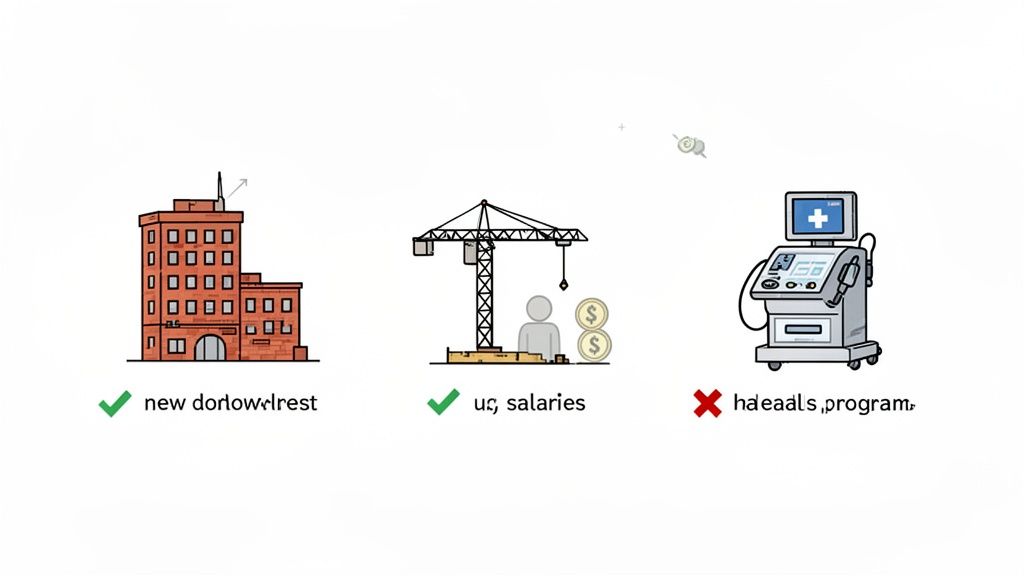
You won't get a Mabee grant for:
- General operating budgets or administrative costs
- Staff salaries or program expenses
- Special events, fundraising galas, or conferences
- Debt retirement or covering an operating deficit
Their focus on tangible, long-lasting assets is a direct reflection of the founders' vision to create a permanent legacy in the communities they serve.
A History of Major Impact
To give you a quick summary, this table breaks down the essentials of what the Mabee Foundation is all about.
J.E. and L.E. Mabee Foundation at a Glance
| Funding Focus | Geographic Area | Grant Type | Key Requirement |
|---|---|---|---|
| Brick-and-mortar capital projects, major renovations, and large equipment purchases. | Texas, Oklahoma, Arkansas, Kansas, Missouri, and New Mexico. | Challenge Grants. Funds are released only after the nonprofit raises a significant portion of its goal. | Projects must have already raised at least 40% of their total cost from other sources before applying. |
This clear and consistent strategy has made them a philanthropic powerhouse in the region.
Since its start in 1948, the J.E. and L.E. Mabee Foundation has been a pillar of community development, granting over $935 million in total. Their giving remains robust, with $105,658,983 awarded in 2023 alone. This consistent, high-level support shows their deep commitment to helping organizations build for the future. You can learn more about how this model fits into the broader landscape in our complete guide on foundation grants for nonprofit organizations.
The Founders' Vision and Enduring Legacy
If you want to have a real shot at a grant from the J.E. and L.E. Mabee Foundation, you first need to understand the "why" behind their famously strict rules. The foundation's entire philosophy is a direct reflection of its founders, John and Lottie Mabee. Their story of hard work, savvy business, and deep generosity is the blueprint for every grant they award today.
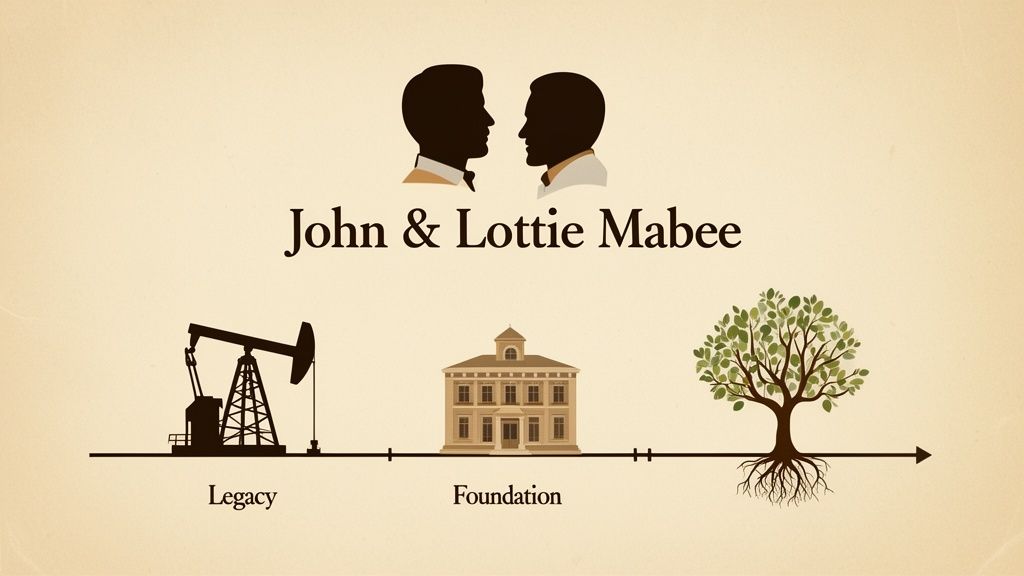
The Mabees were self-made entrepreneurs who built their fortune from the ground up in the tough-as-nails world of the early 20th-century oil industry. They believed in tangible results, solid structures, and things built to last. That mindset became the very DNA of the foundation they established in 1948.
Building a Multi-Generational Powerhouse
The Mabee Foundation wasn't built on a single, one-time gift. It was designed for sustained, multi-generational impact through a series of incredibly strategic financial moves. While formed in 1948, its true strength was unlocked through meticulous estate planning that set the stage for it to become a philanthropic powerhouse.
"Although the couple had no children, they left the majority of their estate to the Foundation with a desire to invest in people and institutions that reflect their values of innovation, stewardship, and generosity."
When Mr. Mabee passed away in 1961, the foundation became the main beneficiary of his immense estate, including valuable shares in Mabee Royalties and Mabee Investments. Just a few years later, upon Mrs. Mabee’s death in 1965, her personal estate followed suit. This one-two punch of funding supercharged the endowment, creating a financial engine that has fueled over 60 years of major grants. You can dig deeper into the foundation's history with resources like the Foundation Directory Online.
The Legacy in Practice
This history isn't just a fun fact; it directly explains the foundation’s laser focus on capital projects. The Mabees didn’t want to just pay for temporary programs. They wanted to provide the very buildings and infrastructure that would allow those programs to flourish for generations. Their goal was to create a permanent legacy in the communities they cared about.
This focus should completely shape how you frame your proposal:
- Emphasize Permanence: Your project isn't just a new wing; it's a future community anchor.
- Showcase Stability: Explain how this physical investment secures your organization’s mission for the long haul.
- Connect to Their Vision: Draw a clear line showing how your project, like the foundation itself, is truly built to last.
When you understand the founders' intent, you can do more than just list project specs. You can tell a compelling story that resonates with the core principles of the J.E. and L.E. Mabee Foundation—proving your organization is the right partner to carry their enduring legacy forward.
Understanding the Mabee Foundation's Funding Priorities
If there’s one thing to know about the J.E. and L.E. Mabee Foundation, it’s this: they focus exclusively on brick-and-mortar projects. Getting a handle on this is the first and most important step to figuring out if they’re a good fit for your organization.
Their funding is laser-focused on tangible, long-term assets. This generally means they will only consider grants for:
- New Building Construction: Putting up a brand-new facility that is essential to your mission.
- Major Renovations or Expansions: Projects that significantly overhaul or add on to your current buildings to boost your capacity or improve services.
- Acquisition of Major Medical Equipment: Purchasing high-cost, critical pieces of equipment that are fundamental to providing healthcare.
Anything that falls outside these categories is, simply put, not something they will fund. This means no operational costs like salaries, no program expenses for day-to-day services, and no support for fundraising events. Think of it this way: the Mabee Foundation helps you build the stage, but they don't pay the actors or the electric bill for the performance.
The Capstone Funder Philosophy
Here's the most critical concept you need to grasp: the Mabee Foundation acts as a "capstone" funder. Imagine you’re building a massive pyramid. You've spent years getting the community to help you source the stone and lay the foundation, and you've painstakingly built it up layer by layer. The Mabee Foundation provides the grant for that final, crowning stone at the very top.
This isn't just a casual preference; it's a foundational requirement of their grantmaking. They intentionally structure their grants to be the last money into a project. The idea is to provide that final push that gets a well-planned, well-supported project across the finish line. This strategy is smart for two reasons. First, it ensures the project truly has broad support from the community. Second, it minimizes their risk by backing campaigns that have already proven they have the momentum to succeed.
A Mabee grant is a signal of confidence—an endorsement that your project has demonstrated significant community support and is poised for completion.
Specific Exclusions to Note
The foundation’s guidelines are famously specific, and they go beyond just the focus on capital projects. It's just as important to know what they won't fund. For instance, they do not provide grants to any educational institutions below the college level. Churches are also ineligible for funding. This narrows their focus to higher education and a specific set of other charitable organizations.
For a deeper dive into these nuances, you can find more details on their grantmaking strategy from resources like those offered by Upstream from Grantsoffice.com.
This strict focus is at the very core of the foundation’s identity. Before you even think about starting an application, your very first task is to honestly ask whether your project is the kind of tangible, community-backed capital investment that perfectly fits their capstone model.
Mastering the 40% Fundraising Requirement
Let's talk about the single biggest hurdle I see organizations face with the J.E. and L.E. Mabee Foundation: that infamous 40% fundraising requirement. This isn't a soft guideline or a number to aim for; it’s a hard and fast rule that serves as a financial stress test for your entire capital campaign. If you don't meet it, your application simply won't move forward.
Why are they so strict about this? Think of it from their perspective. By requiring you to raise 40% of your project's total cost from other donors first, they're ensuring your project has real momentum and broad community buy-in. It gives them the confidence that their grant will be the final piece of the puzzle, not the first.
What Counts Toward Your 40%
Figuring out what actually counts toward this goal is where many people get tripped up. The foundation is very specific. They want to see that your 40% comes from private, gift-based sources that show genuine community support.
Generally, you can include the following:
- Cash on Hand: These are the funds you’ve already collected and have sitting in an account specifically designated for the project.
- Secured Pledges: We're talking about iron-clad, legally enforceable written commitments from your donors. A verbal "I'm in!" won't cut it.
- In-Kind Donations (for Construction): If your project involves construction, you can count documented contributions of labor or materials. You'll need to value these at their fair market price.
You absolutely must have airtight documentation for every single dollar you claim. Be prepared to present a clear, undeniable case that you've hit the benchmark.
Funds That Are Explicitly Excluded
Just as critical is knowing what not to include. Miscalculating this can lead to an automatic rejection, and it's a mistake I've seen happen more than once.
The Mabee Foundation's focus is on seeing external, private support. Funds that come from your own pockets or from the government don't demonstrate the kind of community backing they're looking for.
Keep these sources completely out of your 40% calculation:
- Government Grants: Any funding from federal, state, or local government agencies is off the table.
- Loans or Debt Financing: The foundation wants to see gifts, not borrowed money that needs to be paid back.
- Internal Reserves: You can't use money from your own endowment or savings to meet this requirement.
Getting your capital campaign structured correctly from day one is essential for success with a Mabee grant. If you need help mapping this out, our guide to building a strong fundraising plan format is a fantastic place to start.
This chart gives you a good visual of how a project funded by the Mabee Foundation typically progresses, from initial construction to getting the right equipment.
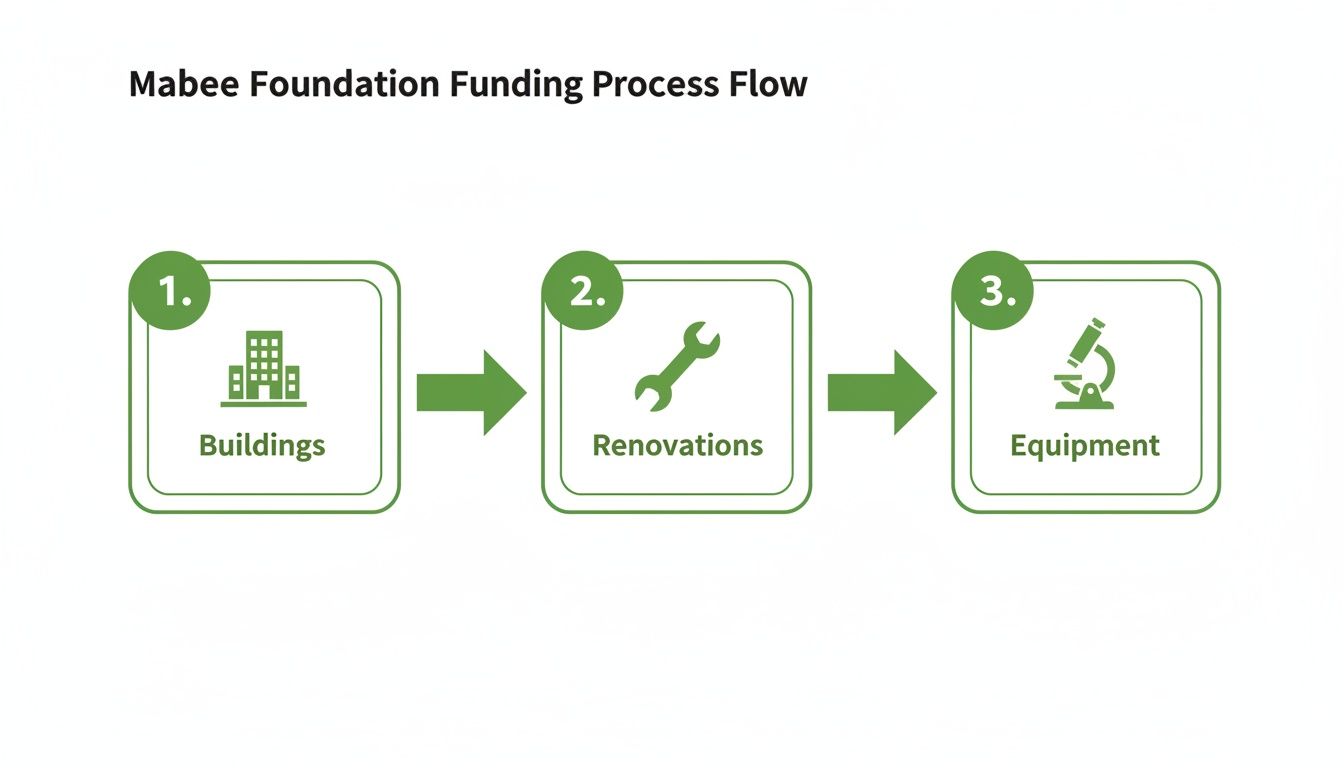
As you can see, the foundation supports distinct capital needs, but it all hinges on you meeting those initial fundraising goals first. When you can present a clear and accurate picture of your progress, you're signaling to the J.E. and L.E. Mabee Foundation that you're a trustworthy partner, ready for that final, capstone investment.
Crafting a Winning Mabee Foundation Proposal
Alright, you’ve put in the hard work. Your capital campaign has momentum, and you’ve hit that critical 40% funding milestone. Now, it's time to turn your attention to the proposal for the J.E. and L.E. Mabee Foundation.
Think of this application less as a simple request for money and more as the final blueprint for a project that's already well on its way. You're not asking them to start the journey with you; you're inviting them to be the partner that helps you cross the finish line. Your story must be one of readiness, stability, and undeniable community need.
The foundation is focused on legacy, so your narrative needs to show how this project will become a lasting asset for your community. Keep a close eye on the clock—the application deadlines are strict, typically April 1, July 1, October 1, and January 1. Plan your submission timing carefully.
Building Your Narrative
To make your proposal truly stand out, you need to weave a compelling story. Honing a strong persuasive writing technique isn't just a nice-to-have; it's essential for getting the review committee to see the merit and urgency of your project.
Your story should stand on three solid pillars:
- Urgent Community Need: Don't just say you need a new building or equipment. Show it. Use hard data, personal stories, and specific examples to paint a clear picture of the problem you are solving. Why is this project absolutely essential, right now, for the people you serve?
- Organizational Stability: The Mabee Foundation invests in organizations that are built to last. You need to inspire confidence by providing a clear snapshot of your financial health, the experience of your leadership team, and your history of seeing projects through to completion.
- Broad Financial Support: This is where your 40% comes into play. Your application must include a detailed list of every single donor who has contributed so far. This isn't just a list of names; it's powerful evidence that the entire community believes in and is invested in your project's success.
From Strategy to Execution
The application process itself demands an almost fanatical attention to detail. You'll be gathering a whole host of documents, from financial statements and project budgets to architectural plans and that all-important donor list. If even one required item is missing, it could sideline your entire application.
A common pitfall is to treat the Mabee application like any other grant form. It’s not. It’s a final presentation to a key investment partner. Every single detail should reinforce your credibility and the project's importance.
This is a great place to bring in some help. A tool like Fundsprout can be your co-pilot, helping you move from a solid strategy to a flawless submission. Its RFP analyzer can instantly create a compliant outline from the Mabee Foundation’s guidelines, making sure you don't miss a single requirement. If you need a hand getting started with the writing, our nonprofit grant proposal template is a great resource.
You can even use an AI writer, trained on your own organization's data and past wins, to help draft powerful sections that showcase your impact. This method ensures your proposal isn’t just compliant but also truly compelling, blending the foundation's specific rules with your unique story. By marrying a powerful narrative with meticulous preparation, you put your organization in the best possible position to secure that final, transformative capstone grant.
Using Technology to Keep Your Grant Strategy on Track
Let's be honest: securing a major challenge grant from a foundation like J.E. and L.E. Mabee is a massive undertaking. You're not just writing a proposal; you're orchestrating a full-blown capital campaign, tracking countless donor interactions, and documenting every single dollar. It's a logistical beast, and trying to manage it all with spreadsheets and scattered files can quickly lead to chaos.
This is exactly where modern grant management tools can step in and save the day. Think of it like this: you wouldn't try to navigate a cross-country road trip with a torn paper map when a GPS is available. Technology like Fundsprout acts as your team's GPS, guiding you through every turn. Instead of spending hours hunting for funders, you can get daily scans that flag opportunities like a Mabee grant the moment they fit your capital project's needs.
Keeping the Entire Project on the Rails
Once you’ve found a potential funder, the real work begins. The journey to raising that required 40% in co-funding is a marathon, not a sprint. A good grant management platform helps you lay out a clear project timeline, delegate tasks to your team members, and, most importantly, track every single donation and pledge as it comes in.
This keeps everyone on the same page and makes sure nothing critical falls through the cracks. It transforms what can feel like a frantic, disorganized scramble into a clear, step-by-step process.
Technology in grant management isn't about replacing people. It's about amplifying their work. It handles the administrative grind so your team can focus on what truly matters: building relationships and telling a powerful story.
When it's time to write the proposal, some tools even have features that can break down the Mabee Foundation's dense guidelines into a structured outline. This essentially creates a compliance checklist, ensuring you’ve hit every single point the foundation asks for.
Showing You’re a Partner They Can Trust
Your work isn't finished once you hit "submit." If you’re awarded a challenge grant, you have to meticulously track your fundraising progress to meet the final goal. This is where integrated reporting tools become indispensable.
They give you a clean, professional audit trail to share with the foundation, which builds a relationship based on transparency and accountability. A system like this makes it simple to report back on your milestones, just as Dallas Baptist University did when it successfully raised $8 million to secure its $2 million Mabee grant.
For organizations looking to shore up their operations even further, exploring tools like AI legal software can provide broader support for administrative and compliance needs. By using technology to manage the entire grant lifecycle, you demonstrate that your organization is sophisticated, organized, and ready to handle a major investment from the J.E. and L.E. Mabee Foundation.
Common Questions About the Mabee Foundation
Even with the clearest guidelines, applying to a major foundation always brings up a few tricky questions. Based on our experience working with nonprofits, we've found that a few specific points about the J.E. and L.E. Mabee Foundation tend to trip people up. Let's clear those up right now.
Does the Foundation Fund Projects Outside Its Six Primary States?
This is a big one. While the foundation focuses almost exclusively on its core region—Texas, Oklahoma, Arkansas, Kansas, Missouri, and New Mexico—the door isn't completely shut to others. It is, however, almost shut.
To have even a remote chance, an out-of-region project must demonstrate undeniable national importance. You’d need to build a case so powerful and show such overwhelming community backing that the board feels compelled to make a rare exception.
Think of it this way: for an out-of-region project, your application must be so compelling that it commands the foundation’s attention despite its geographical preference.
What Exactly Qualifies as a Capital Project?
When the Mabee Foundation says "capital," they mean bricks-and-mortar and major equipment—tangible assets built to last. This typically includes constructing new buildings, undertaking significant expansions or renovations, or purchasing high-value equipment, especially for medical use.
It's just as important to know what they won't fund. This is a common mistake. Their grants do not cover:
- Operational funding
- Staff salaries or program costs
- Events or vehicles
They are investing in the physical infrastructure that will serve your mission for years, not the day-to-day costs of running your programs.
Can We Apply Before Reaching the 40% Fundraising Threshold?
Absolutely not. This is the foundation's most famous—and most rigid—rule. You must have documented proof that at least 40% of your total project cost is already secured through other private gifts and pledges.
What doesn't count toward this total? Government grants, bank loans, or money you’ve pulled from your own reserves. The foundation wants to see that your community is already invested in the project. Applying before you hit this mark guarantees a rejection, so make securing that first 40% your absolute top priority.
Juggling a major capital campaign to meet these strict requirements is no small feat. A tool like Fundsprout can be a game-changer, helping you track every donation, manage your timeline, and ensure your proposal is perfectly compliant before you hit "submit."
Try 14 days free
Get started with Fundsprout so you can focus on what really matters.