How to Write a Budget Narrative: Guide for Nonprofits
Learn how to write a budget narrative for nonprofits. Our 2026 step-by-step guide covers structure, examples, and reviewer expectations for a compelling story.

Abdifatah Ali
Co-Founder
You've got the budget spreadsheet open, the proposal narrative mostly drafted, and one blank page left that suddenly feels harder than all the rest. The line items make sense to you because you built them. To a reviewer, though, they're just numbers unless you explain what each one does, why it costs what it costs, and how it helps the project succeed.
That's the job of a budget narrative. It isn't administrative filler. It's the document that proves your budget reflects an actual plan rather than a pile of estimates. If you want to learn how to write a budget narrative that gets approved, start by treating it like both financial justification and program strategy.
What a Budget Narrative Is and Why It Matters More Than Ever
A budget tells the reviewer what you want to spend. The budget narrative explains why those costs belong in the project and how you arrived at them.
That sounds simple. In practice, many otherwise solid proposals weaken at this point. Teams spend days refining need statements, outcomes, and work plans, then rush through the narrative with phrases like “supplies for program activities” or “staff time to manage the grant.” Reviewers read that and still don't know whether the cost is necessary, reasonable, or tied to the work.
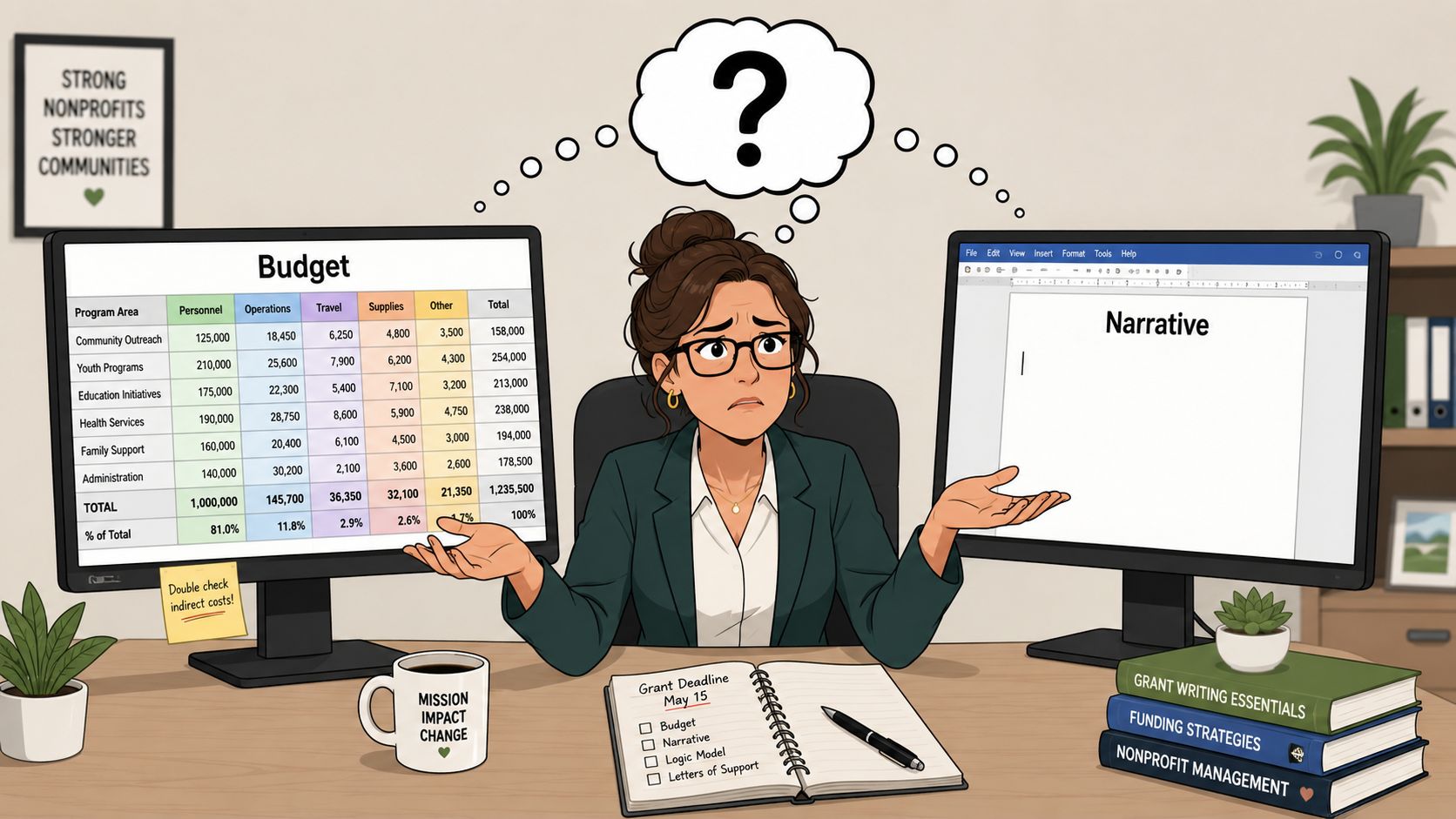
The narrative is where your budget becomes credible
A good budget narrative does three things at once:
- Explains necessity so the reviewer can see why the cost belongs in the project
- Shows reasonableness by naming the basis of estimate, such as market rates, vendor quotes, or historical spending
- Connects money to work so the budget supports the statement of work instead of floating beside it
That standard has tightened. In January 2024, the U.S. Department of Energy's OCED required budget narratives to be “concrete and specific” and warned that lump-sum requests without detailed justification are “sure to raise questions” in review, as described in the OCED budget narrative instructions and example. That's a clear signal about where funder expectations are heading.
Practical rule: If a reviewer can't understand a line item without calling you, the narrative isn't finished.
Why this matters for nonprofit teams
For many nonprofit staff, the budget narrative sits in an awkward middle ground. Program managers know the work. Finance staff know the numbers. Development staff know the application. The narrative has to translate across all three.
That's why I tell new program managers to stop thinking of the document as a summary of the spreadsheet. It's closer to an operating memo for someone outside your organization. The reviewer needs to understand not just the amount, but the logic behind it.
If you need a straightforward budgeting refresher before writing the narrative, this guide on Stewart Accounting Services financial planning is useful because it starts with how to build a working budget that reflects reality rather than wishful math.
The strongest narratives feel obvious to the reviewer
When a budget narrative works, it lowers friction. The reviewer doesn't have to guess whether a travel line is tied to service delivery, whether a consultant rate came from a real source, or whether fringe costs were calculated. The story is already there.
That's the shift. You're not defending your budget after the fact. You're showing that the budget is the natural financial expression of the project plan.
Anatomy of a Winning Budget Narrative
A reviewer opens your application and sees a clean budget form, then hits a narrative that skips categories, lumps costs together, and leaves key assumptions unstated. At that point, the budget stops helping your case and starts creating work for the reviewer. Strong proposals avoid that problem. They make the money easy to follow and make the spending strategy feel deliberate.
The best budget narratives do more than explain charges. They show that the project is staffed appropriately, priced realistically, and built to last beyond the grant period. Reviewers may not write “sustainability” next to every line item, but they score for it indirectly. They notice whether you are buying one-time capacity, relying too heavily on contractors, or adding recurring costs your organization may struggle to carry later.
Start with the same structure as the budget form
Match the funder's budget categories and keep the same order as the spreadsheet. That simple choice reduces reviewer friction and signals that your program plan and financial plan were built together.
Common categories usually include:
- Personnel
- Fringe benefits
- Travel
- Equipment
- Supplies
- Contractual or consultant
- Other direct costs
- Indirect costs
That list is familiar. Your job is to make each category answer a harder question: why this cost, at this level, in this project, right now?
What belongs in each category
Personnel
Personnel usually carries the story of the project. Reviewers look here first because staffing reveals whether the scope is realistic and whether the organization has the capacity to deliver.
For each role, include:
- position title
- project responsibilities
- level of effort or time commitment
- salary or wage basis
- connection to a defined activity, output, or management function
Weak version: “Program Coordinator to support implementation.”
Better version: “Program Coordinator will oversee participant intake, session scheduling, attendance tracking, and monthly reporting for the outreach and service activities in the work plan.”
A stronger personnel section also shows restraint. If senior staff appear on every task, reviewers may question cost efficiency. If junior staff carry complex compliance or evaluation duties alone, reviewers may question execution.
Fringe benefits
Fringe needs the same level of discipline as salaries. State what is included, how the rate was calculated, and whether it applies uniformly across staff or varies by role.
Teams often blur fringe and overhead. Keep them separate. Use this guide on calculating indirect costs if you need a clearer way to distinguish employee-related expenses from organization-wide administrative cost recovery.
Travel
Travel lines should read like implementation logistics, not placeholders. Identify who is traveling, where they are going, how often, and what project activity requires the trip.
Good travel narratives also show judgment. Site visits across a large service area may be reasonable. Conference travel during a short project period may need stronger justification unless it directly supports required training, partnership development, or dissemination.
Equipment
Equipment gets close review because it can look like infrastructure spending dressed up as program delivery. Explain what the item is, why the project needs it, why current organizational resources are not enough, and who will use it.
This category is also where sustainability starts to show. A purchase that builds long-term service capacity can strengthen your case. A purchase that creates maintenance, licensing, or replacement costs with no plan for future coverage can weaken it.
Supplies
Supplies should be specific enough that a reviewer can picture them in use. “Program materials” is thin. “Participant workbooks, printing for training packets, and consumable lab materials for weekly instruction” gives the reviewer something concrete to assess.
For teams working in community settings, examples from adjacent sectors can still be useful. This piece on how to improve financial stewardship in churches shows how clearer financial explanation builds trust when budgets mix program and operating costs.
A visual summary helps when you're building your own template:
Contractual or consultant
Consultant lines need enough detail to prove that outside help is both necessary and well scoped. Name the function, describe the work product, explain the rate or fee basis, and clarify why the work is contracted out instead of handled by staff.
This is also a place where reviewers test long-term logic. A consultant can fill a short-term gap, launch a specialized function, or provide independent evaluation. Heavy dependence on consultants for core program operations can raise questions about continuity after grant funding ends.
A budget category only names the cost. The narrative has to prove the cost belongs in the project.
Other direct costs
Use this category carefully and define every item. It often includes communications, software, meeting expenses, printing, facility rental, or project-specific occupancy costs. If “other” becomes a catch-all bucket, reviewers may assume the budget was assembled late or without enough internal coordination.
Indirect costs
Indirect costs show whether your organization understands its real cost of delivery. State the approved rate, de minimis rate, or funder-capped method clearly and apply it consistently.
This section does quiet strategic work. A reasonable indirect line shows that the project is not subsidized by hidden administrative strain. That matters to reviewers even when they do not say it outright, because underfunded infrastructure can become a performance risk later.
Build each category to answer the questions behind the score
Every category has the same burden of proof. The reviewer needs to see what the cost covers, why the project needs it, how you estimated it, and whether the expense supports a project that can be managed responsibly.
That is the anatomy of a winning budget narrative. It mirrors the form, explains the math, and signals that the project is credible, feasible, and sustainable enough to trust with funding.
Writing Your Narrative Line by Line with Examples
A reviewer is reading fast. They have your budget sheet in one window and your narrative in another. If a line item forces them to stop and guess what the cost does, why it is priced that way, or whether the project can carry it after the grant ends, you have created risk that did not need to exist.
Strong budget narratives reduce that risk line by line. Each paragraph should answer four practical questions: what the cost buys, who or what it supports, how the amount was estimated, and why that expense belongs in this project at this stage.
That last part matters more than many new grant writers expect. A budget narrative is not only a justification document. It is also where reviewers look for signs of operational discipline, realistic planning, and whether the project can continue without collapsing once grant funds end.
Use a repeatable line-item formula
For each cost, write a short paragraph built on one structure:
[Cost item] will support [named role, activity, or purchase] for [specific project function]. The cost is based on [rate, quote, prior cost, unit price, or policy] and calculated using [hours, units, trips, months, percentage of effort, or other method].
That formula keeps your writing specific and keeps your math visible.
If your team still mixes true cost units with vague labels, review what defines a line item before drafting. It helps separate a real budget component from a broad category that needs to be broken down further.
A personnel example that does more than restate salary
Personnel paragraphs often decide whether a reviewer trusts the rest of the budget. Salary lines show how the program will run.
A stronger personnel narrative looks like this:
The Program Manager will direct participant outreach, coordinate implementation with partner sites, and submit monthly performance and compliance reports. The cost is based on the organization's approved salary scale for program management staff, multiplied by the portion of time assigned to this grant, with fringe benefits applied under organizational policy. This role supports delivery of services on schedule and reduces continuity risk by placing core program oversight within a staff position rather than an external contractor.
That final sentence does strategic work. It addresses staffing logic and sustainability at the same time. Reviewers may not label that as a separate scoring point, but they notice it.
Show the math in plain language
Some funders want only a short justification. Others expect the calculation to be visible enough that they can recreate the total without opening a calculator. The safest practice is to write the math in words if the line could raise questions.
A simple personnel breakdown might look like this:
| Component | Basis of Estimate (Sample Justification) | Calculation | Total |
|---|---|---|---|
| Base salary | Approved annual salary for this position under internal compensation policy | Annual salary x percentage of time charged to project | Project share of salary |
| Time commitment | Staff effort required for outreach, coordination, and reporting | Full-time or part-time allocation tied to work plan duties | Allocated salary amount |
| Fringe benefits | Standard benefit rate applied under organization policy | Fringe rate x salary charged to project | Fringe amount |
| Total personnel cost | Direct personnel expense for this position | Salary amount + fringe amount | Final personnel total |
If your draft process gets messy at this stage, use a grant budget template for nonprofit proposals. A clean template forces the worksheet, formulas, and written justification to match.
Examples for common categories
A useful test is whether the paragraph reads like an operating decision instead of a label copied from the spreadsheet.
Travel
Weak:
“Travel for site visits.”
Stronger:
“Travel will support quarterly site visits to partner locations for implementation monitoring, staff training, and problem resolution during service delivery. The estimate is based on projected trip frequency, mileage reimbursement or common-carrier cost, and lodging and meal expenses for trips that require an overnight stay. Regular in-person monitoring is budgeted early to stabilize rollout and reduce corrective costs later in the grant period.”
Supplies
Weak:
“Program supplies for workshops.”
Stronger:
“Program supplies will cover participant handouts, consumable learning materials, and basic facilitation items used during scheduled workshops. The estimate is based on the number of planned sessions, expected participant volume, and recent purchasing records for similar program activities. Limiting this line to items consumed during delivery helps show that the request is tied to direct service rather than general office operations.”
Consultant
Weak:
“Consultant to assist with evaluation.”
Stronger:
“An external evaluation consultant will design data collection tools, review performance data, and prepare findings required for grant reporting and program improvement. The cost is based on the consultant's proposed hourly rate and estimated level of effort for the approved scope of work. The consultant's role is limited to specialized evaluation tasks, while routine program management and participant services remain with internal staff to support continuity after the grant period.”
That last distinction matters. Reviewers are often more comfortable with consultants when the scope is specialized, time-bound, and clearly separate from the organization's core delivery functions.
What reviewers actually reward
Reviewers usually respond well to paragraphs that do three things at once. They explain the expense, show how the number was built, and signal that the project team has made intentional choices about capacity and long-term operation.
That means a good line-item narrative often includes one detail beyond bare compliance. For example, note why a purchase is timed for startup, why a consultant is narrower than a staff role, or why an annual software license avoids higher per-user costs later. Those details turn the narrative into a story of managed impact rather than a stack of expenses.
A quick screening standard helps: if a paragraph could be dropped into any proposal in any field with no changes, it is still too generic.
Use this final check on every line item:
- names the specific activity, role, or purchase
- explains the basis of estimate
- shows or clearly implies the calculation method
- ties the cost to a real operational need in the project
- signals sound judgment about feasibility, continuity, or sustainability
If any one of those is missing, the line is probably compliant but not persuasive.
Connecting Budget Costs to Program Outcomes
A compliant budget narrative explains the expense. A persuasive one shows what that expense produces.
That's the difference between writing “staff travel for outreach meetings” and writing “staff travel to conduct outreach meetings with referral partners, which supports participant recruitment and early enrollment.” Same cost category. Very different level of strategic value.
Tie each cost to an activity, then to an outcome
The cleanest path is:
cost → activity → output or outcome
For example:
- Personnel cost supports case management sessions
- Case management sessions support participant retention
- Participant retention supports the project's intended results
That chain matters because reviewers don't fund expenses in isolation. They fund a plan to achieve outcomes. Your narrative should make that plan visible.
A logic model is useful here. If your team hasn't mapped one yet, this guide to a logic model for program evaluation can help you align costs with activities, outputs, and intended results before you draft the budget narrative.
Rewrite line items as operational decisions
When I edit budget narratives, I often look for places where the cost sits alone with no program meaning attached. That's where a narrative sounds administrative instead of strategic.
Compare these:
- “Printing costs for materials.”
- “Printing costs for bilingual intake and outreach materials used to recruit and enroll participants into program services.”
The second version tells the reviewer what the organization is doing with the money.
A useful test for every paragraph
Ask whether the justification answers all three of these:
- What happens if this cost is approved
- What part of the project depends on it
- What reviewer concern does this explanation remove
If the paragraph only answers the first question, it's incomplete.
Reviewers rarely separate financial logic from program logic. If the cost doesn't clearly support the work, they assume the planning is weak.
Build a story of implementation, not just expense
Many nonprofits often leave points on the table. They write a budget narrative as if the reviewer only cares whether arithmetic is correct. Arithmetic matters, but review panels also look for coherence. They want to see that the staffing pattern matches the service model, the travel plan matches the geography, and the supply costs match the participant activities.
A strong narrative gives them that confidence. It shows that the organization knows how the project will run in real life and that each dollar has a clear job inside the implementation plan.
Avoiding Common Mistakes and Meeting Reviewer Expectations
The biggest mistake I see is assuming all funders want the same level of detail. They don't. Some want a tight summary. Others want a full breakdown by category and budget period. If you reuse the same narrative without adapting it, you can lose points before anyone debates the quality of your program design.
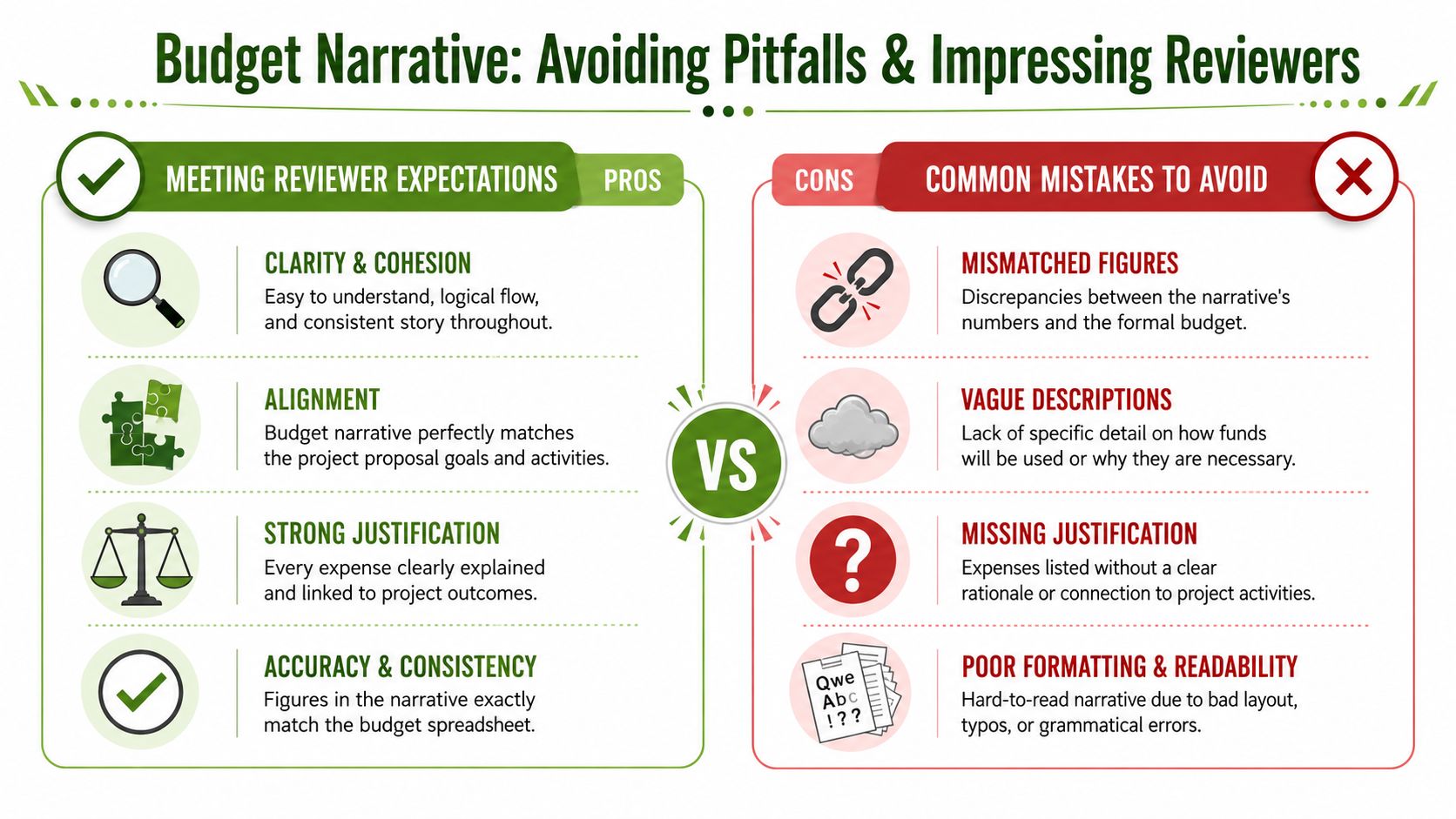
Funder rules can change the shape of the narrative
For NSF proposals, the budget justification must be “concise” and no longer than three pages, while the 2026 SAC sample budget narrative from HRSA requires a “detailed budget narrative” covering all costs in each object class category for each 12-month period of performance, according to the budget justification best practices summary from Montana State University.
That contrast matters. A narrative that works for one can fail the other even if the numbers are sound.
Mistakes that trigger reviewer doubt
Some errors are common enough that reviewers spot them immediately:
- Mismatched figures between the budget form and the narrative
- Vague descriptions such as “miscellaneous supplies” with no explanation
- Unclear calculation methods for personnel, fringe, or consultant costs
- Costs that don't match the proposal narrative, such as promising training events without budgeting for travel, materials, or staffing
- Unallowable items slipped into direct costs
- Poor formatting that makes the reviewer hunt for information
A reviewer shouldn't have to reconcile your math, decode your categories, or guess what a line item means.
What reviewers actually want to see
They want clarity more than flourish. The strongest budget narratives usually share a few traits:
- Consistency: the numbers, staffing, and activities all match across documents
- Specificity: each line has enough detail to judge necessity and reasonableness
- Restraint: no filler language, no inflated explanations, no dramatic claims
- Readability: short paragraphs, logical order, and plain labels
A quick red-flag check
Before you submit, scan for these phrases and rewrite them:
| Weak phrase | Why it fails | Better direction |
|---|---|---|
| “Miscellaneous expenses” | Tells the reviewer nothing | Name the cost type and its project use |
| “Staff will support the project” | Too broad to evaluate | Name duties and level of effort |
| “Supplies for activities” | Circular and vague | Identify materials and linked activity |
| “Consultant services” | Missing scope and estimate basis | State service, rate basis, and role |
When reviewers see vague budget language, they don't assume flexibility. They assume uncertainty.
The budget narrative isn't the place to sound broad and adaptable. It's the place to show that your planning is disciplined.
Advanced Strategies and a Final Review Checklist
A budget narrative can lose points even when the math is right.
That usually happens when the document explains what you plan to buy, but not what those choices say about the project. Reviewers often score for more than allowability and accuracy. They also look for signs that the work can hold up after the grant period, that partners are real contributors, and that the organization has made disciplined decisions about staffing, match, and phased delivery. The narrative is where those signals become visible.
One area where teams miss that opportunity is cost share. In a NFWF-focused video discussion, reviewers note a common problem: applicants list match in the budget, but fail to explain it clearly in the narrative. I see the same issue across proposals. A cash contribution, donated facility use, or partner staff time only helps your score if the reviewer can see what it funds, why it matters, and whether it lowers delivery risk.
Use the narrative to show durability
Strong budget narratives use cost share to answer questions reviewers may not ask directly on the form:
- Who else is carrying part of the project cost
- Which activities are backed by partner time, space, equipment, or cash
- How outside support reduces dependence on a single grant
- What the organization can keep doing after the grant period ends
- Where the applicant made deliberate trade-offs, such as using in-kind technical support instead of hiring a new consultant
That last point matters. Reviewers notice when a budget reflects choices, not just requests. If a partner is covering data analysis, say so. If existing staff absorb supervision so grant funds can stay focused on direct service, say that. Those details frame the budget as a plan for impact, not a shopping list.
Final review checklist
Before submission, run a last pass with a scoring mindset:
- Match every figure to the final budget worksheet and any match table
- State the basis of estimate for each significant cost
- Show what each cost produces, not just what it is
- Explain cost share by activity or role, not as a lump sum
- Flag sustainability signals such as partner support, retained capacity, or post-grant coverage
- Cut generic wording and replace it with named functions, quantities, and time commitments
- Check for reviewer friction, especially places where someone has to cross-reference multiple documents to understand one line
- Read the narrative once for strategy, asking whether it makes the project look stable, realistic, and worth funding
A strong budget narrative justifies cost, supports hidden scoring criteria, and shows that the project can deliver results without falling apart when the grant term ends.
If your team wants a faster way to move from opportunity research to compliant proposal drafts, Fundsprout helps nonprofits find relevant grants, organize requirements, draft narrative sections, and keep the full application process on track without losing sight of the details reviewers score.
Try 14 days free
Get started with Fundsprout so you can focus on what really matters.