How to Start a Nonprofit Your Complete Guide
Thinking about how to start a nonprofit? Our guide covers the real-world steps from crafting a mission and filing for 501(c)(3) to fundraising and impact.

Abdifatah Ali
Co-Founder
You've got a world-changing idea, a fire in your belly, and a desire to make a difference. That's the perfect starting point for a nonprofit. But before you dive into legal paperwork, the real work begins—transforming that passion into a strategic, sustainable organization that a community actually needs.
Laying Your Strategic Foundation
The most successful nonprofits are built on a solid foundation, and that foundation is laid long before you ever file for incorporation. This isn't the paperwork phase; it's the "prove it" phase. It’s about ensuring your brilliant idea solves a real problem, not just one you think exists. Skipping this step is a classic, and often fatal, mistake for new founders.
And what a time to be starting. The nonprofit world is booming. In the U.S. alone, the number of nonprofits jumped by nearly 20% in 2023, with over 1.8 million organizations now in operation. Globally, there are more than 10 million nonprofits, creating a massive network for collaboration. The money is there, too—charitable giving in the U.S. hit a record $520 billion in 2022, and by 2024, global philanthropy reached a staggering $2.3 trillion. You can get a deeper look at these numbers in Cazoomi’s 2025 nonprofit statistics report. This isn't just a sector; it's a movement, and you're about to join it.
Validate Your Mission with Community Research
First things first: put on your detective hat. Your mission is to uncover hard evidence that the problem you want to tackle is real and that your solution is truly needed. The last thing you want is to create another organization duplicating services that already exist. Your goal is to find the gaps.
This means conducting a real community needs assessment. It’s a formal way of figuring out a community's strengths, assets, and, crucially, its unmet needs. Solid research moves you beyond good intentions and gives you the data to build a compelling case for support when you start fundraising. For a practical walkthrough, check out our guide on community needs assessment tools.
Here are a few ways to get your hands dirty with research:
- Host listening sessions: Get out into the community and hear directly from the people you want to serve. Don't talk; listen.
- Interview local leaders: Chat with people at existing nonprofits, schools, or city hall. They know the landscape better than anyone.
- Dig into the data: Look up local statistics on demographics, poverty rates, or health outcomes relevant to your cause.
- Survey potential beneficiaries: Instead of assuming what people need, ask them. Their answers might surprise you and will definitely strengthen your mission.
Define Your Core Programs and Target Audience
With your research in hand, it's time to sharpen your focus. A nonprofit that tries to be everything to everyone ultimately helps no one effectively. Get specific. Who, exactly, are you going to serve? What specific programs will you offer to address the needs you just uncovered?
For example, a vague mission like "helping the homeless" won't get you far. A laser-focused mission, however, sounds like this: "providing overnight shelter and job placement services for homeless veterans in downtown Austin." See the difference? That level of clarity is pure gold. It makes everything from grant writing to volunteer recruitment a thousand times easier.
A well-defined mission is your organization's North Star. It guides every decision, from program development to fundraising appeals, ensuring your team stays aligned and your impact remains focused.
Assemble Your Founding Board of Directors
Let’s be clear: a nonprofit is not a solo act. You need a dedicated, skilled founding board of directors to provide governance, oversight, and strategic direction. Think of them as your co-founders and brain trust, because they are legally and financially responsible for the organization.
When you're building this team, aim for a mix of skills and perspectives—you don't want a boardroom full of clones. An ideal founding board might include people with expertise in:
- Finance or accounting (an absolute must!)
- Law
- Marketing and communications
- Fundraising
- Strong connections to the community you serve
This group will help you draft bylaws, approve your first budget, and navigate the entire incorporation process. Choose them wisely. Their passion, networks, and expertise will be the bedrock of your success.
Before you jump into the legal steps, it's incredibly helpful to organize these foundational decisions. Think of it as your pre-launch checklist.
Key Pre-Launch Strategic Decisions
Taking the time to answer these questions with your founding team doesn't just prepare you for the paperwork; it ensures you're building an organization with a clear purpose and a real shot at making a lasting impact.
Making It Official: Incorporation and Tax-Exempt Status
You've done the hard work of building a solid strategy and gathering your founding board. Now it's time to bring your vision to life by making it a legal entity. This is where your nonprofit stops being an idea and officially becomes an organization in the eyes of the law.
The process boils down to two major milestones: incorporating in your state and then getting your federal tax-exempt status from the IRS. It sounds intimidating, but think of it as a logical sequence of steps that formalizes all the planning you've already done.
First things first: you need a name. And this isn't just a branding exercise—it has to be legally unique in your state. Before you get too attached to a name, do a quick search on your state’s business registry. Making sure it’s not already taken by another company or nonprofit will save you a major headache and a potential rejection of your paperwork down the road.
The strategic planning you've already poured your heart into serves as the perfect blueprint for this legal phase.
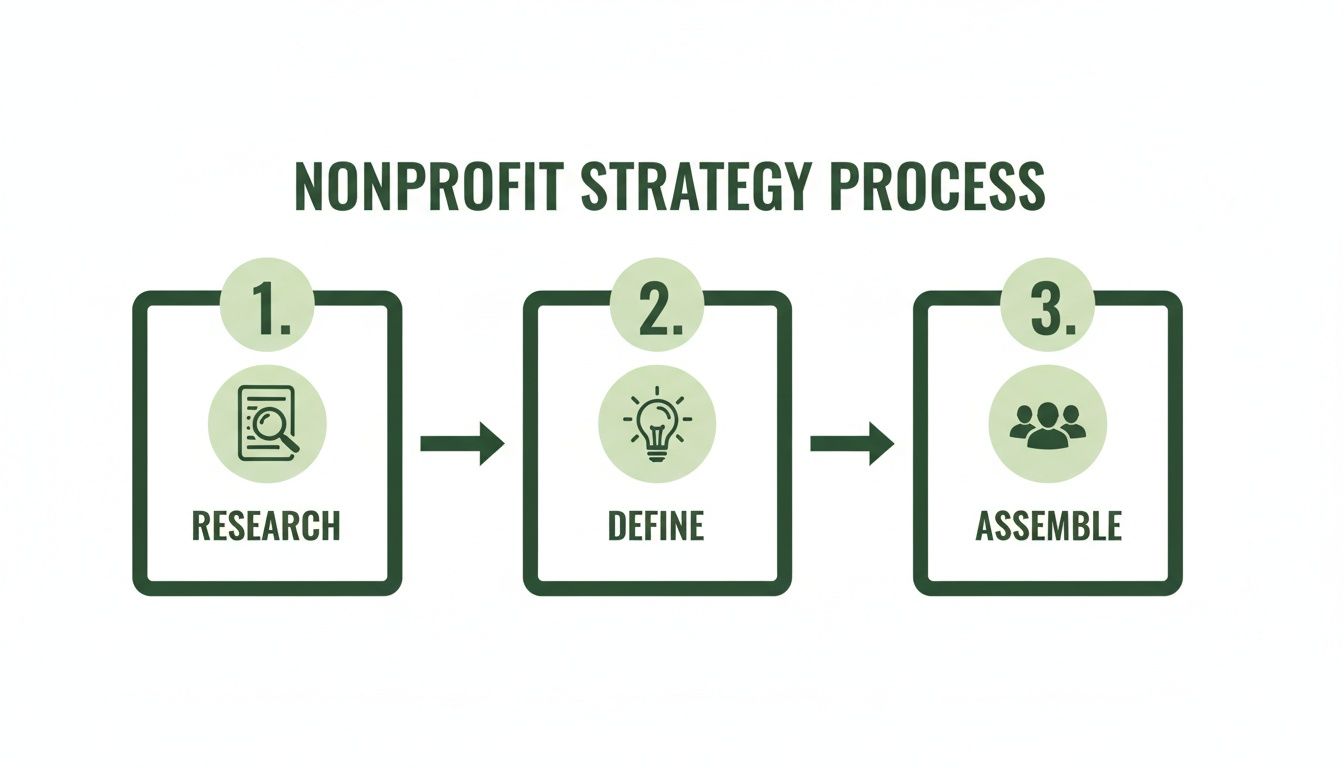
See how each step builds on the last? When you file these legal documents, you’re not just submitting paperwork; you're codifying a well-researched, clearly defined mission.
Filing Your Articles of Incorporation
With a unique name secured, your next move is filing the Articles of Incorporation. This is the document that officially creates your nonprofit corporation with your state, usually through the Secretary of State's office.
While the specifics vary from state to state, you'll generally need to include:
- Nonprofit Name & Address: Your official, registered legal name.
- Registered Agent: The person or service designated to receive official legal notices for the organization.
- Purpose Clause: This is where that mission statement you labored over comes into play. It's critical to use the specific language required by the IRS here to pave the way for your 501(c)(3) application.
- Board of Directors: The names and addresses of your founding board members.
Once your articles are approved, you’ll get a certificate of incorporation. Pop the cork! Your nonprofit is now a real legal entity. But don't celebrate too long—next up is creating your internal rulebook.
Drafting Your Organizational Bylaws
If your Articles of Incorporation are the birth certificate, your bylaws are the operating manual. This is a crucial internal document that outlines the rules and procedures for how your nonprofit will actually run. Good bylaws are the bedrock of good governance, ensuring everything is handled with consistency and transparency.
Your bylaws need to clearly spell out things like:
- The size of your board and how directors are elected.
- The specific roles and duties of officers (President, Treasurer, etc.).
- Rules for board meetings, including how often they happen and what a quorum is.
- A clear procedure for handling any conflicts of interest.
- The process for amending the bylaws in the future.
Your bylaws are a living document, but they provide the essential framework that protects your organization and its leadership. A well-drafted set of bylaws can prevent countless future disputes and operational roadblocks.
Securing 501(c)(3) Tax-Exempt Status
Just because you’re incorporated doesn’t mean you’re tax-exempt. That power belongs solely to the IRS. To become a public charity that can offer tax deductions to donors, you must apply for 501(c)(3) status. As you move to formalize your organization, understanding the path to charity status is absolutely essential, as it unlocks critical financial and legal benefits.
This is done by filing IRS Form 1023 or, for smaller groups, the more streamlined Form 1023-EZ. The EZ form is an option if your projected annual gross receipts are under $50,000 and your total assets are less than $250,000. It's simpler, but it's not for everyone—organizations like schools, for instance, can't use it.
Filing the full Form 1023 is a pretty intensive process. You’ll need to have your ducks in a row and provide:
- Copies of your approved Articles of Incorporation and signed bylaws.
- A detailed description of your activities—past, present, and future.
- Financial data, including a projected budget for your first three years.
- Information on your board members, including any compensation.
The IRS review can take anywhere from a few months to over a year, depending on how complex your application is and how backed up they are. Your best bet for a speedy approval is to submit an application that is meticulously complete and accurate from the get-go.
Building Your First Fundraising Strategy
You’ve done the paperwork. Your nonprofit is officially a real, legal entity. Now for the part that keeps most founders up at night: getting the money to actually do the work.
Building a fundraising strategy from the ground up feels massive, but let's reframe it. It's not just about asking for money. It’s about building relationships, telling a powerful story, and inviting people to be part of something important.
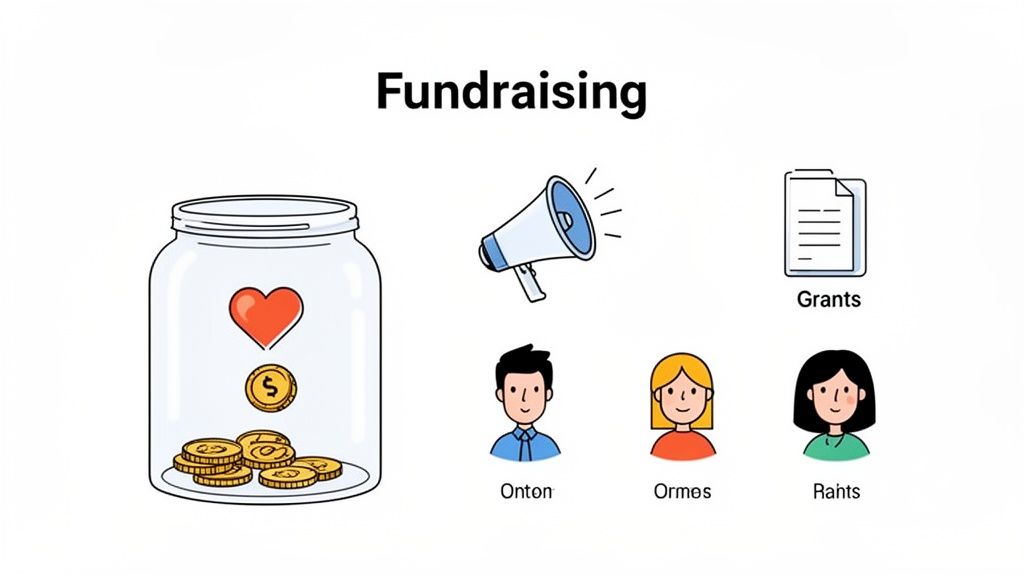
The name of the game in these early days is diversification. Putting all your eggs in one basket—whether it's one major donor or one big grant—is a recipe for disaster. Your goal is to build a healthy mix of funding streams: individual donors, grants, and maybe even a local business sponsor. This creates resilience, helping you ride out the inevitable ups and downs.
Your Secret Weapon: The Case For Support
Before you can ask for a single dollar, you need a rock-solid answer to the question, "So what? Why should I give to you?" This is your case for support. It’s the heart and soul of every email, grant proposal, and coffee meeting you'll have.
Think of it as your core story, boiled down to its most compelling elements:
- The Problem: What specific, urgent need exists right here in our community?
- Your Solution: How, exactly, do your programs fix that problem?
- The Impact: What does a dollar actually do? Show the tangible change.
- The Urgency: Why now? What happens if you don't get this funding today?
Don’t just say, "We help at-risk youth." That's generic.
Try this instead: "Every year, 500 teenagers in our city drop out of high school, putting their futures in jeopardy. Our mentorship program changes that. A gift of $50 today provides one student with a full week of after-school tutoring, keeping them on the path to graduation." See the difference?
Finding Your First "Yes"
Forget cold calls and mass emails. Your first fundraising push should feel more like a conversation with friends, because that’s exactly where you’ll start. Your initial support will almost always come from people who already know you, trust you, and believe in your vision.
Grab a notebook and start listing your "inner circle":
- Your Board Members: This is non-negotiable. Your board must be the first to donate. It’s a powerful vote of confidence that other funders look for.
- Founders & Volunteers: The core team's personal networks are a goldmine.
- Friends & Family: Never underestimate their desire to see you succeed.
- Professional Contacts: Colleagues and mentors who respect your work ethic.
This isn’t about hitting up everyone you know. It's about strategically identifying who in your network might be passionate enough about the cause to make a "founding gift." These first checks are pure momentum.
Make It Ridiculously Easy To Give
You could have the most compelling story in the world, but if donating is a hassle, you’ll lose people. In this day and age, a simple, secure online donation process is an absolute must-have.
Platforms like PayPal, Stripe, or nonprofit-focused tools like Givebutter can get you set up with a "Donate" button in no time. Test it on your phone. If it takes more than a few clicks, simplify it.
A seamless online donation experience is no longer a luxury; it's a fundamental requirement. If a potential donor can't give easily from their phone in under two minutes, you've likely lost them forever.
Securing funding is the lifeblood of any new nonprofit, and the stats reveal a goldmine for those who start smart. Corporate giving exploded 9.1% in 2024 to $44.4 billion—the fastest growth among sources and the highest ever, yet it’s just 7.5% of total U.S. philanthropy, leaving room for newcomers. For small nonprofits, the barrier is high—only 19% raise over half their revenue digitally, and 11% do zero online, but that's your edge. Discover more insights from NonProfit PRO’s 2025 study.
The world of early-stage funding can feel overwhelming. Let's break down the most common options you'll encounter as you get started.
Early-Stage Funding Options: A Comparison
Each of these avenues has its place in a healthy funding mix. Starting with your "friends and family" and individual donors often provides the quickest path to your first dollars, which then makes you a more attractive candidate for grants and sponsorships down the line.
Getting Ready For Grants
While individual donors build your foundation, grants can pour the concrete. A single grant can provide the capital to launch a major program or scale your operations. But diving into the world of grant writing unprepared is a fast track to burnout. You need to be grant-ready.
This means having a "grant-ready toolkit" on hand—a digital folder with all the core documents that funders ask for. Assembling this before you find the perfect grant opportunity will save you from frantic, last-minute scrambles. You can dive deeper into this by checking out our guide on creating a fundraising plan format.
Your toolkit absolutely must include:
- Your IRS 501(c)(3) determination letter
- A list of your board of directors with their professional affiliations
- Your annual organizational budget and a specific project budget
- Your most recent financial statements (even if they're simple to start)
- Your powerful case for support, ready to be copied and pasted
With this folder ready to go, you can start searching for foundations that care about the same things you do. Pro-tip: start local. Community foundations are often far more interested in funding new, homegrown organizations than massive national funders. This turns grant seeking from a reactive chore into a strategic, manageable part of your growth.
Setting Up Your Operational Systems
You've navigated the legal maze and have an initial fundraising plan. Now it's time to build the engine that will actually run your nonprofit day-to-day. This is where the real work begins.
Strong operational systems are the unsung heroes of every successful nonprofit. They're what build trust with donors, keep you on the right side of the law, and, most importantly, free you up to focus on your mission instead of getting buried in administrative chaos. Think of this as building your organization's central nervous system—it needs to be reliable and transparent from the very start.
Your Financial Foundation
First things first: your nonprofit needs its own financial identity. The most critical step here is opening a dedicated bank account for the organization.
I can't stress this enough: Never commingle nonprofit funds with personal accounts. It's a massive red flag for the IRS and donors, not to mention a guaranteed accounting nightmare.
To open the account, your bank will likely ask for:
- Your Employer Identification Number (EIN)
- A copy of your filed Articles of Incorporation
- Your organizational bylaws
Next, you need a reliable way to track every dollar that comes in and goes out. A spreadsheet might seem fine for the first couple of weeks, but it will quickly become a liability. Investing in simple, user-friendly accounting software is one of the smartest early decisions you can make. Tools like QuickBooks for Nonprofits or Aplos are built for our world, easily handling things like restricted grants and generating the reports funders expect to see.
Managing Donor Relationships
Every donation, big or small, represents a relationship. How you cultivate those relationships will ultimately define your long-term success. This is where a donor management system, often called a Customer Relationship Management (CRM) system, comes into play.
You don't need a complex, expensive system right out of the gate. A well-organized spreadsheet can be a great starting point. Just make sure you're tracking the essentials for each supporter: name, contact info, donation dates and amounts, and any personal notes from conversations.
As you grow, though, a dedicated CRM becomes absolutely essential. It helps you spot giving patterns, automate thank-you messages, and segment your communications for more personal and effective appeals. To get a better sense of the options out there, you can check out our guide to the best CRM software for nonprofits. The goal is to build a system that helps you treat a $10 donor with the same care and attention as a major funder.
A strong operational backbone isn't about bureaucracy; it's about building an organization that is transparent, accountable, and worthy of public trust. These systems are what turn a passionate idea into a sustainable, impactful institution.
Staying Compliant and Accountable
Finally, solid systems are your best defense for staying compliant. Your obligations don't just disappear once the 501(c)(3) approval letter arrives. Maintaining that status is a year-round job.
Here are the key compliance areas you need to manage from day one:
- Annual IRS Filings: Most charities must file a version of the Form 990 every year. This is a public document detailing your finances, programs, and governance, making it a critical transparency tool.
- State Fundraising Registration: Before you ask for a single dollar, know that most states require you to register with their charity official (usually the Attorney General's office). You’ll need to do this in every state where you actively solicit donations.
- Meticulous Record-Keeping: You have to keep detailed financial and corporate records. This covers everything from board meeting minutes and donation receipts to expense reports and contracts.
As you get your operations running, you might also want to look into communication software tailored for nonprofit organizations to keep your team, board, and volunteers all on the same page. Great internal communication is the glue that holds everything together, building an accountable organization that funders can support with confidence.
Launching and Growing Your Impact
Alright, the legal filings are in, the bank account is active, and your 501(c)(3) application is somewhere in the IRS pipeline. Deep breath. Now the real work starts.
This is where the rubber meets the road. Those first 90 days are absolutely critical. It’s all about turning your beautiful plans into real-world action and building the momentum you need to survive and thrive. You're not aiming for perfection here; you're aiming to prove your concept and make an impact, even a small one.
Announcing Your Arrival
Your launch isn't just a formality—it's the opening line of your story. You need a simple, powerful message that tells people what problem you're here to solve and, crucially, invites them to be a part of the solution. Don't get bogged down in jargon.
Even with a tiny budget, you can make a splash. A solid launch plan really just needs three things:
- A Simple Website: Seriously, a single page will do. Make sure it clearly states your mission, shows who's behind the curtain (your team), and has a big, obvious "Donate" button.
- A Social Media Push: Don't try to be everywhere. Pick one or two platforms where your community actually hangs out. Post your story, announce you're officially open, and put out a call for volunteers or your first small donations.
- Direct Outreach: This is your secret weapon. Send personal emails to your inner circle—friends, family, former colleagues, and anyone who offered early encouragement. Thank them. Let them know you've launched. People want to help those they know.
The goal is to create a coordinated buzz that announces, "We're here, we're real, and we're ready to get to work." Mastering this is a huge part of learning how to start a nonprofit that builds a genuine community from day one.
Running Your First Pilot Program
With the word out, it's time to get your hands dirty. A pilot program is just a small, controlled version of your main service. Think of it as a test flight. It’s your chance to see if your brilliant ideas actually work in the real world, iron out the wrinkles, and collect some powerful stories.
For example, if you want to provide tutoring, don't try to serve a whole school district. Partner with one teacher and help just five students. This keeps things manageable and allows you to learn fast without getting overwhelmed.
Your pilot program is your most powerful fundraising tool. The data, testimonials, and lessons learned from this initial effort will be the core of your first real grant applications and donor appeals.
Track everything. What worked? What was a disaster? Most importantly, what changed for the people you served? Those outcomes are gold.
Recruiting Your First Volunteers
For most new nonprofits, volunteers aren't just helpful—they're essential. They are the engine, bringing skills, passion, and time you couldn't possibly afford.
Your first recruitment effort needs to be personal and specific. Don’t just put out a vague call for “help.” People respond to concrete needs.
Instead, create clear, bite-sized role descriptions. Try something like, "Seeking a social media volunteer to manage our Facebook page for 2 hours a week," or "Looking for 3 volunteers to help with our launch day event." It feels achievable and professional.
Ask your board members to tap into their networks. Reach out to local universities or community groups. When you talk to potential volunteers, frame it as a unique opportunity: a chance to get in on the ground floor and help build something meaningful from scratch. These founding volunteers often become your most loyal champions for years to come.
Common Questions About Starting A Nonprofit
The big-picture strategy is exciting, but let's be honest—it's often the small, nitty-gritty questions that trip up new founders. When you're in the thick of it, you need practical answers to keep the momentum going. This section tackles those common "how do I actually..." hurdles that pop up along the way.
Can I Get Paid To Run The Nonprofit I Started?
Yes, you absolutely can, but there’s a critical distinction to understand. As the founder, you can hold a position like Executive Director and draw a salary. The catch is that the IRS requires your compensation to be "reasonable and not excessive."
Your board of directors is legally responsible for setting your pay. They'll need to base it on what similar-sized nonprofits in your sector and city are paying their leaders. You can't just pick a number. What you can't do is profit from the organization. All surplus funds must be put right back into the mission—that's the core difference between a nonprofit and a for-profit business.
Key Takeaway: You can be a paid employee, but your salary must be justifiable and approved by an independent board. Founders cannot receive dividends or profits.
Do I Need A Lawyer To Start A Nonprofit?
Technically, no. You could try to navigate the paperwork on your own. But should you? I'd strongly advise against it. Getting a lawyer who specializes in nonprofit law is one of the smartest upfront investments you can make.
The language required for your Articles of Incorporation and the IRS Form 1023 is incredibly specific and full of potential traps. One small mistake can lead to months of delays or even an outright rejection of your 501(c)(3) application, forcing you to start over. Many state bar associations and larger law firms have pro bono programs for new nonprofits, so cost doesn't have to be a barrier.
How Long Does It Take To Get 501(c)(3) Status?
This is the big one, and unfortunately, the answer is "it depends." The timeline hinges on which application form you're eligible for and how backed up the IRS is at that moment.
Here’s a realistic breakdown:
- Form 1023-EZ: If you qualify for this shorter, streamlined application (for smaller organizations), you're in luck. Approvals often come through in 2 to 4 months.
- Form 1023 (Full Version): For everyone else, patience is key. The standard, more complex form can take anywhere from 6 to 12 months. If the IRS requests more information, the clock can tick even longer.
While you're waiting, you can still raise money, but you have to be transparent with donors that your tax-exempt status is "pending." The good news? Once you get that approval letter, your status is retroactive to your incorporation date, so all those early donations become tax-deductible for your supporters.
Ready to supercharge your grant strategy from day one? Fundsprout uses AI to find your perfect funding matches, helps you write compelling proposals in a fraction of the time, and keeps your reporting organized. Stop the frantic search and start building a sustainable funding pipeline. Discover your next grant at https://www.fundsprout.ai.
Try 14 days free
Get started with Fundsprout so you can focus on what really matters.