How to find board members for nonprofit: A practical guide to vetting leaders
How to find board members for nonprofit: Discover sourcing, vetting, and onboarding tactics to build a mission-driven board.


Abdifatah Ali
Co-Founder
Before you even think about posting a role or asking around, you have to know exactly who you’re looking for. Finding the right board members isn't about filling seats with warm bodies; it's a strategic move to build a powerhouse team that can steer your nonprofit toward its future goals.
The first step is always an honest look inward. You need to audit your current board, define the skills you're missing, and then craft a profile that will attract the high-impact leaders you need. This turns recruitment from a panicked reaction into a proactive strategy.
Defining Your Ideal Board Member Profile
Let's be real: recruiting without a clear plan often gets you a board full of well-meaning people who lack the specific expertise needed to govern and grow the organization effectively. To avoid that, you need a crystal-clear picture of what "the right fit" actually means for your nonprofit at this specific moment.
Think of it like casting a play. You wouldn’t just hire a talented actor without knowing what part they’re supposed to play. The same logic applies here. Every new member should fill a specific gap and bring tangible value that moves your mission forward.
Start with a Board Skills Audit
First thing's first: you need to take stock of who you already have around the table. A board skills audit is a straightforward but incredibly powerful tool for this. It’s all about mapping the expertise, experience, and network connections of your current members against the goals laid out in your strategic plan.
This audit gives you a bird's-eye view of your strengths and, more importantly, your blind spots. Do you have a finance whiz but no one who understands marketing? Plenty of legal eagles but zero connections in the corporate world? An audit brings these gaps into sharp focus.
To get started, you can use a simple matrix to track key competencies like:
- Professional Expertise: Finance, accounting, legal, marketing, HR.
- Fundraising Experience: Major gifts, grant writing, corporate sponsorships, event planning.
- Community Connections: Relationships with local government, business leaders, or key community groups.
- Demographic Diversity: Representation that reflects the community you serve in terms of age, race, gender, and lived experience.
This process immediately tells you where to concentrate your search efforts. The infographic below shows how this simple audit-to-action flow works in practice.
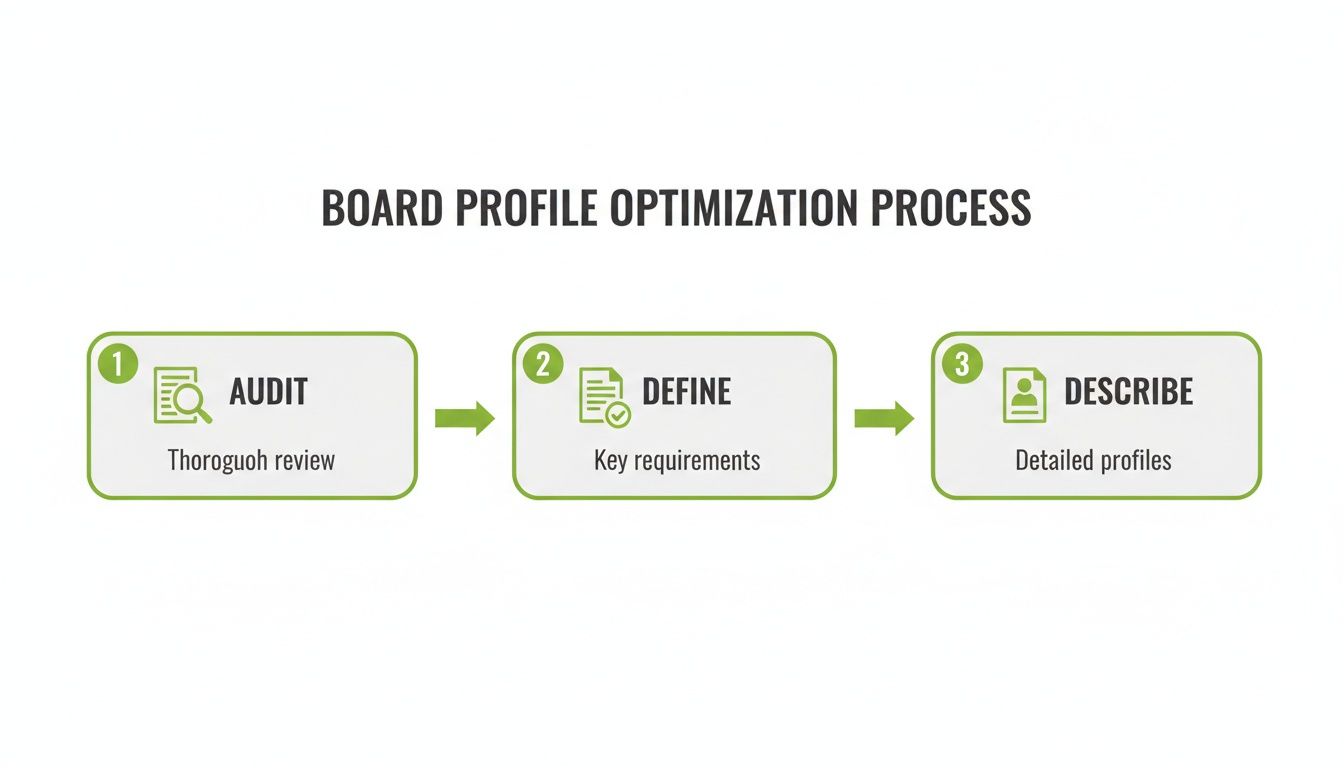
This visual really clarifies how a systematic audit naturally leads to a well-defined profile, which then becomes the basis for a compelling role description.
Board Needs Assessment Matrix
To make this practical, here's a template you can adapt. Use it to map your current board's strengths and pinpoint the most critical gaps you need to fill in skills, diversity, and network connections.
Completing this exercise transforms your recruitment from guesswork into a targeted search for the exact expertise and perspectives your organization needs to thrive.
Crafting a Compelling Job Description
Once you know what you’re looking for, you can write a board member job description that truly resonates. A generic description that just drones on about meeting attendance and fiduciary duties will only attract generic, uninspired candidates. You want this to be an exciting recruitment tool, not a legal document.
Your description should connect the role directly to your mission. For example, if your audit screamed "we need digital marketing skills!" to reach younger donors, the job description should say that, loud and clear.
A strong board member job description is a marketing document. It sells the opportunity to make a meaningful impact and clearly outlines how a candidate's specific skills will contribute to the organization's success.
This detailed description becomes the cornerstone of your recruitment conversations. It shows you’ve done your homework and that you value what a specific candidate can bring to the table. Remember, building a solid board is a fundamental part of a healthy nonprofit organizational structure, providing the high-level governance essential for long-term stability.
Defining Clear Expectations Upfront
Finally, your ideal profile must include unambiguous expectations. Nothing kills engagement faster than ambiguity. Be completely transparent from the start about the three core commitments: time, talent, and treasure.
- Time: How many meetings are there per year? Are members expected to join a committee? What’s a realistic estimate of the hours required per month?
- Talent: How will their specific skills be put to work? Will they be reviewing legal documents, helping create a marketing plan, or chairing the fundraising committee?
- Treasure: Is there a specific "give/get" policy? What are the real expectations around personal giving and helping with fundraising?
Laying all this out upfront ensures you and the candidate are on the same page from day one. It helps filter for people who are genuinely ready and able to commit, preventing future misunderstandings and empowering new members to contribute effectively from their very first meeting.
Finding Board Members Beyond Your Inner Circle
It’s tempting—and easy—to fill board seats by just asking friends, family, or your most dedicated donors. We've all done it. But relying only on your immediate network is one of the biggest mistakes a growing nonprofit can make, often leading to a board that thinks and looks the same. Real growth happens when you get intentional about building a pipeline of diverse, dynamic candidates.
The first step is moving from passive referrals to proactive scouting. This starts with changing how you ask for help.
Stop asking, "Who do you know who might be good for our board?" It's too vague. Instead, arm your current board, staff, and top volunteers with the detailed board role description and skills matrix you already created. Now they're not just friends of the organization; they're targeted talent scouts.
A better ask sounds like this: "We're specifically looking for someone with a strong background in corporate partnerships to help us scale our social enterprise. Do you know anyone in your network who lives and breathes that kind of work?" See the difference? You’ve turned a generic request into a focused mission, and you’ll get much better leads because of it.

Uncovering Hidden Talent Pools
Some of the most incredible future board members are out there, you just have to know where to look. When you expand your search beyond the usual suspects, you find people with fresh perspectives and connections that can be game-changing for your mission.
Here are a few goldmines for qualified candidates that are often overlooked:
- Corporate Employee Resource Groups (ERGs): Think about the big companies in your area. They almost certainly have ERGs for women in leadership, young professionals, LGBTQ+ employees, and more. These are full of skilled, motivated people actively looking for ways to make a difference in their community.
- Niche Professional Associations: Go beyond the general chamber of commerce. Need a finance whiz? Reach out to the local chapter of the Certified Financial Planner (CFP) Board. Looking for a marketing guru? Connect with the American Marketing Association (AMA). These groups can blast your opportunity to members with the exact skills you're targeting.
- Local Leadership Programs: Nearly every city has a "Leadership [Your City]" program that grooms a cohort of community-minded professionals each year. The graduates are proven leaders who have already signaled their commitment to civic life. They're often looking for their next big thing.
Sourcing from these pools is a direct line to finding candidates who bring not just their skills, but also entirely new networks that can open doors you didn't even know existed.
How to Proactively Build a Diverse Board
Let's be direct: building a board that truly reflects the community you serve is a strategic imperative, not just a feel-good exercise. Diverse boards make better decisions, drive more innovation, and build more trust with stakeholders and funders. But this kind of diversity almost never happens by accident.
The data shows we have a lot of work to do. Nonprofit boards in the US are still overwhelmingly white, with 66% of board positions held by white individuals, compared to just 17% by Black/African American members. This is a critical gap. As leaders, we have to address this head-on during recruitment.
To find board members who genuinely represent your community, you have to shift from a passive, network-based model to an active, outreach-based strategy. This means you must go to where diverse candidates are, rather than waiting for them to come to you.
Start building authentic relationships long before you have an open seat. Go to events hosted by groups like the National Black MBA Association or the Association of Latino Professionals for America. Connect with community leaders from underrepresented groups. Showing up and listening is the first step toward building the trust needed to recruit effectively.
Using Technology to Widen Your Net
Modern tools can be a massive help in expanding your search beyond your zip code or industry. Don’t be afraid to use them. Platforms like BoardSource and VolunteerMatch are fantastic starting points specifically designed to connect nonprofits with people looking for board roles.
But you can get even more specific. Think of LinkedIn as a powerful search engine for people. With its advanced search filters, you can proactively identify potential candidates who have the exact skills and background your organization needs, then begin the slow, important work of building a relationship.
You can also explore how AI-powered candidate sourcing can help you find prospects beyond your immediate connections. These tools can match your specific needs against profiles of individuals looking for service opportunities, saving you a ton of time.
By combining smart, targeted networking with the right technology, you can build a strong, consistent pipeline of incredible candidates ready to help you drive your mission forward.
Making the Connection: How to Interview Potential Board Members
Alright, you've got a list of promising candidates. Now comes the crucial part: the conversation. This isn't your standard job interview. Think of it less like a grilling and more like a mutual discovery session. You're trying to figure out if there's a real spark between their passion and your mission. The goal is to get past the polished resume and understand their motivations, how they collaborate, and what their commitment really looks like.
Your first email or call sets the whole tone. A generic, copy-paste message is a fast track to being ignored. Make it personal. Show them you've done your homework. Mention a specific project they led or a shared connection you have. Be direct and explain why you think their unique expertise—whether it's in finance or community organizing—could be a game-changer for your organization. This simple act of personalization shows you respect their time and elevates the conversation from the very beginning.

Crafting Questions That Reveal More Than a Resume
If you ask standard interview questions, you'll get rehearsed, standard answers. To really get to know someone, you have to ask questions that reveal how they think, what drives them, and if they truly grasp what nonprofit governance is all about. While you don't want a rigid script, walking in prepared with a few key lines of inquiry is essential.
I find it helpful to focus my questions on three core areas:
- Real Passion for the Mission: Why us? Why now? What is it about our work that genuinely speaks to you?
- Grasp of Governance: What's your take on the role of a board member? Where do you see the line between governing and managing day-to-day operations?
- Willingness to Fundraise and Advocate: How do you feel about fundraising? In what ways do you see yourself helping us secure the resources we need?
These kinds of questions shift the focus from what they've done to how they think, which is a much better predictor of their fit as a strategic leader for your nonprofit.
Using Stories to Predict Future Performance
Let’s be honest: past behavior is the best crystal ball we have for predicting future performance. Behavioral questions are your best tool here because they force candidates to share real stories from their past, giving you concrete evidence of their skills instead of just well-intentioned promises.
Don't ask, "Are you a good collaborator?" That’s a dead end.
Instead, try something like: “Tell me about a time you were on a board or committee that hit a major roadblock. What was the issue, what was your specific role, and how did you contribute to getting things moving again?” This kind of question uncovers their problem-solving style, how they handle pressure, and what being a "team player" actually means to them.
A great interview uncovers how a candidate thinks, collaborates, and confronts challenges. Focus on questions that ask for specific stories, not just opinions. This is how you find board members for your nonprofit who are truly prepared for the role.
This storytelling approach gives you a much richer picture of whether their style will mesh with your current board's culture. It helps you see the person who will be sitting at the table debating tough decisions, not just the impressive credentials on paper.
Framing "The Ask" with Clarity and Confidence
The interview is also your moment to be completely transparent about what you expect. This is where you lay out "the ask" with total clarity. Don't be timid about the tough stuff, especially when it comes to time and money.
Be ready to clearly outline the commitments:
- The Time: Be specific. Talk about the number of board and committee meetings per year, plus any annual events or retreats. Give them a realistic estimate of the hours required per month.
- The Financials: Explain your "give/get" policy. Be upfront about the personal donation expectation and the fact that every single board member is expected to be an active fundraiser.
- The Expertise: Circle back to why you reached out to them. Reiterate how you see their specific skills plugging in, whether that’s joining the finance committee or spearheading a new marketing initiative.
Once you’ve laid it all out, give them a moment to process. The most important part of this conversation is what comes next: their questions for you. A truly engaged candidate will want to know about the board’s biggest challenges, the organization's financial stability, and the working relationship between the board and the executive director. This two-way dialogue is what builds a foundation of trust. It ensures that when they say "yes," it’s an enthusiastic, fully-informed "yes" from someone ready to hit the ground running.
Making the Final Call: Vetting Your Top Candidates
You’ve had some fantastic conversations and you're feeling excited about a few potential board members. It's easy to get caught up in that energy and want to send an invitation right away. But hold on. This is exactly the moment to slow down and do your homework.
This final vetting stage isn't about being suspicious; it’s about being responsible. It’s the due diligence that protects your nonprofit’s reputation, your team, and the very mission you work so hard to advance. Think of it as building a strong foundation for a long-term partnership, ensuring everyone comes to the table with complete clarity and confidence.
Go Beyond the Standard Reference Check
Let’s be honest: most reference checks are a waste of time. They’re often a quick formality just to confirm someone worked somewhere. We need to do better. This is your chance to get a real, unvarnished look at how a candidate operates from people who have seen them in action.
The key is to ask open-ended questions that get people talking. Instead of asking, "Would you work with them again?", try these:
- "Could you walk me through a time you and [Candidate's Name] disagreed on a project? How did they navigate that?"
- "From your experience, what kind of environment does this person thrive in? Where do they struggle?"
- "When it comes to board dynamics, how do they contribute to a healthy debate or a tough decision-making process?"
- "If we bring them on board, what’s one piece of advice you’d give us to help them succeed here?"
Questions like these open the door to genuine stories and insights, giving you a much clearer picture of who you're really inviting to the table.
The Three Duties Every Board Member Must Understand
Before anyone says "yes," they need to understand this isn't just a volunteer role—it's a legal and ethical commitment. Every single board member has a fiduciary duty to the organization, which simply means they are legally obligated to act in its best interest.
This commitment breaks down into three core responsibilities:
- The Duty of Care: This is the "pay attention" rule. Board members must be diligent, show up prepared for meetings (meaning they've actually read the materials!), and ask probing questions. They need to act with the same care a reasonably prudent person would use in their own affairs.
- The Duty of Loyalty: A board member's allegiance is to the organization, period. They must put the nonprofit's interests above their own personal or professional gain. This is where avoiding conflicts of interest becomes absolutely critical.
- The Duty of Obedience: This duty requires the board to ensure the nonprofit stays true to its mission, follows its own bylaws, and complies with all laws and regulations. It keeps the organization on track and out of trouble.
Having a frank conversation about these duties is non-negotiable. It separates the candidates who are truly ready for the weight of governance from those who are just passionate about the cause. It's a critical step in building a board built on trust and accountability.
Tackling Conflicts of Interest and Background Checks
A formal conflict of interest disclosure isn't an accusation; it's a standard tool for transparency. Ask every serious candidate to complete a form listing any financial, professional, or even personal relationships that could potentially cloud their judgment. You can find a great starting point with our sample conflict of interest policy for nonprofits.
You also need to consider background checks. If your nonprofit serves children, the elderly, or other vulnerable populations, a basic criminal background check is a must-have.
These formal steps are crucial for good governance and equity. While corporate boards have made progress—female directors in the S&P 500 rose from 23% in 2018 to 32% in 2023—the nonprofit sector still has work to do, with boards remaining 66% white. A consistent, fair, and well-documented vetting process for every candidate is how we ensure we're building the diverse, effective boards our missions deserve. You can discover more insights about board diversification trends to see how the landscape is shifting.
Setting New Board Members Up for Success
The work isn’t over once your top candidate says “yes.” In fact, getting that acceptance is just the beginning. A thoughtful, structured onboarding process is probably the single most important thing you can do to turn an enthusiastic new recruit into an effective, engaged leader for the long haul.
Without a clear plan, new members often feel like they're trying to find their footing in the dark. They’re unsure of how to contribute and sometimes hesitant to even speak up. A great onboarding experience changes all of that. It empowers them to make a real impact from their very first meeting and sets a tone of professionalism and respect that will define their entire tenure.
Designing a Powerful Onboarding Experience
Your main goal here is to get new members up to speed on your organization's history, finances, strategic direction, and unique culture as quickly and smoothly as possible. This isn't just a one-and-done meeting; think of it as a phased experience that unfolds over their first few months.
This journey starts long before they walk into the boardroom. The first step is to send them a comprehensive orientation packet. This is their roadmap to your organization, and it's critical to get it into their hands before their first meeting so they can arrive feeling prepared and confident.
A solid orientation packet should include:
- Core Governance Documents: This means your articles of incorporation, bylaws, and a current list of board members with brief bios.
- Strategic & Financial Overviews: The current strategic plan, the most recent annual report, this year's approved budget, and recent financial statements are non-negotiable.
- Key Program Information: Give them a rundown of your main programs and who you serve. You can even explore our guide on creating a solid fundraising plan format to show how program goals and financial strategy are intertwined.
- Meeting Logistics: A simple calendar of upcoming board and committee meetings for the year.
This packet isn't just a pile of paperwork—it's the foundational knowledge they need to jump into high-level discussions right away.
To help you track all the moving parts, a checklist can be a lifesaver. It ensures no one falls through the cracks and that every new member gets the same high-quality introduction to your organization.
New Board Member Onboarding Checklist
This checklist standardizes your process, making it repeatable and ensuring every new board member feels fully integrated from day one.
The Impact of a Board Buddy
Let’s be honest: joining an established board can be intimidating. You’re the new person walking into a room full of pre-existing relationships and inside jokes. To break down that barrier, I highly recommend a "board buddy" or mentorship program.
Pair each new member with a seasoned board member who can be their guide. This mentor’s job is to be the go-to person for all the "silly questions" a new person might hesitate to ask the full group. They can explain the backstory on past decisions, clarify the unwritten rules of board culture, and make personal introductions.
A board buddy system dramatically speeds up a new member's integration and sense of belonging. It turns a formal process into a human connection, which is the bedrock of any strong, cohesive board.
This simple, no-cost strategy is one of the most effective ways to make your new recruits feel welcomed, valued, and ready to contribute.
Strategies for Long-Term Engagement and Retention
Onboarding is just the beginning; keeping great board members requires ongoing effort. The secret to retention is making sure their service remains meaningful and rewarding, which means getting them involved beyond just attending meetings.
Meaningful committee work is the perfect place to start. Assign new members to a committee that directly uses the skills you recruited them for. If you brought someone on for their marketing savvy, get them on the communications committee right away. This gives them a chance to see their direct impact and feel a sense of ownership.
It's also worth noting that a staggering 69% of nonprofit board members are 45 or older, with only 9% under 35. This demographic gap underscores a critical need for fresh perspectives. Engaging younger members often means focusing on tangible, project-based work with clear metrics for success. You can discover more insights about engaging younger generations on nonprofitlawblog.com to learn how to tap into this vital talent pool.
Finally, never underestimate the power of a simple "thank you." Acknowledging contributions—whether it's landing a new grant or making a key introduction—reinforces that their hard work is seen and valued. Consistent appreciation, combined with opportunities for real impact, is the cornerstone of a retention strategy that will build a loyal, effective board for years to come.
Answering Your Top Questions About Nonprofit Board Recruitment

When you're in the trenches of recruiting new board members, a lot of questions pop up. It's totally normal. From figuring out the right board size to navigating tricky money conversations, getting clear on these points will give you the confidence to build a powerhouse team. Let's tackle some of the most common challenges I see nonprofit leaders face.
How Many Members Should a Small Nonprofit Board Have?
For most small nonprofits, a board with 7 to 11 members is the sweet spot. This range gives you enough horsepower to get the work done and bring in diverse perspectives, but it's still nimble enough to make decisions without getting stuck in committee.
Pro tip: Aim for an odd number. It’s an old-school trick that still works wonders for avoiding tie votes on crucial decisions.
But remember, the real goal isn't just hitting a magic number; it's about covering your bases. Your skills matrix is your roadmap here. If you're missing a finance whiz, a legal expert, or a fundraising champion, you need to fill those seats, no matter your current count. While your state might only require a minimum of three members, a slightly larger, well-rounded board will always give you a bigger network and more capacity to grow.
What Is the Best Way to Ask Someone to Join a Board?
The most powerful "ask" is always a personal, thoughtful conversation—not a generic email blast. If you don't know the candidate well, invest some time in building a genuine connection first. The invitation to join should feel like a natural next step, not a cold pitch.
The ideal scenario is to have the invitation come from a peer—the Board Chair or another respected board member—along with the Executive Director. When you sit down with them, be prepared to:
- Explain why them: Get specific. Tell them exactly what skills and experiences they have that made you think of them and how those strengths align with your current strategic needs.
- Share your passion: Lead with stories about your mission and the impact you're having. People are moved by purpose, not just statistics.
- Be transparent from the start: Lay out the time commitment, financial expectations, and fundraising responsibilities with total honesty. No surprises.
Always wrap up by giving them an easy "out" and plenty of time to review a full board packet. A respectful, no-pressure approach shows you're looking for a true partner, and it's the foundation for a long and fruitful relationship.
A thoughtful, personalized invitation is the first step in building a strong relationship. It signals that you're looking for a partner in your mission, not just a name on your letterhead.
This turns recruitment from a simple transaction into a meaningful conversation about shared values and vision.
Should Nonprofit Board Members Be Paid?
The short answer is no. As a general rule, nonprofit board members should be dedicated, unpaid volunteers. It’s the standard practice across the sector for a good reason. It demonstrates to donors, funders, and the community that the board's first priority is the mission, not personal financial gain.
Putting board members on the payroll can create some serious conflicts of interest and might even be illegal depending on your state's laws. It blurs the critical line between governance and employment, which can cause a world of headaches down the road.
That said, you should absolutely reimburse board members for legitimate expenses they incur while on duty, like travel to meetings or conference fees. If you truly need ongoing, specialized expertise, it's far better to hire that person as a paid consultant. This keeps the roles clean, avoids ethical tangles, and maintains clear professional boundaries.
How Do You Recruit a Candidate Who Is Nervous About Fundraising?
Ah, the classic fundraising fear. This comes up all the time. Many incredible leaders freeze up at the thought of asking for money because their idea of fundraising is limited to making big, scary asks. Your job is to show them the bigger picture.
Start by reframing what "fundraising" actually means. It's so much more than just soliciting donations. It’s about:
- Making introductions to people in their network.
- Hosting a small "friend-raiser" at their home or office.
- Sharing your organization's stories on social media.
- Being a passionate ambassador for the cause everywhere they go.
Talk them through your "give/get" policy and show them the different ways they can contribute that don't involve writing a huge personal check. Offering fundraising training or pairing them with a seasoned board member as a mentor can also make a world of difference.
If a candidate has a game-changing skill your board desperately needs but remains hesitant, you have a strategic choice to make. You might make a rare, well-documented exception, but be careful that it doesn't become the norm.
Finding the right funding opportunities to support your mission can be as challenging as finding the right board members. At Fundsprout, our AI-powered platform helps you discover relevant grants and craft winning proposals, so you can focus more on impact. Learn how Fundsprout can streamline your grant success.
Try 14 days free
Get started with Fundsprout so you can focus on what really matters.