Decoding the Hierarchy of Nonprofit Organization Structures
Explore the hierarchy of nonprofit organization models, from board governance to daily operations. Build a structure that supports growth and grant compliance.

Abdifatah Ali
Co-Founder
Every nonprofit needs a clear structure to bring its mission to life. This hierarchy isn't about red tape or corporate stuffiness; it's the internal map that outlines roles, responsibilities, and how decisions get made. Think of it as the blueprint that ensures everyone, from the board of directors down to the newest volunteer, is pulling in the same direction.
Without this map, you risk confusion and inefficiency. With it, you build a foundation for accountability, smart operations, and long-term growth.
The Blueprint for Your Mission
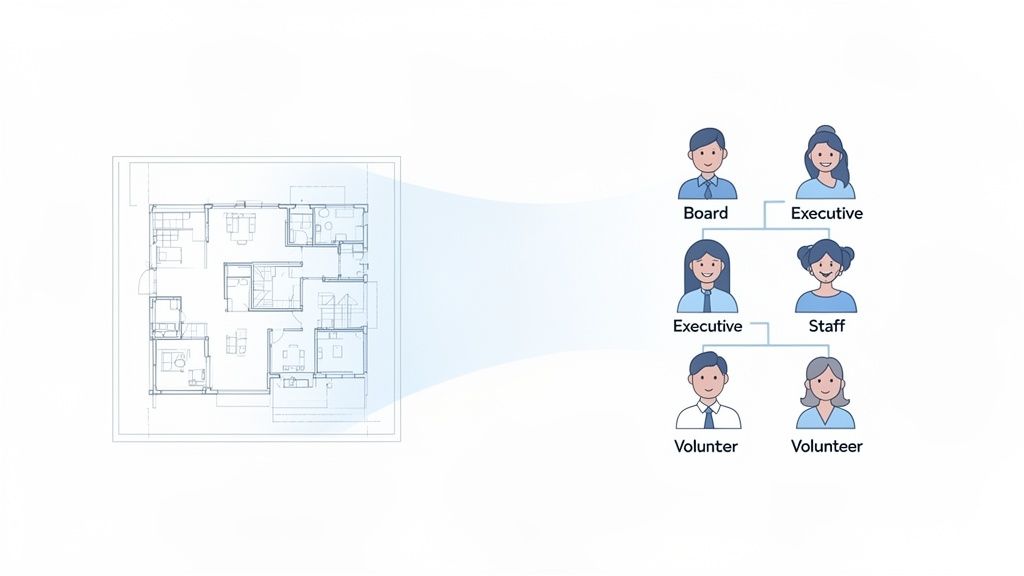
It’s helpful to think of your nonprofit's hierarchy less like a rigid corporate ladder and more like the architectural plan for a community center. A good blueprint shows how the foundation, walls, and rooms all connect to create a building that's both stable and serves its purpose. In the same way, your organizational chart shows how different roles and departments link together to deliver on your mission.
When you have a well-designed structure, everyone knows who is responsible for what. This simple clarity prevents crossed wires and duplicated work, which is absolutely critical when resources are tight. This isn't just an internal benefit, either. Funders, grant-making foundations, and major donors are looking for stable, well-managed organizations to support. A coherent org chart is a powerful signal that you have the capacity to handle their investment responsibly.
Why Structure Is More Than Just an Org Chart
A nonprofit hierarchy is a living tool that directly impacts your ability to serve the community. It creates clear channels for communication, making sure the board's big-picture vision gets translated into real-world action by the program staff on the ground.
It’s also a two-way street. That same structure allows vital feedback and data from the front lines to flow back up to leadership, helping them make smarter strategic decisions.
A strong structure helps your nonprofit in a few critical ways:
- Accountability and Governance: It sets up a clear chain of command, so there's no question about who is accountable for specific outcomes. This allows the board to provide meaningful oversight.
- Grant Compliance: Many grant applications demand a clear picture of your organizational capacity. A defined hierarchy shows funders you have the right people and systems in place to manage their money properly.
- Scalable Growth: As your organization expands, a solid structure lets you add new roles or programs without everything descending into chaos. It gives you a framework to build upon.
This need for structure is felt across the entire sector. While there are roughly 1.8 million nonprofits in the United States, more than 70% of them operate on annual budgets under $500,000. For these smaller organizations, a simple and clear hierarchy is the secret to making every dollar and every hour count. You can explore more stats on the nonprofit sector to get a better sense of this landscape.
Understanding the Core Roles in a Nonprofit
A nonprofit structure isn't just a chart; it's a living, breathing system powered by people. Each role is like a specialized gear, turning the mission from a hopeful idea into real-world impact. When you look past the titles, you find a dynamic ecosystem where every position has a unique job to do, ensuring the whole machine runs smoothly.
The Board of Directors
At the very top, you have the Board of Directors. Think of them as the guardians of the mission and the architects of the organization's future. They don’t get involved in the day-to-day grind; their focus is on the big picture.
Their main responsibilities boil down to a few critical areas:
- Setting Strategic Direction: They map out the long-term vision and define the ultimate goals that guide everything the nonprofit does.
- Ensuring Financial Health: The board provides crucial fiscal oversight. They're responsible for approving the annual budget and making sure the organization's resources are managed wisely.
- Hiring and Supervising the Executive Director: Perhaps their most important job is hiring the right Executive Director (ED). They then delegate the authority for running the organization to that person.
- Maintaining Legal and Ethical Integrity: Board members are the final line of defense, legally responsible for ensuring the organization follows all laws and upholds the highest ethical standards.
The Executive Director
The Executive Director (ED)—sometimes called a CEO or President—is the critical link between the board's high-level strategy and the staff's on-the-ground work. If the board designs the building, the ED is the general contractor who makes sure it gets built right, day in and day out.
This is the one employee who reports directly to the board. The ED’s primary function is to translate the board’s vision into action. They manage the staff, oversee programs, drive fundraising, and ensure the entire operation is effective and efficient. It's a role that demands a rare mix of visionary leadership and hands-on management.
One of the most common friction points, especially for new nonprofits, is the line between governance (the board's job) and management (the ED's job). Getting this separation right is absolutely fundamental to a healthy hierarchy of nonprofit organization.
A strong partnership between the Board of Directors and the Executive Director is the bedrock of a successful nonprofit. The board steers the ship by setting the destination, while the Executive Director commands the crew and navigates the waters to get there.
Department Leadership and Staff
Reporting to the Executive Director, the rest of the organization branches out into various departments. Each is typically led by a director or manager who is an expert in their functional area. This ensures that specialized work gets the focused attention it needs. While the exact setup depends on the nonprofit's size and mission, most organizations have leaders for a few core functions.
These leaders often include:
- Program Director: Manages the direct services and activities that bring the nonprofit's mission to life.
- Development Director: Leads all fundraising, from writing grants and planning events to building relationships with donors.
- Finance Director/Manager: Handles all the numbers—bookkeeping, financial reporting, and budget management.
- Operations Manager: Keeps the internal engine running by managing everything from HR and IT to office administration.
To really nail down the critical difference between governance and management, let's break it down in a simple table.
Governance vs Management Key Role Distinctions
This table clearly outlines the separate but complementary roles of the Board and the management team. Understanding these distinctions helps everyone stay in their lane and work together more effectively.
This clear separation of duties is the secret to avoiding micromanagement and empowering everyone in the hierarchy to do their best work. To maintain this healthy balance, you need clear policies and constant communication. For example, a key governance responsibility is establishing a strong conflict of interest policy to protect the board’s integrity. You can find out more about how to build a conflict of interest policy sample for non-profit to keep your leadership structure transparent and accountable.
Exploring Common Nonprofit Structure Models
So, how does the theory of an organizational hierarchy actually play out in the real world? Think of it like building a house. You wouldn't use the same blueprint for a tiny cabin as you would for a sprawling community center. Nonprofits are the same—they adopt different structures to fit their size, the complexity of their mission, and where they are in their growth journey.
There’s no one-size-fits-all answer here. The "best" structure is simply the one that helps you achieve your mission most effectively. Let's look at a couple of the most common frameworks to see how reporting lines and departments are set up to get the job done. Remember, these aren't set in stone; they should be living, breathing frameworks that grow and change right alongside your organization.
The chart below gives you a bird's-eye view of the fundamental chain of command you'll find in most nonprofits. It shows how oversight flows from the board down to the director, who then empowers the staff to bring the mission to life.

This visual really clarifies that core flow, where strategic governance at the top enables the operational and programmatic work on the ground.
The Flat or Simple Structure
Picture a small, scrappy team launching a new community garden. Everyone is passionate, and everyone pitches in. This is the perfect setting for a flat structure. In this model, you have very few layers of management. Often, it's just an Executive Director with a small team of staff or volunteers who all report directly to them.
This lean approach is all about simplicity and direct communication. It’s naturally collaborative, and it’s common for team members to wear multiple hats, jumping between different tasks as needed. Decisions can be made quickly because there's virtually no bureaucracy to slow things down.
- Best For: Startups, small local nonprofits, and organizations run entirely by volunteers.
- Pros: Keeps the organization nimble, fosters a strong sense of teamwork, and minimizes administrative overhead.
- Cons: As the organization grows, this model can get chaotic. Roles can become blurry, and the leader at the top risks burnout from being the single point of contact for everything.
A flat structure thrives on a shared sense of purpose and tight-knit teamwork, but it starts to strain when you need specialized roles to manage complex programs or major fundraising efforts.
The Functional or Departmental Structure
Now, imagine that community garden project takes off. It expands to multiple sites, launches educational programs, and starts planning a major annual fundraiser. The flat structure just can't handle that complexity anymore. It’s time to evolve into a functional or departmental structure. This is, by far, the most common model for established and growing nonprofits.
Here, the organization is broken down into departments based on what they do, like:
- Programs
- Development (Fundraising)
- Finance & Administration
- Marketing & Communications
Each department has a director or manager—an expert in that specific area—who reports to the Executive Director. This creates crystal-clear lines of responsibility and allows people to specialize. Program staff can zero in on delivering services, while the development team can focus entirely on donor relationships and grant writing.
The departmental model brings order to complexity. It allows an organization to scale its operations efficiently by creating centers of excellence for each core function, ensuring that specialized work is handled by experts.
This structure provides the stability and clarity needed to manage bigger budgets, more intricate programs, and a larger team. It's the natural next step for any nonprofit that has outgrown its startup phase and needs a more robust framework to support its impact.
Choosing the Right Model for Your Mission
Picking a structure isn't a decision you make once and forget about. It's an ongoing strategic conversation about what your organization needs to succeed right now. A small, fast-moving advocacy group might be perfectly served by a flat hierarchy, but a large social service agency with dozens of programs would grind to a halt without a clear departmental structure.
The goal is to match your organizational design to your strategic plan. An effective nonprofit hierarchy is one that clarifies who does what, makes communication easier, and ultimately empowers everyone—from the board member to the newest volunteer—to work together toward that shared mission. Your structure should be a tool that makes your work possible, not a barrier that gets in the way.
How Your Structure Shapes Day-to-Day Work
A nonprofit's hierarchy is much more than just lines and boxes on a chart. Think of it as the central nervous system of your entire organization. A good structure creates clear channels for communication and decision-making, preventing the kind of operational bottlenecks that can grind your mission to a halt.
When everyone knows their role, they can act with confidence. Your team members understand who to consult on a new idea, who has the final say, and where to go for help. This clarity is what turns a great idea into a real-world program without getting bogged down in confusion.
We see this play out across the entire nonprofit sector. The employment landscape is quite top-heavy, with the largest organizations employing the bulk of the 12.5 million U.S. nonprofit workers. In 2017, nonprofits accounted for a full 10% of total private employment, with sectors like healthcare and social assistance leading the way. You can see how these structures scale by reading more about the national trends in nonprofit employment.
Tracing a Decision Through the Hierarchy
Let’s walk through a common scenario to see a functional hierarchy in action. Imagine your team wants to apply for a major federal grant—the kind that could launch a brand-new community program.
This one decision sets off a chain reaction, with actions flowing up and down the org chart.
- Step 1: Idea and Initial Vetting: The Program Director spots the grant opportunity. They huddle with their team to figure out if the grant’s goals actually match the organization's mission and if they have the bandwidth to pull it off.
- Step 2: Cross-Departmental Collaboration: The Program Director then pulls in the Development Director. The development team looks at the reporting requirements and gauges the odds of winning. At the same time, they loop in the Finance Manager to sketch out a realistic budget for the proposed program.
- Step 3: Leadership Review: With input from all sides, this small group presents a solid proposal to the Executive Director (ED). The ED examines it from a high level, checking for strategic fit, resource needs, and any potential risks.
This collaborative process makes sure the decision is well-rounded—informed by programmatic, financial, and fundraising expertise—long before it gets to the very top.
Securing Final Approval and Ensuring Compliance
Once the Executive Director gives the initial nod, the proposal moves up the final rungs of the ladder for strategic approval.
The ED presents the grant proposal to the board's program or finance committee for a closer look. This gives the board members, who carry the ultimate legal and financial responsibility for the organization, a chance to ask tough questions and offer their guidance. With the committee’s blessing, the proposal is presented to the full Board of Directors for a final vote.
A well-defined hierarchy is a funder's best evidence of your organization's capacity. It demonstrates that you have the internal controls, oversight, and accountability systems required to manage their investment responsibly and deliver on your promises.
After the board gives its approval, the decision flows back down the chain. The ED gives the green light, and the development and program teams start writing the application. Every part of this process, from the initial spark of an idea to the final submission, is documented. This clear trail of accountability is exactly what funders want to see; it proves you operate with transparency and a clear plan. The whole thing depends on solid non-profit project management to keep all the moving parts in sync.
Building a Hierarchy for Fundraising Success
A nonprofit's org chart is so much more than an internal roadmap. It's a powerful tool that can either supercharge or completely sabotage your fundraising. Big-picture funders and major donors aren’t just investing in a mission—they’re investing in an organization they trust to deliver on that mission. A strategic hierarchy of nonprofit organization proves you have the capacity, accountability, and stability to turn their dollars into real impact.
Think of your structure as the foundation of a house. If the foundation is solid, you can confidently build anything on top of it. But if it's weak or poorly designed, every addition puts the whole thing at risk. It’s the exact same for your nonprofit; a clear, logical hierarchy provides the stability you need to support ambitious fundraising goals.

The numbers back this up. If you look at the revenue hierarchy across the entire sector, you'll see a pyramid where a few massive organizations capture most of the $289.25 billion global market. That leaves smaller, emerging nonprofits competing for the rest. With the number of U.S. public charities growing by a staggering 85% to 1.5 million since 2000, having a strong internal structure is one of the clearest ways to stand out. Discover more insights about the growth of the nonprofit sector to get a better sense of this competitive landscape.
Structuring Roles for Maximum Fundraising Impact
To turn your org chart into a fundraising machine, you have to define and position key roles with intention. It's all about creating a system where everyone contributes to bringing in revenue, whether directly or indirectly. This means getting past the idea of just having a "fundraising person" and, instead, building an integrated system for growth.
Start by carving out clear responsibilities for these functions within your hierarchy:
- Grant Writing and Management: Dedicate a specific person or team to finding, writing, and managing grants. This role needs to work hand-in-glove with your program staff to get the compelling data and stories that make an application shine.
- Major Donor Cultivation: Put the responsibility for building relationships with high-impact donors on your senior leadership—usually the Executive Director and Development Director, with strong support from the board.
- Program Impact Reporting: Make sure your program team has the tools and time to track and report on outcomes. Their data is the raw material your development team needs to prove to funders that you’re making a real difference.
When designed this way, you create a natural feedback loop. The program team delivers the services and collects the data, and the development team translates that proof into powerful narratives for grants and donor appeals.
Designing Financial Roles for Grant Compliance
One of the quickest ways to get a grant application rejected is by failing to demonstrate solid financial capacity. Funders need absolute confidence that you can manage their money responsibly. Your hierarchy must show them you have robust financial oversight baked right in.
A transparent financial structure is non-negotiable for serious fundraising. It tells funders that their investment will be tracked, managed, and reported with precision, building the trust necessary for long-term partnerships.
To get there, make sure your structure includes these elements:
- Clear Segregation of Duties: This is non-negotiable. The person who approves an expense should never be the same person who signs the check. This basic internal control is a hallmark of a well-run organization.
- A Designated Financial Officer: Even in a tiny nonprofit, one person must be the go-to for financial reporting, budgeting, and compliance. This could be a Finance Manager, a Director, or even a highly skilled bookkeeper.
- Board-Level Oversight: Your Board Treasurer and a dedicated finance committee must provide regular, high-level oversight. Their job is to review financial reports, ask tough questions, and approve the annual budget.
This structured approach doesn't just keep funders happy; it protects your organization from significant risk. For more ideas on building a strong framework to secure funding, check out guides like these 10 Proven Charity Fundraising Strategies.
Ultimately, aligning your hierarchy with your fundraising strategy is about showing you're ready for investment. Your structure should tell a clear story of competence and accountability. For a deeper dive into organizing your revenue-generating activities, take a look at our guide on creating a fundraising plan format that matches your organization's capacity.
Got Questions? We've Got Answers.
Even after you've mapped out the basics, real-world questions always pop up when you're trying to build or tweak your nonprofit's structure. Let's tackle some of the most common ones that leaders grapple with.
How Do We Change Our Hierarchy as We Grow?
Think of your first organizational chart like a starter home. It's perfect for when you're just starting out, but you’ll eventually need to add some rooms. The trick is to plan for that expansion instead of just reacting when things start to feel cramped.
Most nonprofits start with a flat structure, which works great when the team is small and everyone wears multiple hats. But as you hire more people and launch new programs, you’ll naturally need to shift toward a more departmental model.
This usually happens in a few phases:
- The Startup Phase: You have an Executive Director and a small team where everyone pitches in on everything.
- The Growth Spurt: You hire your first specialists, maybe a dedicated Program Manager or a Development Coordinator to focus on fundraising.
- The Mature Model: You build out a full leadership team with Directors overseeing Programs, Development, Finance, and Operations, each with their own staff.
So, when do you make the leap? The signal is usually a pain point. Maybe your ED has become a bottleneck for every decision, or you realize your fundraising is stuck because no one has the specialized skills to take it to the next level.
The best nonprofit structures aren't set in stone. They're living, breathing frameworks that should adapt as your mission and size change. Make it a habit to review your org chart once a year to make sure it’s still helping you meet your goals, not holding you back.
What About an All-Volunteer Organization?
A hierarchy absolutely still exists, even without a single paid staff member. It just looks a little different—it’s more fluid and revolves almost entirely around the Board of Directors. In this setup, the board becomes a "working board," getting much more involved in the day-to-day.
Instead of an Executive Director, the Board Chair or President usually takes the lead on running things. Key responsibilities are handed off to board committees—like a Fundraising Committee or a Program Committee—which act like mini-departments. The board member chairing each committee essentially serves as the department head.
The key to making this work is absolute clarity. You need clearly defined committee charters and volunteer role descriptions. Without them, you risk confusion, duplicated effort, and burning out the very people who are generously giving their time and talent to your cause.
Can One Person Wear Multiple Hats?
Of course! In small nonprofits, it’s practically a given. You’ll often see an Executive Director who is also the lead fundraiser, or a Program Manager who handles all the marketing and communications.
This is totally fine—and often necessary—when you're working with a tight budget. The most important thing is to be intentional about it. Write down exactly what those dual responsibilities look like in the job description so there are no surprises.
Just be careful about potential conflicts of interest and maintaining good checks and balances. For example, your Board Treasurer shouldn’t also be the person writing the checks and balancing the books. That setup eliminates a crucial layer of financial oversight. As your organization gets bigger, one of your main goals should be to separate these combined roles to build a more resilient team with stronger internal controls.
At Fundsprout, we know from experience that a solid organizational structure is the bedrock of successful fundraising. Our AI-powered platform helps you prove your capacity to funders by simplifying every part of the grant process—from discovering the right opportunities to writing compelling proposals and staying on top of reporting. Let Fundsprout help you build the operational excellence that funders reward.
Try 14 days free
Get started with Fundsprout so you can focus on what really matters.