A Guide to Grant Writing Courses That Win Funding
Find the best grant writing courses to master proposals and secure funding. Our guide helps you choose the right training to level up your nonprofit's success.

Abdifatah Ali
Co-Founder
Grant writing courses aren't just a line item in your training budget; they're an investment that can completely reshape how your nonprofit secures funding. They take the sprawling, often confusing world of grant applications and turn it into a clear, repeatable process for bringing in the money you need to make a difference.
Why the Right Grant Writing Course Is a Game Changer
Let's be honest: staring at a 50-page grant application can feel overwhelming, especially when your team is already wearing multiple hats. The requirements are dense, the competition is fierce, and the future of your programs can hang in the balance. It’s no wonder so many people see grant writing as some kind of dark art.
But it doesn’t have to be that way. The right course pulls back the curtain on the entire process. Think of it less like a stuffy academic class and more like getting a master toolkit for your nonprofit's growth. You're not just learning to write one proposal; you're building a sustainable engine for funding your mission for years to come.
A great course shifts your perspective from simply asking for money to demonstrating a partnership opportunity. You learn to show funders how your work helps them achieve their goals, creating a powerful, mutually beneficial relationship.
A good training program gives your team the exact skills needed to confidently find opportunities and tell a story that grant reviewers actually want to fund.
From Confusion to Clarity
One of the biggest struggles for any nonprofit is figuring out where to even begin. A quality course gives you a roadmap. It takes the guesswork out of the equation and replaces it with a clear, step-by-step plan. Instead of trying to read a funder's mind, you learn to see the entire application process through their eyes.
You'll walk away with practical skills, including how to:
- Find Aligned Funders: Learn how to stop wasting time on long-shot applications and instead identify foundations whose mission is a perfect match for yours. This alone dramatically increases your odds of success.
- Decode Grant Guidelines: Master the art of breaking down a Request for Proposal (RFP). You’ll learn to spot the critical details and avoid the simple mistakes that get so many applications tossed out before they're even read.
- Craft Compelling Narratives: Go way beyond just listing your activities. You'll learn to weave a story that connects with reviewers on both an emotional and a logical level, making your impact impossible to ignore.
- Build a Budget That Tells a Story: A budget isn't just a spreadsheet. You'll discover how to create a budget narrative that clearly justifies every dollar and showcases your organization as a responsible and effective steward of funds.
A Strategic Investment in Sustainability
For Executive Directors and board members, the real payoff is in building a more resilient organization. When you invest in training your own team, you reduce your long-term reliance on expensive grant-writing consultants. This builds in-house capacity that pays dividends for years.
Success in grant writing also creates its own momentum. That first big win doesn't just fund a program; it builds credibility and attracts the attention of other funders. It’s a snowball effect that can lead to more stable, predictable funding streams.
Ultimately, a good grant writing course empowers your team to take the reins of your organization's financial future. It replaces anxiety with competence, giving you the tools to not just apply for grants, but to win them—again and again.
What Do You Actually Learn in a Grant Writing Course?
A top-tier grant writing course does more than just teach you how to write. It fundamentally shifts your perspective, training you to think like a funder. The best programs give you a repeatable system for crafting winning proposals from scratch. It’s like getting the blueprints to a finely tuned engine—suddenly, every component makes perfect sense.
Instead of throwing you into the deep end, these courses break the entire grant lifecycle into clear, manageable steps. This builds your skills one piece at a time, giving you the confidence to know exactly what to do at every stage.
And make no mistake, these skills are in high demand. The grant writing services market in North America has blown past $6.2 billion, and it's still climbing. That reflects some pretty fierce competition for limited dollars. With the average grant success rate hovering at a tough 10%, structured training gives the 74% of grant seekers who are internal employees a serious leg up. You can dig into more research on the growing demand for grant writing expertise to see the market trends for yourself.
Mastering the Art of Prospect Research
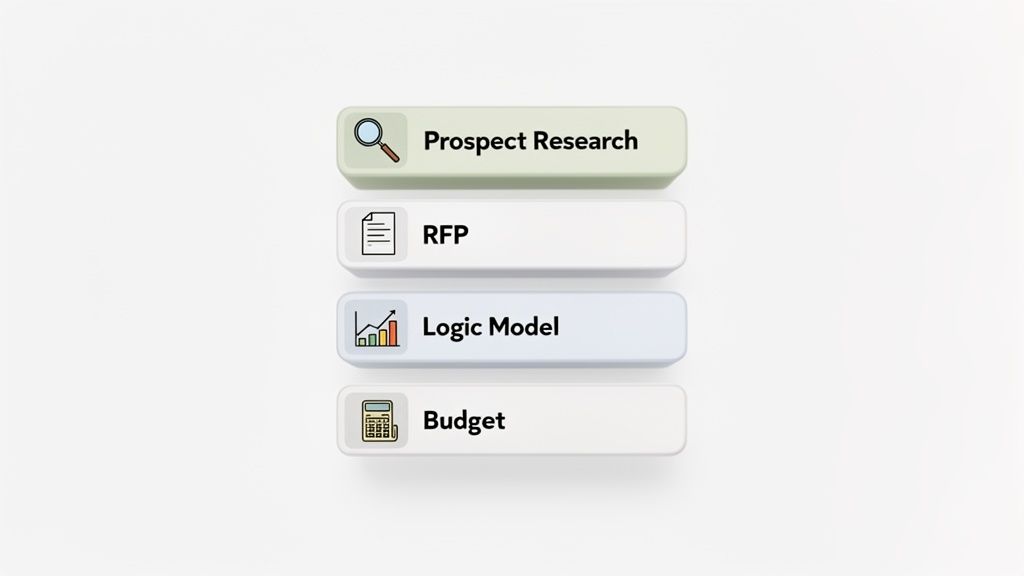
Before you type a single word of a proposal, you have to find the right funder. This is why any worthwhile course dedicates a huge chunk of time to prospect research—the detective work of identifying foundations whose missions truly click with your own.
This is where you learn to solve the #3 challenge for most grant seekers: finding good-fit opportunities. You'll move way beyond simple keyword searches and learn to analyze a funder’s giving history, their core values, and even who they've funded in the past. Think of it as matchmaking for your nonprofit.
A good module will teach you how to get clear answers to critical questions:
- Does this funder typically support organizations of our size and budget?
- How does our project align with their specific, stated priorities?
- Is their average grant award large enough to meet our needs?
From RFP to a Rock-Solid Proposal
Once you’ve found a promising match, your focus shifts to the Request for Proposal (RFP). A solid curriculum teaches you to see an RFP not as a list of tedious rules, but as a strategic roadmap that tells you exactly what a funder wants.
A Request for Proposal is your treasure map. Every requirement, question, and formatting guideline is a clue pointing directly to what the grant reviewer values most. Learning to read it correctly is the key to unlocking funding.
From there, the course will guide you through the building blocks of a truly persuasive proposal. This is where you learn to transform your organization's big-picture goals into a fundable project with concrete, measurable outcomes.
You’ll get hands-on experience with skills like:
- Building a Logic Model: This is a simple visual chart that connects your project activities directly to your outcomes. It shows the funder, in a single glance, how their money will create real-world change.
- Developing a Budget Narrative: This is where you justify every single dollar. You'll learn to craft a budget that tells a story of fiscal responsibility, proving you’re a trustworthy steward of their funds.
- Writing a Persuasive Narrative: Finally, you'll learn to pull everything together. This is the art of crafting a powerful story that makes a clear, compelling, and urgent case for your mission.
How to Choose the Best Grant Writing Course
Let's be honest, searching for a grant writing course can feel like a research project in itself. The options are endless, and it’s tough to tell what's marketing fluff versus what will actually make a difference for your nonprofit. Making the right choice here is critical. It’s the difference between buying a certificate that collects dust and making a strategic investment that brings in serious funding.
Think about it this way: you wouldn't hire an electrician who has only read books about wiring. You want someone who has actually done the work and can prove it. The same goes for grant writing training. You need a program that gets you beyond the theory and into the practical, road-tested skills that win grants.
The best grant writing course doesn't just teach you how to fill out forms; it teaches you how to think like a funder. It demystifies the process, turning you into a strategic partner rather than just another applicant asking for money.
Evaluate the Instructor's Real-World Experience
If there’s one thing to scrutinize, it’s the instructor's background. Are they an academic who mostly teaches, or are they an active grant writer with recent, verifiable wins under their belt? A good teacher is important, but in this field, current, in-the-trenches experience is non-negotiable.
Look for instructors who can talk openly about specific grants they’ve secured—for foundations, corporations, and government agencies. This proves they get the nuances of different funding streams. Their stories about what worked, what failed, and why are infinitely more valuable than anything you'll find in a textbook.
Examine the Curriculum for Depth and Breadth
A solid curriculum needs to cover the entire grant lifecycle, from the initial hunt for funding to the final report after you've won. Be skeptical of courses that only focus on the writing itself. Winning a grant starts long before you ever type the first sentence of a proposal.
A top-tier course should feel like a complete roadmap. Make sure it includes:
- Prospect Research: Does it teach you how to find funders who are a perfect match using professional tools and databases? Our guide on the best grant discovery platforms shows what these powerful tools can do.
- Funder Cultivation: Is there a module on how to build relationships with program officers before you apply? This is a game-changer.
- Proposal Components: Does it give you a deep dive into every section? This means mastering the needs statement, logic model, budget narrative, and evaluation plan.
- Types of Funding: Does it clearly explain the different strategies needed for foundation, corporate, and complex government grants?
As you compare programs, it's also smart to look at the learning technology they use. A quick look at the best platforms for selling online courses can give you a behind-the-scenes peek at the features that create a great user experience.
Compare Learning Formats and Post-Course Support
The "how" of learning is just as important as the "what," especially for busy nonprofit professionals. The format can be the key to your team actually finishing the course and using what they learned.
- Self-Paced Online Modules: This format offers ultimate flexibility, which is great for juggling hectic schedules. The potential downside is that it takes discipline to stay on track without direct feedback.
- Live Virtual Bootcamps: These are more intensive, with set schedules, but you get real-time interaction with the instructor and a community of peers to learn alongside.
Finally, ask this critical question: what happens after the final lesson? The best programs don’t just wave goodbye. They offer ongoing support, like a private community for feedback, office hours with instructors, or a library of updated resources. This post-course safety net is often what turns knowledge into actual funding, giving you support when you're tackling your first real-world proposals.
Your First 90 Days From Training to Submission
Finishing a grant writing course is a huge accomplishment, but that certificate of completion is just your license to start. The real work—and the real success—begins when you translate that classroom knowledge into submitted proposals and, ultimately, funded projects. This 90-day plan is designed to be your roadmap, helping you build momentum from day one.
Think of the next three months as your grant writing residency. You've done the academic work; now it's time to apply those skills in a real-world setting. Each month will build on the last, helping you create a reliable process for bringing in grant revenue for your nonprofit.
Month 1: Laying the Foundation and Finding Prospects
Your first 30 days are all about getting organized and identifying your first targets. It’s tempting to jump right into writing, but a little prep work here will save you a massive amount of time and stress down the road. The goal this month is to build a solid launchpad for a strategic, focused effort.
First things first, go back through your course notes and create a "grant readiness" checklist. Gather all your essential documents in one place: your mission and vision statements, program details, key staff bios, and recent financial statements. You’ll thank yourself later.
Next, it’s time to become a detective. Dive into prospect research, using the methods you learned in your course to find 3-5 high-potential grant opportunities. You're looking for funders whose missions are a near-perfect match for your own. For a quick refresher, our guide on grant writing for beginners is a great resource. Remember, quality over quantity. A few perfect fits are infinitely better than a dozen long shots.
Month 2: Drafting and Development
With a short list of promising funders, month two is dedicated to writing. This is where your new skills really get to shine. Your main objective is to build a master proposal and then use it to draft your very first full application.
Start by creating a master proposal. This isn't for any one specific grant. Instead, it’s a comprehensive, go-to document that contains all the core narrative sections of a typical application: your organization's history, a compelling needs statement, detailed program descriptions, and boilerplate budget info.
A master proposal is like your grant writing pantry. Instead of cooking every meal from scratch, you have all your essential, pre-prepped ingredients ready to go, allowing you to quickly assemble a high-quality proposal tailored to any funder's recipe.
Once your master proposal is ready, pick the best-fit opportunity from your Month 1 research. Use an RFP analyzer, like the one in Fundsprout, to break down the funder's specific requirements. Then, adapt your master document to create a complete, customized first draft.
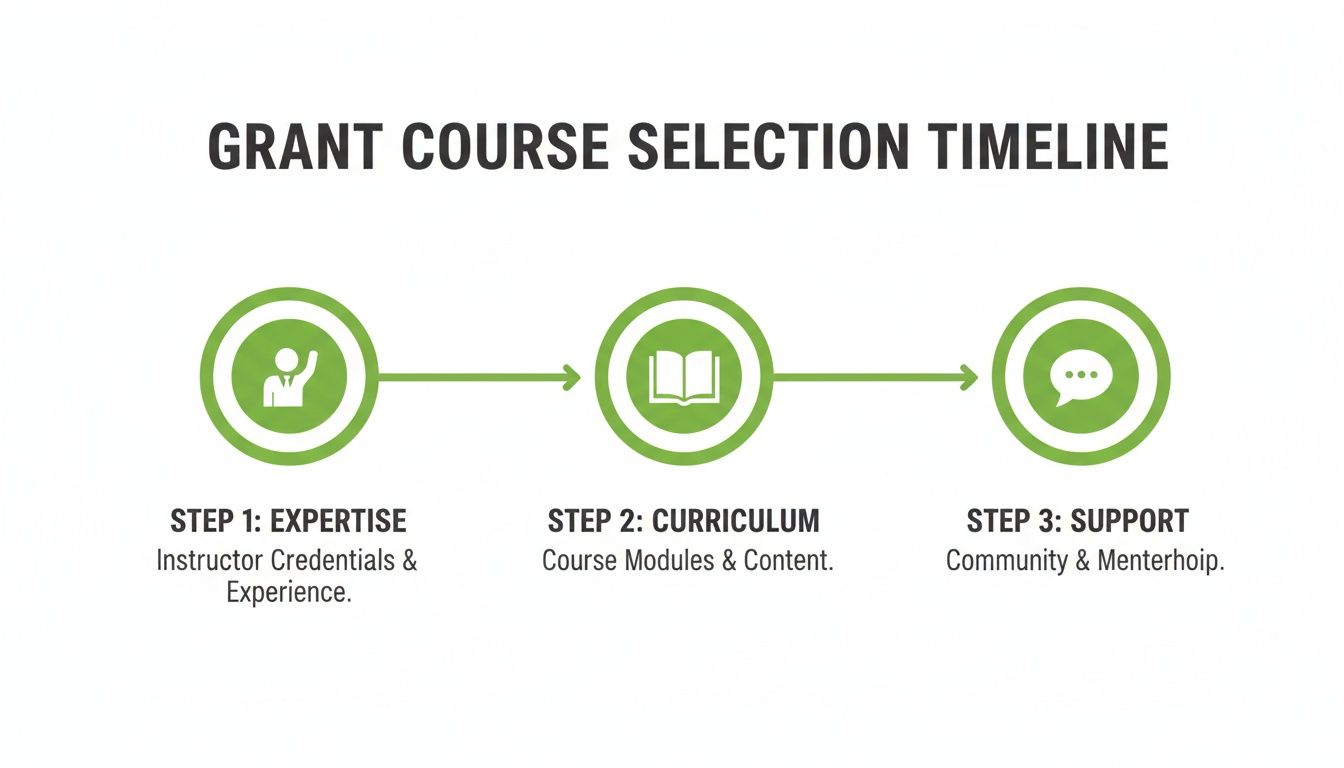
Think of this process like a good course itself—it relies on expert guidance (your research), a solid curriculum (your master proposal), and supportive tools to succeed.
Month 3: Submission and Strategic Follow-Up
The final 30 days are all about hitting "send" and starting to build relationships. Your focus will move from drafting to submitting, following up professionally, and getting a head start on the next cycle.
The month kicks off with one last proofread before submitting the application you drafted in Month 2. But your job isn't over once you send it. Here’s what to do next:
- Confirm Receipt: A day or two after submitting, send a short, polite email to the program officer to ensure your application arrived safely.
- Track Everything: Log the submission in a spreadsheet or grant management tool. Note the date, funder contact, and the deadline for their decision.
- Keep Moving: Don't just sit and wait. Immediately pull up the second funder on your prospect list and start the process all over again. The key to building a healthy grant pipeline is constant momentum.
By following this 90-day plan, you’re doing more than just submitting a grant. You’re building a professional, repeatable system that will deliver value to your organization and set you up for consistent funding success for years to come.
Supercharge Your Skills with AI Grant Writing Tools
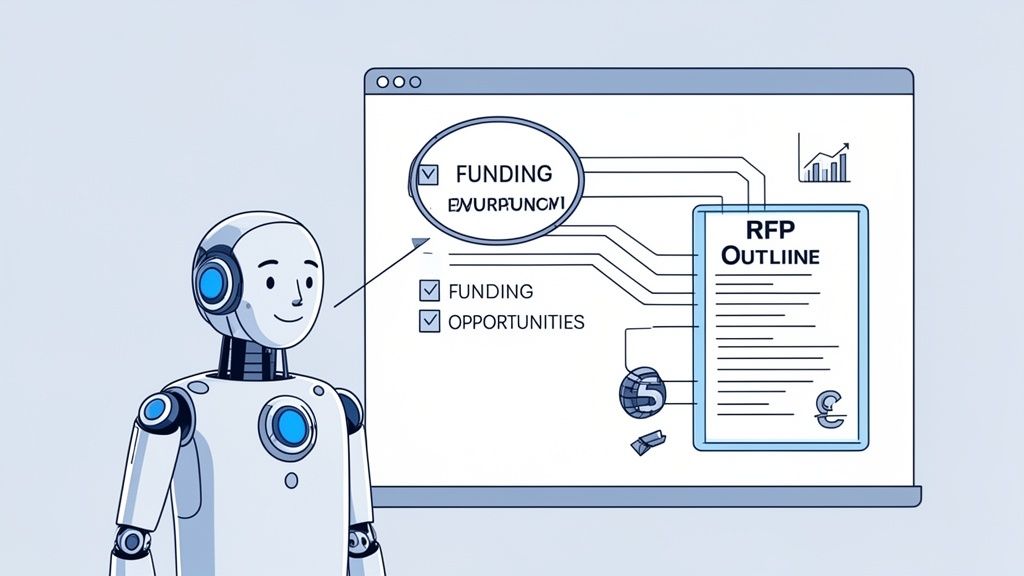
A great grant writing course hands you the strategic playbook. But to really execute that strategy and scale your efforts, you need the right technology. Modern AI tools are a true force multiplier, amplifying the skills you just worked so hard to build. This isn’t about replacing your new expertise—it’s about giving it superpowers.
Think of it this way: your course taught you how to read a map, spot key landmarks, and plan your route. AI tools like Fundsprout essentially give you a high-speed vehicle with GPS. You can cover more ground, far more efficiently than ever before. It's this combination that lets small, nimble teams go toe-to-toe with larger, better-resourced organizations.
These tools are exploding in popularity because they solve a very real problem. The global grant management software market was valued at $3.07 billion in 2025 and is projected to hit an incredible $8.09 billion by 2035. That growth is being fueled by a huge spike in grant funding and the urgent need for nonprofits to work smarter. You can read more about how technology is shaping the grant funding landscape to get the full picture.
Turn Prospecting Theory into Instant Action
Remember all those criteria your course taught you for finding the perfect funder? You learned how to meticulously analyze a foundation’s giving history, geographic focus, and typical award size. Now, imagine applying that knowledge not to one funder at a time, but to thousands in a matter of seconds.
That’s exactly what AI-powered prospect research does. You feed the platform the strategic criteria you learned in your course, and it scans a massive database of opportunities to serve up a prioritized list of your best matches.
- Strategic Alignment: The system automatically pinpoints funders whose mission perfectly aligns with your programs.
- Capacity Matching: It identifies grantors that consistently fund organizations of your budget size, so you aren’t wasting time on applications where you’re too small (or even too big).
- Eligibility Screening: AI instantly sifts through detailed eligibility rules, saving you hours of manually reviewing RFPs that were never going to be a good fit.
From RFP Analysis to Instant Outlines
One of the most valuable skills you gain from any grant writing course is learning how to dissect a Request for Proposal (RFP). You learned to see it as the funder’s blueprint. An AI-powered RFP analyzer takes this skill and puts it on overdrive.
You simply upload the RFP, and the tool instantly transforms that dense document into a structured, actionable outline for your proposal. It breaks down every question, requirement, and word limit into a clear project plan.
AI doesn't write the grant for you; it builds the scaffolding so you can focus on the architecture. It handles the tedious structural work, freeing you up to craft a compelling narrative—the parts that absolutely require your human expertise.
This ensures you never miss a critical instruction, which is one of the most common—and frustrating—reasons for an early rejection. Our article on how to use AI for grant writing dives deeper into this process.
Draft Compelling Narratives with an AI Assistant
Your course taught you the principles of persuasive storytelling—how to construct a powerful needs statement and clearly articulate your impact. An AI writing assistant is the perfect tool to help you apply those principles with incredible speed.
By feeding it your organization's key documents—past proposals, annual reports, and program data—the AI learns your unique voice and mission. From there, it can generate solid first drafts of core narrative sections. Beyond grant-specific tools, understanding the broader applications of AI for content creation can dramatically improve your entire writing workflow.
This technology helps you conquer the dreaded blank page. It lets you spend your valuable time where it matters most: refining, editing, and adding the strategic insights that only a skilled grant writer can provide.
Your Next Steps Toward Grant Writing Mastery
You’ve finished your course, and the certificate is in hand. That’s a huge accomplishment, but it’s not the finish line—it’s the starting line. The real work begins now, turning what you've learned in the classroom into real-world funding for your mission.
Think of it like this: grant writing is a cycle. You learn, you do, you see what works, and you refine your approach. The key is to get that cycle spinning immediately while the concepts are still fresh in your mind. Don't let your notes gather dust on a shelf. Taking action now is the fastest way to build the confidence and momentum you need.
Your Immediate Action Plan
So, what should you do first? The best way to bridge the gap between knowing the theory and winning grants is to set a few clear, simple goals for the next 30 days. This is where the rubber meets the road.
Here’s a straightforward plan to get you started:
Submit Your First Practice Grant: Within a month, get one complete proposal out the door. It doesn’t have to be a massive federal grant. In fact, a smaller, local foundation that aligns well with your work is the perfect target. This exercise builds crucial muscle memory and makes the whole process feel less intimidating.
Build a Prospect Pipeline: Use a tool like Fundsprout to find at least 10 solid grant prospects. Put your new research skills to the test and dig for funders whose mission and giving history genuinely match what you do. A healthy pipeline is the bedrock of a stable funding future.
Establish a Tracking System: This is non-negotiable. Set up a simple spreadsheet or use a dedicated tool to log every application. You’ll want to track the funder’s name, submission date, amount requested, and the deadline for their decision. This simple habit is what separates organized pros from stressed-out amateurs.
This kind of focused effort pays off, and quickly. For example, grant writers coming out of specialized training programs hit the ground running. In January 2026 alone, they secured 37 grants worth over $6 million. What's really telling is that a staggering 84% of that money came from family foundations, proving how effective targeted training can be. You can see more on the significant financial impact of skilled grant writers and just how fast this expertise can translate into dollars.
Grant writing mastery isn't a destination you reach after one course. It's built through the steady, strategic application of your skills, one proposal at a time. That first grant you win isn't the end of the journey; it's the first turn of a flywheel that will power your mission for years.
By committing to this 30-day plan, you’re not just finishing a training program—you're launching a powerful, ongoing fundraising strategy. You have the skills. Now it’s time to put them to work.
Frequently Asked Questions About Grant Writing Courses
Thinking about taking a grant writing course? You’ve probably got a few questions rolling around in your head. Whether you’re a nonprofit leader trying to decide if it’s a smart investment or someone wondering if this is a viable career path, you need real answers. Let's tackle some of the most common questions I hear from people just like you.
How Long Does It Take to Get Good at Grant Writing?
This is the big one, isn't it? While a great course can teach you the entire grant writing playbook in a few weeks, becoming truly good at it comes from practice.
It's a lot like learning to cook. You can read a cookbook cover to cover, but you only become a confident cook after you've actually been in the kitchen and made a few meals. Plan on writing and submitting 3-5 full proposals before you really start to hit your stride. That’s where the lessons from a course truly sink in.
For most people, that feeling of confidence and seeing those first wins comes within three to six months of focused work. Of course, you can speed this up. Using tools to handle the tedious research and initial drafting lets you pour your energy into crafting a compelling story.
Are Free Grant Writing Courses Worth the Time?
Free courses can be a fantastic way to test the waters. They’re perfect for learning the basic lingo and getting a feel for the process. Think of it as a no-risk way to decide if grant writing is something you genuinely want to pursue.
But for any organization that's serious about winning major funding, a paid course is a much smarter move.
A free course is like getting a map, which is helpful. A paid course is like hiring an experienced guide who knows all the shortcuts, dangers, and hidden gems along the trail. The investment often pays for itself with the very first grant you win.
Paid programs bring things to the table that free resources just can't match:
- Expert Feedback: Getting direct input on your work from someone who has won millions in grants is invaluable.
- Proven Templates: You get access to outlines and examples that are road-tested and have a track record of success.
- Networking: You're introduced to a community of peers and mentors who can offer support, advice, and collaboration opportunities for years to come.
Can I Learn Grant Writing if I Am Not a Strong Writer?
Yes, absolutely. This is one of the biggest myths out there, and it keeps a lot of talented people from even trying. Grant writing isn't about writing beautiful, poetic prose; it’s about technical skill and clear communication.
A good course will teach you a step-by-step formula that you can apply to any proposal. The skills that really matter are:
- Following instructions to the letter.
- Building a logical and persuasive argument.
- Presenting information and data clearly and simply.
Think of it this way: a funder is reading dozens, if not hundreds, of proposals. They don't want to be dazzled by your vocabulary. They want to quickly understand what the problem is, how you plan to solve it, and what it will cost. In grant writing, clarity and precision always beat fancy but unfocused writing. If you can explain an idea clearly and follow a checklist, you have what it takes to be a great grant writer.
Ready to turn your new skills into a powerful funding engine? Fundsprout is the AI-powered platform that helps you find perfectly matched funders, create structured proposals in minutes, and manage your entire grant lifecycle. Stop searching and start winning. Explore Fundsprout today.
Try 14 days free
Get started with Fundsprout so you can focus on what really matters.