Grant Scoring Rubric: A Guide to Fairer Funding Decisions
Build a fair and effective grant scoring rubric. Our step-by-step guide helps nonprofits design, weight, and implement rubrics to make better funding decisions.

Abdifatah Ali
Co-Founder
You probably have a rubric draft in a spreadsheet right now. The columns look tidy. The criteria seem reasonable. Then a significant problem emerges: one reviewer gives a proposal a near-perfect score because the mission fit feels strong, another tanks it because the evaluation section is thin, and your committee meeting turns into a debate about instincts instead of evidence.
That's where most grant scoring processes break. Not at the template stage, but at the point where humans have to interpret it.
A good grant scoring rubric doesn't just list criteria. It translates your strategy into repeatable decisions. It tells reviewers what matters most, how much it matters, and what proof earns a high score. If it's working, it protects applicants from arbitrary swings and protects your team from hard-to-defend funding decisions.
The Foundations of a Fair Grant Scoring Rubric
Structured scoring became standard for a reason. Grant scoring rubrics emerged in the 1970s as funders like the National Science Foundation sought to reduce arbitrariness, and analyses have shown they can reduce disagreement among reviewers by up to 30 to 40% compared with unstructured comments alone, leading to more defensible funding decisions, according to this published review of grant evaluation systems.
That history matters because plenty of organizations still treat the rubric as administrative paperwork. It isn't. It's governance. If your committee wants fair decisions, consistent reasoning, and a clear record of why one proposal advanced and another didn't, the rubric is the tool that holds that process together.
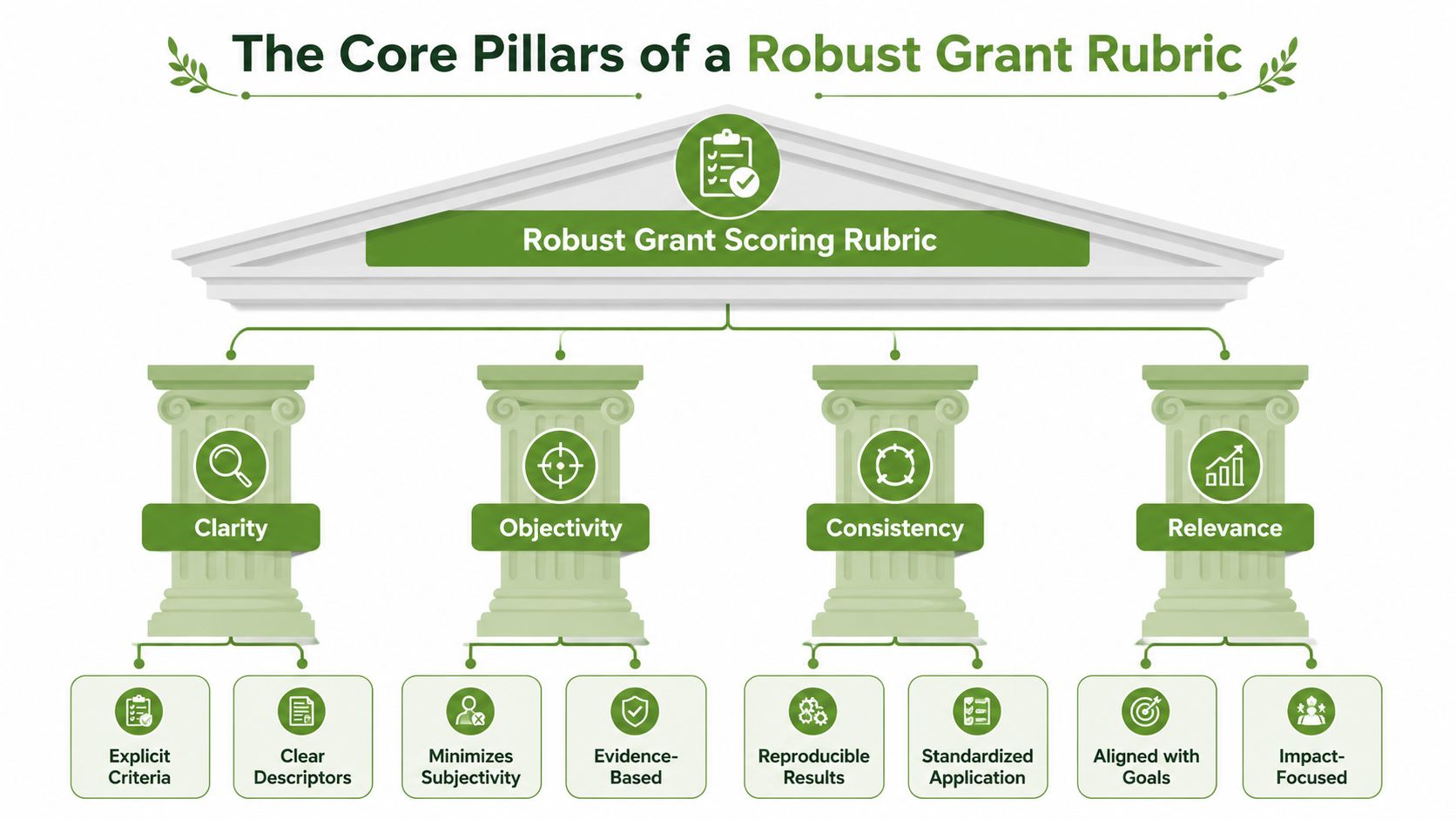
Four parts every rubric needs
A strong rubric has four essential building blocks:
Clear criteria
Reviewers need to know exactly what they are judging. “Impact” is too vague on its own. “Impact on the target population within the grant period” is better.A defined scoring scale
Pick a scale and stick to it. Whether you use 1 to 5, 1 to 10, or weighted bands, reviewers need a shared scoring language.Descriptive performance levels
Numbers without descriptors invite improvisation. A score of 4 should mean something concrete, not “pretty good.”Strategic weighting
If everything is worth the same, you've told reviewers that everything matters equally. That's almost never true.
What fairness actually looks like
Fairness doesn't mean every proposal gets the same style of praise or criticism. It means every proposal is judged against the same published expectations. It also means your organization is honest about what it values.
Practical rule: A rubric should help a reviewer explain a score with evidence from the application, not personal preference.
That's also why governance documents around reviewer behavior matter. A clean scoring process falls apart quickly if panelists have unmanaged relationships with applicants, so your rubric should sit alongside a clear conflict of interest policy for nonprofits.
The difference between a checklist and a decision tool
A flimsy checklist asks, “Did they include a budget?” A real rubric asks, “Does the budget align with the work plan, staffing, and stated outcomes?”
That distinction changes committee behavior. Checklists reward completion. Rubrics reward fit, feasibility, and evidence. When teams miss that difference, they often end up funding polished applications instead of fundable projects.
Designing Your Scoring Criteria and Scale
Most funders use a familiar backbone. A 2016 analysis of major funders found 92% used at least a three-criterion rubric, typically covering need or alignment, capacity or feasibility, and impact or evaluation, and the weight of evaluation and outcomes now averages 22% of total points, reflecting stronger expectations for measurable results, as summarized in this analysis of funder rubric design.
That doesn't mean you should copy a generic template. It means you should start with the core categories reviewers already understand, then define them in a way that reflects your program strategy.
Start with funding decisions you actually want to make
Before drafting criteria, ask your team a harder question: what should win this cycle?
A youth-serving nonprofit launching a pilot program may care most about community need, implementation readiness, and trust with families. A family foundation renewing multi-year partners may care more about results, financial stewardship, and learning capacity. Same sector. Different rubric.
Use prompts like these in a planning meeting:
- Mission fit: Does this proposal advance the outcomes we exist to fund?
- Applicant fit: Are we trying to support established implementers, emerging organizations, or a mix?
- Risk posture: Are we comfortable funding innovation with execution risk, or do we need proven delivery?
- Evidence expectations: What proof is reasonable for this grant size and applicant type?
Turn broad themes into scoreable criteria
Avoid criteria that sound good but can't be scored consistently. “Strong leadership” tends to produce subjective comments. “Demonstrated ability to manage similar projects, partnerships, or compliance requirements” gives reviewers something to look for.
Here's a practical test. If two reviewers read the criterion and would likely look for different evidence, rewrite it.
A few examples:
Too broad: Impact
Better: Clarity of intended outcomes and plan to measure themToo soft: Capacity
Better: Staffing, partnerships, and operational readiness to deliver the projectToo generic: Need
Better: Alignment with target population and evidence the project responds to a defined community need
Reviewers score faster and more consistently when each criterion points to observable evidence in the application.
Build a scale that removes guesswork
A 1 to 5 scale works well for many committees because it gives enough range without inviting false precision. The key is defining what each anchor means in plain language.
Use your midpoint carefully. “3” should mean the proposal meets expectations, not “average” in a dismissive sense. Low scores should reflect meaningful weaknesses. High scores should require specific strengths.
If your team wants a head start, the structure used in many Orbit AI evaluation forms is useful for thinking through how prompts and response formats shape reviewer behavior. The lesson is simple: clear prompts produce cleaner scoring data.
Sample Grant Scoring Rubric Template
| Scoring Criterion | Weight (%) | Score: 1 (Weak) | Score: 3 (Meets Expectations) | Score: 5 (Excellent) |
|---|---|---|---|---|
| Alignment with funding priorities | 20 | Proposal is loosely connected to stated priorities or misses the target population | Proposal addresses stated priorities and target population adequately | Proposal is tightly aligned to priorities and clearly serves the intended population |
| Community need | 15 | Need is asserted but not well supported | Need is clearly described and reasonably supported | Need is compelling, specific, and well connected to the proposed response |
| Organizational capacity | 20 | Staffing, partnerships, or systems appear insufficient | Organization shows adequate capacity to deliver the work | Organization demonstrates strong readiness, relevant experience, and clear implementation roles |
| Project design and feasibility | 20 | Activities are unclear, unrealistic, or poorly sequenced | Activities are logical and feasible within the grant period | Activities are coherent, well paced, and strongly matched to goals and timeline |
| Outcomes and evaluation | 15 | Outcomes are vague or measurement plan is weak | Outcomes are defined and paired with a workable evaluation plan | Outcomes are specific, measurable, and supported by strong indicators, baseline thinking, and clear methods |
| Budget alignment | 10 | Budget is confusing or disconnected from activities | Budget is reasonable and mostly aligned to the work | Budget is clear, credible, and tightly matched to implementation |
Write descriptors before scoring applications
Don't wait until review week to define what “excellent” means. Put the descriptor language in the rubric itself, then connect it to your evaluation framework. If your applicants struggle with that step, a simple logic model for program evaluation can help reviewers and applicants alike connect activities, outputs, and outcomes.
That's the point where the rubric starts doing real work. It stops being a form and becomes a common standard.
Weighting Scores to Reflect Your Priorities
The biggest mistake I see in rubric design is treating weighting like a technical cleanup step. It isn't. Weighting is where your organization admits, on paper, what matters most.
A weak rubric says all criteria are equal because it's easier. A useful one forces a strategic choice. If you say innovation matters but assign it the same value as budget formatting, your scoring process is telling the truth about your priorities, even if your guidelines are not.
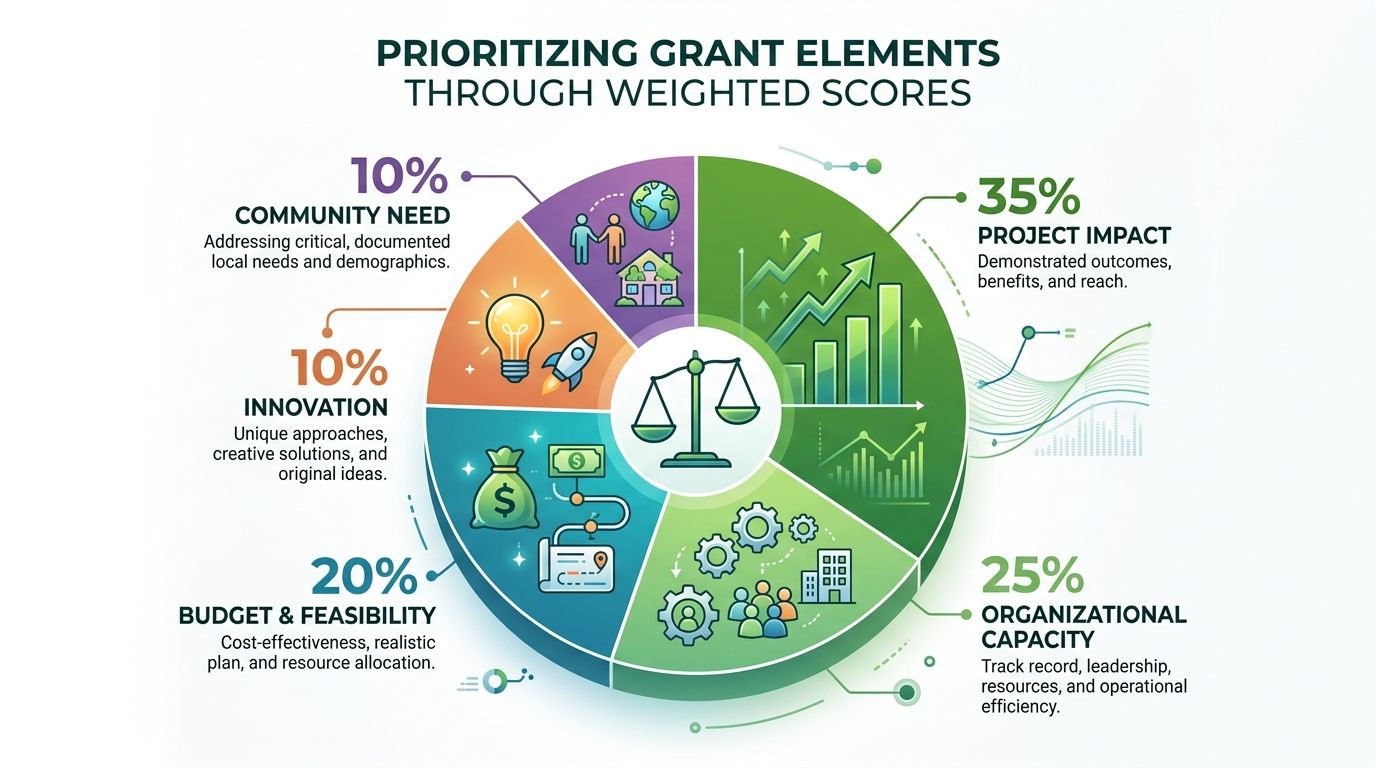
Weight what you can defend in the room
One study found that adding explicit weighting and descriptive labels for each score band reduced inter-rater variability by 20 to 30% while improving applicants' perception of fairness, according to this grant review design guidance.
That finding lines up with practice. When reviewers know that outcomes count more than presentation quality, they spend their energy in the right place. When they don't, they invent their own weighting privately.
Here's a simple weighting conversation that works:
- Ask what this grant round is for. A pilot fund should score differently from a renewal fund.
- Separate mission-critical from nice-to-have. If a criterion wouldn't change a funding decision, it shouldn't carry major weight.
- Test the edge cases. Would your weighted rubric favor a highly groundbreaking but operationally fragile applicant, or a steady implementer with modest ambition? Decide intentionally.
A documented annual strategy can make this easier. If your grantmaking is tied to a board-approved plan of record, weighting can flow from priorities instead of committee politics.
A useful example of how weighting changes outcomes
Take two hypothetical applicants.
Applicant A has deep community roots, strong delivery capacity, and a realistic budget. The project is practical, not novel.
Applicant B presents an exciting idea with strong narrative energy, but the implementation plan is thinner.
If your weights lean toward innovation and broad promise, Applicant B may rise. If your weights lean toward capacity, feasibility, and measurable outcomes, Applicant A may win. Neither result is automatically right. The problem is when your committee gets one outcome while believing it designed for the other.
This visual shows how one organization might distribute emphasis across criteria.
Keep the math simple
You don't need a complex formula. You need a weighting model that reviewers can understand at a glance and staff can explain to applicants if challenged.
If a reviewer can't tell, in under a minute, what deserves the most attention, the weighting scheme is too muddy.
A good weighting system makes trade-offs visible before the scoring starts, not during the appeals process.
Implementing Your Rubric and Training Reviewers
A rubric only becomes real when your reviewers use it the same way. That usually doesn't happen by accident.
I've seen committees with smart, mission-driven people score the same application in completely different ways because they were answering different questions in their heads. One reviewer scored aspiration. Another scored execution. A third scored writing quality. The fix wasn't a new spreadsheet. It was calibration.
What a calibration session should look like
Take one sample proposal before the formal review begins. Ask every reviewer to score it independently using the actual rubric. Then discuss each criterion out loud.
The useful moment is not agreement. It's disagreement with evidence.
One reviewer says the evaluation plan deserves a high score because outcomes are named clearly. Another says it should score lower because there's no baseline, no measurement method, and no clear data collection plan. That discussion trains the committee to distinguish between a well-written intention and a scoreable plan.
Why this matters when margins are tight
Typical grant success rates cluster around 43 to 46%, and applications with baseline data and a dedicated evaluation section consistently score 10 to 20 percentage points higher on average, while weak evaluation plans often sink otherwise strong proposals, according to this grant success rate and evaluation guidance.
That means a calibration session shouldn't be abstract. It should center on the kinds of differences that change funding outcomes.
Use a reviewer guide that covers at least these points:
- What each criterion is meant to capture
- What evidence should count
- What should not influence scoring, such as writing style if it isn't part of the published rubric
- How to handle missing information
- When to leave a comment for staff follow-up
A score is only useful if another reviewer could read the same application, apply the same rubric, and understand why that score was given.
Train for interpretation, not just compliance
Most reviewer orientations spend too much time on deadlines and portals and not enough time on judgment. The better approach is to rehearse the judgment.
Ask questions like:
- What does “organizational capacity” mean for a first-time applicant?
- How should a reviewer score qualitative evidence when hard outcome data is limited?
- When does a lean budget look efficient, and when does it look underbuilt?
Once reviewers have worked through those scenarios together, the final committee meeting gets shorter, calmer, and more focused on actual trade-offs.
Avoiding Common Scoring Pitfalls and Biases
Most organizations assume bias shows up as obvious favoritism. In grant review, it's usually subtler than that. It hides inside terms like “readiness,” “professionalism,” “capacity,” and “confidence.”
That's why a fair grant scoring rubric can still produce unfair outcomes. The document may look neutral while the scoring behavior isn't.
The bias problem many committees miss
A 2023 survey found that 60% of community foundation panelists admitted they downgrade applications from organizations with sparse quantitative data, creating a hidden penalty for smaller or newer nonprofits. The same source reports that while 78% of public funders now include an equity criterion, only 35% provide rubric-specific examples of what a high-scoring response looks like, as noted in this equity-focused rubric discussion.
That combination is rough on applicants. Reviewers say they want equity. The rubric says equity matters. But the actual scoring still rewards the organizations that already know how to package evidence in familiar ways.
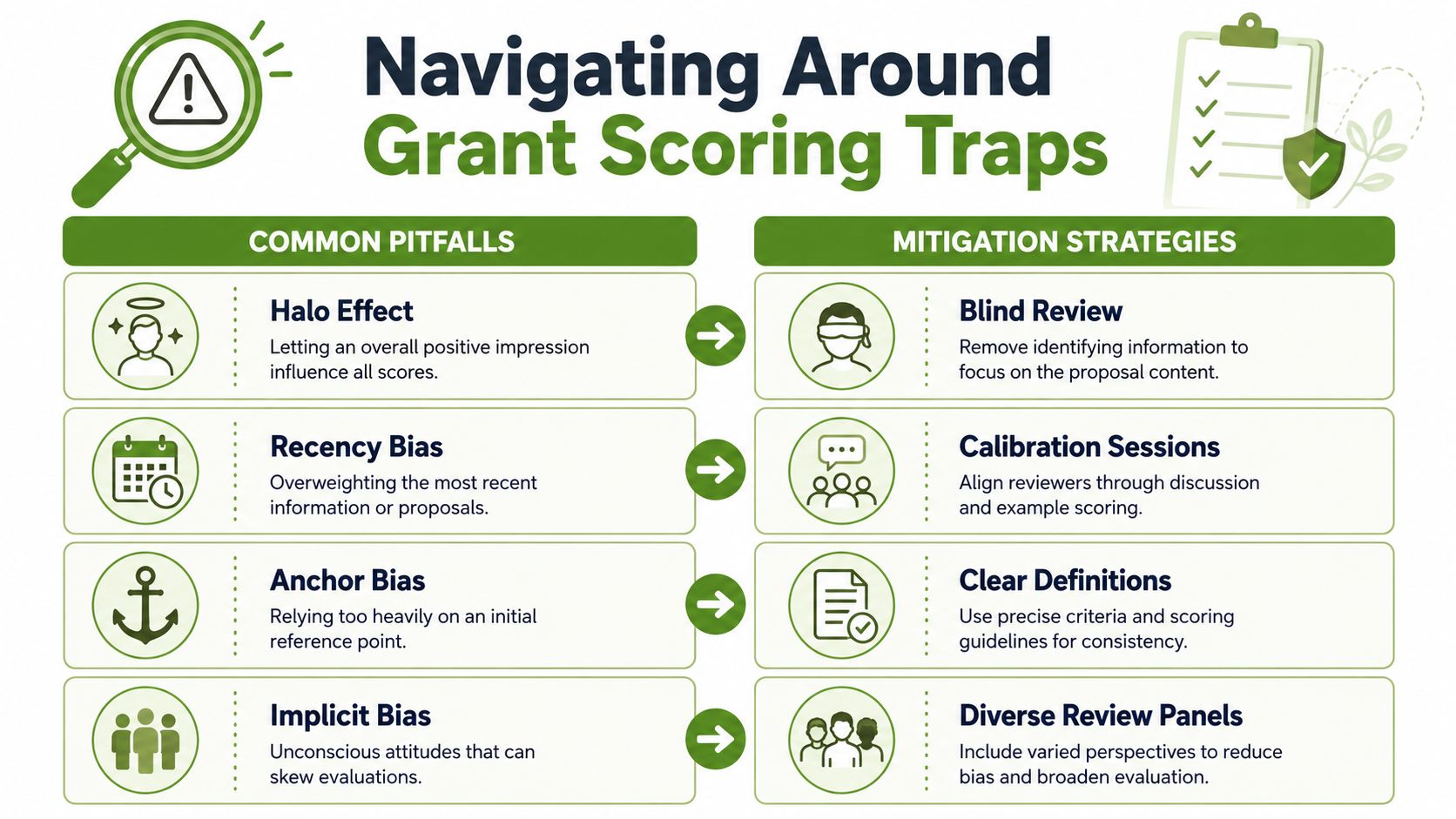
Four common traps
Halo effect
A reviewer likes the mission, the executive director, or the applicant's reputation, so high marks spill into unrelated categories.
Fix: Score criterion by criterion, not applicant by applicant. Require written justification for unusually high or low scores.
Central tendency bias
Some reviewers avoid the ends of the scale and give mostly middle scores. That blurs distinctions that the committee needs to make.
Fix: Define what a top score requires. If “5” feels unreachable, your descriptors are too vague or too strict.
Anchor bias
The first proposal a reviewer reads becomes the mental reference point for all others.
Fix: Randomize application order when possible and use calibration samples before live scoring begins.
Implicit bias against small or emerging nonprofits
Reviewers may treat polished infrastructure as a proxy for effectiveness, especially when community impact is qualitative or locally rooted.
Fix: Rewrite criteria so they don't confuse scale with strength. Ask whether the organization has the capacity appropriate to the proposed work, not whether it resembles a larger institution.
Equity criteria need operational definitions
A lot of rubrics now include language about underserved communities, geographic equity, or reducing disparities. That's not enough if reviewers don't know what evidence counts.
Instead of scoring “commitment to equity,” score elements that can be observed:
- Community connection: Does the proposal show direct knowledge of the population served?
- Barrier awareness: Does the applicant explain who lacks access and why?
- Responsiveness: Are activities designed around those barriers?
- Outcome tracking: Will results be understood across relevant groups without flattening differences?
Equity scoring fails when reviewers reward language fluency instead of community-grounded evidence.
Build structural safeguards
Bias training helps, but design choices matter more. Put fairness into the process itself.
| Pitfall | Structural fix |
|---|---|
| Reputation-driven scoring | Use partial blind review where feasible |
| Inconsistent interpretation | Run calibration sessions and refresh them each cycle |
| Overvaluing polished narratives | Tie scores to evidence prompts and required fields |
| Penalizing newer applicants | Separate organizational maturity from project feasibility |
| Vague equity scoring | Add examples of strong, moderate, and weak responses |
The hard truth is that many rubric problems are design problems wearing the mask of reviewer judgment. If you want different outcomes, change the scoring conditions, not just the training slides.
Automating and Tracking the Review Process
Once your rubric is solid, manual administration becomes the next weak point. Spreadsheets get version conflicts. Review comments end up in inboxes. Staff spend hours reconciling scores instead of analyzing them.
A better setup centralizes the rubric, the applications, and the reviewer workflow in one place. That gives you weighted score calculations, deadline tracking, reviewer progress monitoring, and a cleaner audit trail. It also makes it easier to spot patterns, such as one reviewer scoring far outside the group or one criterion generating repeated confusion.
For smaller teams, even improving the intake and routing process helps. If your review operation still depends on staff forwarding files manually, this guide to automating workflows from your Gmail inbox offers a practical starting point for reducing handoffs and missed messages.
This is also where a platform like Fundsprout can fit operationally. It helps teams surface funder criteria, structure proposal work around those requirements, and keep application materials organized from drafting through submission and reporting. The value isn't replacing judgment. It's making sure the judgment happens inside a process your team can operate effectively.
A fair review process takes more than a template. It takes strategy, calibration, and systems that hold up under pressure. If your team wants a more organized way to align applications with funder criteria, manage proposal development, and keep grants work moving from opportunity search to renewal, Fundsprout is built for that kind of workflow.
Try 14 days free
Get started with Fundsprout so you can focus on what really matters.