Grant Management Software Nonprofits: The Essential Guide
Discover how grant management software nonprofits can streamline funding, boost efficiency, and amplify your mission, your essential guide.

Abdifatah Ali
Co-Founder
At its heart, grant management software is a dedicated system built to handle every single part of the grant lifecycle. Think of it as moving from a jumble of spreadsheets, sticky notes, and calendar alerts to a single, unified command center for all your grant-related activities.
This software organizes the entire process—from hunting for the right opportunities and writing proposals to tracking progress and filing reports—all in one place. It helps your team save a massive amount of time, avoid costly mistakes, and ultimately, win more funding.
Unlocking Your Mission with Grant Management Software
Picture your nonprofit's grant process as a bustling kitchen during the dinner rush. You have applications sizzling on one burner, reports simmering on another, and deadlines dinging like timers all around you. Without a head chef to direct the chaos, things get burnt. Grant management software is that head chef, bringing calm, order, and efficiency to every step.
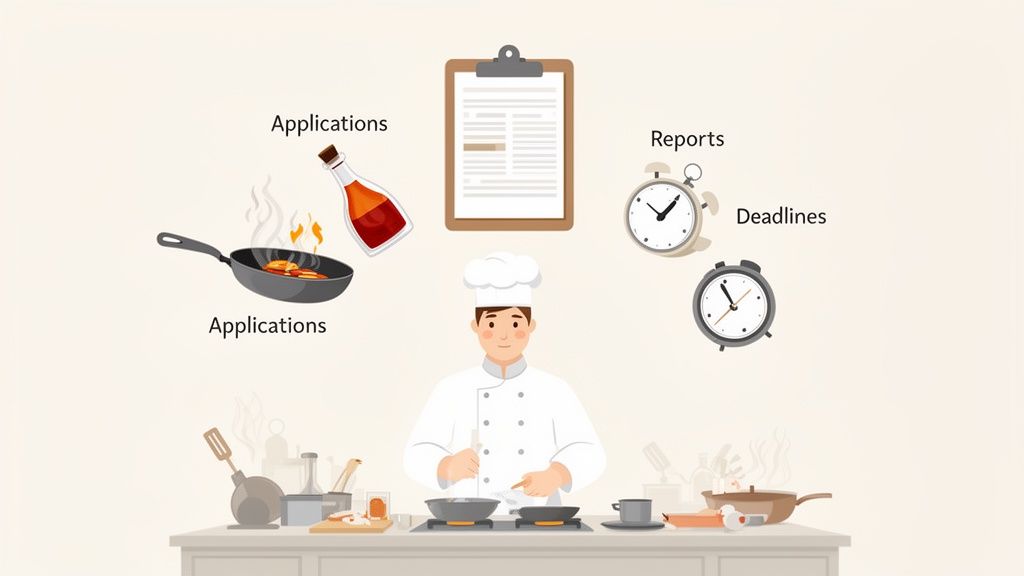
This technology pulls everything together. It takes all those disconnected spreadsheets, packed inboxes, and a dozen different calendars and turns them into a "single source of truth." Your whole team can finally see exactly who is doing what, when it's due, and what the requirements are. No more guessing games.
Moving Beyond Manual Mayhem
For too many nonprofits, especially smaller ones, the "grant system" is just a messy patchwork of manual tools. This approach almost always creates problems that put funding—and your mission—at risk.
- Missed Deadlines: It’s easy for a critical reporting deadline to fall through the cracks when you're just relying on memory or a basic calendar.
- Version Control Nightmares: How many times has someone accidentally submitted an old draft because multiple versions were flying around in emails? It happens.
- Lost Institutional Knowledge: When a grant manager leaves, all their knowledge—stashed away in personal files and their inbox—walks out the door with them.
This kind of friction is exactly what grant management software is designed to eliminate. It creates a structured, secure place where every detail is captured, every document is stored centrally, and every deadline is flagged automatically.
The real job of this software is to get your team out of the administrative weeds. By automating the tedious, repetitive work, it frees up your people to focus on what actually moves the needle: building relationships and delivering on your mission.
The shift toward these systems is happening fast. The global grant management software market was valued at USD 2.78 billion and is expected to hit USD 7.44 billion by 2034. Why the jump? Nonprofits are tired of inefficient processes and are looking for better ways to manage complex grants and prove their impact to funders. For organizations without a full-time grant writer, a good platform can be a complete game-changer. You can explore more about this growing market on Precedence Research.
To see the difference in black and white, let’s compare the old way of doing things with the new.
Manual Grant Tracking vs Grant Management Software
The table makes it clear: moving to a dedicated system isn’t just a small upgrade, it’s a fundamental shift in how your organization operates.
Ultimately, grant management software for nonprofits is much more than just a fancy organizer. It's a strategic investment in your organization's health, stability, and ability to make a lasting impact.
Why Top Nonprofits Are Making the Switch
If you’re a program manager, you know the feeling. Your desk is buried under stacks of applications and reports. Critical deadlines are screaming at you from three different calendars. And the constant pressure to prove your impact to funders is an ever-present weight.
This isn't a sign that your team is failing. It's the inevitable chaos that comes from trying to manage a modern grant lifecycle with outdated, manual systems. When you're juggling spreadsheets, endless email chains, and shared drives, you're not just working hard—you're working against yourself. This is exactly why so many leading nonprofits are finally ditching their makeshift setups for dedicated grant management software for nonprofits.
This isn't just about adopting a new piece of tech. It’s a strategic move to build a stronger, more efficient organization that can focus on what truly matters: the mission.
From Administrative Burden to Strategic Advantage
Making the switch to specialized software directly tackles the biggest headaches in the grant process, turning those daily struggles into real opportunities for growth.
- Boost Your Team's Efficiency: Imagine automating all those tedious, repetitive tasks like data entry and tracking upcoming deadlines. This simple change can free up countless hours, letting your team shift their focus from paperwork to building funder relationships and improving program delivery.
- Make Collaboration Actually Work: Say goodbye to version control nightmares. A central hub means everyone—from the grant writer to the finance team—is looking at the same information. No more digging through emails to find the "latest" draft.
- Nail Your Compliance and Reporting: With every document, email, and data point in one place, pulling a report for a funder becomes a quick, painless process. This dramatically lowers the risk of compliance mistakes that could put your funding in jeopardy.
This shift helps your entire staff get a handle on their day-to-day work, making everything run more smoothly.
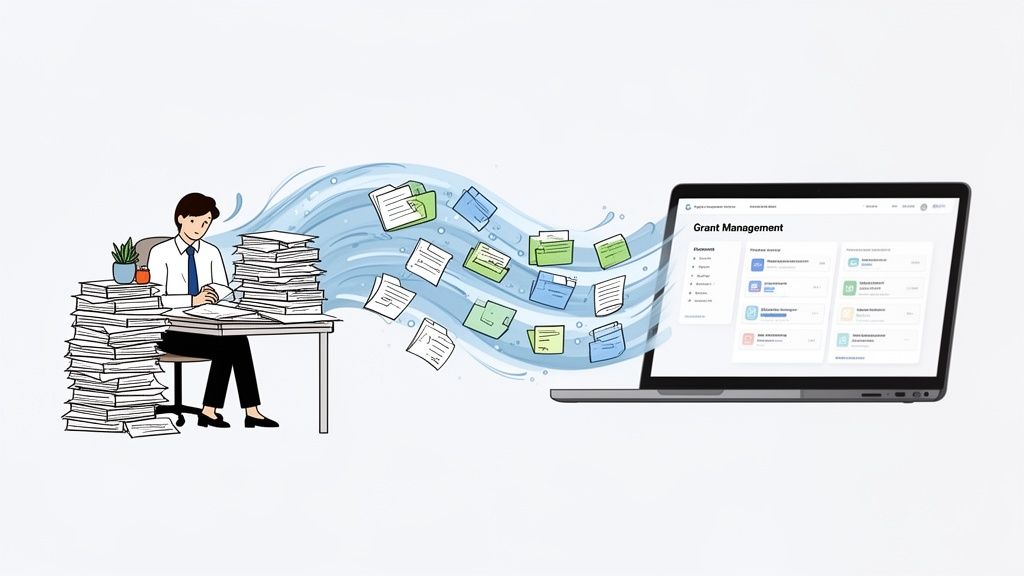
The image above really captures the heart of this change: moving from physical clutter to a clean, digital command center.
Unlocking Data-Driven Grant Success
Maybe the single biggest leap forward is how these platforms turn your grant data from a scattered mess into a strategic weapon. Your entire grant history suddenly becomes a roadmap for the future.
With modern grant management software, you get a bird's-eye view of your entire funding pipeline. You can see at a glance which grants you win most often, which funders align best with your mission, and where your proposals are falling short. This kind of insight leads directly to writing better proposals and winning more grants.
The market statistics tell the same story. Nonprofits and NGOs are the dominant force here, making up a massive 58.2% share of the grant management software market. As the funding world gets more competitive, this sector is driving the demand.
The global market, currently valued at USD 2.4 billion, is expected to more than double to USD 5.8 billion by 2034. This explosive growth shows just how essential these tools have become. For an executive director, the ROI is undeniable, especially since cloud-based options make this technology affordable and scalable for nonprofits of any size. You can discover more insights about this growing market on Mordor Intelligence.
Ultimately, making the switch is about setting your organization up to win. It’s an investment that pays for itself by saving time, cutting down on risk, and giving your team the tools they need to secure the funding that makes your work possible.
What to Look for: The Must-Have Features of Grant Management Software
Picking the right software can feel like you're staring at a giant, confusing menu. To cut through the noise, don't just look at a random checklist of features. Instead, think about how the tools support the three main stages of your work: finding grants, writing proposals, and managing the awards you win.
When you frame it this way, you stop looking at technical specs and start seeing how a platform solves the real-world headaches your team deals with every single day.
Stage One: Finding and Vetting Grant Opportunities
Before you can win a grant, you have to find the right one. This first stage is all about pinpointing funders whose mission and priorities truly click with yours. The right software transforms this from a tedious, manual slog into a focused, efficient hunt.
Here’s what you need for this stage:
- A Built-in Grant Discovery Database: Look for a single, searchable database packed with federal, state, and foundation grants. This stops your team from having to bounce between dozens of different websites, pulling all the opportunities into one central hub.
- Smart, Automated Matching: The best systems do more than just list grants. They use your nonprofit’s profile—your mission, location, and specific program areas—to automatically flag the most relevant opportunities. It’s like having a research assistant working around the clock to find your perfect funding match.
- Deep Funder Profiles: A great platform gives you the inside scoop on a funder’s history. You can see who they’ve funded before and for how much, helping you gauge if your organization is a strong fit before you sink hours into writing a proposal.
These tools are all about making sure you spend your precious time chasing grants you actually have a shot at winning.
Stage Two: Writing and Collaborating on Proposals
Once you’ve found a great opportunity, the sprint to write a winning proposal is on. Too often, this is a chaotic mess of coordinating with different people, hunting for documents, and racing against a tight deadline. Good software brings calm to that chaos.
A central place for all your documents and a shared workspace are non-negotiable. Your team needs one source of truth where anyone can find the latest proposal draft, boilerplate text, and supporting files without ever having to ask, "Hey, is this the final version?"
Look for features that make the entire writing process smoother:
- Task Management and Calendars: This is absolutely essential for breaking a massive proposal down into small, doable tasks. You can assign duties, set internal deadlines, and see exactly where things stand so nothing ever slips through the cracks.
- Collaborative Document Editing: Imagine Google Docs, but built specifically for grant writers. It lets multiple people work on the narrative at the same time, leave comments, and track changes, which completely eliminates the nightmare of emailing attachments back and forth.
- A Template and Boilerplate Library: Why start from scratch every time? A solid system lets you save and quickly pull up standard organizational info, past narratives, and staff bios, which can slash your writing time.
Stage Three: Managing Grants and Reporting After You Win
Winning the grant is incredible, but it’s really just the beginning. The post-award stage is where the real work of accountability, compliance, and building a strong relationship with the funder happens. Effective software helps you deliver flawlessly on your promises, protecting your reputation and setting you up for future funding.
This is where the nitty-gritty details really matter. You need tools that can handle budgets, track your progress, and manage reporting schedules with absolute precision.
Here are the key features for post-award success:
- Budget Tracking and Financials: The software should let you build a detailed budget for every single grant, track your spending against it in real-time, and generate financial reports with a few clicks. This level of clarity is vital for staying on track and proving you’re a responsible steward of their funds.
- Automated Reporting Reminders: Missing a reporting deadline is a huge mistake that can damage your relationship with a funder. A core feature of any good system is an automated calendar that pings your team with reminders long before any progress or financial reports are due.
- Compliance and Document Management: Your software needs to be a Fort Knox for all grant-related documents, from the original award letter to the final report. For nonprofits getting federal funding, compliance is everything. Look for software that helps with complex requirements, like those in the OMB A-133 Compliance Supplement. This ensures you're always ready for an audit and can pull up any document a funder asks for.
To make this even easier, we've put together a simple checklist you can use when evaluating different software options.
Essential Grant Management Software Features Checklist
Use this table as a quick reference to ensure any software you consider covers the critical functions needed to support your team through every stage of the grant lifecycle.
By prioritizing tools that align with these core stages, you’ll be well on your way to choosing a platform that doesn't just add another subscription fee, but actively helps you secure more funding and advance your mission.
How to Choose the Right Grant Management Software
Picking the right grant management software is a huge decision for any nonprofit, and it’s one you want to get right the first time. Think of it less like a simple purchase and more like a long-term investment in your organization's ability to win and manage funding. A little strategic thinking upfront can save you from a world of headaches down the road.
The best place to start isn't with a list of vendors, but with an honest look at your own processes. You need to map out your entire grant workflow, from the moment you spot an opportunity to the day you submit that final report.
Where are the bottlenecks? Where do emails get lost, or deadlines get missed? Answering these questions gives you a clear picture of the problems you're actually trying to solve.
Start With an Internal Needs Assessment
Before you even think about watching a demo, get your team in a room. I’m talking about the program managers, development staff, and finance folks who are in the grant trenches every single day. Their perspective is pure gold.
Start a shared document and list every single pain point. Is it a nightmare to track reporting deadlines across a dozen different grants? Do you end up with five different versions of the same proposal narrative? Is it a Herculean task to pull the right financial data for a funder report?
Once you have that list, start prioritizing. Mark the absolute must-haves versus the nice-to-haves. This simple exercise becomes your roadmap, helping you cut through the noise of flashy features you’ll never use and focus on what truly matters.
Key Considerations for Long-Term Success
With your needs clearly defined, you can finally start looking at different platforms. But don’t just get mesmerized by a long feature list. Dig deeper and think about the things that determine if a tool will be a genuine partner or just another frustrating login.
Three things are absolutely critical for any growing nonprofit:
- Scalability: You’re planning to grow, right? Your software needs to be ready to scale with you. Ask vendors how their platform handles more users, more projects, and a higher volume of grant applications. The last thing you want is to outgrow your system in two years.
- User-Friendliness: The most powerful software on the planet is worthless if your team hates using it. If a tool is clunky or confusing, people will find workarounds, and you’ll be right back to managing things in spreadsheets. Always ask for a live demo, and even better, a trial period so your team can get their hands on it.
- Integration Capabilities: Your grant software can't operate in a silo. It needs to play nicely with your other essential systems, like your donor CRM and your accounting software. Smooth integrations prevent the mind-numbing task of double data entry and ensure everyone is working with the same, accurate information.
This diagram shows how the right features support every stage of the grant lifecycle, from finding opportunities to reporting on your impact.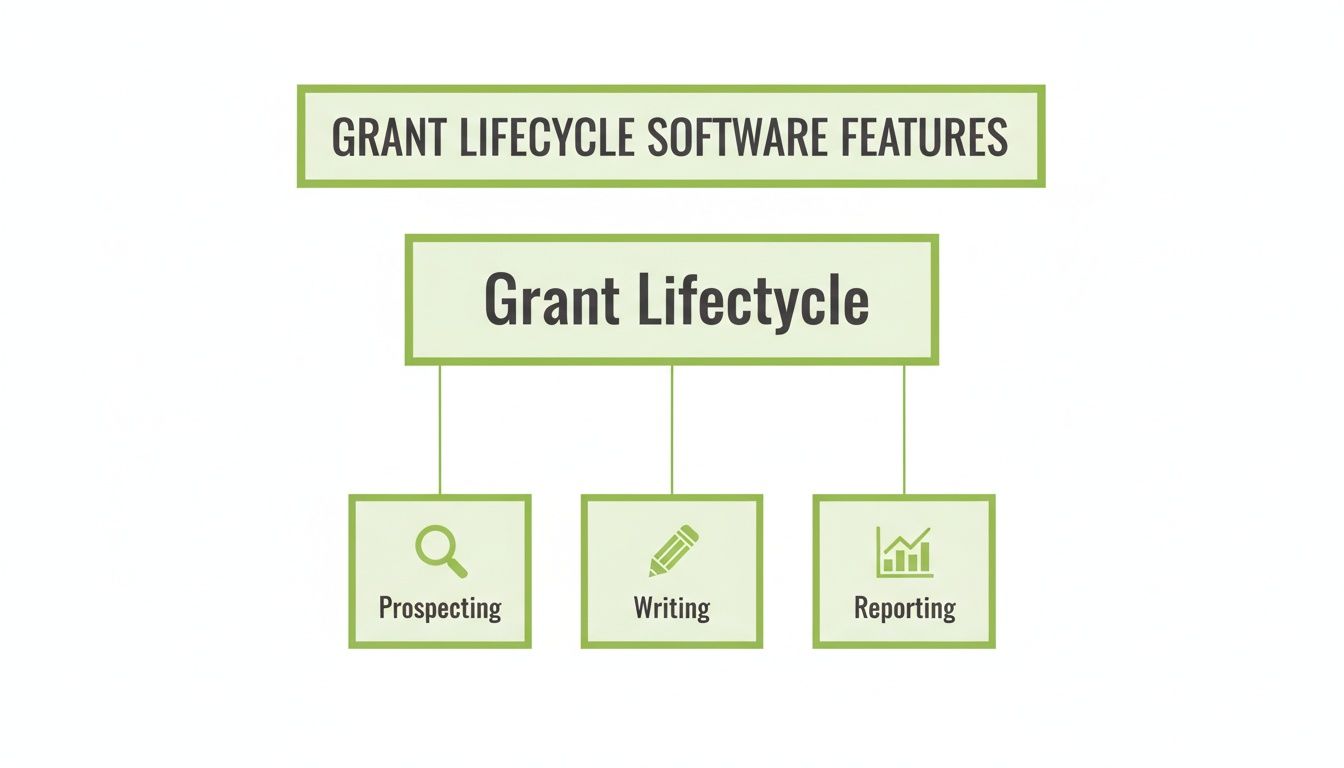
Making sure your chosen tool covers prospecting, writing, and reporting sets your entire grant program up for success.
Budgeting Beyond the Sticker Price
Finally, let's talk about money. It’s crucial to look at the total cost of ownership, not just the monthly subscription fee. As many have learned from the hidden costs of 'free' software, the initial price tag rarely tells the whole story.
When you're building your budget, be sure to ask about one-time setup fees, the cost of migrating your existing data, and any charges for training and ongoing technical support. A platform that seems cheaper at first can easily become more expensive if you have to pay extra for help when you need it most.
By taking the time to assess your real needs, evaluate these key long-term factors, and budget for the full investment, you can choose your software with confidence. For a deeper dive into tools that help with the application process itself, check out our guide to nonprofit grant writing software. This thoughtful approach will empower your team and set your organization up for greater funding success for years to come.
Implementing Your New Software for Maximum Impact
You did it. You picked the right grant management software for nonprofits. But as any seasoned grant professional knows, buying the software is just the first step. The real journey—and the real payoff—starts with implementation.
Think of it like getting a major upgrade for your organization's kitchen. You've invested in top-of-the-line equipment, but those shiny new tools won't produce amazing results on their own. Your team needs to learn the new layout, understand how everything works, and feel confident using it. A smart implementation plan is the training that turns your staff into master chefs, ready to win and manage grants more effectively than ever before.
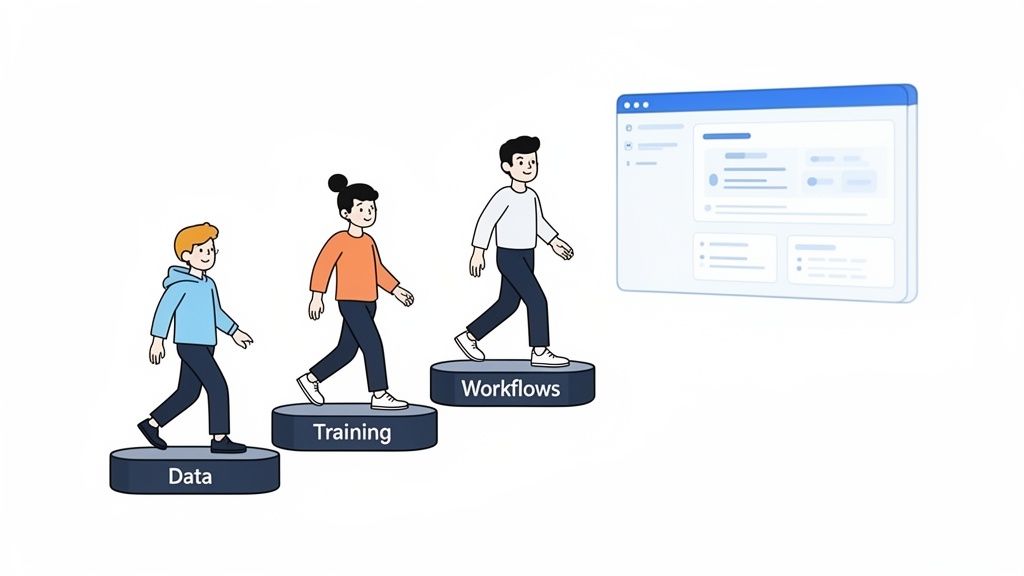
This isn't about just flipping a switch. It's about shifting your entire team's approach from scattered, individual efforts to a cohesive, powerful system.
Phase 1: Your Data Migration Strategy
First things first: you need to move your grant data from its old home—spreadsheets, shared drives, and countless email chains—into your new, centralized platform. This can feel like a huge task, but getting it right is the foundation for everything else. If you just dump messy data into a new system, you’re just creating new problems.
Before you move a single file, take a moment to be strategic. You don't need to bring every single draft or old email along. Think of it as spring cleaning.
Focus on migrating the data that truly matters:
- Funder Information: All your contacts, relationship notes, and giving history.
- Past Submissions: Both the wins and the losses—they're all valuable learning experiences.
- Active Grant Details: Every deadline, reporting requirement, and budget for your current awards.
This initial cleanup gives your team a clean, reliable source of truth from day one.
Phase 2: Team Training and Overcoming Resistance
Here's a simple truth: technology is only as effective as the people using it. One of the biggest obstacles you'll face is the natural human resistance to change. Your team has their routines, even if those routines are clunky and inefficient. The key is to show them this new software isn't just another task on their to-do list; it's a tool designed to make their jobs easier.
"A study of grant managers found that inefficient software systems and staffing limitations are major hindrances to effective grant management."
This perfectly captures the "why" behind your new investment. This software is the solution to those exact frustrations. Frame your training around solving real-world problems. Show them how it ends the frantic search for the latest proposal draft or how it automates deadline reminders.
To get everyone on board, your training needs to be:
- Role-Specific: Your finance director cares about different features than your program managers. Tailor training sessions to what each person actually does day-to-day.
- Hands-On: Don't just talk at them. Set up a "sandbox" environment where everyone can click around, enter test data, and run reports without any fear of breaking something.
- Ongoing: A single training session is never enough. Make sure everyone knows where to find video tutorials, help guides, and support when they have a question a week or a month down the road.
Phase 3: Building New Workflows and Showing Early Wins
Once your data is in and the team feels comfortable, it's time for the final phase: building your new, standardized workflows inside the software. This is the moment you officially retire the old ways of doing things. Document your processes clearly, from how you track a new opportunity to the final sign-off on a grant report.
To keep the momentum going, make a point to highlight early wins. Did the new system save someone 15 hours on compiling a quarterly report? Did an automated reminder prevent a crucial deadline from slipping through the cracks? Share those victories!
These small but tangible successes are what turn hesitant users into true believers. By following a thoughtful implementation plan, you ensure your software investment pays off, transforming your grant operations and freeing up your team to do what they do best: focus on your mission. For more ideas on refining your grant processes, check out these grant management best practices.
The Fundsprout Advantage: How AI Drives Grant Success
Most grant management software is built to keep you organized. That’s a good start, but what if your platform could do more? What if it could actually help you win more funding?
That’s exactly where we designed Fundsprout to be different. We built our platform around artificial intelligence to give your nonprofit a real, strategic edge. It’s not about replacing the incredible expertise of your team; it’s about making them even more effective.
Our AI focuses on the two biggest headaches in the grant world: finding the right funders and writing knockout proposals. By tackling those challenges, we free up your team to do what they do best—building relationships and making an impact.
From Manual Searches to a Curated Pipeline
We all know the grind. Your team spends hours upon hours every month digging through databases, chasing down leads, and trying to find the perfect grant. It's often the single biggest bottleneck in the entire process.
Fundsprout’s AI essentially becomes your in-house prospect researcher, and it never sleeps.
- AI-Powered Prospecting: The system constantly scans thousands of grant opportunities from federal, state, and private foundations.
- Mission-Aligned Matching: More importantly, it learns what your nonprofit is all about—your programs, your location, your goals—and intelligently matches you with funders who are genuinely interested in your work.
The result? You get a ranked pipeline of best-fit opportunities delivered right to you. No more chasing dead ends. You can finally focus your energy on grants you have a real shot at winning.
The dashboard below gives you a glimpse of how Fundsprout turns all that data into a simple, actionable list of priorities.
It immediately shows your team where to direct their attention, ensuring you never miss a high-potential opportunity.
From a Blank Page to a First Draft in Minutes
The second major hurdle? The actual writing. That blinking cursor on a blank document is a familiar sight for any grant writer facing a tight deadline. It can be paralyzing.
Fundsprout’s AI writing assistant changes the entire dynamic. It acts as a partner, analyzing your past proposals and program details to help you generate tailored narrative sections that speak directly to what a funder wants to see.
Think of it as a co-writer that already knows your organization's voice and impact. It helps you build proposals that are not just compliant, but compelling, consistent, and finished in a fraction of the time.
This isn’t just about working faster; it’s about improving the quality of your submissions. If you're curious about how this works, our guide on AI for grant writing dives into the details.
By handing off the heavy lifting to AI, Fundsprout’s grant management software for nonprofits lets your team put their energy into the strategy and storytelling that truly secures funding and moves your mission forward.
Frequently Asked Questions
Jumping into the world of grant management software can feel like learning a new language. You're not alone. Here are the straight answers to the questions we hear most often from nonprofit leaders trying to find the right fit.
How Much Does Grant Management Software for Nonprofits Cost?
This is the big one, isn't it? The truth is, prices are all over the map. You can find some basic tools starting around $50-$100 per month. For more powerful systems, especially those loaded with advanced reporting or AI features, you could be looking at several hundred to over a thousand dollars a month.
Think of it like buying a car—a basic sedan gets you from A to B, but a fully-loaded SUV offers more capacity and features. Most software providers use a tiered model, so you can pick a plan that matches your budget and grow into it. Always ask for a complete cost breakdown; you don't want to get surprised by one-time setup or data migration fees down the road.
Is This Software Difficult for a Non-Technical Team to Learn?
That’s a perfectly fair question. Most nonprofit teams are stretched thin and don't have time for a steep learning curve. The good news is that the best modern platforms are designed specifically for people who aren't tech wizards. They focus on clean, simple dashboards and navigation that just makes sense.
The whole point of good software is to make your life easier, not give you another headache. It should feel intuitive and helpful from day one.
This is why a live demo is a must-have during your search. It’s your chance to see the software in action and get a gut check on whether your team will actually use it. Be sure to ask about their training, onboarding process, and what their customer support is really like.
Can This Software Integrate with Our Donor CRM or Accounting Tools?
Yes, and you should absolutely insist on it. A quality grant management platform should play nicely with the other tools you already rely on, like Salesforce, QuickBooks, or whatever donor CRM you use.
Think of these integrations as bridges that let information flow freely between your systems. This puts an end to the soul-crushing (and mistake-prone) task of manually entering the same data in multiple places. It ensures your grant, donor, and financial data are all telling the same story. Before you sign anything, make a list of your current software and confirm the vendor has solid, direct integrations.
Is Grant Management Software Worth It for a Small Nonprofit?
Absolutely. In fact, you could argue it's even more valuable for smaller teams. When you’re wearing multiple hats and don't have a dedicated grant writer, every minute counts. The time you save by automating the hunt for new grants or tracking deadlines is time you can pour directly back into your mission.
Cloud-based software has made this kind of technology much more affordable than it used to be. Put it this way: the cost of missing just one important grant deadline could easily be more than the software's entire annual fee. It’s an investment in efficiency and sustainability.
Ready to see how AI can give your grant strategy a serious boost? Fundsprout provides the tools to find the right funding, write winning proposals, and manage your awards with confidence. Discover the Fundsprout advantage today.
Try 14 days free
Get started with Fundsprout so you can focus on what really matters.