Funding Opportunities for Charities: A Complete Guide [2026]
Explore all funding opportunities for charities. Our 2026 guide covers grants, donors, and tools like Fundsprout to build a sustainable funding pipeline.
![Funding Opportunities for Charities: A Complete Guide [2026]](https://cdn.prod.website-files.com/68d218aac03c489c1296d334/69e9ceeb770f37b77ce8cd72_funding-opportunities-for-charities-charity-guide.jpeg)

Abdifatah Ali
Co-Founder
If you're leading a charity right now, the pressure usually looks the same. Program needs are growing. Staff time is thin. Someone on the team is maintaining a spreadsheet of deadlines that already feels out of date. You keep hearing that “there’s money out there,” but finding the right opportunities, writing strong applications, and managing the grants you already have can feel like three separate jobs.
That pressure is real. It's also solvable if you stop treating fundraising like a series of isolated asks and start treating it like an operating system.
Navigating the Modern Charity Funding Landscape
The first thing to know is that the funding market is large enough to support disciplined organizations. In 2024, total U.S. charitable giving reached a record $592.50 billion, primarily driven by individuals ($392.45 billion) and foundations ($109.81 billion), according to Kindsight’s fundraising statistics summary. For charities, that matters because it confirms a simple point: the issue usually isn't whether money exists. The issue is whether your organization can consistently identify the right slice of it and pursue it well.
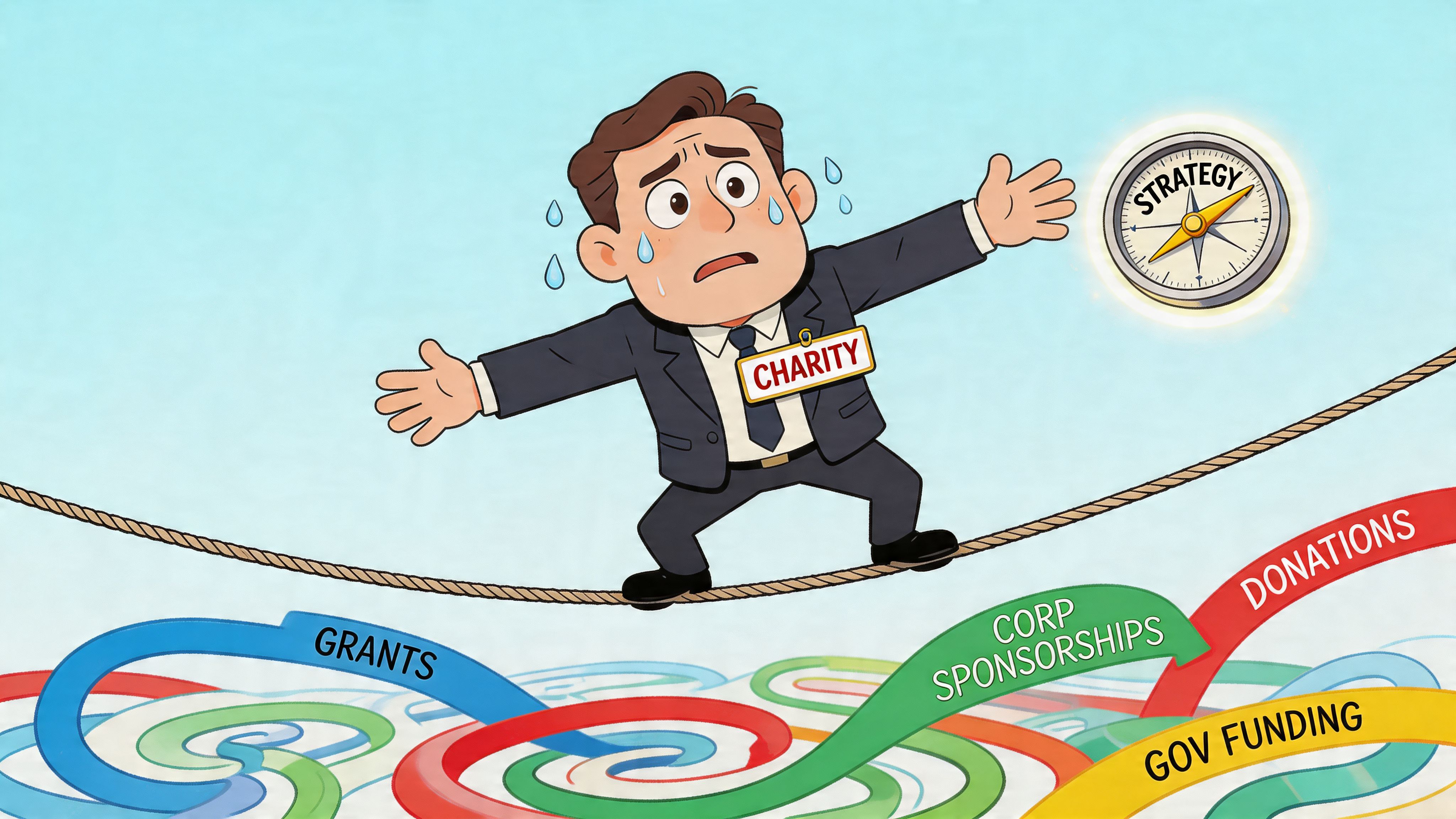
Many leaders still approach funding opportunities for charities as a hunt for a single breakthrough grant, sponsor, or donor. That mindset creates whiplash. One quarter feels flush, the next feels fragile. A healthier approach looks more like pipeline management in sales: build a mix of leads, qualify them, move the strongest ones forward, and track every stage so nothing important slips.
If your team also runs events, peer-to-peer campaigns, or community appeals, this practical guide on How to Fundraise for Charity is useful because it complements grant work with broader fundraising mechanics. And if you're trying to sort through how grants fit into the bigger picture, Fundsprout's overview of funding for nonprofits is a good companion reference.
Practical rule: Funding stability usually doesn't come from one heroic application. It comes from repeatable process.
That process starts with understanding the major funding streams and the trade-offs that come with each.
The Six Primary Streams of Charity Funding
A charity that relies on one source of revenue is operating with avoidable risk. If one major grant ends, one corporate sponsor changes priorities, or one campaign underperforms, the damage reaches staffing, delivery, and planning almost immediately.
A better model is a diversified funding portfolio. Not every stream will fit every organization, and not every stream belongs at the same stage of growth. But most charities are stronger when they combine restricted and flexible income, short-cycle and long-cycle revenue, and relationship-based and transaction-based funding.
Comparison of Charity Funding Streams
| Funding Stream | Primary Source | Typical Scale | Application Complexity | Best For |
|---|---|---|---|---|
| Government grants | Federal, state, and local agencies | Often larger and more structured | High | Organizations with compliance capacity and clear program delivery systems |
| Foundation grants | Private, family, and community foundations | Small to substantial | Moderate to high | Charities with strong mission alignment and clear outcomes |
| Corporate sponsorships | Businesses and CSR teams | Varies widely | Moderate | Events, visibility-driven programs, local partnerships |
| Individual giving | Major donors, recurring donors, annual appeals | Ranges from small gifts to transformational support | Low to moderate | Nearly every charity, especially those with strong storytelling |
| Earned income | Fees, services, products, rentals | Depends on model | Moderate operational complexity | Organizations with mission-aligned expertise or assets |
| Crowdfunding | Online supporters and peer networks | Usually campaign-based | Low barrier, high promotion effort | Time-bound stories, urgent needs, community-led momentum |
Government grants reward control
Government funding can be meaningful for charities that have solid financial systems, documented program workflows, and comfort with formal reporting. These opportunities often come with detailed scopes, fixed requirements, and little tolerance for improvisation.
This stream works well when your charity already knows how to deliver a program at a predictable standard. It works poorly when your model is still evolving or your internal administration is shaky.
Common mistake: chasing a government grant because the award looks large, then discovering too late that the reporting burden is heavier than the team can carry.
Foundation grants reward fit
Foundation funding sits in the middle ground between structured public funding and relationship-driven private philanthropy. It often depends on how well your work aligns with a funder’s priorities, geography, values, and grant history.
For many charities, this is the most practical place to build an intentional pipeline. You can research patterns, review past awards, and decide whether your organization is fundable for that specific institution.
Use resources like Fundsprout's guide to sources of funding for nonprofits to map which funder categories make sense for your mission before you start writing.
Foundation fundraising is less about writing brilliance and more about strategic matching.
Corporate sponsorships depend on mutual value
Corporate support often looks attractive because it can move faster than institutional grants. But companies don't fund in the same way foundations do. Many want visible partnership value, employee engagement, local relevance, or brand alignment.
That doesn't mean you need to commercialize your mission. It means you need to frame the partnership in a way a business can act on. A sponsorship package for an annual event is different from a workplace giving partnership, and both are different from in-kind support.
What works:
- Clear audience access: Show who the company reaches through your work.
- Defined activation: Explain exactly what the sponsor gets, such as event presence or employee volunteering.
- Reputation screening: Decline support that creates mission conflict or community mistrust.
Individual giving builds resilience
Individual donors rarely feel as efficient as grants because the revenue is distributed across many people and campaigns. But this stream often gives charities something institutional funding cannot: flexibility.
When you build recurring giving, major donor relationships, and annual appeals, you create a cushion for core costs, emergencies, and match requirements. Individuals also often become ambassadors, board prospects, and future legacy donors.
This stream is slow to mature if you ignore stewardship. It strengthens quickly when you communicate clearly, thank promptly, and report impact in plain language.
Earned income can support mission, or distract from it
Earned income includes fee-for-service work, ticketed programs, product sales, consulting, rentals, and other mission-aligned revenue activities. It can be valuable because it reduces dependence on external approval.
But it only works when the income model fits your mission and your capacity. Some charities launch an earned income project because unrestricted revenue sounds appealing, then learn they're running a side business that consumes staff attention.
Before pursuing earned income, ask:
- Does this use an existing strength?
- Will staff have to split focus from core delivery?
- Can we explain how this supports mission integrity, not just cash flow?
Crowdfunding is accessible but labor-intensive
Crowdfunding can bring new supporters into your orbit quickly, especially around urgent cases, campaign moments, or highly shareable community stories. The barrier to launch is low. The barrier to traction isn't.
This stream works when you already have a responsive audience and a compelling story. It fails when teams assume posting a page is the same as running a campaign.
Good crowdfunding has rhythm:
- A defined need
- A strong opening story
- Regular updates
- Active sharing by staff, board, and supporters
The strongest charities don't pick one of these streams and ignore the rest. They decide which two or three deserve serious focus now, then build outward from there.
How to Discover Relevant Funding Opportunities
Most charities don't have a funding problem first. They have a discovery problem. The team is either drowning in irrelevant opportunities or missing good ones because nobody has time to search systematically.
The fix is to build discovery in layers. Start simple. Add better research tools when the volume justifies it. Use automation where it removes repetitive screening rather than replacing judgment.
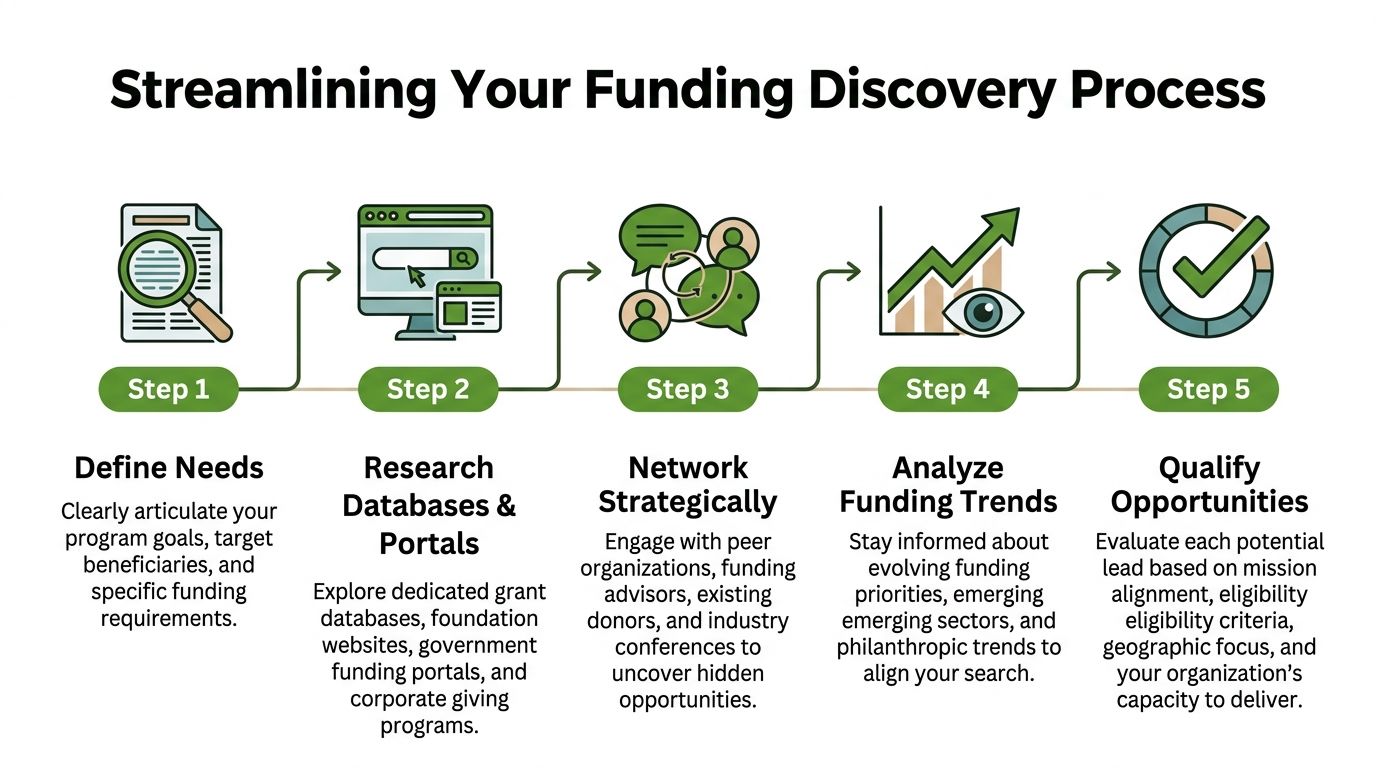
Start with manual discovery
Manual research still matters because it teaches your team how funders describe the work they want to support. Search agency portals, foundation websites, local community foundation listings, association newsletters, and sector-specific roundups.
At this stage, don't just collect links. Capture the core filters that keep your team honest:
- Mission match: Is this about the work you do?
- Geography: Are you eligible where you operate?
- Entity type: Does the funder support your legal structure?
- Program stage: Are they funding pilot, expansion, or ongoing delivery?
- Use of funds: Can the grant cover what you need funded?
Teams often waste weeks on opportunities they were never qualified for. A rough first-pass filter prevents that.
Use databases to uncover the non-obvious
Professional databases become useful when you need more than open deadlines. They let you research patterns. That matters because many of the most promising prospects aren't sitting in a public list waiting for anyone to apply.
According to Instrumentl’s review of grants databases, nonprofits using smart matching algorithms and automated eligibility screening reduce research time by up to 70%, and organizations that apply to 20+ well-matched prospects quarterly have been shown to secure 15-25% more awards. The point isn't volume for its own sake. The point is disciplined volume applied to the right-fit opportunities.
Useful databases and research tools generally help you do four things:
- Search by issue area and geography
- Review past giving history
- Identify giving patterns beyond open RFPs
- Screen out poor-fit prospects before writing begins
If your team is comparing options, this overview of grant discovery platforms can help frame what to look for in a research workflow.
The fastest way to burn out a small development team is to confuse “many opportunities” with “many viable opportunities.”
Add network intelligence
Some of the best leads don't come from databases first. They surface through conversations with peer nonprofits, local funder briefings, consultants, fiscal sponsors, and current donors who know the field.
Ask practical questions, not vague ones. Instead of asking, “Do you know any funders?” ask, “Which funders have recently supported organizations doing this kind of work in this region?” That produces better information.
Networking is also where you pick up context that listings rarely show:
- whether a funder prefers prior introductions
- whether they care more about direct service or systems change
- whether they are open to newer organizations
- whether timing matters more than the posted calendar suggests
Use automation for screening and pipeline creation
Once your team knows what good fit looks like, automation can remove the repetitive parts. Operationally, platforms like Fundsprout provide a solution. It scans federal, state, local, and foundation opportunities, screens for relevance based on your organization profile, and builds a ranked pipeline so staff can spend more time qualifying and drafting rather than searching line by line.
That kind of tool is useful when it helps your team answer one hard question faster: “Which opportunities deserve our limited writing time this month?”
A practical discovery cadence
A working discovery process usually looks like this:
- Weekly scan: Review new opportunities and discard obvious non-fits.
- Monthly qualification session: Rank prospects and decide what moves forward.
- Quarterly portfolio review: Check whether your pipeline is too narrow, too deadline-heavy, or too dependent on one funding type.
Discovery isn't a one-time project. It's ongoing market intelligence. The charities that do it well don't feel less busy. They feel less random.
Assessing Funder Fit and Prioritizing Your Pipeline
Finding opportunities is the easy part. Choosing the right ones is where most charities either become strategic or stay stuck in reactive mode.
Small organizations feel this most sharply. A cited claim in the provided material states that 68% of nonprofits with budgets under $500K miss deadlines due to poor pipeline management, highlighted in the referenced Compassion Capital Fund catalog source. Whether your team calls it pipeline management or just “keeping track of what we're pursuing,” the practical lesson is the same: when no one is actively ranking opportunities, deadlines start running the organization.

Stop chasing every available dollar
A charity without a prioritization system often behaves like a prospector grabbing every shiny rock. The team sees an RFP, forwards it around, asks whether “we could make this fit,” and ends up rewriting programs to match the wrong funder.
That approach creates three problems:
- Staff fatigue: Program leaders get pulled into low-probability applications.
- Weak narratives: Proposals sound forced because the fit isn't real.
- Missed deadlines: High-quality opportunities get crowded out by noise.
A good pipeline doesn't reward enthusiasm. It rewards fit.
Score opportunities before you commit
You don't need a complicated model. A simple scorecard used consistently is enough. I usually recommend ranking every prospect against a short list of practical criteria.
Funder fit scorecard
| Criteria | What to ask |
|---|---|
| Mission alignment | Does the funder clearly support work like ours? |
| Geographic fit | Do they fund in our service area? |
| Eligibility | Are we an eligible applicant without stretching interpretation? |
| Program readiness | Do we already have the program, partners, and data needed? |
| Relationship strength | Do we have any direct or indirect connection to this funder? |
| Effort required | Can we complete this well without disrupting stronger priorities? |
| Strategic value | Would this funder matter beyond one grant cycle? |
Not every criterion carries equal weight. A perfect geographic fit with weak mission alignment is still a bad bet. A strong foundation match with a complicated application may still be worth it if the relationship has long-term potential.
Field note: A “maybe” prospect is often more expensive than a “no” because it consumes the same early attention as a strong lead.
Build stages like a sales pipeline
Fundraising teams sometimes resist sales language, but the pipeline concept is useful because it creates clarity. Each opportunity should sit in a visible stage, with a next action and an owner.
Simple pipeline stages
Identified
The opportunity exists, but no decision has been made.Qualified
You have confirmed fit, eligibility, and internal capacity.In cultivation
You're gathering context, materials, or making contact.In development
The application is active, with tasks and deadlines assigned.Submitted
The proposal is in, and follow-up steps are tracked.Awarded or declined
You capture the result and what you learned.
Opportunities ultimately die when they linger in vague middle stages. “We're sort of working on it” isn't a stage. It's a warning sign.
Ruthless prioritization helps smaller teams most
Larger institutions can absorb some wasted effort. Small charities can't. If you have one development lead, a busy executive director, and program staff who are already stretched, prioritization is not a nice-to-have. It's how you protect the team.
Use a simple rule: only advance opportunities that are both winnable and worth winning.
That second test gets overlooked. Some grants are technically attainable but so restricted, administratively heavy, or misaligned that they don't improve your organization. Winning bad-fit funding can create just as many operational problems as losing good-fit funding.
A disciplined pipeline gives you permission to say no early, so you can say yes well.
Planning and Drafting a Winning Grant Application
Strong applications rarely come from inspiration. They come from preparation, structure, and version control.
When teams say grant writing feels overwhelming, the problem usually isn't the writing itself. It's that the RFP arrives as a dense document full of requirements, attachments, forms, and hidden dependencies. People don't know where to begin, so they begin everywhere at once.
Break the RFP into a project plan
Treat every application like a managed build. The first task isn't drafting. It's deconstructing the request.
Start by extracting:
- Eligibility requirements
- Submission deadline and time zone
- Narrative questions
- Required attachments
- Budget rules
- Evaluation criteria
- Any mandatory forms, letters, or registrations
Once you've pulled those pieces out, assign owners. Not everyone needs to write. Some people need to supply program details, data, budgets, board lists, or partner documents.
A healthy application process separates content creation from information collection. Those are different jobs.
A simple case example
Consider a fictional community nonprofit that runs after-school programming and wants to apply for a youth development grant. The executive director initially thinks, “We need to write a proposal.” In practice, the work is more specific.
The program manager needs to confirm participant model and delivery timeline. The finance lead needs to build a compliant budget. The development lead needs to draft the narrative. A partner school needs to provide a letter. Someone needs to pull the latest organizational documents.
Once that work is visible, the proposal stops feeling like one giant task and starts feeling like coordinated assembly.
Build an application checklist
| Workstream | Example tasks |
|---|---|
| Core compliance | Confirm eligibility, registrations, and required forms |
| Narrative | Draft need statement, program design, outcomes, and organizational capacity |
| Budget | Build line items, match narrative, confirm allowability |
| Attachments | Gather financials, board list, audits, letters, and policies |
| Review | Final edit, consistency check, approvals, submission test |
Create reusable grant assets
Most charities rewrite too much. If your team starts from a blank page every time, you're wasting scarce energy.
Build a library of reusable materials such as:
- Organization overview
- Mission and history
- Leadership bios
- Program summaries
- Community need language
- Past accomplishments
- Standard attachments
- Frequently used budget notes
The key is not to reuse blindly. Boilerplate should be modular, not generic. A solid base paragraph saves time, but it still needs tailoring to the funder’s priorities and language.
A proposal gets stronger when staff spend less time retyping facts and more time sharpening fit.
Draft in the order that reduces risk
Many teams start with the hardest narrative question because it feels important. I usually advise the opposite. Start with the structural elements that stabilize the application.
A practical sequence often looks like this:
- Compliance and forms first
- Budget framework second
- Program design narrative third
- Need statement after the program is clear
- Final edits after all attachments are in place
This order prevents a common failure: writing a persuasive narrative that later conflicts with the budget or funder rules.
Review for alignment, not just grammar
Final review should answer operational questions, not only style questions.
Check whether:
- The budget matches the story
- The outputs promised are feasible
- The named population matches the eligibility rules
- The attachments support the claims
- The deadlines for internal approvals are realistic
A grant can read well and still lose because the package feels inconsistent.
Where tools help
Application tools are useful when they convert messy instructions into visible workflow. An RFP analyzer can pull requirements into a structured outline. A writing assistant can help generate first drafts from your approved organizational materials. Version control helps when several people are editing at once and nobody wants to guess which file is final.
Those functions matter because they reduce friction in the process. They don't replace judgment. They make it easier for the right people to apply their judgment at the right time.
The most dependable writing process isn't dramatic. It looks almost boring from the outside. Deadlines are mapped backward. Source materials are ready. Roles are clear. Drafts get better by revision, not by panic.
Beyond Submission Managing Compliance and Renewals
Many grant guides stop at submission, as if the finish line is the upload button. In practice, submission is the handoff from fundraising work to grant management work. If your charity treats post-award management as administrative cleanup, you weaken your odds of renewal before the program is halfway through.
Recent benchmarks cited in the provided material show 55% renewal success for compliant organizations versus 20% for those that struggle with post-award management, referenced in the source list as additional grant opportunities and post-award context. The exact benchmark matters less than the operational lesson it points to: compliance isn't a back-office chore. It's a funding strategy.
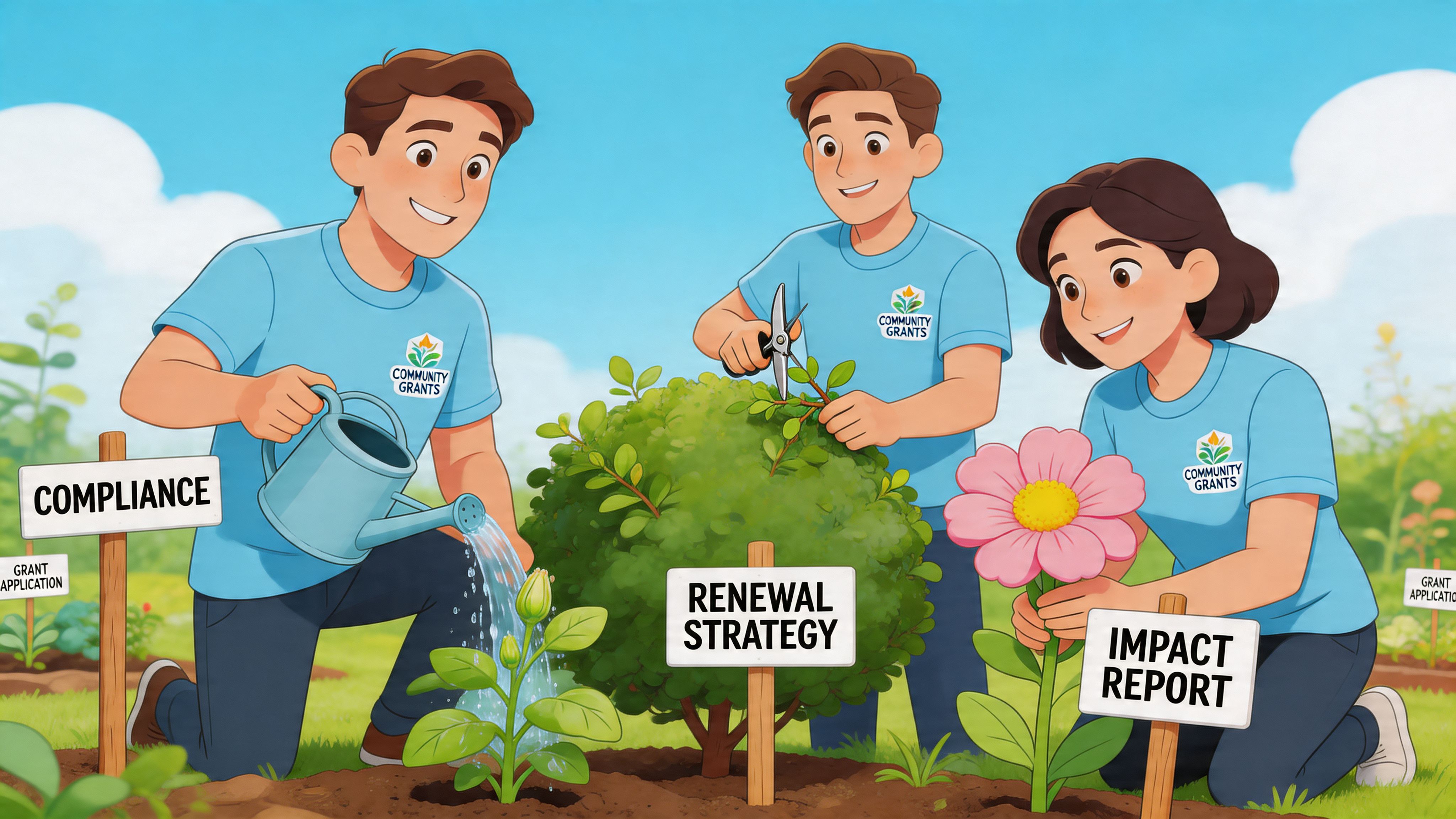
Think of grants as relationships with evidence
Funders don't just want to know that you spent money. They want confidence that your organization can manage commitments, communicate clearly, and surface issues early.
That means tracking:
- Program milestones
- Budget use
- Reporting deadlines
- Document versions
- Changes to scope or timeline
- Proof points you may need for renewal
The charities that do this well don't scramble at report time because they aren't trying to reconstruct six months of activity from inboxes and memory.
Compliance starts the day you apply
The strongest renewal workflow often begins before submission. If a proposal promises quarterly outputs, named partners, and a specific implementation timeline, those elements should already be captured somewhere your team can manage after award.
Internal disunity often creates avoidable problems for many organizations. The development team submits one version of the story. Program staff operate from another. Finance tracks the grant in a separate system. By the time the report is due, nobody agrees on what was promised.
Post-award control points
| Area | What to track |
|---|---|
| Deliverables | Activities, outputs, due dates, responsible staff |
| Budget | Approved categories, spend pace, restrictions, adjustments |
| Reporting | Narrative deadlines, financial reports, templates, submission history |
| Communications | Funder check-ins, questions, approvals, changes in scope |
| Renewal readiness | Results, lessons, beneficiary stories, unresolved risks |
Good compliance is organized memory. It lets your team prove what happened without starting over every time.
Renewal work begins before the funder asks
A common mistake is waiting for the renewal notice. By then, you may already be behind if the grant period wasn't documented cleanly.
Renewal readiness looks more like ongoing cultivation than a final sprint:
- Capture results as they happen
- Save quotes, stories, and examples with context
- Flag implementation changes early
- Track what the funder responded well to
- Note what you'd propose differently next cycle
That record becomes the raw material for continuation proposals, stewardship updates, and future asks to similar funders.
Make reporting easier on your future team
Even if your organization is small, you need institutional memory. Staff change. Consultants rotate out. Program details blur.
A workable system should show:
- what was promised
- who owns each requirement
- what has already been submitted
- where the latest approved files live
- what needs to happen next
When those pieces are visible, renewals become a continuation of managed work instead of a forensic exercise.
The payoff of post-award discipline is not just cleaner reporting. It's credibility. Funders remember which organizations communicate well, manage change responsibly, and make renewal easy to justify.
Building a Sustainable Funding Engine
Sustainable funding doesn't come from mastering one tactic. It comes from connecting the whole lifecycle.
A strong charity funding system does six things well. It understands the market. It diversifies revenue. It discovers relevant opportunities consistently. It qualifies prospects before investing scarce time. It drafts applications through process, not chaos. And it treats compliance as part of fundraising, not an afterthought.
That combination is what turns scattered effort into a funding engine.
For executive directors and development teams, the biggest shift is operational. Stop measuring fundraising only by the grants won this quarter. Measure whether your organization is building repeatable habits that make future wins more likely. A visible pipeline, better qualification, reusable materials, and disciplined post-award tracking can change the day-to-day experience of fundraising as much as they change the results.
Funding opportunities for charities are real. The challenge is building a system that can find the right ones, pursue them well, and keep them alive long enough to matter.
Take the first step by fixing one weak point in your process. For some teams that's discovery. For others it's deadline control, draft management, or renewals. Start there, tighten it, and build outward.
Fundsprout brings the full grant lifecycle into one workflow, from finding relevant opportunities to organizing proposal tasks and maintaining the records that support reporting and renewals. If your team wants a more structured way to manage funding work without juggling disconnected spreadsheets, folders, and calendars, take a look at Fundsprout.
Try 14 days free
Get started with Fundsprout so you can focus on what really matters.