Firm Fixed Price Contracts: Secure Funding & Manage Risk
Master firm fixed price contracts for nonprofits. Secure funding, manage projects without risk. Guide covers pricing, proposals, and compliance.

Abdifatah Ali
Co-Founder
Your team just won a grant or service contract that could fund meaningful work. Staff are excited. Program plans are moving. Then the finance question lands on your desk: what happens if the work costs more than expected?
For a nonprofit Executive Director, that question is never abstract. If a project runs over budget, you may have to pull from unrestricted funds, delay another program, or ask already stretched staff to do more with less. Mission and money meet very quickly.
That's why Firm Fixed Price contracts matter. They look simple on the surface. A funder or buyer agrees to pay a set amount for a defined result. But the simplicity is a little deceptive. These contracts can protect your revenue forecast and reduce administrative friction, yet they can also put real pressure on your organization if the scope is fuzzy or your pricing is off.
For nonprofits, that tension is especially important. You're not just protecting margin. You're protecting services, staff capacity, and community trust.
Introduction When Budgets Are Not Just Numbers
Nonprofit budgets carry more emotional weight than most business budgets. A missed estimate doesn't just affect a quarterly report. It can affect meals served, counseling sessions delivered, outreach events staffed, or housing placements completed.
That's why many leaders feel both relief and worry when they see a fixed contract amount. Relief, because the revenue is clear. Worry, because the work itself may not stay as neat as the contract language suggests.
Why this contract type gets attention
A Firm Fixed Price contract, often shortened to FFP, can feel reassuring because everyone knows the price from the start. If you're managing a workforce program, a training series, or a clearly defined community deliverable, that predictability can help with staffing and cash planning.
For a new Executive Director, FFP is often the first contract type that seems easy to understand and hard to manage at the same time. That reaction is normal. The phrase “fixed price” sounds safe for everyone involved. In practice, it mostly creates safety for the buyer and discipline for the seller.
Reality check: A fixed price doesn't make the work less variable. It sets rules for who absorbs that variability.
Why nonprofits need a practical lens
In nonprofit settings, contract decisions are often made under pressure. You may need the revenue. You may believe in the mission fit. You may also have limited back-office capacity to model every risk perfectly.
That's why the right question isn't “Are firm fixed price contracts good or bad?” The better question is, “When does this structure fit our work, and how do we protect ourselves before we sign?”
If you understand the mechanics, define the scope tightly, and manage changes carefully, FFP can be useful. If you underprice or accept vague deliverables, the same contract can insidiously drain unrestricted resources.
Understanding Firm Fixed Price Contracts
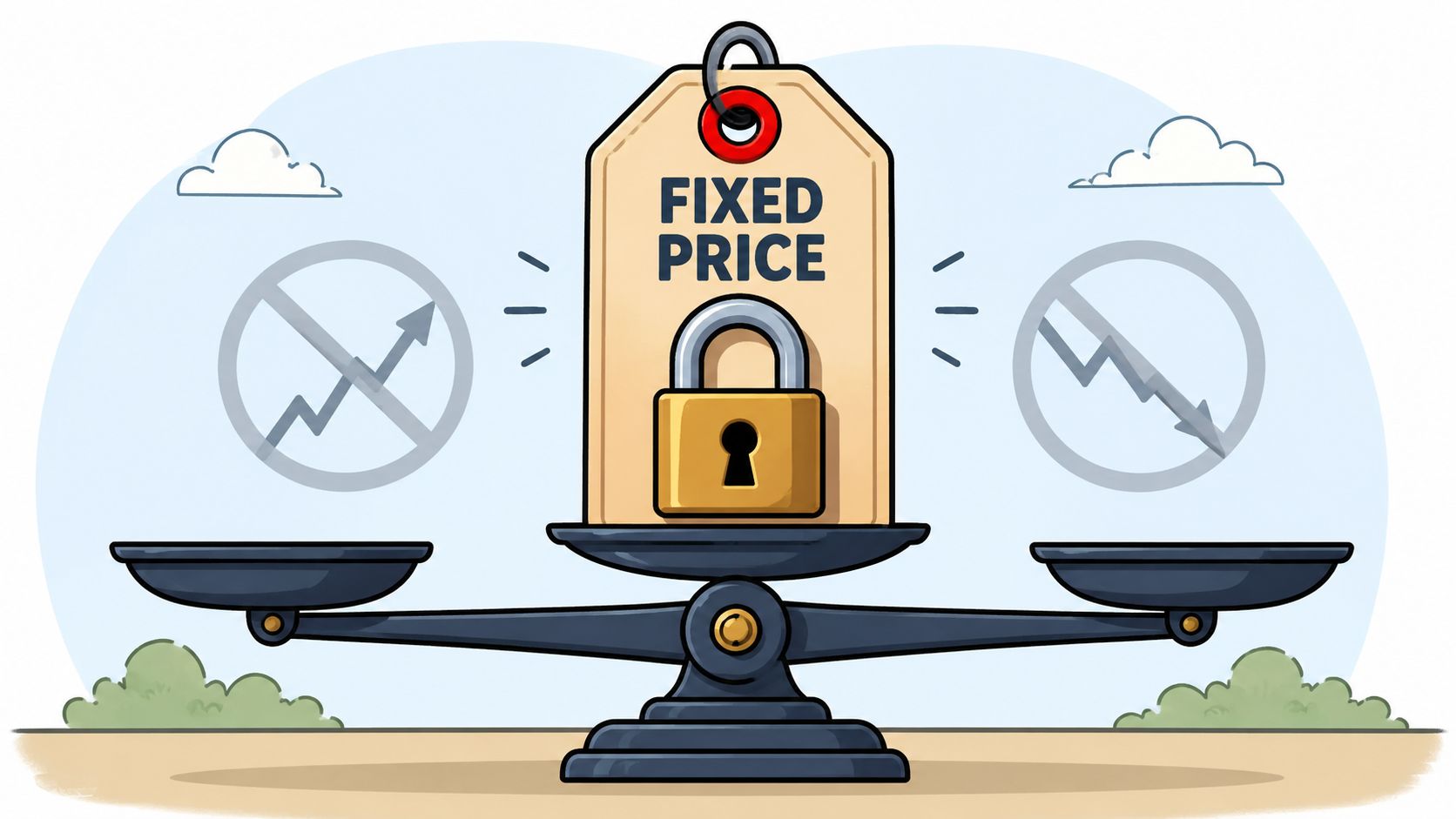
A Firm Fixed Price contract means the price is agreed in advance and does not change based on the contractor's actual cost experience. Under the Federal Acquisition Regulation, the contractor carries maximum risk and full responsibility for profit or loss, and this structure creates minimal administrative burden for the parties. The same rule treats FFP as the default fixed-price form when risk is minimal or can be predicted with reasonable certainty, as stated in the Federal Acquisition Regulation guidance on fixed-price contracts.
A plain-language example
Think about hiring a caterer for your annual gala.
If the caterer quotes one set price for the whole event, that's similar to an FFP arrangement. If food costs rise or staffing takes longer than expected, the caterer still has to deliver for the agreed amount. If the caterer manages the event efficiently, they keep the benefit of that efficiency.
That's different from an arrangement where you pay for every labor hour and every ingredient after the fact. In that model, your final cost moves with the provider's actual expenses.
What “risk transfer” really means
This is the part people often misunderstand. “Fixed price” does not mean the project itself becomes predictable. It means the contract assigns the financial consequences of unpredictability.
For nonprofits, that means:
- If your costs are lower than expected, your organization keeps the remaining margin or operating cushion, depending on the terms and your accounting treatment.
- If your costs are higher than expected, your organization absorbs the shortfall.
- If the funder wants more work, the answer should not be “we'll figure it out later.” It should be “is that within the signed scope, or does it require a change?”
Why funders and agencies like it
Buyers often prefer FFP because it's easier to administer. They know the amount they expect to pay. They don't have to scrutinize every cost detail in the same way they would under a cost-reimbursement arrangement.
For a nonprofit, that simplicity can be appealing too. But only when the deliverables are concrete. Training cohorts, a fixed number of workshops, a set curriculum, a standard outreach campaign, or a clearly bounded technical assistance package are all easier to price than work where client needs shift week to week.
The best use case for firm fixed price contracts is work you can define before the work begins.
FFP vs Other Common Contract Types
If you only hear “fixed price,” it's easy to assume every other contract is just a looser version of the same thing. That's not how it works. Different contract types answer one central question differently: who carries the cost risk?
Contract type comparison for nonprofits
| Factor | Firm-Fixed-Price (FFP) | Cost-Reimbursement (Cost-Plus) | Time & Materials (T&M) |
|---|---|---|---|
| How payment works | One set price for defined deliverables | Buyer reimburses allowable costs, often with an agreed fee structure | Buyer pays set labor rates plus material costs |
| Who carries cost risk | Mostly the nonprofit or contractor | Mostly the funder or buyer | Shared, but buyer often has less budget certainty |
| Administrative burden | Lower after award if scope is clear | Higher, because cost tracking and documentation are central | Moderate to high, because hours and materials must be tracked carefully |
| Best fit | Stable, repeatable, clearly scoped work | Uncertain work, developmental work, or projects with evolving requirements | Advisory, technical, or short-term work where level of effort matters more than fixed deliverables |
| Main nonprofit concern | Underpricing and scope creep | Heavy reporting and strict allowability rules | Budget drift if hours expand |
How this looks in real nonprofit operations
Suppose your organization is asked to deliver a defined set of board trainings across a year. FFP may fit because the sessions, materials, and timeline can be described in advance.
Now suppose a funder wants you to build a new pilot program while learning from each phase as you go. A cost-reimbursement structure may fit better because the work will evolve and your actual costs may legitimately shift. If you forced that into a fixed price too early, your team could end up carrying uncertainty that should have been shared.
T&M usually lands somewhere in the middle. It can work for consulting, interim capacity support, or specialized help where the buyer wants flexibility. The downside is that a T&M agreement may not give your leadership team the budget clarity you need.
A practical decision test
Ask these questions before you accept FFP:
- Can we define the deliverable clearly? If you can't describe what “done” looks like, fixed pricing is risky.
- Can we estimate staffing with confidence? If staff time is highly variable, be careful.
- Are assumptions stable? If partner participation, referral volume, or client complexity may swing sharply, the price may not hold.
- Do we have procurement discipline? If your team needs help distinguishing RFQs, RFPs, and contract structures, this guide to RFPs and RFQs for nonprofits can help align the bidding process with the contract you're being asked to perform.
No contract type is morally better. Each one fits a different kind of work. Trouble starts when a nonprofit accepts an FFP structure for a project that behaves like a fluid service engagement.
The Major Risks and Rewards for Nonprofits
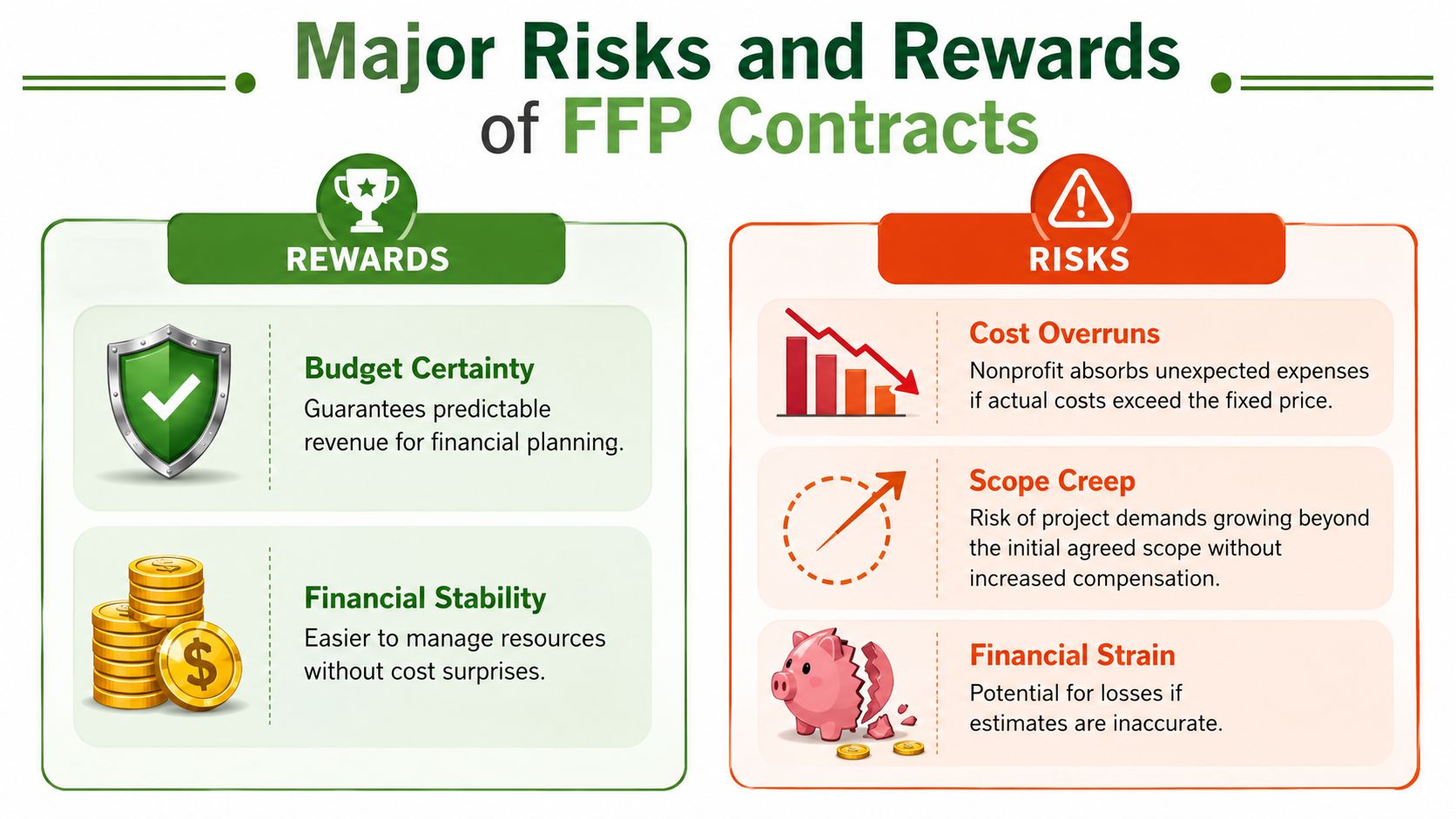
For nonprofits, the biggest reward of FFP is stability. The biggest risk is false confidence.
When an FFP contract is well priced and tightly scoped, leadership can plan around known revenue. That helps with staffing, board reporting, and program pacing. When it's badly scoped, the same contract can turn into a silent subsidy from your unrestricted budget.
The reward side
A fixed amount gives you a cleaner planning base. Your finance lead can map expected revenue without waiting for every cost item to be approved. Program staff can focus more on outputs and deadlines instead of building reimbursement packets for each expense.
There's also an operational advantage. If your team can deliver efficiently, the contract gives you room to keep the benefit of that efficiency, subject to the contract terms and any applicable funding restrictions. That can support organizational resilience.
The risk side
The danger isn't just “cost overrun” in a generic sense. It usually shows up in three concrete ways:
- Scope creep. The buyer asks for added meetings, added reports, or added customization that wasn't priced.
- Bad estimating. Your original assumptions about staff time, subcontractor costs, or participant volume were too optimistic.
- Operational friction. Delays, turnover, procurement hiccups, or partner issues make the work more expensive than planned.
Research on FFP contracts is useful here because it shows both why buyers like them and why contractors still need caution. An analysis of 1,729 firm-fixed-price contracts found that 88% had zero cost growth, while 12% experienced cost growth, and those growing contracts increased by an average of about 6%, according to this analysis of firm-fixed-price contract cost risk.
That doesn't mean every nonprofit contract follows the same pattern. It does mean fixed price is not magic. Most contracts may hold, but a minority can still create real budget pressure.
A simple explainer is worth watching if your team is new to this vocabulary:
What prudent nonprofits do differently
Strong organizations treat risk review as part of program design, not just legal review. Before signing, they test staffing assumptions, delivery dependencies, and the cost of delays. If your team needs a structured way to think through exposure, this resource on risk assessment for organizations and projects from Lighthouse Consultants can help frame those conversations.
Don't ask whether the contract is fixed. Ask whether the scope, assumptions, and staffing model are fixed enough to support the price.
Building a Bulletproof FFP Budget and Proposal
Most FFP problems begin before award. They start in the pricing worksheet, the workplan, or the sentence in the proposal that sounds harmless but leaves too much open to interpretation.
A strong FFP budget isn't padded. It's defensible. It reflects the actual cost of delivering the promised work under normal conditions, with enough room to absorb reasonable disruption.
Start with the work, not the price
Many nonprofits make the same mistake. They see the available award amount and try to squeeze the project into it. That approach almost always creates hidden strain later.
Start by defining the work at operating level detail.
Break down the deliverable
List what your team must do to complete the contract:
- Direct service tasks such as workshops, case management sessions, technical assistance calls, or outreach events
- Support tasks such as scheduling, data entry, supervision, quality checks, and reporting
- External costs such as interpreters, venue fees, software, printing, or partner payments
If a task takes time, requires a person, or creates a bill, it belongs in the estimate.
Build the budget from the inside out
Price the work using realistic assumptions from the people who will do it. Your program director, operations lead, and finance manager should all be in the room for this.
Include all cost layers
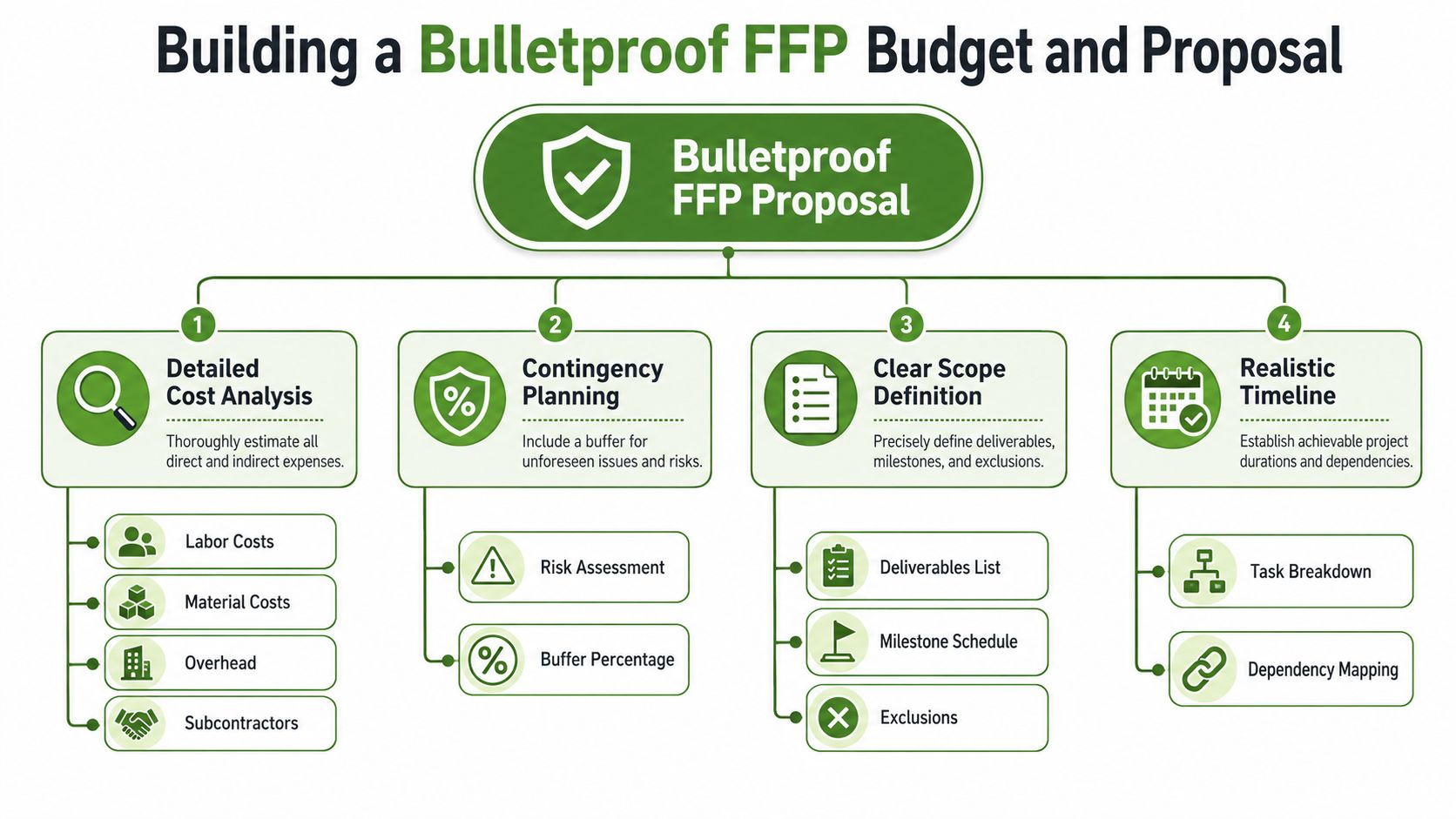
A practical FFP budget usually includes:
- Labor costs based on actual effort, not hopeful effort.
- Materials and operational inputs tied to the service model.
- Subcontractor costs if another organization or consultant supports delivery.
- Indirect costs, because compliance, finance, HR, and management still support the contract even when those expenses aren't visible to the funder.
If your team needs help calculating overhead fairly, this guide on how to calculate indirect costs for grants and contracts is useful for building a price that reflects the actual organization behind the program.
A broader budgeting process matters too. For finance leaders who want a practical frame for annual planning and program budgeting, this comprehensive guide for nonprofit finance leaders is a helpful companion resource.
Add contingency without apology
Nonprofits often hesitate here because they fear looking expensive. That hesitation creates underpriced contracts.
Contingency is not a gimmick. It's recognition that delivery rarely happens in a frictionless environment. Staff absences, referral variability, procurement delays, and partner coordination issues all have cost implications.
You don't need to sell contingency as “extra money.” Present it as part of responsible pricing based on identifiable risks and assumptions.
Practical rule: If your price only works when everything goes right, your price doesn't work.
Define scope in writing that a tired person can understand
The strongest proposal language is boring in the best possible way. It leaves little room for competing interpretations.
Use plain statements such as:
- The contractor will deliver a specified number of training sessions.
- Each session will cover named topics.
- Reporting will include named outputs on a defined schedule.
- Work outside the listed deliverables requires written approval.
This is also where tools can help. Some teams use spreadsheets and shared docs. Others use dedicated platforms. For example, Fundsprout includes an RFP analyzer that turns requirements into structured outlines and helps teams organize proposal inputs and compliance tasks. The tool doesn't replace judgment, but it can make scope review more consistent.
Stress-test the timeline
A fixed price tied to an unrealistic schedule is just a delayed budget problem.
Ask:
- What happens if the buyer is slow to approve materials?
- What happens if a partner starts late?
- What happens if participant recruitment takes longer than expected?
If your timeline has no slack at all, the price is more fragile than it looks.
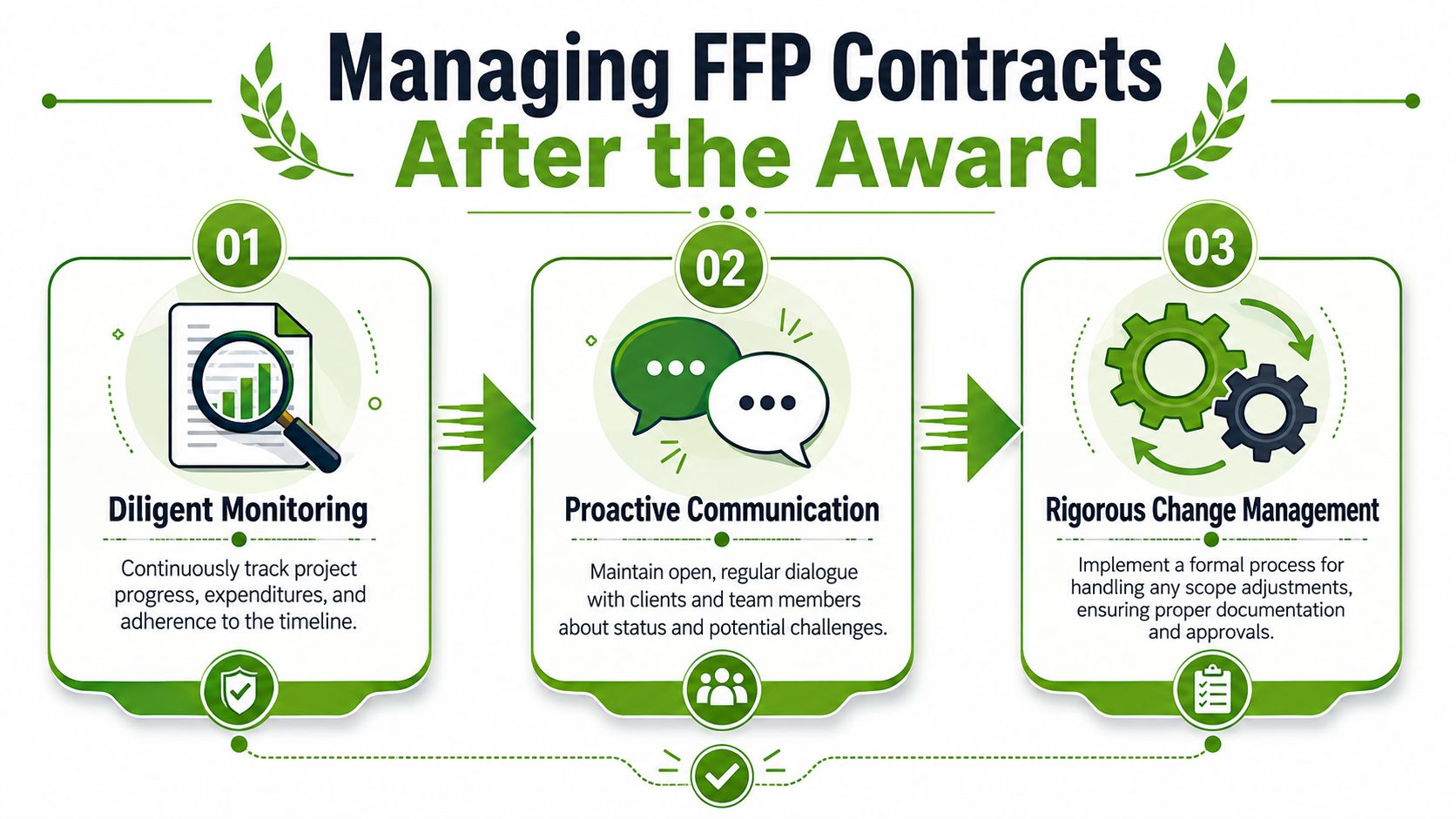
Managing FFP Contracts After the Award
Once the contract is signed, your main job changes. You're no longer pricing risk. You're controlling it.
Many nonprofits lose money on FFP contracts not because they priced them badly, but because they managed them casually after award. Staff say yes to extra requests. Subcontract terms don't match the prime contract. Documentation gets scattered across inboxes.
Monitor the work like a contract, not just a program
Your program team may focus on service quality. That matters. But under FFP, leadership also has to track delivery against the contracted scope and timeline.
Use a simple monthly review that checks:
- Deliverables completed against the statement of work
- Labor consumption against your original assumptions
- Emerging changes requested by the buyer
- Documentation gaps that could become problems later
If your reporting systems are messy, even basic extraction and organization can become painful. Teams modernizing that workflow may find value in learning about understanding financial data extraction APIs, especially if they're trying to reduce manual handling of invoices, financial records, or backup documentation.
Handle subcontractors carefully
If another organization helps you deliver the work, your subcontract should reflect the structure of the prime agreement as closely as appropriate. Don't accept fixed-price risk upstream and then issue a vague, open-ended subcontract downstream.
Your subcontract should spell out:
- exact deliverables
- due dates
- reporting expectations
- payment triggers
- what happens if the scope changes
If you don't pass down clarity, you may end up carrying risk on both sides.
Use a real change order process
Many nonprofits face problems when a program officer asks for “one small addition.” A municipal partner wants an extra stakeholder meeting. Someone requests a new report format that takes staff hours every month.
None of those requests are automatically unreasonable. But they are not automatically free.
When a request falls outside the original agreement, use a formal change process. Put the request in writing. Describe the added work. State the effect on timeline and cost. Wait for approval before treating it as part of the contract.
Added work without written approval is often just unfunded work with a polite email attached.
Keep an audit trail that future-you can survive
Good recordkeeping protects both finances and relationships. Save meeting notes, approval emails, revised scopes, deliverable submissions, and invoice support in one system.
If your team is refining post-award discipline more broadly, these grant management best practices for nonprofit teams can help create habits that support both grants and service contracts.
Key Takeaways and Contract Management Best Practices
Firm fixed price contracts can serve nonprofits well when the work is stable, the scope is precise, and the price reflects reality. They become dangerous when organizations accept them for fuzzy projects or build budgets on best-case assumptions.
Keep these points close at hand:
- Define deliverables tightly. If the scope is vague, the price won't protect you.
- Price the actual work. Include labor, operations, subcontractors, and indirect costs.
- Treat contingency as responsible planning. It protects mission delivery when normal disruptions happen.
- Watch for scope creep early. Small additions accumulate fast.
- Mirror terms in subcontracts. Don't absorb downstream ambiguity.
- Require written change approval. Verbal agreement is not budget protection.
- Document everything. Clear records preserve both compliance and relationships.
The most effective nonprofit leaders treat FFP discipline as part of stewardship. You're not being rigid. You're protecting the organization's ability to deliver on its promise.
If an FFP contract lets you focus on outcomes without putting your balance sheet at risk, it's doing its job. If it depends on staff absorbing unpaid extra work, it was never priced or scoped correctly in the first place.
If your team needs support finding grant and contract opportunities, organizing requirements, and managing proposal and compliance workflows, Fundsprout offers an AI-powered platform built for mission-driven nonprofits. It helps teams discover relevant funding, structure application work, and keep the records needed from submission through renewal.
Try 14 days free
Get started with Fundsprout so you can focus on what really matters.