How to Write a Cover Letter for Grants and Secure Funding
Learn how to write a compelling cover letter for grants with our expert guide. Get actionable tips and examples to make your nonprofit's application stand out.

Abdifatah Ali
Co-Founder
Think of your grant cover letter as the handshake that happens before you even walk in the room. It’s that first, critical moment that decides whether a funder invites you to sit down and tell your story, or politely shows you the door. This one-page document isn't just a formality; it's your opening argument, designed to grab a reviewer’s attention and immediately connect your work to their mission.
In essence, it has to answer three gut-level questions every reviewer is asking: Who are you, why are you asking us for money, and why should we care?
Your Grant Cover Letter Is Your First Impression
Your full grant proposal is the deep, detailed narrative of your organization's work and vision. Your cover letter? That’s the headline. It's the powerful, punchy summary that convinces a busy program officer that the rest of your story is worth their time.
Get it wrong, and your carefully prepared proposal might end up in the "no" pile without a second glance. This isn’t an exaggeration. Just look at the W.K. Kellogg Foundation, where a reported 80% of applications are immediately rejected for a simple lack of alignment with their priorities—a problem a strong cover letter is designed to prevent.
The numbers are just as tough in the federal space. NIH data for 2024 shows success rates for key research grants hovering at a challenging 19%. With over 55,000 applications vying for about 10,000 awards, you can’t afford a weak start.
Moving Beyond a Simple Formality
I see it all the time: nonprofits treat the cover letter as a last-minute task, a final chore before hitting "submit." This is such a missed opportunity. A truly effective cover letter is more than an introduction; it’s a bridge built directly between your project and the funder’s goals. It translates the passion you have for your work into the language of impact and alignment that grantmakers need to hear.
A great cover letter doesn't just summarize the proposal—it sells it. It's the moment you prove you've done your homework and understand that you're not just asking for money, but proposing a partnership.
To pull this off, your letter must be concise, confident, and completely customized. It should echo the funder's own language and priorities, proving you've done your research. While it feels a bit like a letter of inquiry, its job is different. An inquiry letter is like asking if you can pitch; the cover letter is the opening line of the pitch itself. You can explore this difference in our guide on crafting a grant inquiry letter.
The Three Essential Questions Your Cover Letter Must Answer
Before diving into the nitty-gritty of writing, let's step back and focus on the core job of the cover letter. It has one mission: to deliver clear, compelling answers to the three questions every single grant reviewer is asking, whether they realize it or not.
Here’s a quick breakdown of what those questions are and why they matter so much.
Nailing these three points transforms your cover letter from a procedural document into a powerful strategic tool. It ensures the funder immediately gets the what, why, and who of your request, making them eager to learn more.
Anatomy of a Winning Grant Cover Letter
Think of your grant cover letter less like a formal introduction and more like a strategic preview. It’s your first, and sometimes only, chance to convince a grant reviewer that your proposal is worth their time. This isn’t just a summary; it's a persuasive handshake that guides their thinking and makes them want to fund you.
A powerful cover letter builds a direct bridge between the problem you solve and the funder’s own mission. It makes supporting your work feel like the most logical, impactful choice they could make. Getting this right is crucial. With national grant win rates hovering between 10-30%, a polished and perfectly aligned cover letter can be the very thing that sets you apart from a sea of worthy applicants.
The Opening Hook: Your Salutation and Introduction
Your first paragraph is your most valuable real estate. You need to get straight to the point with clarity and confidence. The reviewer should know exactly who you are and what you want within the first few seconds.
Leave no room for guesswork. Immediately answer these questions:
- Who are you? State your organization's full name.
- How much do you need? State the exact funding amount you're requesting.
- What's it for? Name the specific project and, if applicable, the grant program you're applying to.
For example, a community food bank could open like this:
"On behalf of the Maplewood Community Food Bank, I am pleased to submit this proposal requesting $25,000 to support our 'Fresh Access for Families' initiative, in response to the Grove Foundation's call for proposals under your Community Health and Wellness grant program."
That one sentence tells the reviewer everything they need to know to get started. It’s professional, direct, and respectful of their time.

As you can see, establishing your identity ("Who?") and proving your alignment ("Why Us?") are the essential first steps before you can truly make the case for why a funder should care.
The Crucial Connection: Demonstrating Mission Alignment
This is where the magic happens. Your second paragraph is your proof that you’ve done your homework and aren’t just blasting out generic applications. The goal here is to draw an explicit, undeniable line between your project and the funder’s own priorities.
The best way to do this? Speak their language.
Go through the funder’s website, dig into their annual reports, and read their recent press releases. What words do they use over and over? Do they talk about "economic empowerment," "youth leadership," or "sustainable food systems"? Pick up on those key phrases and weave them directly into your narrative.
Let’s say an arts program is applying to a foundation focused on "bridging the opportunity gap for underserved youth." Their alignment paragraph could look something like this:
"This project directly supports the Sterling Foundation's commitment to bridging the opportunity gap for underserved youth. By providing free, high-quality arts education, our program gives students in low-income neighborhoods the creative tools and confidence needed for future success, aligning perfectly with your goal of fostering equitable pathways to achievement."
See how that works? It doesn't just claim alignment—it proves it using the funder's own words. This simple technique shows you view them as a genuine partner, not just a checkbook.
The Confident Close: Your Call to Action and Signature
It's time to bring it home. Your final paragraph should be short, professional, and forward-looking. Use this space to tie up any loose ends and provide a clear, confident next step.
Here’s what to include:
- Clarify Eligibility: If your organization’s status isn't immediately obvious, clear it up. For example, if your nonprofit has "school" in its name, you might briefly state your 501(c)(3) status.
- Provide Contact Info: Make it easy for them to reach you. Include the name, title, direct phone, and email for the main contact person.
- Say Thank You: A simple, sincere thank you for their time and consideration goes a long way.
- The Call to Action: Your CTA isn't a hard sell. It's a polite, confident invitation to dive into the full proposal.
A simple closing like, "Thank you for your consideration. We welcome the opportunity to partner with the foundation to achieve these goals," is all you need. It signals that you are a capable, professional organization ready to manage their investment well.
To see how the cover letter fits into the larger puzzle of grant seeking, check out this excellent guide to responding to an RFP.
Bringing Your Story to Life
If a solid structure is the skeleton of your cover letter, the narrative is its heart and soul. This is where you go beyond just stating facts and start making a persuasive case. Your mission here is to make funding your project feel not just like a good idea, but an absolute necessity.
To do this, you need to shift the focus from what your organization wants to what the community truly needs. A powerful narrative is built on solid evidence, makes an emotional connection, and radiates credibility. It turns a simple request into a compelling invitation for partnership.
Ground Your Ask in Community Need
Here’s a hard truth: funders don’t fund organizations; they fund solutions to problems. The most convincing cover letters always frame the funding request around a clear, data-backed community need. So, instead of saying, "We need $30,000 for our literacy program," you reframe it to spotlight the problem you're tackling head-on.
For instance: "Over 40% of third-graders in our district are reading below grade level, putting them at significant risk of falling behind permanently. Our program directly addresses this gap..." See the difference? This approach immediately raises the stakes and positions your organization as the go-to expert with a solution. For a deeper dive into this, check out our guide on writing a powerful statement of need.
This is a small but critical shift in perspective. It proves your project isn't just a nice-to-have—it's an essential intervention designed to create real, measurable change.
The Power of a Single Story
Data makes things urgent, but stories make them real. You don't have room for a full-blown case study in a cover letter, but weaving in a brief, one-sentence story can be incredibly powerful. It puts a human face on all those statistics.
Think about the impact of these two statements:
- Data-only: "Our program provides job training to 100 homeless individuals annually."
- Data + Story: "Our program provides job training to 100 individuals annually, helping people like Maria, a single mother who secured full-time employment after completing our course last spring."
That tiny addition transforms an abstract number into a tangible, relatable success. It gives the grant reviewer an emotional anchor, a reminder that their investment impacts actual lives.
A great cover letter answers the question, 'Why this, why now?' with both logic and heart. The data proves the problem is real; the story proves your solution works for real people.
Just remember to keep it brief. You’re offering a snapshot of your impact, not a full biography. This little glimpse is all you need to build an emotional bridge between your work and the funder’s mission.
Mirror the Funder’s Language to Show Alignment
Genuine mission alignment is more than just saying your goals are similar. It’s about showing you have a deep, nuanced understanding of how the funder sees the world. And the best way to do that is by "mirroring" their language.
Spend some time with the funder's most recent annual report, their strategic plan, or even the CEO's latest blog post. Look for the specific words and phrases they use to talk about their priorities.
- Do they talk about "fostering community resilience"?
- Is their main focus on "creating equitable pathways to success"?
- Do they keep mentioning "data-driven interventions"?
When you sprinkle this exact terminology into your cover letter, you create an instant feeling of familiarity and shared purpose. It’s a clear signal that you've done your homework and aren't just sending another generic, blast-it-out-to-everyone letter. This kind of tailoring is crucial in a competitive field where foundations may only fund 10-20% of applications and often reject proposals for poor alignment.
Project Credibility and Competence
Finally, a funder needs to know their money will be in safe hands. Your cover letter has to project competence and credibility without bragging. You can do this by subtly highlighting key assets that prove your organization can deliver on its promises.
Here are a few quick ways to build that confidence:
- Highlight Staff Expertise: "Our program is led by Dr. Jane Smith, a recognized expert with 15 years of experience in early childhood literacy."
- Mention Key Partnerships: "We are delivering this project in partnership with the City School District, ensuring direct access to the students who need our services most."
- Reference a Major Accomplishment: "This initiative builds on the success of our pilot program, which was recognized with the 2023 Community Impact Award."
These brief mentions are your proof points. They reassure the funder that you have the right team, the right relationships, and a solid track record to make their investment count. It’s the final piece of the persuasive puzzle, turning your compelling story into a proposal they simply can't ignore.
Common Mistakes That Lead to Rejection
You’ve poured weeks, maybe even months, into a grant proposal. The last thing you want is for a simple, avoidable slip-up in the cover letter to sink your chances before the reviewer even gets to page two. I’ve seen it happen more times than I can count.
These aren't just minor typos; they are strategic blunders that signal a lack of preparation or attention to detail. In the hyper-competitive world of grant funding, your cover letter needs to be flawless.
Let’s walk through the most common tripwires I see and how you can sidestep them.
Generic Greetings and Copy-Paste Content
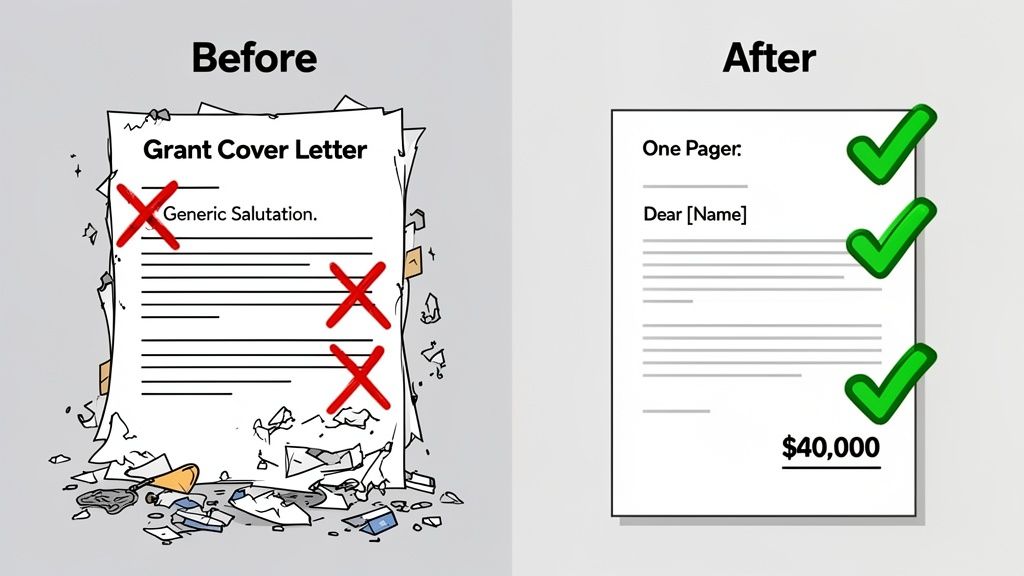
Nothing kills your credibility faster than a "Dear Sir or Madam" or "To Whom It May Concern." It’s the grant-writing equivalent of junk mail and immediately tells the funder you haven't done your homework.
Take the time to find the right person's name—the program officer, the foundation director, whoever is managing the portfolio. A quick look at their website or a call to their office is all it takes. This simple act of personalization shows respect and frames your proposal as a potential partnership, not just another anonymous ask.
The same goes for the body of the letter. If you could swap out the foundation's name and send the exact same letter to ten other funders, it’s too generic.
What gets ignored: "To Whom It May Concern, Our organization is seeking funding for our new initiative."
What gets read: "Dear Ms. Anya Sharma, Following our conversation last week, I am excited to submit our proposal for the 'Digital Futures' initiative, which aligns perfectly with the Sharma Foundation's focus on youth STEM education."
See the difference? One is a cold call; the other is the continuation of a warm conversation.
Burying the Lead and Vague Requests
Grant reviewers are under immense pressure, often sifting through hundreds of proposals. They don't have time to play detective. A huge mistake is making them hunt for the core details of your request: what you want the money for and how much you need.
Your opening paragraph needs to be a clear, confident snapshot of your proposal. State your request directly.
Ambiguous language makes you sound hesitant and unprofessional. Phrases like these are red flags:
- "We are looking for financial assistance..."
- "Any support you could provide would be appreciated..."
- "Funding to help us continue our important work..."
Instead, be specific. "We are requesting $50,000 to launch our after-school coding bootcamp for 100 underserved high school students." This shows you have a concrete plan and a well-researched budget, building immediate trust.
Focusing on History Instead of Future Impact
Your organization’s legacy is important, but a cover letter isn’t the place for a long trip down memory lane. Funders are investing in the future—the change you will create with their support. A letter that gets bogged down in your origin story fails to build excitement for what’s ahead.
Establish your credibility quickly, then pivot to the future. What problem will you solve? Whose lives will you change? How will their investment make a tangible difference?
This is all about shifting from a passive historical account to an active, forward-looking pitch. It’s not just about what you’ve done; it's about what you will do with their partnership.
Quick Fixes for Common Cover Letter Errors
Reviewing your own work can be tough. I've put together this quick table to help you spot some of the most frequent errors I see in first drafts and turn them into compelling statements.
Think of this table as a cheat sheet for self-editing. A few small tweaks in phrasing can dramatically elevate your letter from a standard application to a powerful invitation for a funder to join you in making a real-world impact.
Your Final Pre-Submission Checklist
Before you hit "submit," take a deep breath and pause. Giving your grant cover letter one last, meticulous look-over is your final line of defense against the small mistakes that can have a surprisingly big impact.
This isn’t just about catching a typo. It’s a strategic check to make sure every word is working to present your organization as professional, prepared, and a smart investment. Think of it like a pilot's pre-flight inspection—rushing this step is a risk you just can’t afford.
Content and Formatting Essentials
Let's start with the basics. These details seem minor, but getting them wrong sends a clear signal to a program officer: a lack of attention to detail. Your job is to make their job easier, not harder.
- The One-Page Rule: Is your letter tight, focused, and kept to a single page? Brevity is a sign of respect for the reviewer's limited time.
- The Right Salutation: Did you find a specific person to address? "Dear Ms. Chen" feels personal and direct, while "To Whom It May Concern" is generic and easy to dismiss.
- Accurate Grant Details: Double-check the grant's official name and ID number. Using the wrong one is a dead giveaway that you're just copying and pasting from another application.
Getting these small things right is non-negotiable. It immediately tells the funder you’ve prepared a thoughtful document, not just another form letter.
Financial and Narrative Alignment
Next, you need to make absolutely sure the story your cover letter tells matches the full proposal. Any inconsistency, especially when it comes to the numbers, can raise an immediate red flag.
The funding amount you mention in the letter must be exactly the same as the total request in your formal budget. A mismatch, even by a few dollars, suggests poor internal controls or just plain sloppiness.
This is a simple but critical cross-check. For more on this, our grant budget template and guide can help you keep everything aligned.
A cover letter is the gateway to your proposal. If the key doesn't fit the lock—if the numbers don't match or the names are wrong—the gate might not open at all.
This alignment goes beyond just the budget. Does the project name in your letter match the one used throughout the proposal? Does your brief summary accurately capture the core activities and outcomes you've detailed inside? Consistency builds trust from the very first sentence.
The Final Polish
Okay, it's time for the final buff and shine. The best trick in the book is to read your letter out loud. Your ear will catch awkward phrasing your eyes might miss.
After that, run it through a tool like Grammarly. Then, and this is crucial, ask a colleague who hasn't been staring at the proposal for weeks to read it. A fresh set of eyes is your secret weapon against hidden typos and unclear sentences.
- Proofread, Then Proofread Again: Hunt down any spelling, grammar, or punctuation errors.
- Verify Your Contact Info: Is your name, title, email, and phone number 100% correct?
- Confirm Attachments: If you wrote "Please find the following attachments," are they actually attached?
This final check is what elevates a good letter to a great one. It gives your proposal the strong, polished introduction it deserves and gives you the confidence to finally click that "submit" button.
Grant Cover Letter FAQs
Even with the best template, you're bound to run into some tricky situations when you're deep in the grant writing process. Crafting a standout cover letter for grants means knowing how to handle those nuanced, "what-if" moments. Let's dig into some of the most common questions I hear from fellow grant writers.
Think of this as your go-to guide for navigating those gray areas with confidence.
What’s the Ideal Length for a Grant Cover Letter?
Easy one: one page, maximum. That’s the golden rule.
Your cover letter is just the handshake, not the full conversation. Grant reviewers are buried in paperwork, and a letter that bleeds onto a second page often signals a writer who can't get to the point. Aim for three, maybe four, tight paragraphs.
Keeping it brief does two things: it respects the funder's time and proves you can communicate your mission clearly. A powerful, focused single page will always beat a rambling two-page letter.
Should I Send a Cover Letter if They Don’t Ask for One?
This question comes up all the time. The simplest advice is to follow the instructions precisely. If the guidelines flat-out say not to include a cover letter, then don't. Sending extra, unsolicited documents can make it look like you can't follow directions, which is not the first impression you want to make.
But what if the guidelines are just silent on the issue? In that case, I'd say including a concise, professional cover letter is a smart strategic move. It acts as a formal introduction and helps set the stage for your proposal. And if you're submitting by email, the body of your email essentially becomes your cover letter anyway, so you don't need a separate attachment.
Always defer to the funder’s guidelines. But when they're silent, a well-written, one-page cover letter is a professional touch that can help you stand out.
Who from My Organization Should Sign the Letter?
The signature on your grant cover letter is more than just a name—it’s a symbol of accountability. It should come from the highest-ranking leader appropriate for the request.
For most nonprofits, that’s going to be your Executive Director or CEO. Their signature communicates that this proposal has the full support and oversight of the organization's leadership.
In larger institutions, you might see a Director of Development or a specific Program Director sign off. But for the vast majority of small and mid-sized organizations, the ED’s signature carries the most authority and weight.
Is It Okay to Reuse a Cover Letter for Different Funders?
You can absolutely reuse your template, but you should never, ever reuse the exact same letter. Every single cover letter needs to be tailored to the specific funder you're writing to. A generic, copy-and-paste job is glaringly obvious and can get your proposal tossed in the "no" pile before it's even read.
Here are the non-negotiables you have to customize every single time:
- Funder’s Name & Contact: Get it right. Find a specific person to address it to.
- Mission Alignment: Draw a direct line between your work and their specific funding priorities. Use their own language back to them.
- Grant Program: Mention the exact name of the grant you're applying for.
- The "Ask": Make sure the funding amount matches what's in your proposal budget.
Skipping these details just screams a lack of effort. Taking those few extra minutes to personalize your letter shows you see the funder as a genuine partner, not just another checkbook. It's a small step that makes a world of difference.
Ready to stop chasing grants and start building a predictable funding pipeline? Fundsprout uses AI to match you with the right funders, analyze RFPs, and help you write winning proposals in a fraction of the time. Discover how our platform can supercharge your grant-seeking efforts. Learn more at https://www.fundsprout.ai.
Try 14 days free
Get started with Fundsprout so you can focus on what really matters.