Component of strategic planning: A Practical Guide for Nonprofits
Explore the component of strategic planning with a nonprofit-friendly framework from mission clarity to impact metrics, and turn strategy into action.


Abdifatah Ali
Co-Founder
For many nonprofits, the term "strategic planning" can feel a bit sterile and corporate. But in reality, it’s the blueprint you build to turn your passion into real, lasting impact. Each component of a strategic plan is a critical building block, and getting it right is a game-changer. In fact, 86% of nonprofits with a formal plan report a positive effect on their fundraising.
Think of it less like a rigid set of rules and more like a living roadmap. It’s the tool that gets your team pulling in the same direction, lights a fire under your donors, and makes sure every dollar and hour you invest moves the needle on your mission. A solid plan is your best argument for securing grants and making the most of the resources you have.
So, where do you begin? To take your nonprofit from a powerful mission to measurable impact, you need to understand the foundational and essential strategic planning process steps that successful organizations follow. This guide will walk you through the entire process, breaking it down into clear, manageable parts.
The Core Components of a Nonprofit Strategic Plan
Before we dive into the nitty-gritty of each stage, it helps to see the big picture. Here’s a quick summary of the essential components that form a complete and effective strategic plan.
Each of these elements builds on the one before it, creating a cohesive strategy that gives your work direction and focus.
From Vision to Action
The journey from a lofty vision to on-the-ground action can feel long, but a good plan bridges that gap. It connects the "why" of your organization to the "what" and "how" of your daily work.

This map shows it perfectly: your strategic plan is the critical link between your mission and the impact you create. To see how these ideas look in a finished document, this complete nonprofit strategic plan example is a great resource.
A strategic plan gives your organization a clear direction. Your action plan is what brings that direction to life. Together, they create a transparent, effective framework that turns your biggest priorities into results you can actually measure.
Ultimately, this process gives you the structure you need to make smart decisions, allocate your budget wisely, and prove your value to funders. With Fundsprout's AI planning and grant tools, you can make each phase more efficient—from identifying the right funding opportunities to reporting back on your incredible success.
Defining Your North Star With Mission and Vision
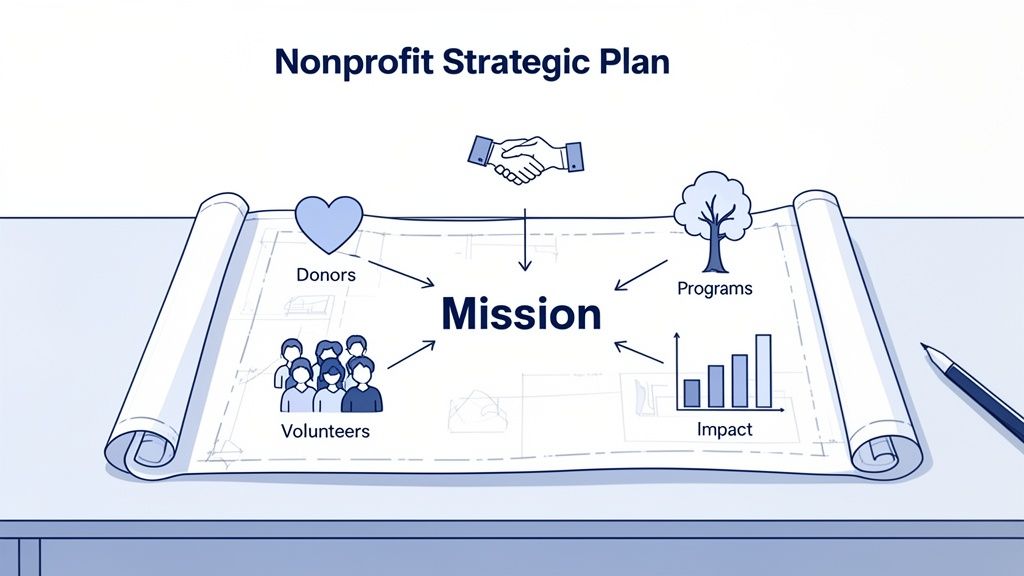
Before you can map out a journey, you have to know where you’re going. Think of your mission and vision statements as your nonprofit's North Star—they are the foundational component of strategic planning. These aren't just feel-good phrases for your website; they're the very soul of your organization.
Your mission statement is your "why." It's a short, powerful explanation of why you exist, what problem you solve, and who you do it for. A great mission is instantly understood by everyone, from your staff and board to donors and the people you serve.
Your vision statement, on the other hand, is your "what if." It paints a picture of the world you’re trying to build, a future where your mission is a complete success. This is the big, audacious goal that gets your team out of bed in the morning and inspires others to join your cause.
Mission vs. Vision: A Simple Analogy
Let's say your nonprofit is building a bridge.
Your Mission: "To build a safe and reliable bridge connecting the isolated east side of town with the resource-rich west side, ensuring all residents have access to jobs and healthcare." This is clear, grounded in the present, and defines exactly what you do.
Your Vision: "A vibrant, unified town where geographic barriers no longer limit opportunities for any resident." This is aspirational, looks to the future, and describes the ultimate change you hope to see.
These two statements are a powerful team. The mission guides your day-to-day work, while the vision provides the long-term inspiration and direction for that work. For nonprofits, this kind of clarity isn't a luxury—it's essential. In fact, research shows that 86% of organizations with a formal strategic plan say it boosts their revenue generation, and it all starts right here.
A well-crafted mission acts as a filter for every decision you make. If a new program, funding opportunity, or partnership doesn't directly advance your mission, it's a distraction, not an opportunity.
This focus is absolutely critical when you're writing grant proposals. Funders want to see a straight line from their money to your mission. If your purpose seems fuzzy, it can plant a seed of doubt that undermines an otherwise solid application.
Crafting Statements That Resonate
The best mission and vision statements aren't written in a vacuum. Get your board, staff, and even some community members in a room and ask the tough questions that get to the core of your work.
For Your Mission:
- What specific problem are we here to solve?
- Who, exactly, are we serving?
- What do we do that no one else can?
For Your Vision:
- What does the world look like if we are wildly successful?
- What is the ultimate, long-term impact we want to have?
- What change do we want to spark in our community?
Once you've nailed these down, they become the first and most important piece of your strategic plan. They set the tone for every goal, strategy, and action item that follows, making sure your entire organization is pulling in the same direction toward that inspiring future. Fundsprout’s platform can even help you find funding opportunities that are a perfect match for your mission, ensuring every grant you chase reinforces your North Star.
Getting to Grips With Your Landscape: The SWOT Analysis
Now that you have your North Star—your mission and vision—it's time to map the actual ground you'll be covering. You need a clear-eyed view of your internal realities and the external world you're working in. The classic, and for good reason, tool for this is the SWOT analysis.
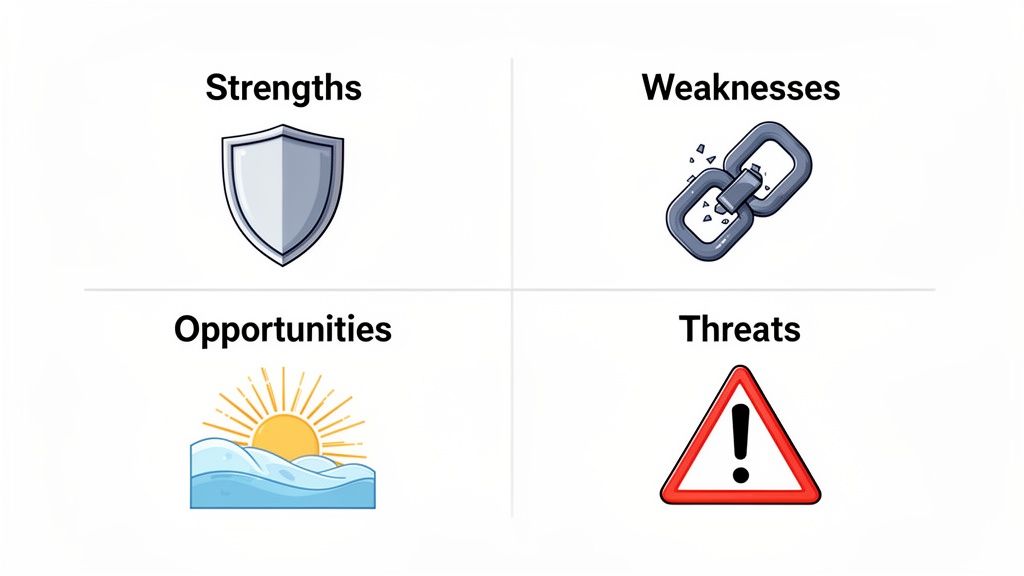
Think of it as a strategic check-up for your nonprofit. It’s a simple framework that helps you organize what you know into four distinct areas: Strengths, Weaknesses, Opportunities, and Threats.
Looking In the Mirror: The Internal Factors You Control
The first half of the SWOT analysis is all about looking inward. These are the things your organization has direct influence over, for better or for worse.
Strengths: What do you do exceptionally well? These are your internal superpowers. Maybe it's a deeply committed volunteer base that contributes thousands of hours of skilled work. It could also be a unique, proven program model that sets you apart from everyone else.
Weaknesses: This part requires honesty. Where are the gaps or challenges holding you back? A common weakness for many nonprofits is relying too heavily on a single funding source, like one major grant, which puts the organization in a precarious spot. Other weaknesses might be a burned-out team or outdated technology that slows you down.
Getting real about these internal factors is the essential first step. You can't build a realistic plan if you don't know what you're working with.
The real magic of a SWOT analysis isn't just making lists. It’s about finding the connections—how you can use your Strengths to jump on Opportunities, and how to protect your Weaknesses from looming Threats.
Looking Out the Window: The External Factors You Must Respond To
The second half of your analysis shifts your gaze outward. These are the forces and trends you can't control, but absolutely must anticipate and react to.
Opportunities: What’s happening out in the world that you could use to your advantage? An opportunity might be a new community need that aligns perfectly with your mission. It could also be a new government grant program opening up or a local company looking for a social impact partner.
Threats: What external challenges could derail your work? Threats can come in many forms: a shift in government policy that cuts funding, growing donor fatigue around your cause, or even another nonprofit opening up nearby with a very similar mission. Naming these threats is the first step to building a defense against them.
Turning Your Analysis into a Game Plan
A SWOT analysis should never be a one-and-done, box-ticking exercise. Its purpose is to spark conversation, challenge assumptions, and push you to connect the dots in a way that truly informs your strategy.
Start by asking these questions with your team:
Strengths + Opportunities (SO): How can we use what we’re good at to seize these opportunities?
- Real-world example: "Our incredible volunteer base (Strength) is perfect for launching that new mentorship program the community has been asking for (Opportunity)."
Weaknesses + Opportunities (WO): How can we use these opportunities to fix our internal weaknesses?
- Real-world example: "We can finally address our stretched staff capacity (Weakness) by going after that new capacity-building grant (Opportunity) to hire a dedicated program manager."
Strengths + Threats (ST): How can our strengths shield us from these external threats?
- Real-world example: "Let's lean on our strong community reputation (Strength) to keep our donors close, especially with new competitors popping up (Threat)."
Weaknesses + Threats (WT): What do we need to do to protect our vulnerable areas from these threats?
- Real-world example: "To reduce the risk of losing our one big grant (Threat), we have to create a real fundraising plan that diversifies our income and makes us less dependent (Weakness)."
- Example: Increase community access to healthy food.
- Example: Launch three new weekly farmers' markets in underserved neighborhoods by October 1st.
- Specific: It isn't just about "health." It pinpoints the action (free health screenings), the target number (500), and the location (downtown district).
- Measurable: Success is crystal clear. Did you hit 500 screenings? Did 75% of participants report learning something new? You can track this.
- Achievable: While ambitious, providing 500 screenings over a couple of years is a realistic target for a health-focused organization. It stretches you without being impossible.
- Relevant: This objective directly fuels the larger goal. Providing screenings and measuring health literacy is a direct line to "improving community health."
- Time-bound: The deadline of December 31, 2026, creates urgency and a clear finish line for evaluation.
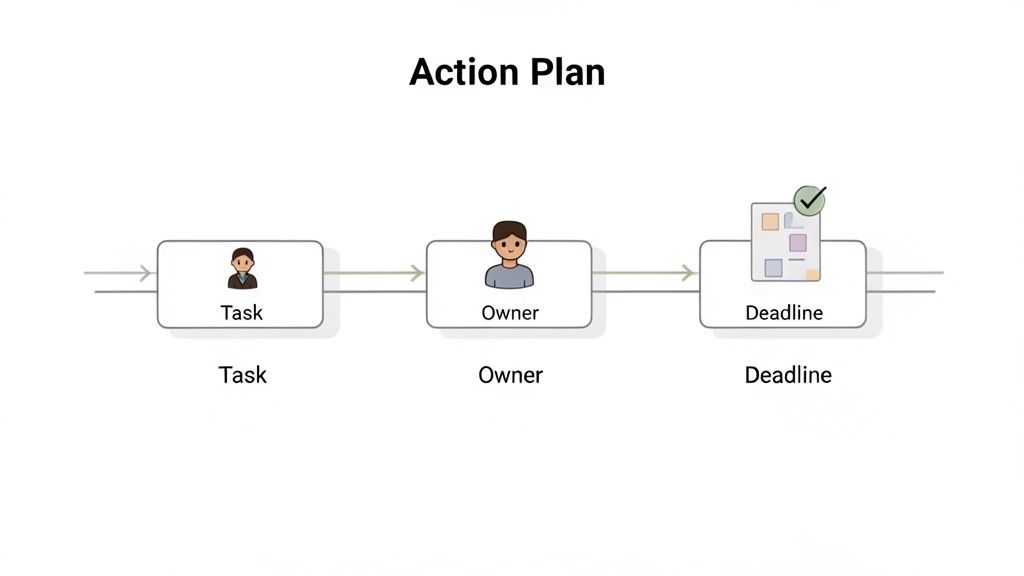
- The Specific Task: Write a clear, simple description of the work. For example, "Draft volunteer recruitment post for social media."
- The Owner: Name the one person who is ultimately responsible for getting the task done. Assigning a single owner is the secret to real accountability.
- Necessary Resources: What’s needed to do the job? This could be anything from budget and staff hours to software or specific supplies.
- The Deadline: Set a firm due date. Deadlines create urgency and help you map out the entire project timeline logically.
- Outputs are the direct results of your activities—the "stuff" you produce. They are usually easy to count but don't show the real story of your impact.
- Outcomes are the actual changes or benefits your program creates for the people you serve. This is the meaningful change you’re working so hard to achieve.
- Clarify your mission and vision.
- Get honest about your strengths, weaknesses, opportunities, and threats (SWOT).
- Set a handful of clear, achievable goals.
- Map out the concrete steps you'll take to reach them.
By approaching it this way, your simple four-quadrant chart transforms into a dynamic tool for strategic thinking. The insights you uncover here will become the raw material for the concrete goals, objectives, and strategies you'll build next.
From Big Ideas to Actionable SMART Objectives
So, you’ve wrestled with your mission and stared reality in the face with a SWOT analysis. That’s fantastic, but those big ideas won't implement themselves. This is the stage where the magic really happens—where you translate your grand aspirations into concrete, measurable actions your team can actually get done.
It's time to build the bridge from your vision to your day-to-day work.
Think of it like planning a road trip. Your mission is the ultimate destination—say, the Pacific Ocean. Your goals are the major cities you need to hit along the way. But the objectives? Those are the turn-by-turn directions that get you from one city to the next. Without them, you’re just driving, hoping you’ll eventually see water.
The Difference Between Goals and Objectives
I see nonprofits get tangled up in this all the time, but the distinction is pretty straightforward once it clicks. A goal is the high-level outcome you're aiming for. An objective is the specific, measurable step you’ll take to get there.
Goals point you in the right direction, but objectives give you the traction you need to move forward. For any nonprofit, well-crafted objectives are the bedrock of accountability. They prove to your board, your staff, and especially your funders that you have a real plan, not just good intentions.
The single most effective way to create powerful objectives is to make them SMART: Specific, Measurable, Achievable, Relevant, and Time-bound. This framework transforms a vague wish into a trackable commitment.
This structure is an absolute game-changer for grant proposals. Grantmakers need to see exactly how their investment will produce tangible results, and SMART objectives deliver that clarity on a silver platter.
Crafting SMART Objectives for Your Nonprofit
Let’s walk through how to use the SMART framework to turn a common nonprofit goal from a nice idea into a fundable, actionable objective.
Vague Goal: Improve community health.
SMART Objective: "Provide 500 free health screenings in the downtown district by December 31, 2026, with 75% of participants reporting increased health literacy on post-screening surveys."
Let's break down why this works so well:
When you define your work this way, you're not just asking for money to "do good work." You are presenting a detailed, professional plan for creating specific, measurable change on a set schedule. It’s a powerful shift.
And once you have these objectives, you need a way to manage them. Tools like Fundsprout's planning features can help you track each objective, assign ownership, and see your progress in real-time, making sure no part of your strategic plan ever gets left behind.
Building Your Action Plan and Implementation Strategy
You’ve set your North Star and defined your SMART objectives. Now comes the hard part: making it all happen. This is where we shift from big-picture thinking to creating an action plan, the detailed roadmap that turns your strategy into reality. If your objectives are the "what," the action plan spells out the "who, how, and when."
Think of your strategic plan as the beautiful architectural blueprint for a new community center. Your action plan is the day-to-day construction schedule. It tells you exactly who is laying the foundation, when the framing needs to be finished, and which team is responsible for installing the windows. Without that schedule, the blueprint is just a dream on paper.
From Strategy to Specific Tasks
An action plan's job is to break down a big, ambitious goal into small, manageable steps. It’s how you take an idea like "launch a new mentorship program" and turn it into a concrete checklist that people can actually follow. This level of detail is absolutely essential for creating momentum and holding everyone accountable.
An action plan bridges the gap between good intentions and real-world results. It grounds your lofty goals in daily work, makes progress easy to see, and keeps the entire team moving in the same direction.
For every single objective, you need to think through all the steps required to get there. This process might feel tedious, but it eliminates confusion and makes sure no critical task gets forgotten. It's really just applying solid project management principles to your nonprofit's mission.
The Essential Elements of an Action Plan
A truly effective action plan has a few key pieces of information for every task. This simple structure is what gives it so much power.
For each item on your to-do list, make sure you have these non-negotiables:
When you spell out these details, you create a clear guide that anyone on your team can understand and follow. A well-built action plan is your best defense against a great strategy dying on the vine, which is an all-too-common problem. To learn more about keeping your strategy documented and accessible, it’s worth exploring the idea of a plan of record.
Visualizing Your Implementation Strategy
Once you have all your tasks, owners, and deadlines, it’s time to visualize the workflow. This is crucial for helping everyone see how their individual piece of the puzzle fits into the larger timeline.
A simple table or a more sophisticated project management tool can bring your action plan to life. Let’s map out a few steps for an objective to "Acquire 50 new monthly donors by the end of Q4."
This kind of clear structure ensures your team stays coordinated and focused on getting things done, not just talking about them. Fundsprout’s planning tools can actually help you build these workflows, automate your task assignments, and track progress against deadlines, turning your strategic plan from a static document into a dynamic guide for growth.
So, you’ve mapped out your grand objectives and built a solid action plan. The big question now is: how will you know if any of it is actually working? This is where you need to start measuring what matters.
Welcome to the world of Key Performance Indicators (KPIs). These aren't just fancy acronyms; they are the vital signs of your strategic plan. KPIs are the specific, measurable data points that tell you if you're on track to hit your goals.
Think of it like this: your strategic plan is the road map for a cross-country trip. Your KPIs are the gauges on your car's dashboard. The speedometer tells you if you're moving at the right pace, the fuel gauge shows if you have enough gas to keep going, and the temperature gauge warns you of potential engine trouble. Without them, you’re just driving blind and hoping for the best.
H3: Outputs vs. Outcomes: The Difference Funders Care About
For nonprofits, one of the most important concepts to master is the difference between outputs and outcomes. Getting this right can completely change how funders see your impact.
Let’s take a classic nonprofit example: a job skills workshop. An output would be "50 people attended the workshop." An outcome, on the other hand, is "the percentage of attendees who found a job within three months" or "a 40% increase in participants' confidence in their interviewing skills."
Funders are laser-focused on outcomes. They don't just want to see how you spent their grant; they want to know what real-world change you created with it. Proving outcomes is everything.
You need a plan to measure both. Outputs show that you're active, but outcomes prove that you're effective. If you want to dig deeper into structuring your programs for measurement, our guide on creating a logic model for program evaluation is a great place to start.
H3: Choosing the Right KPIs for Your Nonprofit
The best KPIs are not one-size-fits-all; they are tailored to the specific part of your organization you're measuring. The trick is to choose a handful of powerful indicators that connect directly to your objectives.
To help you get started, let’s look at some examples of KPIs for common nonprofit functions. Notice how they measure different aspects of success, from how many people you reach to how efficiently you operate.
Example KPIs for Nonprofit Program vs. Fundraising
As you can see, a program team might focus on participant success, while the fundraising team tracks donor engagement and giving trends.
Of course, choosing your metrics is only half the job. You also need a simple, clear plan for collecting the data from day one. This means deciding who will collect it, how they'll do it (surveys, interviews, database reports), and how often.
When you make measurement an integrated part of your strategy—not a stressful afterthought—you gain the power to learn, adapt, and tell a compelling story of your success to the world.
Frequently Asked Questions
Even with the best-laid plans, questions will come up. That’s a normal part of the process. Here are some quick answers to the most common questions we hear from nonprofits as they put their strategy into action.
How Often Should We Update Our Plan?
Think of your strategic plan as having a 3-5 year lifespan, but don't mistake it for a document that’s set in stone. The single biggest error is to create a plan and then let it sit on a shelf. It needs to be a living, breathing guide.
We strongly suggest a formal review at least once a year. This is your chance to check your progress against the big goals, see what's changed in your environment, and adjust your course. The smaller pieces, like your action plans and quarterly objectives, should be looked at much more often—monthly or quarterly meetings are perfect for keeping the team focused and the strategy relevant.
What Is the Biggest Mistake in Strategic Planning?
Hands down, the most common pitfall is creating the plan in isolation. When a plan is developed only by leadership and then handed down, it almost never gets the buy-in needed to succeed. An essential component of strategic planning is bringing people along for the ride. When your staff, board, and volunteers feel a sense of ownership, they become champions for the plan.
The flip side of that mistake is failing to weave the plan into your organization's daily life. If your strategy doesn't guide your team meetings, budget talks, and performance reviews, it's not a plan—it's just a document.
Can a Small Nonprofit Really Do This?
Absolutely. In fact, you could argue strategic planning is even more essential for smaller nonprofits. When your time and money are tight, a good plan forces you to be ruthless about prioritization, making sure every single resource is aimed at activities that deliver the most impact.
You don't need a huge budget or a fancy retreat to make it happen. The process can easily be scaled to fit your team’s capacity. It might just be a series of focused, two-hour meetings. The goal is to cover the core components:
A simple, focused plan is infinitely better than no plan at all. If you have more questions about getting started, you may find what you're looking for in these Frequently Asked Questions.
With Fundsprout, you can transform your strategic plan from a static document into a dynamic roadmap for success. Our AI-powered platform helps you discover aligned funding opportunities, manage every task and deadline, and track your progress toward each and every goal. Start building a plan that delivers results with Fundsprout.
Try 14 days free
Get started with Fundsprout so you can focus on what really matters.