Community Center Grant: Your Path to a winning community center grant
Discover practical tactics to secure a community center grant. Find opportunities, craft winning proposals, and demonstrate real impact.

Abdifatah Ali
Co-Founder
Winning a community center grant rarely starts with writing the proposal itself. The real work—the work that separates the funded from the forgotten—happens long before you even type a single word. It’s all about building an unshakeable foundation that shows any funder you’re a credible, impactful, and low-risk partner.
Building a Fundable Foundation for Your Grant Proposal
Let’s be honest: funders are drowning in applications. They're looking for any reason to move a proposal from the "maybe" pile to the "no" pile, and a disorganized, last-minute scramble is a massive red flag. A well-prepared organization, on the other hand, just feels different. It radiates confidence and competence from the very first page.
The good news is that the field is massive. We're talking about over 7,000 available grants that add up to more than $2.6 billion in potential funding. With a median award of around $30,000, these grants are a lifeline for community centers. The challenge is cutting through the noise, and that starts with having your ducks in a row.
Back Up Your "Why" with Hard Data
Before you can pitch your amazing solution, you have to prove the problem is real. This is where a data-driven needs assessment becomes your best friend. It elevates your argument from a well-meaning "we think our community needs this" to a powerful "the data proves our community needs this." Trust me, grant reviewers notice the difference.
Don't just rely on anecdotes. You need to dig into local, specific data to paint a clear picture of the need. Some of the best places to look are:
- Local Census Data: This is a goldmine for demographic info, income levels, and household stats that can instantly highlight underserved groups.
- Public Health Reports: These can give you concrete numbers on everything from food insecurity rates to the lack of safe recreational spaces for teens.
- School District Data: Look for trends in academic performance, graduation rates, or attendance that point to a need for after-school support.
- Community Surveys and Focus Groups: This is how you add the human story to your statistics. Nothing is more powerful than direct quotes from the people you plan to serve.
Imagine the impact of showing that 40% of local seniors live alone (census data) and that a recent survey found they overwhelmingly report feelings of isolation. Suddenly, your proposal for a new senior wellness program isn't just a nice idea—it's an undeniable necessity.
Align Your Mission with the Need
Once you've defined the problem with data, you have to show why your organization is the perfect one to solve it. Your mission and vision statements aren't just fluff for your website; they're the North Star for your entire grant proposal. Every program, every activity, and every dollar in your budget must tie directly back to that core purpose.
A powerful mission is clear, specific, and memorable. It tells funders exactly what you do, who you serve, and why it's so important. This clarity is the first filter. It helps reviewers quickly see if your work fits their funding priorities, which is half the battle.
Key Insight: Grant funders don't just fund projects; they invest in organizations. A clear mission paired with a data-backed needs assessment shows you have the strategic vision to turn their dollars into real, measurable change in the community.
Assemble Your Grant-Ready Toolkit
The final piece of your foundation is getting all your essential paperwork in order before you need it. I can't tell you how many panicked calls I've gotten from teams scrambling to find their IRS letter an hour before a deadline. It's a recipe for disaster and immediately tells a funder you aren't prepared.
Getting your "grant-ready toolkit" organized ahead of time is a professional power move. It shows you're serious and allows your team to focus on what matters most: writing a compelling story.
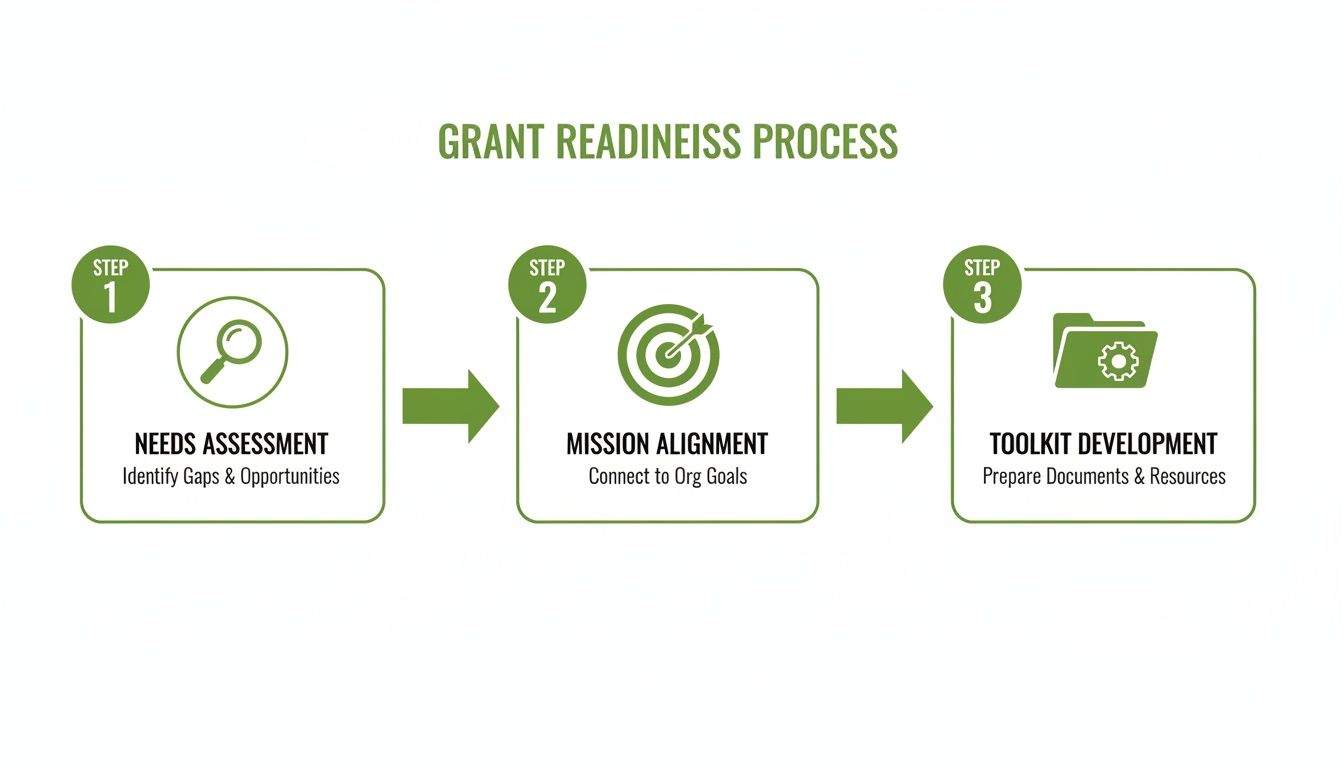
Think of it this way: first, you use data to identify what your community truly needs. Then, you connect that need directly to your organization's mission. The final step is having all your proof points and official documents ready to go.
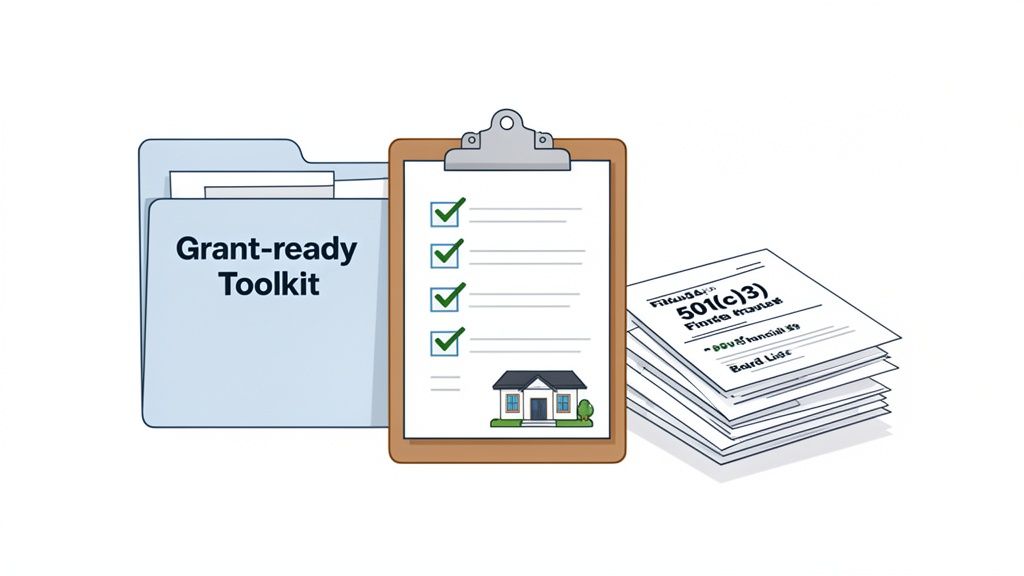
Make sure this toolkit is in a shared, easy-to-access folder. It should contain:
- Your official 501(c)(3) determination letter.
- An up-to-date list of your board of directors, including their professional affiliations.
- Your most recent financial documents (like an audit or Form 990).
- Short biographies for key staff and a clear organizational chart.
- A basic budget outline. You can get a head start by using a proven grant budget template.
Once you have this foundation in place, your entire approach changes. You're no longer just asking for a handout. You're presenting a meticulously researched, credible investment opportunity to a potential partner who wants to see you succeed.
Finding and Qualifying the Right Grant Opportunities
Searching for the perfect grant can feel like digging for gold. A quick search for "community center grant" might give you thousands of results, but the truth is, most of them won't be a good fit. To find the real gems, you have to get smarter than a simple Google search and start thinking like a seasoned grant professional.
This is about shifting from a wide-net approach to a targeted one. It’s the difference between chasing every dollar and building a sustainable funding pipeline with funders who genuinely want to see you succeed.
Look Where the Funders Are
So, where do you even start looking? While a search engine can be a starting point, the best opportunities are hiding in plain sight on dedicated grant databases. These platforms are built for nonprofits and let you filter out all the noise.
Here are the places I always tell people to start:
- Federal Portals: For big, ambitious projects, Grants.gov is your go-to. It’s the official source for all federal grants, from agencies like the Department of Health and Human Services (HHS) or Housing and Urban Development (HUD). It can be a beast to navigate, but the funding can be significant.
- State and Local Clearinghouses: Don't sleep on your own backyard. Most states run their own grant portals that pull together funding from state agencies. These are often less competitive than federal grants and are, by nature, focused on solving local problems.
- Foundation Directories: This is where you'll find private, family, and corporate foundations. Tools like Candid's Foundation Directory Online and Instrumentl are absolutely essential. Foundations account for a huge slice of the nonprofit funding pie, and these directories are the maps to find them.
How to Know If a Grant Is a Good Fit
Finding a promising community center grant is one thing; knowing if it's worth your time is another. This is where the real detective work begins. Chasing a grant from a misaligned funder is one of the biggest time-wasters in the nonprofit world.
A solid qualification process will save you hundreds of hours. It ensures you only spend your limited energy on proposals that have a real shot. For instance, the Oregon Department of Energy recently funded solar panels for a new Latino community center. If your organization focuses on youth sports, that's an obvious mismatch. But if your center is all about building community resilience, you're a perfect candidate.
Start by visiting the funder’s website. Read their mission, check out their latest news, and download their annual reports. Then, dig deeper by looking at their past grantees.
Pro Tip: Don't just scan the list of who they funded. Pay close attention to what specific projects they supported and for how much. If a foundation’s typical community center grant is $25,000, sending them a beautifully written proposal for $250,000 is almost always a waste of everyone's time.
This research helps you answer the most important question: Do we actually fit?
Create Your Funder Alignment Checklist
To keep yourself honest, run every potential funder through a simple checklist. This formalizes your vetting process and stops you from falling for an opportunity that looks great on the surface but is fundamentally a poor match.
Your Alignment Checklist:
Answering these questions honestly provides a clear "go" or "no-go" signal. This disciplined approach is a game-changer for improving your grant-seeking efficiency. As you get more comfortable with this process, you might want to explore more advanced techniques for funding community development projects.
Ultimately, this methodical qualification ensures you're always writing for a receptive audience, which is the secret to dramatically boosting your success rate.
Designing Programs That Funders Want to Back
A great idea gets you in the door, but a well-designed program is what actually gets funded. Grant reviewers see countless inspiring concepts for community center grants. The ones that stand out—and get the check—are the ones with a clear, logical, and impactful plan. This is your chance to show you’ve done the hard work of turning a community need into something a funder can trust and get excited about.
Your program design needs to walk a fine line. It should be ambitious enough to make a real difference, yet practical enough that it feels completely achievable. It’s about proving you have a rock-solid plan for not just what you want to do, but how you’ll do it and why it’s going to work.
Setting Goals That Impress
Nothing sinks a proposal faster than vague goals. "We want to help local seniors" is a wonderful mission, but it’s not a fundable objective. Funders need specifics they can measure. For this, the SMARTIE framework is your best friend: Specific, Measurable, Achievable, Relevant, Time-bound, Inclusive, and Equitable.
Let's see what this looks like in practice. Instead of that vague goal, a SMARTIE goal sounds more like this:
- Specific: We will launch a "Tech Connect for Seniors" program to combat social isolation by teaching digital literacy skills.
- Measurable: We aim to enroll 50 seniors and achieve a 25% decrease in self-reported loneliness scores, measured by pre- and post-program surveys over six months.
- Achievable: Our team includes a certified instructor, and we’ve already secured a donated classroom space with 15 computers.
- Relevant: This directly answers the high rates of senior isolation we uncovered in our community needs assessment.
- Time-bound: The program will run for one year, consisting of two separate six-month cohorts.
- Inclusive: All program materials will be available in English and Spanish. We're also partnering with local senior housing facilities to reach those with limited mobility.
- Equitable: The program is free. We will also provide transportation vouchers to eliminate financial barriers for low-income participants.
See the difference? That level of detail proves you’ve graduated from wishful thinking to concrete, actionable planning.
Visualizing Your Path to Success with a Logic Model
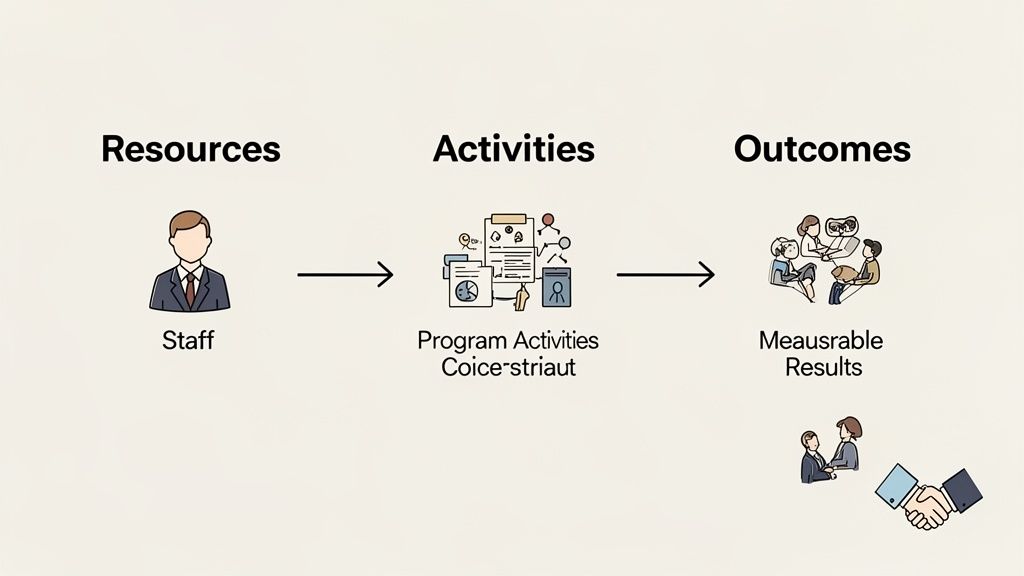
Once you've nailed down your goals, you need a way to show the funder exactly how you'll connect your activities to your intended impact. This is where a logic model comes in—it’s a simple but incredibly effective visual chart that lays out your entire program from start to finish. Think of it as your program’s roadmap.
A good logic model connects the dots between your resources and your long-term vision. It shows you’ve thought through the entire chain of events.
Example Community Program Logic Model
This table illustrates a simplified logic model for an after-school tutoring program, showing how the resources you put in (Inputs) lead directly to the long-term changes you want to see (Outcomes).
Building a logic model isn't just for the proposal; it forces your own team to get crystal clear on whether your plan holds water. To dig deeper, check out our guide on building a logic model for program evaluation.
The Power of Smart Partnerships
Your community center doesn’t exist in a vacuum, and your programs shouldn't either. Grant reviewers get excited about collaboration because it shows your project has deep roots in the community and a plan to maximize its reach. Partnering with schools, local businesses, or other nonprofits makes your proposal exponentially stronger. It proves you’re building on existing community strengths, not starting from scratch.
For example, a youth arts program could partner with the school district for student recruitment and with a local artists' guild to bring in professional mentors. To show funders just how effective these collaborations are, it's vital to know how to promote an event effectively and track the results.
A strong partnership signals to funders that your project is not just a good idea, but a well-integrated community solution with multiple stakeholders invested in its success.
This is especially true for government grants, which often prioritize initiatives that tackle city-wide challenges. For example, Portland's recent Community Grants program awarded over $64 million to 60 community-led projects. The common thread? Many were collaborations aligned with specific city goals like climate resilience and workforce development. It’s a perfect example of how aligning your program with broader priorities—often through partnerships—can pay off in a big way.
Crafting a Narrative That Connects and Persuades
This is where the real storytelling begins. You've done all the heavy lifting—the needs assessments, the partner meetings, the program design. Now it's time to translate that hard work into a story that a grant reviewer simply can't ignore. Think of this as the heart of your community center grant proposal.
Don't be intimidated by a blank page. The secret is that you already have the perfect outline waiting for you. It's hidden in plain sight, right inside the funder's Request for Proposal (RFP).
Using the RFP as Your Narrative Blueprint
Think of the RFP not as a list of rules, but as your story's chapter list. Sections like "Project Description," "Organizational Capacity," or "Evaluation Plan" are direct prompts from the funder. They are telling you exactly how they want to hear your story.
Here's a trick I've used for years: copy and paste the main headings and subheadings from the RFP directly into a new document. Under each one, list out the specific questions they ask. This instantly transforms the daunting task of writing from scratch into a much more manageable, fill-in-the-blanks process. It also ensures you don't miss a single requirement.
Blending Data with Human Stories
The most powerful proposals I've ever read walk on two legs: solid data and real human connection. Your needs assessment gives you the "what"—the cold, hard facts that prove a problem exists. But it's the personal stories that provide the "why"—the emotional core that makes a reviewer care.
For example, a statistic like "65% of teens in your service area report having no safe after-school activities" is strong. But imagine pairing it with a short, powerful quote from a local mom who’s terrified for her son’s safety between 3 PM and when she gets home from work. Suddenly, your statistic has a face and a name.
This blend shows the reviewer you understand the issue from every angle, both intellectually and on a deeply human level.
Key Takeaway: Data makes your argument credible, but stories make it memorable. The best proposals weave them together seamlessly, creating a narrative that speaks to both the head and the heart.
Building the Financial Story of Your Grant
Your budget isn't just a spreadsheet; it's the financial chapter of your story. Every single line item must be a direct reflection of the activities you've already described. If a reviewer has to struggle to connect a budget request to a program activity, it's a huge red flag for them.
Interestingly, you can pick up great storytelling tips from unexpected places. Looking at a well-structured scholarship application template, for example, shows how to persuasively argue for financial support by telling a compelling story—a skill that's universal in the funding world.
A well-justified budget builds an incredible amount of trust. Be ready to explain the "why" behind every dollar.
- Personnel Costs: Don't just write "Program Manager - $50,000." Justify it. "Program Manager at 1.0 FTE, responsible for all program delivery, volunteer coordination, and outcomes reporting as detailed in the project activities."
- Direct Program Costs: Connect supplies directly to your plan. "Art supplies for 25 participants in our twice-weekly Youth Arts Workshop for one full year."
- Indirect Costs: Be upfront. If you have a federally negotiated indirect cost rate, state it. If not, briefly explain how you calculated your overhead and what it covers—like the portion of rent, utilities, and administrative support that truly makes the program possible.
Planning for a Future Beyond the Grant
Funders are investors. They want to see a return on their investment in the form of lasting impact, not just a one-off project that vanishes when the money does. Your sustainability plan is your answer to the reviewer's most important unasked question: "What happens when our funding ends?"
This section shows you're thinking strategically about the long-term health of your community center. A fantastic example is the Latino Network in Oregon, which secured a $579,841 grant for solar panels. They didn't just frame it as an environmental project; they highlighted the long-term energy cost savings and the center's ability to act as a resilient hub during power outages. This forward-thinking approach made their proposal a far more attractive investment.
Your sustainability plan might include a mix of strategies:
- Diversifying revenue with individual giving campaigns or new corporate sponsorships.
- Introducing a sliding-scale fee for certain programs, ensuring access with scholarships.
- Building an endowment or a rainy-day reserve fund over time.
- A clear plan to absorb successful pilot programs into your general operating budget.
Showing a clear path forward tells the funder you're a responsible partner who is truly committed to serving your community for the long haul.
Using Data to Build an Unbeatable Case for Funding
In the grant world, let’s be honest: passion gets you in the door, but hard data gets you the check. Grant reviewers see hundreds of applications filled with compelling stories and good intentions. What they're really looking for is proof that your community center is a smart, low-risk investment capable of making a real impact.
Building a data-driven case for your community center grant is how you provide that proof. It shows you’re not just mission-driven but also strategic and accountable. For a funder, that’s the sign of a partner they can trust to deliver results.
First, Build Your Evaluation Roadmap
Before you write a single word of the proposal, you need an evaluation plan. This isn't just a box to check; it’s the roadmap you'll use to prove your program actually works. A strong plan is proactive, showing you’ve thought deeply about what success looks like and how you'll measure it.
Your plan should answer a few critical questions for the reviewer right away:
- How will you know you're succeeding?
- What specific metrics will you track to measure both your activities and their real-world impact?
- What’s your timeline and method for collecting this data?
- Who on your team is in charge of making sure this happens?
Answering these questions upfront signals a level of preparedness that immediately sets you apart. It tells funders you’re focused on outcomes from day one.
Go Beyond Activities: Pinpoint Your Key Performance Indicators
The heart of your evaluation plan is your Key Performance Indicators (KPIs). These are the specific, measurable data points you’ll track. The most common mistake organizations make is only tracking what they do, not the difference they make. That’s why you have to distinguish between outputs and outcomes.
Outputs are the direct results of your activities. Think of them as proof of work. For example, "the number of workshops held" or "the number of youth who enrolled in our program." They're important, but they don't tell the whole story.
Outcomes measure the actual change your program creates in people's lives. This is the impact story. Did you achieve "a 20% improvement in participants' reading scores" or "a 30% reduction in feelings of social isolation among local seniors"? That's the gold.
Funders care about outputs, but they invest in outcomes. Your ability to define and track clear outcome KPIs is what truly demonstrates your value and potential for creating lasting change in the community.
This focus on data isn't just a suggestion; it's a clear trend. Just look at the competition for the 2026 Road to Zero Community Traffic Safety Grants, which saw a record 170 organizations apply. The projects that won were the ones that used data-driven approaches—from GIS mapping to pinpoint accident hotspots to AI-powered crash prevention models. You can read more about how data influenced these funding decisions to see where the industry is heading.
Turn Your Numbers into a Narrative
Raw data in a spreadsheet is boring. To make your case, you need to turn those numbers into a compelling visual story. Simple charts, graphs, and tables can transform a dry list of statistics into a powerful argument that’s easy to grasp in seconds.
Imagine showing a simple bar chart that illustrates the massive gap between the need for after-school programs in your community and the services currently available. Then, right next to it, a projection showing exactly how your program will help close that gap over the next two years. That’s infinitely more persuasive than a dense paragraph of text.
Sample KPI Tracking for a Community Center Program
A clear, well-organized table like this one can be your best friend. It directly connects your program's goals to your measurement strategy, making it incredibly easy for a reviewer to see the logic behind your plan.
This level of detail does more than just strengthen your community center grant proposal. It gives your own team a powerful internal tool to stay focused on what really matters: making a measurable difference.
Your Community Center Grant Questions Answered
When you're deep in the trenches of grant funding, a lot of questions pop up. It’s completely normal to hit a few roadblocks. Let’s walk through some of the most common hurdles we see organizations face when trying to land a community center grant, so you can feel ready to tackle them yourself.
What Are the Most Common Reasons Grant Proposals Get Rejected?
Getting a rejection letter stings, no doubt. But nine times out of ten, it’s not because your idea wasn’t good—it’s because the proposal itself stumbled. The good news is that most rejections stem from a few core issues that are completely avoidable.
The biggest reason, by far, is a simple misalignment with the funder's priorities. You could have the most amazing project, but if it doesn't line up with that foundation's specific mission or geographic focus, it’s a non-starter. It’s the classic square-peg-in-a-round-hole problem.
Another dealbreaker? Not proving the need. If your proposal doesn't back up its claims with hard data, reviewers will see a risky idea, not a solid community investment. A messy or vague budget is another huge red flag that screams "poor planning."
Finally, you’d be surprised how many applications are tripped up by simple administrative mistakes. These are the easy-to-miss details that can get you disqualified before a reviewer even reads your story.
- Failing to follow the exact formatting instructions.
- Forgetting a required attachment (like your 501(c)(3) letter).
- Missing the deadline, even by just a few minutes.
Your best defense here is a good old-fashioned checklist. Go through the funder's instructions line by line before you even think about hitting "submit."
Can We Apply for a Grant if We Are a New Nonprofit?
Yes, you absolutely can, but you have to be strategic. While it’s true that many funders want to see a long track record, others specifically look for promising new groups to support with "seed funding" or "capacity-building" grants.
Without years of program data to show off, your job is to build credibility in other ways.
Your main goal as a new nonprofit is to lower the funder's perceived risk. You do that by showing you have strong leadership, deep community support, and a rock-solid plan that's ready to go on day one.
Start by building a powerhouse board of directors with real expertise and strong ties to the community. You should also forge partnerships with well-known local organizations; their established credibility can give your project a major boost. Powerful letters of support from community leaders, principals, and potential clients are also incredibly persuasive.
Even a small, self-funded pilot project can be a game-changer. It lets you gather some early performance data, proves your concept works, and makes you a much stronger candidate for that first community center grant.
How Far in Advance Should We Start the Grant Process?
The real answer? Probably earlier than you think. The grant process is so much more than just writing. It’s about research, building relationships, and detailed planning. For a major foundation or federal grant, you should plan for at least 8-12 weeks from the moment you decide to apply to the final deadline.
That may sound like a lot, but it gives you the breathing room you need for every critical step:
- Weeks 1-2: Take a deep dive into the funder's guidelines and create your project outline.
- Weeks 3-5: This is your data-gathering phase. Collect community stats, get quotes for expenses, and formalize partner agreements.
- Weeks 6-8: Time to write. Draft the full narrative and build out your line-item budget.
- Weeks 9-10: Get fresh eyes on it. Have team members and maybe even a trusted outsider review everything and provide feedback.
- Week 11: Final proofreading and formatting. Make sure every 'i' is dotted and every 't' is crossed.
- Week 12: Submit! Aim to get it in a few days before the deadline to avoid any last-minute tech glitches.
Trying to cram this into two weeks is a recipe for a sloppy, uncompetitive proposal. A simple trick I love is to work backward from the due date on a calendar. This simple step helps you visualize the timeline and avoids that all-too-common last-minute panic.
Navigating the complexities of finding, writing, and managing a community center grant is a full-time job. Fundsprout is your AI-powered partner for grant success, helping your team discover the perfect funding opportunities, draft compelling proposals, and stay compliant. See how our platform can transform your grant workflow at https://www.fundsprout.ai.
Try 14 days free
Get started with Fundsprout so you can focus on what really matters.