Funding from the College Success Foundation: A Guide
Explore the College Success Foundation's mission, programs, and funding priorities. Our guide helps nonprofits navigate application pathways and find support.

Abdifatah Ali
Co-Founder
You're probably staring at the same puzzle most nonprofit leaders face. Your team has a program that helps students persist, but funders keep sorting your work into narrow buckets. One grant covers scholarships. Another wants mentoring. A third supports college readiness but not follow-through after enrollment. Meanwhile, students don't experience their lives in separate budget lines.
That's why the College Success Foundation matters. For grant seekers, it's easy to treat CSF like just another education funder or scholarship brand. That's a mistake. CSF is better understood as a systems partner with a specific view of what college success requires, who needs support, and how long that support must last.
If you're trying to align with CSF, the practical question isn't “How do we ask for money?” It's “How do we show that our program fits the way CSF thinks about student success?” That means reading past the public-facing student language and understanding the operating logic underneath it.
A strong approach starts with fit, not flattery. You need to know what CSF does, where your organization complements that work, what kind of partnership is realistic, and how to present your value in terms a strategic partner will respect.
Your Guide to Partnering with the College Success Foundation
Many organizations approach the College Success Foundation after a familiar stretch of frustration. They've built a credible college access or persistence program, they can point to student stories that matter, and they know their work fills a real gap. But they still struggle to translate that work into fundable language that resonates with a mission-driven education organization.
The first shift is mental. CSF isn't just a potential check writer. It operates more like a long-horizon partner that cares about whether supports hold together across transition points, especially for students who face the most friction navigating school, finances, family responsibilities, and college systems. If your organization only presents one isolated intervention, you may sound useful but not aligned.
That doesn't mean you need to replicate CSF's full model. It means you need to understand where your contribution fits inside a broader student-support pathway.
Practical rule: Don't lead with need alone. Lead with how your work strengthens continuity for students who are most likely to be lost at handoff points.
Grant writers often over-focus on organizational biography. CSF-oriented outreach works better when it answers operational questions. Which students do you serve? Where do they get stuck? What support do you provide that schools or colleges struggle to sustain? How do you coordinate academic, financial, social, or emotional support rather than treating them as unrelated services?
Keep your eye on three things:
- Mission fit: Your work should support student persistence, access, completion, or transitions, not just one-off enrichment.
- Population fit: You should be able to speak clearly about low-income students, first-generation students, or others who face structural barriers.
- Delivery fit: Your model should show how support is maintained over time, across institutions, or across geography.
The organizations that make progress with a funder like CSF usually do one thing well. They present themselves as a credible piece of a larger student success system.
What Is the College Success Foundation
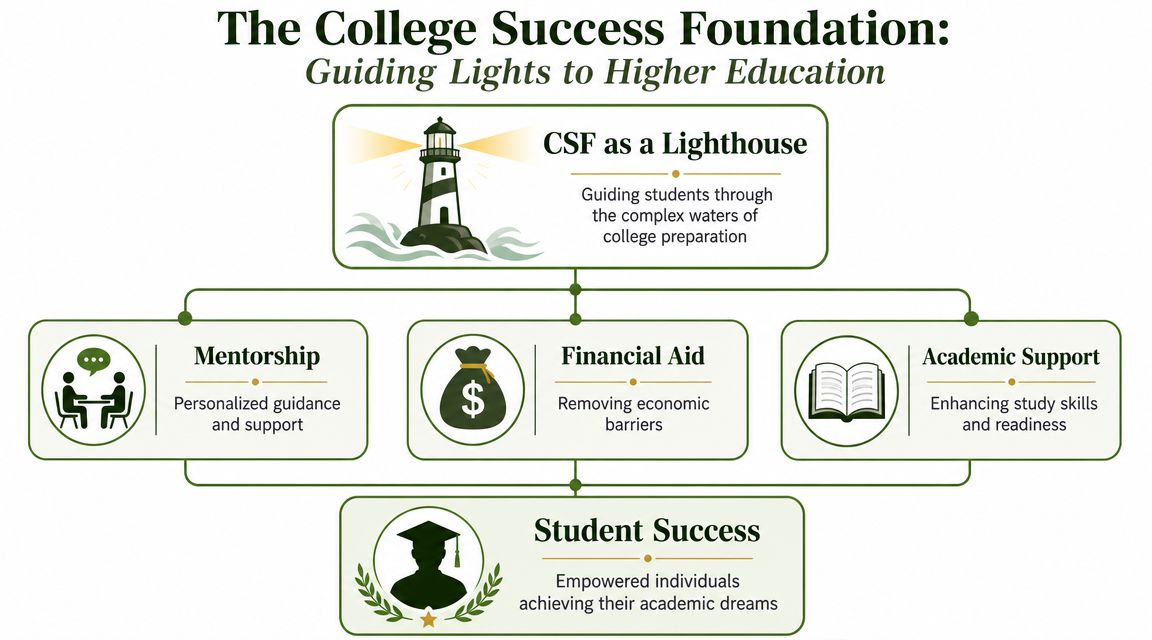
The College Success Foundation is easiest to understand as a support scaffold, not a scholarship fund. Scholarships matter, but they're only one beam in the structure. CSF's model is built around the idea that students need support before college, during college, and at the moments when many institutions assume students will figure things out on their own.
CSF was established in 2000 by Bob Craves, Ann Ramsay-Jenkins, and community leaders, with initial funding from the Bill & Melinda Gates Foundation to provide scholarships and mentoring for low-income students. In its institutional history, the organization says it now serves students from middle school through college, and a later update reports that it served more than 24,000 students in Washington state and the District of Columbia in a single year, according to the College Success Foundation mission, vision, and history page.
Why the model matters to grant seekers
If you're a new grant writer, this distinction matters immediately. Many education funders support one stage of the pipeline. They may care about college enrollment, FAFSA completion, advising, or emergency financial help. CSF's identity is different. It's built around integration across stages.
That means your organization will look more relevant if you can explain how your work reduces dropout risks at points where students typically lose momentum. Those transition points may include the move from high school to college, the first year on campus, transfer navigation, or the balancing act between school and work.
What makes CSF different from a simple scholarship program
CSF's published operating model describes an integrated, multi-year support system that starts in middle school and continues through high school, college, and beyond. It combines academic, financial, social, and emotional supports with scholarships to reduce persistence barriers that often appear at transition points, as described in the CSF annual report PDF.
For a nonprofit, that creates a useful filter.
| If your organization does this | CSF alignment likely looks like this |
|---|---|
| Offers one-time workshops | Weak unless tied to a larger persistence strategy |
| Provides long-term advising | Stronger, especially if tied to student transitions |
| Combines financial help with coaching | Strong, because it mirrors integrated support logic |
| Serves students in isolation from schools or colleges | Mixed, unless you can show coordination and continuity |
CSF's worldview is practical. Students don't fail because they lack one thing. They get pushed out when several small barriers stack up at once.
That's the lens your proposal should use.
Understanding CSF Programs and Proven Impact
The easiest way to understand CSF's programs is to follow the path of a student who needs more than a scholarship.
A student might first encounter support before college as they begin to imagine higher education as something concrete rather than abstract. That support becomes more intensive in high school, where students often need help translating aspiration into applications, financial decisions, and actual enrollment steps. Once in college, the challenges change. Students aren't just choosing a school anymore. They're trying to persist through costs, coursework, bureaucracy, belonging, and competing life demands.
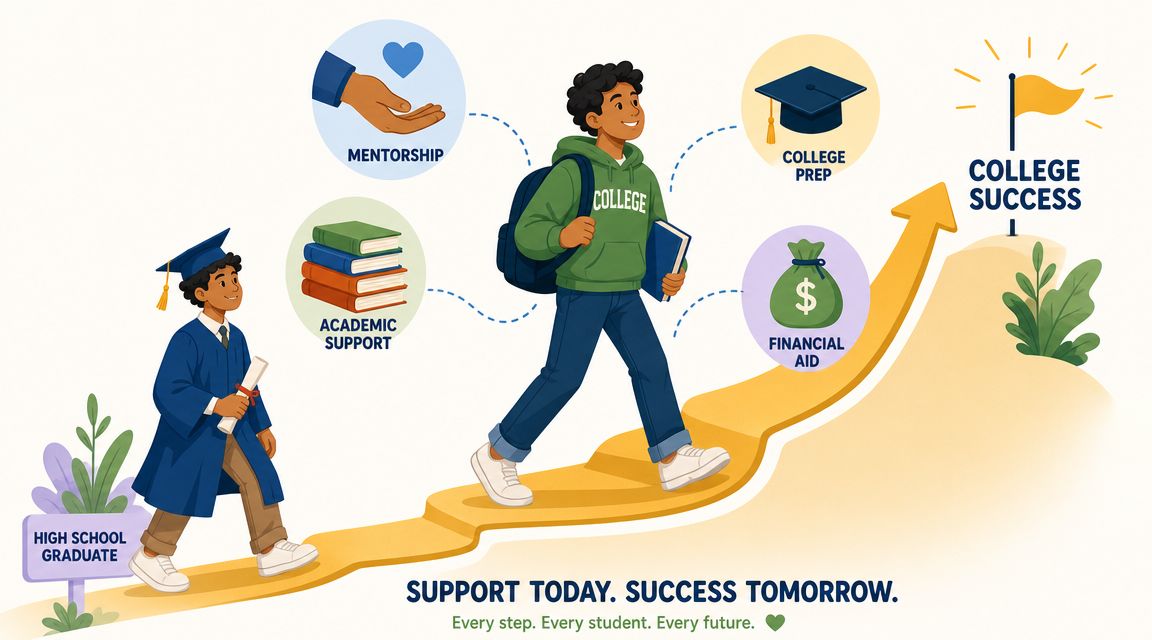
That's where CSF's integrated model becomes concrete. It doesn't treat access as the finish line. It treats access as the beginning of a longer support obligation.
What the program journey tells a funder
For nonprofit partners, the key lesson is that CSF values continuity. If your organization serves students only at intake, or only when there's a crisis, that can still be useful. But you'll need to show how your piece connects to an ongoing student journey rather than functioning as a disconnected intervention.
A good partnership narrative sounds like this: “Students enter our program at a point where they're at risk of losing momentum. We stabilize that stage, coordinate with other actors, and help move them into the next stage with less friction.”
That's much stronger than: “We provide helpful services to deserving students.”
What proven impact looks like here
CSF's alumni survey gives grant seekers something many education organizations struggle to show, which is a line from support to later-life outcomes. According to the College Success Foundation alumni impact release, 65% of alumni earn $60,000 or more annually, 42% earn $80,000 or more, 89% believe their children will attend college, and 72% are already saving for their children's education.
Those numbers matter because they frame college success as both economic mobility and intergenerational change. For a grant writer, that means your proposal shouldn't stop at short-term outputs. If your work contributes to completion, stability, confidence, or family college-going expectations, say so clearly and responsibly.
Here's a useful way to present your own impact evidence:
- Immediate outcomes: What changed while students were actively participating?
- Transition outcomes: What happened when they moved to the next step?
- Longer-range effects: What signs show increased stability, persistence, or family-level aspiration?
Later in the service pathway, CSF has also highlighted remote college coaching across Washington and support across multiple regions through a hybrid approach, as reflected on the CSF Washington state page. That's relevant for partners because it signals openness to scaled support models, while also leaving real operational questions on the table about where virtual advising works best and where it doesn't.
Below is a useful orientation point if you're trying to understand the public-facing student side of the organization.
The practical takeaway is simple. CSF appears to value programs that don't disappear when students leave one institution and enter another.
Decoding Funding Priorities and Eligibility
Most nonprofits look for an application page first. With CSF, that can be the wrong starting point.
In practice, “funding” may mean several different things: direct student support, program collaboration, regional initiative alignment, referral pathways, or a shared delivery model. If you approach CSF as though it were a standard foundation with a broad open-call process, you may waste time building a proposal for an opportunity that doesn't exist in that form.
Start with institutional fit
CSF's operating model centers on a multi-year support system that combines academic, financial, social, and emotional support with scholarships. That tells you a lot about likely priorities, even without a public checklist. They're not just interested in whether students are talented or motivated. They're interested in whether the support environment around those students is strong enough to carry them through predictable barriers.
That gives you a practical screen for eligibility. You're more likely to fit if your organization:
- Serves students over time: One-off exposure activities are harder to position unless they feed into a longer support pathway.
- Works with underserved populations: Your mission should connect clearly to students who face structural barriers in reaching and completing college.
- Adds something complementary: You should solve a problem CSF can't or shouldn't solve alone.
- Can work across systems: School, family, community, and college coordination matter more here than stand-alone programming.
Read priorities through operations, not slogans
A seasoned grant writer pays attention to what an organization must manage internally. CSF serves students across regions and across educational stages. That means any partner conversation is likely to involve delivery consistency, referrals, communication, and the durability of your program.
If your house isn't in order, don't reach out yet.
Use this internal checkpoint before you initiate contact:
| Question | Why it matters |
|---|---|
| Can we describe our target student clearly? | Vague beneficiary language weakens alignment |
| Do we know where students exit our pipeline? | CSF logic is built around persistence barriers |
| Can we explain our role relative to schools and colleges? | Overlap without clarity creates friction |
| Do we retain supporters and relationships well? | Partnership viability depends on follow-through |
On that last point, strong external partnerships usually sit on top of strong internal stewardship. If your donor communications are inconsistent, your partnership communications may be too. That's why many teams benefit from practical resources like Bruce & Eddy's donor retention guide, especially when tightening follow-up systems before approaching relationship-driven funders.
If your team needs a broader shortlist before deciding whether to pursue CSF, it helps to compare opportunities against other education and community funders using a structured grants research process. A practical starting point is this guide to foundation grants for nonprofit organizations.
Don't ask “Are we eligible?” first. Ask “Are we strategically relevant to the way this organization creates student success?”
That question produces better outreach and saves weeks of wasted proposal drafting.
Navigating Pathways to Partnership
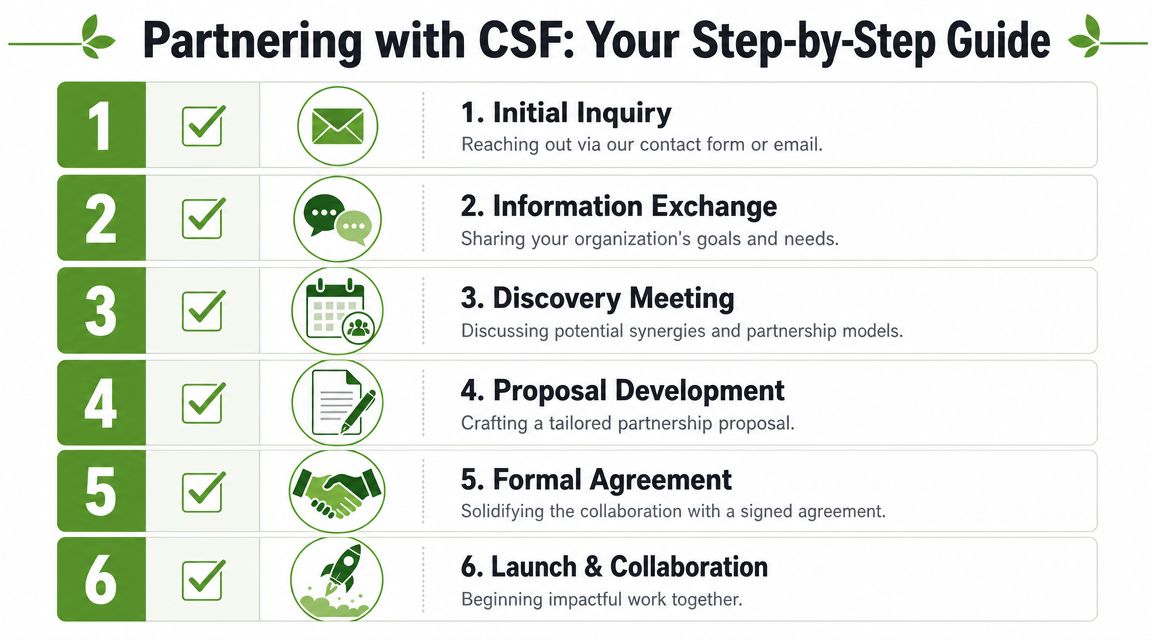
When there isn't a clean RFP to respond to, most organizations either freeze or send a generic introduction email. Neither works well. A better approach is to build a case for partnership the same way you'd build a case for a major donor. You do your homework, narrow the fit, and make the first conversation easy for the other side to enter.
A practical sequence that works
Start regionally. CSF's work is tied to place, institutional relationships, and student pathways. Before contacting anyone, study where your organization intersects with CSF's geographies, school relationships, college access efforts, or transition support needs. Your outreach should reflect that you understand their context, not just their mission statement.
Then identify the operational overlap. What can your organization do that advances continuity for students? The strongest answer is rarely “we also care about education.” It's more specific. It may be summer melt support, near-peer coaching, parent engagement, transfer navigation, emergency persistence coordination, or a specialized service that keeps high-need students from falling through.
The checklist to use before first contact
Use this sequence internally before you send an email or request a meeting:
Map overlap carefully
Note where your students, institutions, and service delivery model intersect with CSF's work.Define the partnership ask
Don't ask for “support” in the abstract. Ask for a conversation about a referral pathway, a co-delivered support function, shared learning, or a targeted funding discussion.Prepare proof, not adjectives
Bring a short impact brief, a program overview, and a clear explanation of how your model supports persistence.Show you understand trade-offs
Acknowledge where your model works well and where it has limits. That builds credibility faster than polished language.Assign one relationship owner
One staff member should manage follow-up, notes, and next steps. Diffuse ownership kills momentum.Draft collaboration language early
If the conversation advances, you'll need a concise way to describe shared work. Many teams find it useful to adapt materials like Press Release Zen's joint venture templates to clarify positioning and responsibilities before communications get public.
A cold outreach becomes a warm conversation when your first message answers the question, “Why should this organization see us as useful right now?”
What to say in the first conversation
Keep the opening practical. Describe the students you serve, the barrier you address, how your model complements long-term persistence work, and where you see natural overlap. Then stop talking.
The first meeting isn't the time to perform scale. It's the time to demonstrate judgment. Ask where CSF sees friction for students in your shared geography or population. Ask how outside organizations are most helpful. Ask what kinds of partnership structures are workable from their side.
That gives you a much better read than a speculative proposal ever will.
Tips for Crafting a Compelling Partnership Proposal
By the time you put a proposal, concept note, or meeting deck in front of CSF, your job is to reduce uncertainty. The organization doesn't need another statement saying college access matters. It needs evidence that your team can carry part of the load responsibly.
What belongs in the proposal
The strongest partnership materials usually include a small set of documents that answer operational and strategic questions quickly:
- A logic model or program map that shows who you serve, what support you provide, and where it fits in the student pathway.
- A clean budget that separates direct service costs, staffing, and any pass-through support.
- Recent impact reporting with clear methodology, even if your evidence is still developing.
- Partnership examples that show you can coordinate with schools, colleges, or community actors.
- A risk statement that names the constraints you're actively managing.
If your team needs a starting structure for the narrative itself, this nonprofit grant proposal template is useful for organizing need, approach, outcomes, and budget logic into a format that's easier to adapt for partnership outreach.
How to frame your story
Don't write as though you're auditioning for sympathy. Write as though you understand student persistence and can document your contribution to it.
That means blending two kinds of proof. First, use the strongest data you have without stretching beyond what your systems can support. Second, include one student story that illustrates the barrier pattern your program addresses. The story should explain the mechanism of support, not just the emotion of hardship.
A weak version says, “Our student overcame many obstacles.”
A stronger version says, “The student was academically capable but nearly stopped out when transportation, work hours, and financial confusion collided. Our staff coordinated advising, benefit navigation, and direct campus follow-up so the student stayed enrolled.”
Proposal standard: If a reviewer can't tell what your staff actually did, the story isn't helping.
What experienced grant writers avoid
A few mistakes come up repeatedly in education partnership pitches:
- Overclaiming impact: If your evidence is early, say it's early.
- Confusing mission overlap with model alignment: Shared values don't prove operational fit.
- Requesting unrestricted support by default: You need to justify why that structure makes sense.
- Ignoring timing: If schools are mid-cycle or teams are restructuring, your ask may be sound but poorly timed.
Strong proposals don't sound bigger than the organization. They sound more coherent.
Finding Alternatives and Your Next Steps with Fundsprout
A common grant writing mistake happens right after a team decides a funder is attractive. Staff spend days tailoring language, pulling data, and shaping a case for support before confirming whether the funder is even a plausible match. With the College Success Foundation, that mismatch usually shows up in geography, program design, target population, or the role your organization plays in the student success pipeline. Grant time is too limited to spend it persuading a funder to want something outside its strategy.
The better approach is to treat CSF as one lane in a broader funding plan. If your organization supports college access, persistence, re-enrollment, advising, family stability, or career-connected student success, build a second list of funders that care about those outcomes from different angles. Community foundations, regional education funders, scholarship organizations, youth-serving philanthropies, and place-based funders tied to economic mobility often make more sense than a highly specific college success partner.
The primary constraint is staff capacity.
Development teams lose time in familiar ways. They research the same prospects twice, rebuild eligibility notes from scratch, and chase opportunities that looked promising until a late-stage fit check ruled them out. For a small shop, that drag can cost an entire cycle.
A tool like Fundsprout's grant research and proposal workflow platform can help reduce that manual work. The practical value is not hype. It helps teams sort opportunities faster, screen for fit earlier, organize proposal tasks, and keep institutional knowledge in one place instead of scattered across spreadsheets and drafts.
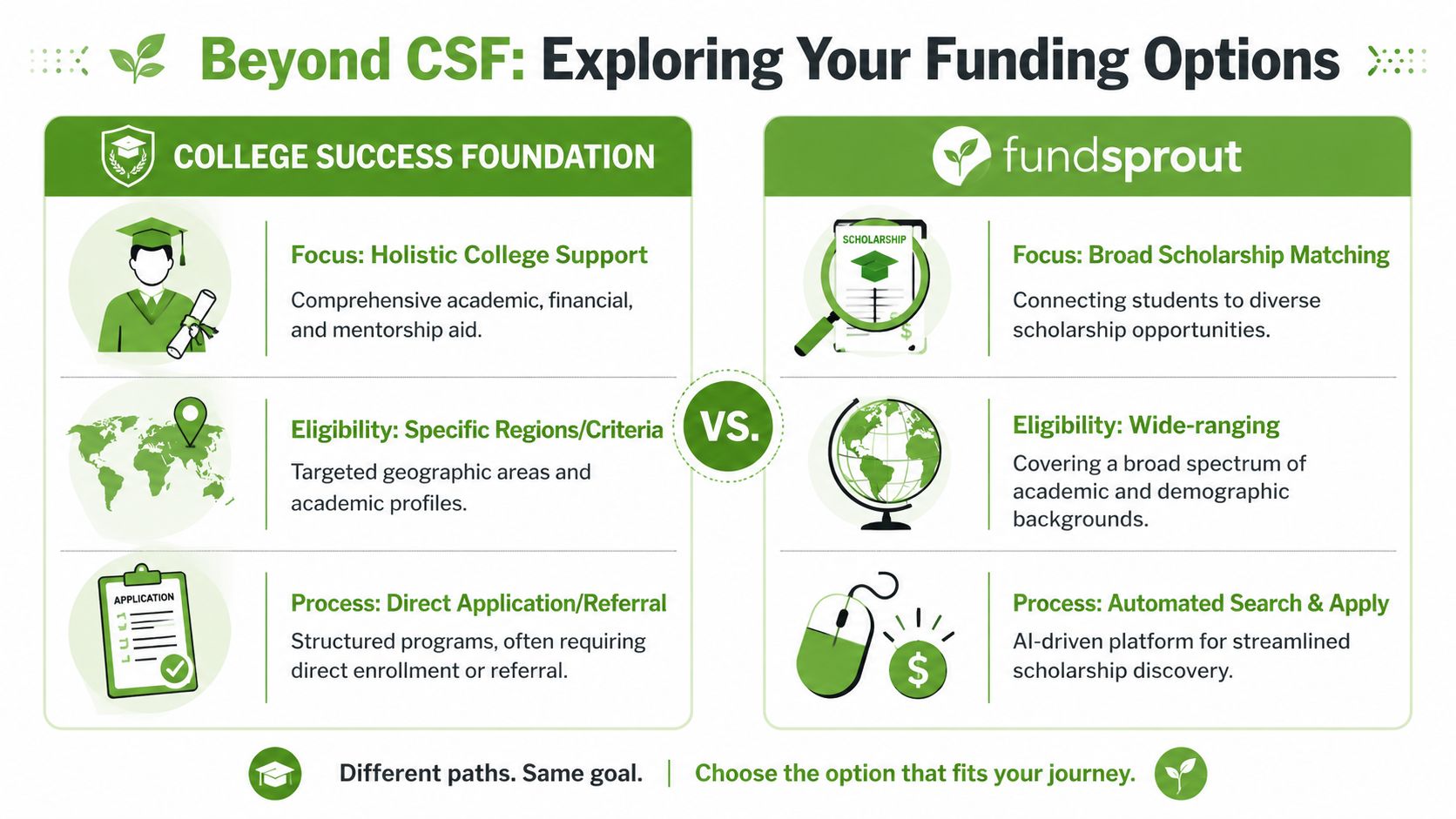
The lesson to carry forward from CSF is straightforward. Strong grant seeking starts with alignment, then moves to evidence, then to timing. Funders rarely respond to generic need statements or broad mission overlap alone. They respond when an organization can show, with discipline, how its work fits the funder's priorities and where that work solves a real implementation problem.
Take the next step in order. Write a one-page fit memo on CSF. Build a short alternative funder list for adjacent outcomes. Gather the materials you will reuse across pitches, including program summary, outcome data, partner list, budget framework, and a clear explanation of your role in student persistence. Then pursue the opportunities where mission, model, geography, and operating capacity line up.
Try 14 days free
Get started with Fundsprout so you can focus on what really matters.