Your Guide to Charles Revson Foundation Grants
Unlock funding with our guide to Charles Revson Foundation grants. Learn its core priorities, grant sizes, and how to craft a winning nonprofit proposal.

Abdifatah Ali
Co-Founder
The Charles Revson Foundation is a name that carries serious weight, especially in New York City. Established back in 1956 by Charles H. Revson, the visionary founder of Revlon Cosmetics, this private foundation has grown into a major philanthropic player. Its focus is sharp and its impact is deep, zeroing in on urban affairs, biomedical research, Jewish life, and education.
A Legacy of Impact in New York and Beyond
The story of the Charles Revson Foundation isn't just about money; it’s a classic tale of entrepreneurial spirit being channeled into a lasting philanthropic legacy. For any nonprofit leader working in the New York metro area or on projects connected to Israel, getting to know this foundation is less of a suggestion and more of a necessity.
Think of the foundation as a strategic investor in the city’s future. Its work is still guided by the ethos of its founder, who felt a deep-seated need to give back to the communities that helped build his empire. That initial commitment has since blossomed into a highly structured, mission-driven grantmaking program that tackles modern challenges while staying true to its roots.
Here's a quick overview to get you started.
Charles Revson Foundation at a Glance
| Key Area | Description |
|---|---|
| Founder | Charles H. Revson (of Revlon Cosmetics) |
| Established | 1956 |
| Endowment | Approximately $200 million |
| Annual Giving | Over $9 million |
| Primary Focus | New York City, with specific programs related to Israel. |
| Core Pillars | Urban Affairs, Jewish Life, Biomedical Research, Education. |
This table gives you the high-level view, but the story of how the foundation got here is what really tells you who they are and what they care about.
From Seed Funding to a Major Philanthropic Force
The foundation didn't start out as the powerhouse it is today. It began in 1956 with an initial fund of over $10 million from Revson and his close associates, which was primarily directed toward Jewish community schools and hospitals in New York City.
The real turning point came after Revson's death. His estate endowed the foundation with an additional $68 million, an infusion of capital that completely changed the game. This set the stage for the modern foundation, and by 1978, a formal grantmaking program was officially up and running. Since then, it has awarded over $145 million in grants.
Today, with an endowment hovering around $200 million, the foundation gives out more than $9 million each year, providing a critical stream of support for its nonprofit partners.
The Four Pillars of Revson's Mission
The foundation's work is organized around four clear and distinct pillars. This isn't just a list of interests; it's a strategic framework that guides every grant they make.
- Urban Affairs: A commitment to strengthening New York City's civic health and infrastructure.
- Jewish Life: Programs dedicated to fostering a modern Jewish identity and deepening connections with Israel.
- Biomedical Research: A focus on cultivating the next generation of top-tier scientific minds.
- Education: Creating clear pathways to public service and expanding access to knowledge.
This focused strategy is a big reason why it's among the more effective foundation grants for nonprofit organizations. By concentrating its resources, the foundation can drive real, measurable change. For nonprofits, this clarity is gold. It lets you know right away if your work aligns with their priorities, long before you spend any time putting a proposal together.
To truly understand the Charles Revson Foundation's strategy, you need to get familiar with its four core funding pillars. These aren't just broad suggestions; they are well-defined program areas that shape every single grant the foundation makes. For any nonprofit leader, grasping the thinking behind each pillar is the first step toward figuring out if your work is a potential fit.
It's best to think of these pillars as interconnected, not as separate silos. The foundation believes that a well-educated population makes for a healthier city, and a strong sense of community ultimately benefits everyone. This idea—that investing in one area creates positive ripple effects in others—is central to their entire philosophy.
This chart really drives home the direct line from Charles Revson's initial vision to the foundation's sharp focus today.
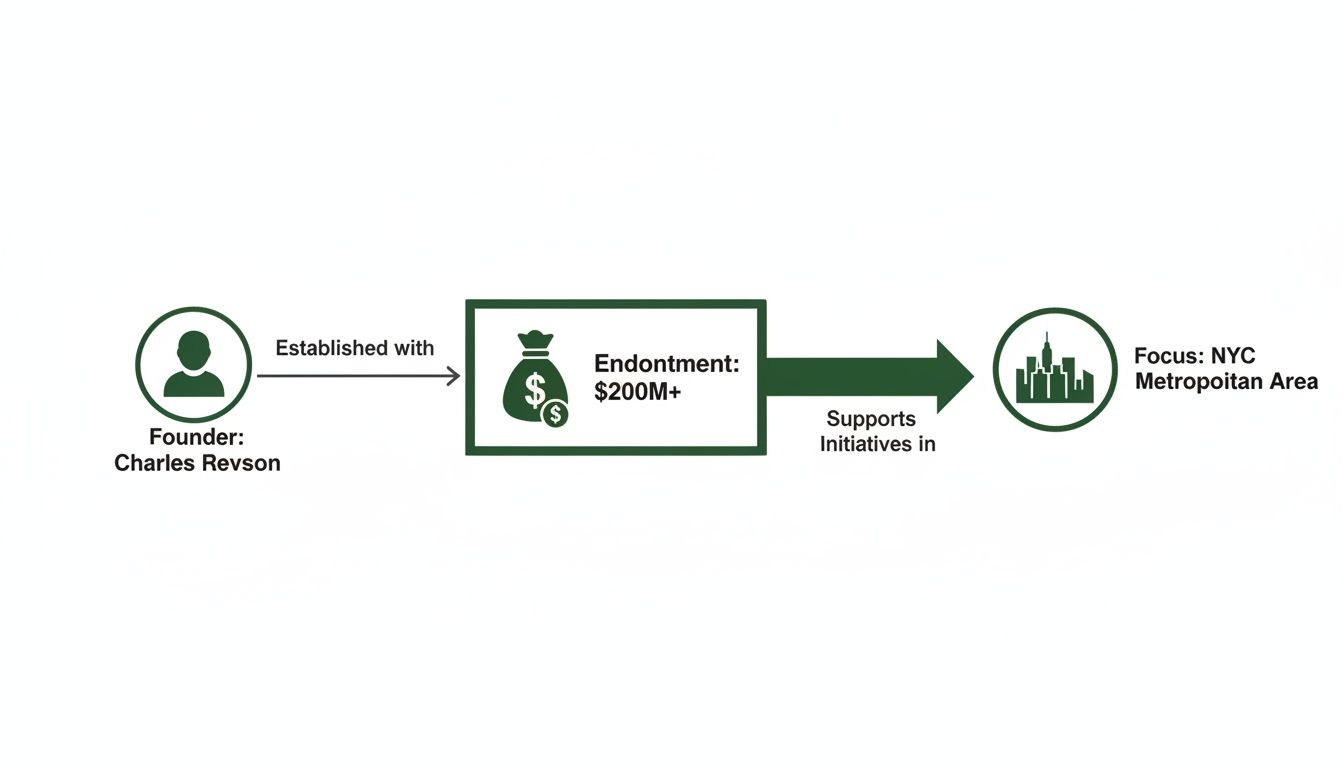
You can see how the founder's legacy, powered by a significant endowment, fuels a philanthropic engine aimed squarely at improving life in New York City.
Urban Affairs: Investing in NYC’s Operating System
The Urban Affairs program is where the foundation’s commitment to its home city really shines. Think of it as an investment in New York’s "operating system"—the fundamental institutions and functions that keep the city running and serving its people.
The foundation channels its resources into areas that strengthen civic life. This means significant support for public libraries, which they see as essential community hubs for learning and connection. They also champion civic journalism, operating on the principle that an informed public is the bedrock of a functioning democracy.
A major piece of this work involves cultivating the next generation of city leaders. The Charles Revson Foundation is a big supporter of fellowship programs that draw talented, passionate people into public service careers, ensuring a strong pipeline of skilled leadership for years to come.
"As charitable giving organizations... we contribute to communities in every corner of America. Together, we support new parents and elders, veterans and school children, hospitals and libraries, churches and food kitchens, artists and researchers..." - A Public Statement from Philanthropy, Council on Foundations
This quote from the Council on Foundations captures the spirit of broad community investment that defines the foundation's Urban Affairs work.
Jewish Life: Fostering Identity and Connection
This pillar is all about nurturing a vibrant, modern Jewish identity and reinforcing the bonds between American Jews and Israel. The program is deeply connected to Charles Revson's own personal history and his earliest philanthropic efforts.
Instead of just one type of grant, the foundation backs a whole spectrum of initiatives:
- Cultural Programs: Projects that explore Jewish history, art, and ideas through a contemporary lens.
- Leadership Development: Investing in the people and programs that are shaping the next generation of leaders in the Jewish community.
- Israel Engagement: Supporting organizations that create space for nuanced dialogue and meaningful connections with Israel. A great example is their funding for the Shalom Hartman Institute's digital content, which fosters thoughtful conversations on complex issues.
The goal here isn't to preserve the past in amber. It’s about helping Jewish life and thought evolve and thrive in the 21st century.
Biomedical Research: Launching Scientific Careers
While the other pillars focus on community and civic life, the Biomedical Research program is a highly targeted investment in individual human potential. The crown jewel of this effort is the prestigious Charles H. Revson Senior Fellowships in Biomedical Science.
These fellowships are designed to be a launchpad. They provide critical seed funding to brilliant early-career scientists in the New York area at a make-or-break moment—that point when they’re struggling to secure the grants needed to start their own labs. By backing these researchers as they pursue high-risk, high-reward ideas, the foundation is betting on individuals to accelerate major scientific breakthroughs.
Education: Creating Pathways to Impact
The Education pillar knits the foundation's other priorities together, especially Urban Affairs. The main objective is to build clear, accessible pathways for people who want to build careers in public service and public interest work.
This involves funding internships, fellowships, and mentorship programs within government agencies and nonprofits. Beyond that, the Charles Revson Foundation is also dedicated to expanding digital access, making sure all New Yorkers have the tools and literacy to participate in the city's economic and civic life. By focusing on education, they are building a more capable and engaged citizenry from the ground up.
Grant Sizes and Financial Scope: Finding the Right Fit
Before you even think about writing a proposal, you need to ask a fundamental question: does my funding need match what the Charles Revson Foundation typically gives? Getting this right is one of the most important first steps. It’s about more than just the numbers; it’s about showing you’ve done your homework and understand how and where they invest their resources.
The foundation is in a strong financial position, drawing on a significant endowment to power its annual giving. This allows it to make some truly impactful investments across its four main program areas.
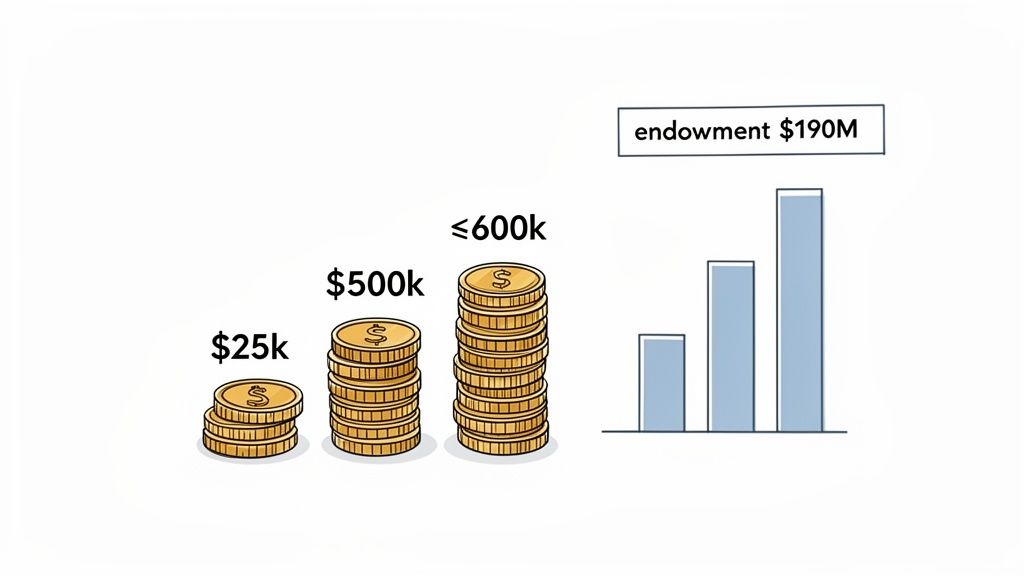
This setup is no accident. It’s designed to give the Charles Revson Foundation the agility to fund both promising new ideas and cornerstone institutions through multi-year commitments.
A Wide Spectrum of Grant Sizes
You won't find a one-size-fits-all grant here. The foundation’s awards cover a wide range, which lets them build a diverse portfolio of projects and organizations. Depending on the program, the project's ambition, and your organization's needs, grant amounts can look very different.
A look at their recent financials gives us a clearer picture. With an endowment of roughly $192.6 million, the foundation directs about $9.2 million toward annual expenses, with most of that going directly to grants. In a typical year, they might award around 86 grants, with the average grant size landing at $85,522.
Of course, an average only tells you part of the story. The real insight comes from looking at the full range of their giving.
Grant awards can start with smaller, targeted funds around $25,000 but can also stretch to major, multi-year investments exceeding $500,000. This shows their dual strategy: they’re willing to nurture smaller, innovative projects while also making substantial bets on established programs with major impact.
This financial flexibility is a core part of how the foundation operates.
What Does a Typical Grant Look Like?
While there isn’t one "typical" grant, you can definitely see patterns emerge within each of the foundation’s funding pillars. Figuring out these patterns will help your team set a realistic funding goal. And remember, a detailed, well-reasoned budget is non-negotiable; our guide on creating a grant budget template can give you a great starting point.
Here’s a general breakdown of what to expect:
- Smaller Strategic Grants: Usually in the $25,000 to $75,000 range, these awards often support pilot programs, research, or critical planning phases. Think of them as seed funding to test a new concept or help an organization at a key moment.
- Mid-Range Programmatic Grants: These are the foundation’s workhorse grants, typically falling between $75,000 and $250,000. They fund ongoing, proven programs that align perfectly with one of the four pillars.
- Major Multi-Year Commitments: Reserved for cornerstone partners and ambitious, large-scale initiatives, these grants can climb above $500,000. They signify a deep, long-term partnership with organizations that are absolutely central to the foundation's mission.
For instance, a major grant in the Urban Affairs pillar might fund a city-wide public service fellowship for several years. On the other hand, a smaller grant in Jewish Life might help an organization launch a new digital series to foster community dialogue. By studying their past grants, you can get a much better feel for where your project might land, helping you make an ask that’s both ambitious and appropriate.
Recent Grants as a Blueprint for Success
If you really want to get inside the heads of the decision-makers at the Charles Revson Foundation, don't just read their mission statement. Look at where their money is actually going.
Past grants are the single best indicator of a foundation's real-time priorities. They're a living blueprint, showing you exactly what kind of thinking gets a proposal across the finish line. By studying these funded projects, you move past the abstract guidelines on their website and get a concrete picture of what a winning pitch looks like.
Think of it as reverse-engineering a successful product. You take it apart to see what makes it work. For a grantseeker, that means asking: Why this specific project? What made this nonprofit the right partner? And what tangible outcome did they promise? The answers are your roadmap.
Deconstructing the Urban Affairs Pillar
A perfect case study is the foundation’s work in civic journalism. In 2026, the Charles H. Revson Foundation announced a massive $6 million grant portfolio distributed among 40 different organizations, a move that underscored its deep commitment to all four of its core pillars. This funding round was a powerful statement about strengthening civic life in New York City and Israel.
Let's zoom in on two grants from that portfolio that reveal the foundation’s urban strategy. One was a $600,000 award to Cornell University to run pro bono legal services for small news outlets in the NYC area. The other was a $200,000 grant to the Fund for the City of New York for its Open Hearts Initiative, which tackles homelessness.
You can dive into the full list of these awards to see how the Charles Revson Foundation is putting its capital to work, but these two grants are particularly telling.
So, let's pull apart that Cornell grant. Why did it work?
- Direct Alignment: It hits a core foundation goal—supporting civic journalism—squarely on the nose. By giving local news outlets the legal muscle they often lack, it reinforces the city’s democratic "operating system."
- An Innovative Model: Instead of just funding one newsroom, this grant shores up an entire ecosystem. A pro bono legal clinic is a smart, scalable way to deliver a critical resource to dozens of organizations at once.
- A Powerhouse Partner: Teaming up with a top-tier institution like Cornell University brings immediate credibility and ensures flawless execution. It’s a partnership that multiplies the impact of every dollar.
This wasn't just a donation to a worthy cause. It was a strategic investment in a project designed to produce a clear, measurable outcome that strengthens the city's civic infrastructure.
The Open Hearts Initiative: A Model for Urban Problem-Solving
The $200,000 grant to the Open Hearts Initiative tells a similar story, but from a direct social services angle. This project likely stood out because it offered a smart, thoughtful solution to one of NYC's most complex and deeply-rooted challenges.
What made this proposal so compelling?
- A Holistic Approach: The initiative goes far beyond temporary shelter. It thoughtfully combines housing with wraparound support services, aiming to fix the root causes of homelessness, not just patch over the symptoms.
- Community-Embedded: This isn’t a top-down program. It's deeply woven into the fabric of the communities it serves, which signals a real, ground-level understanding of the problem. That's exactly the kind of practical approach the foundation wants to see.
- Measurable Impact: You can bet the proposal included clear metrics for success. They probably defined exactly how they would track progress, from the number of people housed to long-term health and stability outcomes.
For any nonprofit considering the Charles Revson Foundation, the lesson is clear: a successful proposal connects an innovative solution to a specific, well-defined problem that aligns perfectly with one of their core pillars.
By studying real-world examples like these, you can sharpen your own approach and see what the foundation truly values. They reward strategic thinking, strong partnerships, and projects that promise not just to do good work, but to create lasting, structural change. Use these wins as your guide, and you’ll be on your way to building a case that’s impossible to ignore.
How to Craft a Compelling Letter of Inquiry
Getting the attention of the Charles Revson Foundation doesn't start with a massive, time-consuming grant proposal. Instead, your first move is a much smarter, more focused step: the Letter of Inquiry (LOI). You'll submit this through their online portal.
Think of the LOI as the high-level pitch for your entire project. It’s your chance to quickly and powerfully show how your work fits perfectly with what the foundation cares about. A great LOI gets you an invitation to submit a full application, while a weak one stops the conversation before it even starts.
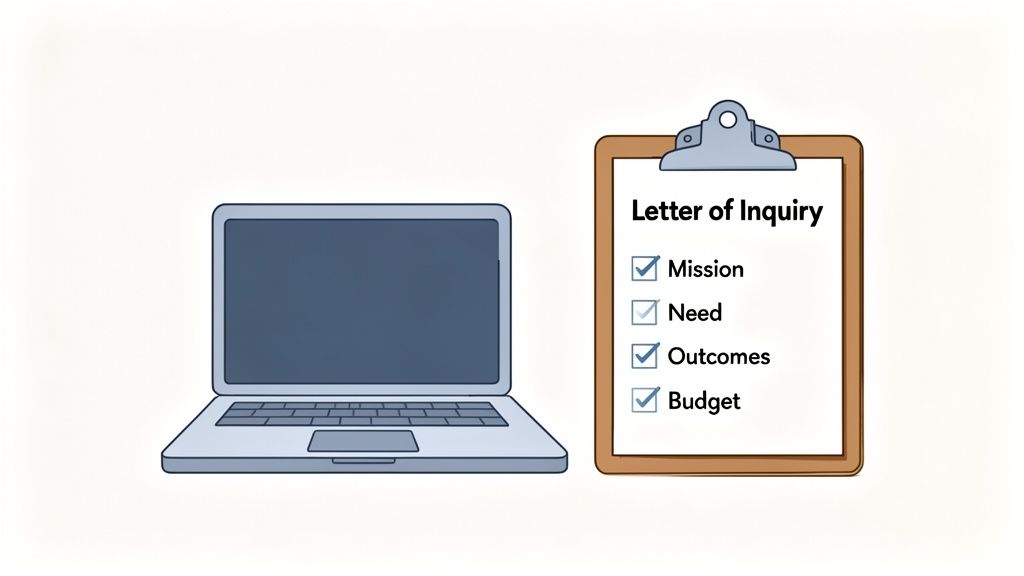
This initial contact is where you prove you’ve done your homework and truly understand the mission of the Charles Revson Foundation.
Key Components of a Winning LOI
Your LOI has to be sharp, direct, and persuasive. The foundation sees a ton of these, so yours needs to get right to the point. While every project has its own story, a strong LOI always weaves together a few core elements.
- The Problem: Clearly state the specific challenge you're tackling. A compelling statistic or a very brief anecdote can make it real and urgent.
- Your Solution: How are you going to fix it? In a few sentences, describe your project's activities, who you're helping, and the general timeline.
- The Revson Connection: This is non-negotiable. You must explicitly draw a line from your project to one of their four main pillars: Urban Affairs, Jewish Life, Biomedical Research, or Education.
- Your Credibility: Who are you? Briefly introduce your organization, touching on your past successes and what makes your team the right one for this job.
- The Ask: Give them the bottom line. Include a high-level project budget and the exact amount of funding you're requesting from the foundation.
Learning how to effectively write a request letter for donations is a foundational skill that will serve you well here.
Essential Eligibility Checks
Before you type a single word, do a quick gut check on eligibility. It will save everyone a lot of time. The Charles Revson Foundation has a very specific geographic focus, and it's a hard-and-fast rule.
The two most important eligibility filters are geographic focus and programmatic alignment. Your organization must primarily serve New York City or, for the Jewish Life pillar, focus on projects strengthening ties with Israel. If your work falls outside these parameters, your inquiry will not move forward.
This tight focus is intentional; it allows their funding to make a much deeper impact in the communities they’ve committed to.
Tips for Making a Strong Impression
The nuts and bolts are important, but so is the tone. Program officers are looking for partners who are not just passionate, but also professional and strategic. Your LOI needs to communicate all of that.
For a deeper dive on this crucial first step, our guide on how to write a letter of inquiry is a great resource.
- Be Direct and Confident: Skip the jargon and fuzzy language. State your case with clarity and conviction. Show them you have a solid, well-developed plan.
- Highlight What's New: How is your approach better or different? The foundation is often drawn to innovative ideas that tackle old problems in new ways.
- Proofread Like Your Funding Depends on It: Because it might. Typos and sloppy mistakes signal a lack of attention to detail. Get a fresh set of eyes to review it before you hit "submit."
Frequently Asked Questions About Revson Grants
Trying to figure out a foundation's unwritten rules can be frustrating. To cut through the noise, we've put together some straight answers to the questions we hear most often about the Charles Revson Foundation.
This is the practical, need-to-know stuff that will help you figure out if you're a good fit and what to do next. Let's get right into it.
Does the Charles Revson Foundation Accept Unsolicited Proposals?
This is the big one, and the answer is a firm no. The foundation does not review or consider unsolicited proposals. If you send one, it will simply be declined.
Your first and only move is to submit a Letter of Inquiry (LOI) through their online portal. Think of the LOI as your foot in the door—it's a quick pitch that needs to show you've done your homework on Revson's mission and funding priorities. If your LOI catches their eye and aligns with their strategy, they'll invite you to submit a full proposal. This two-step process saves everyone a ton of time.
What Is the Primary Geographic Focus for Funding?
Where your work is based is a deal-breaker for the Charles Revson Foundation. Their funding is laser-focused on a couple of key areas to make the biggest splash.
The lion's share of their grants goes to organizations and projects right in New York City. A deep-rooted commitment to NYC is the bedrock of their Urban Affairs, Education, and Biomedical Research programs.
Beyond the five boroughs, the foundation also invests heavily in work related to Israel, primarily through its Jewish Life pillar. These grants usually go to U.S.-based nonprofits aiming to build a more sophisticated understanding of Israel and strengthen ties between American and Israeli communities. If your work isn't in one of these two places, Revson isn't the right funder for you.
For any nonprofit sizing up Revson, this is your first filter. Their dedication to New York City and specific interests in Israel are core to who they are. Your work has to fit squarely within these lines to even be considered.
Does the Foundation Provide Grants for General Operating Support?
While Revson is known for funding specific projects, they aren't completely closed off to general operating support. But let's be clear: it's rare.
These grants are almost always reserved for organizations with a long and trusted history with the foundation. Think of cornerstone partners whose missions are in near-perfect lockstep with Revson's own goals. For most nonprofits, and especially for first-timers, pitching a specific program is a much smarter play. It lets you tell a clear, compelling story about the impact you'll make. If you think you're a candidate for general operating support, the best path is to build a strong relationship over time by delivering high-impact, mission-aligned work.
What Is the Typical Timeline from LOI Submission to a Funding Decision?
Knowing the timeline is key to managing your own expectations and planning. The review process at the Charles Revson Foundation is thorough, and it moves at a deliberate pace. The foundation’s board meets quarterly to make all final funding decisions.
Because of this quarterly schedule, the whole process—from submitting your LOI to getting a yes or no—will take several months. There's no shortcut. After you send in your LOI, program staff review it. If it looks promising, they'll ask for a full proposal. That proposal then goes through another round of due diligence before it even gets to the board.
Here's how it generally breaks down:
- LOI Submission: You send your Letter of Inquiry via the online portal.
- Staff Review: Program officers check your LOI for strategic fit. This can take weeks.
- Proposal Invitation (if you make the cut): You'll get an invitation to submit a full proposal with a clear deadline.
- Due Diligence: The team digs deeper into your proposal, which might involve calls, meetings, or a site visit.
- Board Review: Your proposal is added to the docket for one of the quarterly board meetings.
- Final Decision: You'll be notified of the outcome soon after the board meets.
The takeaway? Plan far ahead. Rushing an application to meet your own deadline is not a recipe for success here.
At Fundsprout, we know that details like these are just one piece of the puzzle. Our AI-powered platform helps you find funders that are a perfect match, like the Charles Revson Foundation, write powerful proposals, and keep your entire grant process on track. Let us help you focus on your mission. Find out how at https://www.fundsprout.ai.
Try 14 days free
Get started with Fundsprout so you can focus on what really matters.