How to Award a Contract: A Nonprofit's Guide
Learn how to award a contract with confidence. Our step-by-step guide for nonprofits covers planning, RFPs, evaluation, negotiation, and compliance.

Abdifatah Ali
Co-Founder
You just got the grant notice. The program team is energized, the board wants momentum, and a vendor has already been recommended by someone you trust. It feels efficient to move fast.
This is also when nonprofits get into trouble.
Most contract problems don't start with bad intent. They start with urgency, thin staffing, and a sincere belief that everyone is aligned. Then six months later, the deliverables are fuzzy, the invoices don't match the budget narrative, a funder asks how the vendor was selected, and no one can find the evaluation notes.
Awarding a contract well is less about sounding complex and more about building a process your team can follow under pressure. For nonprofits, that matters even more. You're balancing mission delivery, donor restrictions, government pass-through rules, board oversight, and very little spare time. A practical procurement process protects all of that.
Why a Formal Contract Process Protects Your Mission
The pressure point usually looks the same. A grant is awarded, the timeline is tight, and a board member, funder, or staff lead already has a vendor in mind. The recommendation may be sound. It still does not replace a documented process.
For nonprofits, contract process is not administrative theater. It is how you show that limited funds were spent for program purposes, under fair terms, with records that hold up when a funder, auditor, or new finance lead asks questions months later. A good process protects against two common failures. Hiring a weak vendor. Hiring a capable vendor through a method your organization cannot defend.
Urgency is real. So is the paper trail.
Small teams often feel they cannot afford formality. In practice, they cannot afford cleanup.
Organizations that touch public money, even indirectly through pass-through grants, partnerships, or subawards, are still operating in a system that expects competition, documentation, and reasonable pricing. Federal procurement itself is large and slow, as reflected in SAM.gov contract data. Nonprofits do not need to copy government procedure line for line. They do need to absorb the lesson: vendor selection needs a record, not just a verbal consensus.
I have seen the same pattern repeat. The team moves quickly because the program need is real. Then the vendor starts work before the scope is pinned down, invoices arrive against vague milestones, and no one can reconstruct why this firm was chosen over other options.
That is a mission problem, not just an operations problem.
Practical rule: If your team would struggle to explain the selection file to a funder, auditor, board member, or successor, the contract is not ready to award.
Informal buying creates avoidable risk
Weak procurement usually fails in ordinary, unglamorous ways:
- Scope drift: Staff expected strategic guidance, while the vendor priced a narrower execution role.
- Budget strain: The contract amount fits the grant total, but not the approved cost categories or payment timing.
- Fairness concerns: A staff referral becomes the default choice without any record that other qualified vendors were considered.
- Governance friction: Leadership approved the spend, but the basis for selection never made it into the file.
- Audit exposure: The organization has emails and calendar invites, but no evaluation notes, conflict review, or approval trail.
None of this requires bad intent. It usually comes from thin staffing, rushed launches, and unclear ownership.
A formal process gives people a repeatable standard. It also lowers the odds that personal relationships shape a purchase more than program need. If your team has not tightened that area, start with a written conflict of interest policy for nonprofits and apply it before vendor outreach begins.
Stewardship supports the mission
Nonprofits sometimes treat procurement as separate from service delivery. On the ground, they are tied together. The contract process determines whether the vendor understands the work, whether the price matches the scope, whether reporting lines are clear, and whether the organization can prove it acted responsibly.
That matters when cash is tight and staff time is tighter. A few hours spent documenting the selection process can prevent weeks of dispute, rework, and funder follow-up later.
A formal contract process protects the mission by protecting execution, budget integrity, and trust.
Laying the Groundwork Before You Solicit Bids
A nonprofit decides in June that it needs a new case management system before a grant report comes due in September. Program staff want better reporting. Finance wants approval controls. IT is worried about data access. The executive director wants it done fast. If those issues stay unresolved when bids go out, vendors end up defining the project for you, and the selection process gets harder to defend.
Strong contract awards start with internal clarity.

Start with a real statement of work
A statement of work, or SOW, should give an outside vendor enough direction to price the job and explain its approach without relying on side conversations.
Write down the basics in plain language:
- The problem to solve: Describe the operational need and the intended result.
- Required deliverables: List the actual outputs, such as a training curriculum, dashboard, outreach plan, database cleanup, printed materials, or final report.
- Timeline and milestones: Include drafts, review points, launch dates, reporting deadlines, and the date you expect work to begin.
- Approval roles: Identify who reviews content, who approves invoices, and who signs off on completion.
- Scope limits: State what the contract does not include.
Scope limits matter a lot in nonprofits. Staff teams are often stretched, and once a vendor is in the door, extra requests tend to pile up. A tighter SOW produces cleaner pricing, fewer assumptions, and fewer disputes after award.
Set the budget before the market sets it for you
Waiting for proposals to tell you what the work should cost is risky. Build an internal budget range first, even if it is preliminary.
That budget should reflect available funding, the likely full cost of the work, and the staff time needed to manage the contract. The lowest price can still be the more expensive choice if it creates extra meetings, change orders, retraining, or payment disputes.
Documentation matters here too. The NSA Office of Inspector General report found repeated problems with support for fee decisions in reviewed contracts. The nonprofit lesson is practical. If your file does not show why the price structure made sense at the start, an auditor or funder may question it later.
A short written budget rationale is usually enough. Note the funding source, expected cost range, pricing assumptions, and any constraint that shaped the estimate.
Get the right people aligned before vendors invest time
Procurement delays usually begin inside the organization.
Program staff may care most about quality and turnaround. Finance may need clean budget coding and payment controls. Operations may be focused on insurance, security, or vendor onboarding. Leadership may want visibility on larger commitments or board review before signature. If those expectations are still in conflict after proposals arrive, the evaluation process slows down and vendors receive mixed signals.
Use a short pre-solicitation check:
Program confirms the need
Define the service need, intended beneficiaries, timeline, and minimum capabilities.Finance confirms the funding
Check budget fit, allowable costs, payment timing, and whether the contract touches more than one funding source.Operations confirms the requirements
Clarify approval thresholds, insurance terms, background checks, data handling rules, and any setup requirements.Leadership confirms authority
Identify who can release the solicitation, approve the selection, and sign the contract.
This meeting does not need to be formal. It does need to produce decisions.
Decide your required terms early
Before outreach begins, settle the terms your organization will require in every serious discussion.
For nonprofits, that often includes:
- Data ownership: Client, donor, participant, and reporting data stays with the organization.
- Confidentiality: Especially for health, housing, immigration, youth, or survivor-serving programs.
- Accessibility: Language access, ADA-related needs, and accessible document formats.
- Insurance and compliance terms: Based on the actual risk of the work.
- Invoice standards: Clear support for billed time, deliverables, or milestones.
If these points are left open, they tend to surface late, after a preferred vendor has already been identified. That creates pressure to relax standards the organization should have set earlier.
Build one planning packet
Many nonprofit procurement files are scattered across email, grant notes, budget worksheets, shared drives, and someone's memory. That is manageable until there is staff turnover, a funder question, or a disagreement about what was approved.
Pull the core planning documents into one packet. Include the SOW, budget range, funding source, approval path, timeline, required contract terms, key risks, and draft evaluation criteria. It does not need polished formatting. It needs to be complete enough that another staff member could pick it up and keep the process moving.
If your team needs a quick refresher on selecting the right bid format, this guide on RFPs and RFQs for nonprofits is a useful planning reference before you draft the solicitation.
For teams that want a quick refresher on writing a stronger scope and planning documents, this walkthrough is useful before the solicitation goes out.
Signs you are not ready to solicit
Pause if any of these are still unresolved:
- The team cannot explain the difference between an activity and a deliverable
- No one has confirmed which budget line or grant source will fund the contract
- Staff are split on whether they need strategy, staffing, implementation, or all three
- The timeline ignores real approval dates
- People are advocating for a vendor before the criteria are written
Rushed solicitations create weak proposals and harder negotiations. Nonprofits do not have much room for avoidable rework. Settling the internal questions first saves time, protects compliance, and gives vendors a fair chance to respond to the same scope.
Choosing Your Procurement Path RFP RFQ or Sole Source
Not every purchase needs the same process. A nonprofit that treats every procurement like a major strategic hire burns staff time. A nonprofit that treats every procurement like a quick price check creates compliance risk.
The method should match the work.
The simplest way to choose
If you need vendors to propose how the work should be done, use an RFP.
If you already know exactly what you want and mainly need pricing, use an RFQ.
If only one provider can reasonably do the work and you can prove why, you may have a sole source situation.
That sounds straightforward. In practice, teams blur these lines all the time.
Choosing the right procurement method
| Method | Best For | Evaluation Criteria | Effort Level |
|---|---|---|---|
| RFP | Complex services, custom solutions, strategic partnerships, projects where method and approach matter | Technical approach, relevant experience, staffing, implementation plan, price | High |
| RFQ | Standardized goods or clearly defined services where specifications are fixed | Price, responsiveness to specs, delivery terms, basic qualifications | Moderate |
| Sole Source | Unique expertise, continuity needs, proprietary systems, or funder-approved noncompetitive situations | Written justification, reasonableness of price, approval and documentation quality | High internal scrutiny |
When an RFP is the right choice
Use a request for proposal when the nonprofit needs judgment, creativity, or customized execution.
Examples include:
- A case management system migration
- A strategic planning facilitator
- A neighborhood engagement campaign
- An external evaluator for a multi-site program
- A consultant to design outcome measurement tools
In these cases, price matters, but it isn't the whole decision. You are buying an approach, not just labor hours.
A good RFP lets vendors respond to your actual problem. A bad RFP asks twenty boilerplate questions and still fails to describe the work.
When an RFQ is enough
Use a request for quote when the specifications are already known.
That might include printing, standard equipment, translation by the word, off-the-shelf subscriptions, or routine maintenance where the scope is fixed and comparable.
An RFQ works best when you can line up bids side by side without interpreting different technical solutions. If one vendor is pricing "basic package," another is pricing "enhanced support," and a third is redesigning the request entirely, you're no longer in RFQ territory.
Sole source is valid, but it needs discipline
Some nonprofit leaders avoid sole source because it feels risky. Others overuse it because it feels practical. Both approaches miss the point.
Sole source can be appropriate when there is one viable vendor because of continuity, compatibility, geography, proprietary access, unique expertise, or a funder's explicit requirement. But it must be documented carefully.
Your file should explain:
- Why competition wasn't practical
- Why this vendor is uniquely qualified
- Why delay or substitution would harm the program
- How price reasonableness was assessed
- Who approved the exception
A common mistake is writing a justification that says, "We've worked with them before and they know us." That's not enough on its own.
A sole source memo should survive review by someone who has never met the vendor and wasn't in the room for the earlier decision.
Match the effort to the risk
Nonprofits often default to one of two bad habits.
The first is overbuilding the process for low-risk purchases. That wastes time and frustrates staff.
The second is underbuilding the process for strategically important work. That creates weak competition and fragile decisions.
A practical framework looks like this:
- Low complexity and clear specs: Short quote process
- High complexity or strategic importance: Full proposal process
- Documented exception with narrow market: Sole source with approvals
If your team needs a side-by-side explainer to clean up terminology, this guide on rfps and rfqs is useful to circulate internally before procurement starts.
What works for nonprofits in real life
For small and midsize nonprofits, the best procurement path is usually the one staff can execute consistently.
That often means:
- A standard RFQ template for routine buys
- A lean RFP template for professional services
- A short sole source justification form with required sign-off
- A threshold chart that tells staff which path applies
What doesn't work is pretending every contract needs a bespoke process while nobody has time to run it properly.
The strongest procurement systems are not the most elaborate. They're the ones staff use.
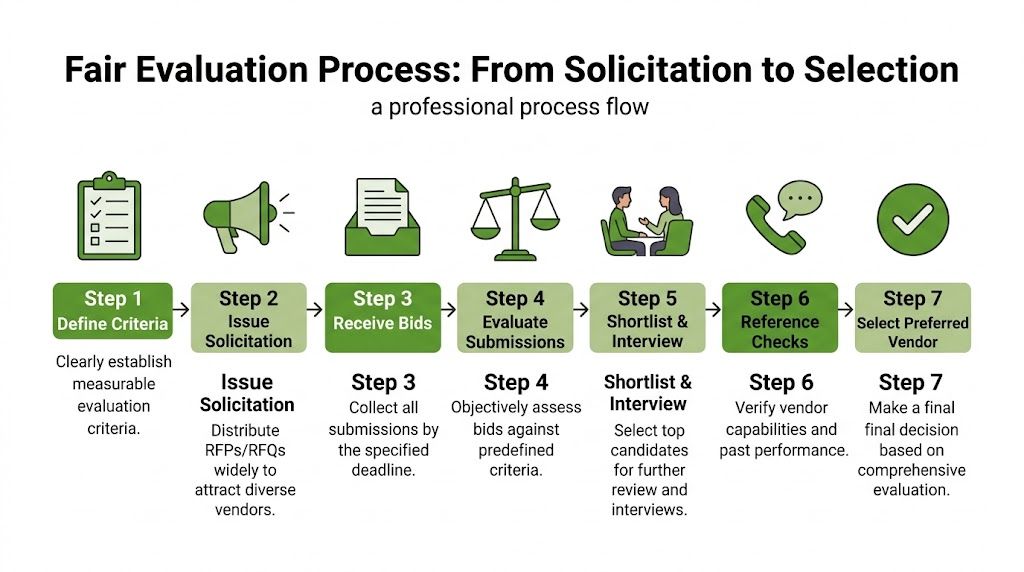
From Solicitation to Selection A Fair Evaluation Process
Once the solicitation goes out, fairness becomes visible. This is the stage where vendors compare notes, staff assumptions get tested, and weak process design turns into confusion fast.
A fair evaluation process is not about being rigid. It's about being consistent.
Write the solicitation to match the way you will score
This sounds obvious, but many teams still issue one set of instructions and evaluate on another.
In federal contracting, technical non-price factors are often weighted 60 to 80 percent in best-value decisions, and acquisition professionals identify misalignment between the solicitation's evaluation procedures and the actual evaluation as a common source of disputes and delays, according to FAI guidance on technical evaluation pitfalls. Nonprofits should take the same lesson seriously. If your scoring rubric doesn't match what the solicitation asked for, your file becomes hard to defend.
Build a scoring matrix before proposals arrive
Do not create criteria after reading submissions. By then, preferences are already forming.
A practical nonprofit scoring matrix often includes:
| Criterion | What to Look For |
|---|---|
| Technical approach | Does the vendor understand the work and offer a credible method? |
| Relevant experience | Have they handled comparable nonprofit, community, or grant-funded work? |
| Project team | Are the named staff qualified and likely to stay involved? |
| Implementation plan | Is the timeline realistic and connected to your deadlines? |
| Price | Is the cost clear, complete, and reasonable for the scope? |
| Mission fit | Do they understand your constituents, constraints, and operating environment? |
For some contracts, diversity, local presence, language capacity, or lived experience may matter. If those factors matter, include them in the solicitation and define how they will be assessed.
Separate responsiveness from quality
Before scoring substance, conduct a basic responsiveness review.
That means checking whether the bidder submitted what you asked for by the deadline, in the required format, with all mandatory attachments. Teams often skip this because they don't want to disqualify a promising vendor. That creates inconsistency immediately.
A responsive review can be simple:
- Did they meet the deadline?
- Did they sign required forms?
- Did they answer all mandatory sections?
- Did they provide pricing?
- Did they disclose conflicts or subcontractors if required?
If you plan to allow clarifications, decide in advance what kinds are acceptable.
Use a real evaluation committee
One person should not make a major award decision alone.
For most nonprofit procurements, a committee of two to four people works well. Keep it small enough to move, but broad enough to catch blind spots.
A good mix often includes:
- A program lead who understands the work
- A finance or operations reviewer who spots budget and compliance issues
- A cross-functional colleague who can challenge assumptions
- Sometimes an executive sponsor for higher-risk awards
Everyone should know the criteria, confidentiality expectations, and conflict rules before they read proposals.
Don't ask reviewers to "just use their judgment." Give them a rubric, written definitions, and a score sheet.
Handle vendor questions in one channel
Vendors should not be getting different answers from different staff members.
Set one contact person. Collect questions by a stated deadline. Share the answers with all bidders at the same time when appropriate. If an answer materially changes the solicitation, issue an addendum and extend the deadline if needed.
What works:
- One email inbox
- Written Q&A log
- Shared addenda
- Standard deadline language
What doesn't:
- Side calls with favored firms
- Verbal clarifications nobody records
- Changing expectations after questions come in
Evaluate in stages if the contract is complex
For bigger or more strategic awards, a staged review is more reliable than trying to decide everything in one meeting.
A practical sequence is:
Independent scoring
Reviewers score proposals individually before group discussion.
Consensus meeting
The team compares scores, discusses major gaps, and records reasons for changes.
Shortlist
Select a smaller group for interviews, demos, or reference checks.
Final assessment
Consider price, risk, references, and implementation readiness together.
This structure reduces groupthink and creates a stronger record.
Document judgment, not just numbers
A score by itself won't help much later. Notes will.
For each proposal, capture the main strengths, weaknesses, open questions, and reasons for ranking. If a lower-priced bidder was not selected, the file should show why. If interviews changed the outcome, document what was learned.
This is especially important for nonprofits because the people reviewing the file later may not be the same people who made the decision. Funders, auditors, boards, and future staff all rely on that record.
Reference checks should test risk, not just confirm likability
Too many reference calls are polite rituals.
Ask specific questions:
- Did the vendor meet deadlines?
- How did they handle scope changes?
- Were invoices clear?
- Who did the work?
- Would you hire them again for this kind of assignment?
If the contract involves community-facing work, ask how the vendor handled communication, cultural fit, and responsiveness under stress.
Fairness is operational, not abstract
A fair process is one where vendors had the same information, the same deadlines, the same evaluation criteria, and the same chance to be understood.
That doesn't guarantee everyone likes the outcome. It does mean your organization can award a contract with confidence that the process was defensible.
Finalizing the Deal Negotiation and Contract Drafting
Selecting a preferred vendor is not the finish line. It is the point where assumptions become legal obligations.
At this point, nonprofit teams either protect themselves or inherit months of avoidable friction.
Notify vendors professionally
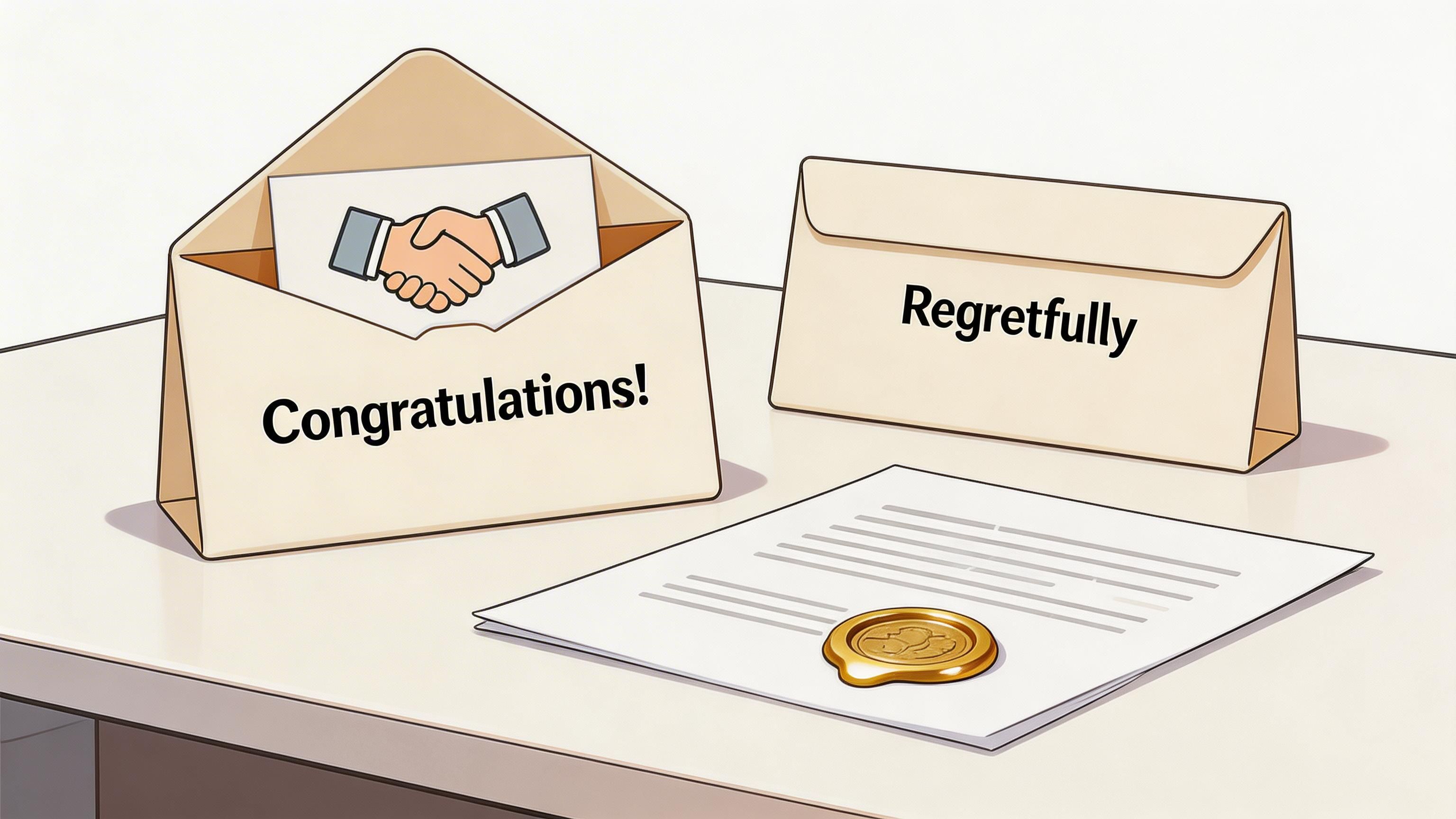
Start with clear written notice to the selected vendor, subject to contract execution if needed. Then notify unsuccessful vendors promptly and respectfully.
Don't overexplain in the initial message. Do be professional, direct, and consistent.
A practical notice should cover:
- The outcome
- Whether the award is final or contingent on contract completion
- Whether feedback will be offered
- A thank-you for the vendor's time
This matters for reputation. Nonprofits often buy in relatively small markets. You may want the runner-up on a future project.
Negotiate the parts that actually affect operations
Many nonprofit leaders focus negotiations on price alone. That's rarely the most important issue.
The bigger operational questions are usually:
- Payment timing: Can the nonprofit pay by milestone rather than by large upfront amount?
- Deliverable acceptance: What triggers approval?
- Revision limits: How many review rounds are included?
- Staffing commitments: Can the vendor swap key personnel without approval?
- Data handling: Who owns source files, data exports, and work product?
- Termination rights: What happens if funding changes or performance slips?
NASA audits found confusion around award fee contracts, including structures where vendors could receive second chances to earn performance payments, according to the NASA OIG report. For nonprofits with tighter cash flow, the practical takeaway is to negotiate clear performance metrics and payment terms upfront. If the payment structure is ambiguous, the vendor may still get paid while your team argues over whether the work met expectations.
The best nonprofit contract language is boring. If a clause sounds clever but nobody on your team can explain how it works during a dispute, rewrite it.
Focus on clauses that prevent common nonprofit pain
Every contract doesn't need twenty pages of legal flourishes. It does need the right basics.
Scope and deliverables
Attach the final scope, timeline, and pricing. If it isn't attached, it will be reinterpreted later.
Payment terms
Tie payments to dates, milestones, or accepted deliverables. Avoid vague language like "monthly consulting support" unless you also define expected outputs.
Data ownership and access
If the vendor touches donor records, client files, case notes, evaluation data, or platform configurations, the contract should state who owns what and what must be returned at the end.
Confidentiality and compliance
Match the clause to the work. Youth records, health information, employee data, and community surveys carry different risks.
Termination
Include both termination for cause and termination for convenience where appropriate. Nonprofits need an exit route if performance fails or funding shifts.
Amendment process
State who can approve changes and in what form. Scope changes should not happen by friendly email alone.
Use tools to speed review without losing control
A lot of nonprofit contract cleanup is repetitive. Teams compare versions, look for missing clauses, and manually pull dates, obligations, and payment terms from PDFs.
That is exactly where a structured tool can help. If your team handles a high volume of agreements or inherited templates, a contract parser can help extract core fields and obligations so staff can review terms faster and catch inconsistencies before signature.
The tool doesn't replace legal review. It makes review more manageable.
Keep the final draft aligned with the award decision
One quiet failure happens after selection. The team negotiates so many edits that the final contract no longer matches the solicitation or proposal that won.
Watch for this:
- Deliverables disappearing
- Named staff being replaced
- Reporting cadence getting looser
- Payment front-loading increasing
- Insurance or security requirements being removed casually
If the contract changes materially, stop and ask whether you are still contracting with the vendor you evaluated.
The strongest nonprofit contracts do not try to anticipate every possible future conflict. They make the current expectations plain enough that both sides can perform without guessing.
Post-Award Success Onboarding and Contract Management
A signed agreement is the start of vendor management, not the end of procurement.
Many nonprofits relax too early at this stage. They file the contract, hand the work to program staff, and assume the vendor relationship will run itself. It won't.
Run a real kickoff
Hold an onboarding meeting with the people who will do and oversee the work.
Cover:
- Scope and deliverables
- Decision-makers on both sides
- Communication cadence
- Invoice format and approval path
- Reporting deadlines
- Escalation process for issues
For community-facing or grant-funded work, connect vendor milestones to your internal reporting calendar from the start.
Document communications and decisions
Federal regulations require contracting officers to notify unsuccessful bidders within three days after a contract award, according to FAR 14.409-1. Even if your nonprofit is not directly operating under that exact rule, the principle is useful. Timely, documented communication reduces confusion and demonstrates fairness.
After award, keep that same discipline. Save major emails, meeting notes, approvals, amendments, deliverable sign-offs, and performance concerns in one file.
A simple contract file should contain:
- Solicitation and addenda
- All proposals or quotes received
- Score sheets and selection notes
- Signed contract and amendments
- Insurance or compliance documents
- Invoices and payment approvals
- Performance records
Manage the contract like a living project
Contract management and project management should not be separate universes.
If your team needs a lightweight way to connect vendor milestones to staff tasks, this guide on non-profit project management is a useful reference. It helps especially when the same staff are juggling programs, grants, and procurement oversight.
For broader operational habits, these contract management best practices are also worth reviewing with operations staff before the work gets too far underway.
Good contract management is mostly calendar discipline, file discipline, and saying something early when the work slips.
Review performance before the next procurement
At closeout, don't just mark the agreement complete.
Record what happened:
- Did the vendor deliver on time?
- Did the budget hold?
- Were amendments frequent?
- Would you use them again?
- What should change in the next SOW?
That short debrief becomes institutional memory. Without it, every procurement starts from zero again.
Frequently Asked Questions on Nonprofit Contracting
| Question | Answer |
|---|---|
| Do we always need multiple bids to award a contract? | Not always. The right answer depends on funder rules, your internal policy, the dollar amount, and whether competition is practical. What matters most is that your file clearly shows why you used the method you used. |
| Can we choose a vendor that isn't the cheapest? | Yes, if your process allows best-value selection and your evaluation criteria support the decision. For many nonprofit projects, experience, technical approach, and implementation fit matter as much as price. Document the rationale. |
| What if we already know the vendor we want? | You can still proceed, but don't skip the process. If competition is required, let the vendor compete fairly. If you believe sole source is justified, write the justification before the contract is drafted, not after. |
| Who should be involved in the evaluation? | Usually a small cross-functional group. Include the person who owns the work, someone who can review budget and compliance issues, and another staff member who can bring a fresh lens. Avoid committees so large that nobody takes ownership. |
| How detailed should the contract be? | Detailed enough that an uninvolved staff member could manage it. The scope, deliverables, payment terms, ownership of work product, timeline, and exit rights should all be clear without relying on memory. |
| What is the biggest mistake nonprofits make when they award a contract? | They rush from need to signature without locking scope, criteria, and documentation first. That usually creates trouble later in payment disputes, performance management, or funder review. |
If your team is trying to build a cleaner funding and compliance workflow around proposals, deadlines, and post-award documentation, Fundsprout is built for mission-driven nonprofits that need structure without extra overhead. It helps teams find aligned opportunities, organize requirements, track submissions, and keep the audit trail that makes future awards and renewals easier to manage.
Try 14 days free
Get started with Fundsprout so you can focus on what really matters.