A Practical Guide to AI Grant Writing for Nonprofits
Unlock funding with this practical guide to AI grant writing. Learn how top nonprofits use AI to find opportunities, draft proposals, and secure funding.


Abdifatah Ali
Co-Founder
Let's be honest: the world of fundraising is changing, and AI grant writing has officially moved from a "maybe someday" idea to a practical tool that savvy nonprofits are using right now.
Think of AI not as a replacement for your skilled grant writers, but as a seriously powerful assistant. It’s designed to take on the most tedious, time-consuming parts of the job—like slogging through prospect research or hammering out a rough first draft. This frees up your team to do what they do best: build genuine relationships with funders and weave the compelling stories that actually win grants.
A Smarter Grant Writing Workflow
Bringing AI into the mix isn't about handing over the keys and letting a robot write your proposals. It's about building a smarter, more efficient process where technology handles the heavy lifting, giving your team the space for the critical human touch that makes a proposal stand out.
This shift moves your development staff from being buried in paperwork to actively engaging with program officers and refining your organization's funding strategy. The whole dynamic changes for the better.
This diagram breaks down how AI fits into the key stages of the grant lifecycle:
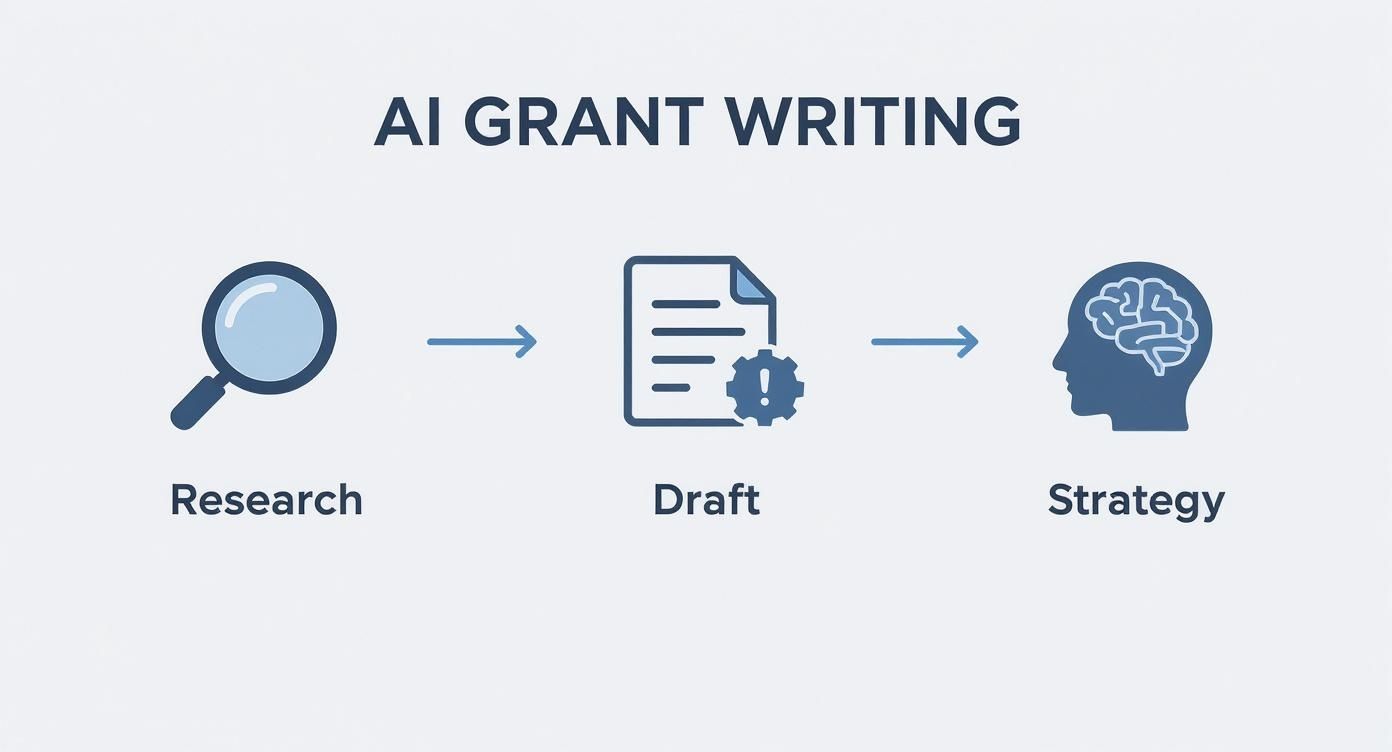
It’s a cycle. AI speeds up the repetitive work, which in turn gives your grant writers more time for the high-level thinking and relationship building that truly drive success.
It’s a Strategic Shift, Not Just a Tech Trend
Adopting these tools is more than just keeping up with the latest trend; it's a strategic move in an incredibly competitive funding environment. Let’s face it, we all need to work smarter, not just harder. Using AI is quickly becoming a key differentiator, separating the nonprofits that are struggling to keep up from those that consistently hit their fundraising targets. By automating parts of the grant process, your team can submit a higher volume of quality proposals without facing burnout.
The real power of AI in grant writing is that it amplifies your team's capacity. It allows a small shop to perform like a much larger one, leveling the playing field and opening doors to funding opportunities that might have seemed out of reach before.
Following the Data to See What’s Next
The data backs this up. It’s predicted that by 2025, over 74% of nonprofits will be exploring AI for grant writing, donor outreach, and other fundraising tasks.
While many are already using it for basic drafting and research, the real potential is still largely untapped. For instance, only about 12.8% of nonprofits currently use predictive analytics. This is where AI analyzes historical funding data to pinpoint the most promising grant opportunities and even suggest how to tailor a proposal for the best chance of success. For organizations willing to lean into these more advanced AI strategies, this is a huge opportunity. You can explore more insights on this and the future of nonprofit technology at professionalgrantwriter.org.
This guide is designed to walk you through the practical, real-world steps of weaving AI into your grant writing process—from finding the perfect opportunities to managing the final submission. You'll learn how to treat AI as a true partner to not only boost your efficiency but also elevate the quality and impact of your proposals, securing the funding your mission truly deserves.
Using AI to Find and Qualify Grant Opportunities
Let's be honest: finding the right grant can be the most soul-crushing part of the entire process. We’ve all been there, spending hours digging through databases, squinting at lengthy funding announcements, and trying to read the tea leaves of a foundation's true priorities. But with the right AI grant writing tools, you can flip that script. This grueling research phase can become a strategic, data-driven activity that brings you the best-fit opportunities in minutes, not weeks.
This is about more than just a souped-up search bar. Think of modern AI platforms as your personal research analyst. They can dig deep into a funder's history to spot patterns a human might easily miss, scanning years of 990 forms and previously funded projects. This reveals recurring themes, typical award sizes, and geographic preferences, giving you a much clearer picture of your chances before you even think about writing.

This analytical power is a huge advantage. Instead of just going by a funder's broad mission statement, AI helps you focus on their actual giving behavior. It’s the difference between what they say and what they do. This simple shift allows you to build a pipeline of highly qualified prospects and stop wasting precious time and energy on long-shot applications.
Moving Beyond Simple Keyword Searches
The old way of searching grant databases—plugging in keywords like "youth arts program" or "homeless services"—usually left you with hundreds of vague results to sift through. AI changes the game by enabling a much more sophisticated, contextual approach. You can feed a model your organization's mission statement, program descriptions, and even past successful proposals to find opportunities that truly align with your specific work.
The quality of your input here is everything. The more detail you provide, the sharper the AI's recommendations will be. I recommend giving the AI:
- Your Mission and Vision: This is the core DNA of your organization.
- Specific Program Details: Describe the who, what, where, and why of your key initiatives.
- Geographic Service Area: Be specific. Define the communities you serve, right down to the city or county.
- Ideal Funding Amount: State your budget needs to filter out grants that are too small or way out of your league.
You're essentially training the AI to think like your development director. You can even explore a free grant database for nonprofits to get a feel for how this works before jumping into a more advanced platform. This is a great first step toward building a smarter, AI-driven prospecting strategy.
The results speak for themselves. A 2023 study found that nonprofits using AI in their grant writing workflows saw a 35% increase in application submissions and a 22% higher success rate. Why? The AI acts as a strategic partner, helping you tailor your language to a funder's specific priorities and ensuring every submission is perfectly aligned. It just makes you more competitive.
Using AI to Rapidly Screen for Eligibility
So, you've got a promising list of opportunities. The next hurdle is qualification. A Request for Proposals (RFP) can be a beast—a dense, 20-page document packed with complex eligibility rules, formatting quirks, and hidden deal-breakers. Going through each one manually is a massive bottleneck.
This is where AI’s speed and precision really shine. You can upload an entire RFP and use a targeted prompt to have the AI instantly pull out the most critical information.
To get the most out of your AI tools for prospecting, it helps to be specific with your prompts. The table below offers a few templates I've found useful for different stages of the grant research process.
AI Prompt Templates for Grant Prospecting
These prompts move beyond simple searches and turn your AI into a true research assistant, helping you make smarter decisions faster.
Pro Tip: Don't just ask the AI to "summarize" the RFP. That’s too generic. Instead, give it a specific role and a clear task. For example, tell it to act as a grant compliance officer and create a checklist of all mandatory eligibility criteria and submission requirements.
Here’s a practical prompt you could adapt:
"Analyze the attached RFP from the [Funder Name]. Extract the following information and present it in a simple table: 1. Application Deadline (including time zone). 2. Eligibility Requirements for the applicant organization. 3. Geographic restrictions. 4. Funding Amount (min/max). 5. Key Funding Priorities."
A single command like this can save hours of tedious review and tell you immediately if an opportunity is worth your time. By building this rapid screening into your workflow, you can quickly build a robust pipeline of grants that you know, with high confidence, your organization is qualified to win. This strategic use of AI grant writing tools doesn't just make you faster; it makes you a smarter, more successful fundraiser.
Drafting Compelling Narratives with an AI Partner
Once you've got a solid pipeline of grant opportunities, the real work begins. This is where your AI assistant shifts gears from a research analyst to a genuine writing partner, helping you get from a blinking cursor on a blank page to a strong first draft in a fraction of the time.
The goal isn’t to have the AI write the entire proposal. Not at all. It's about creating a smart workflow where the AI does the heavy lifting—structuring, organizing, and drafting—so you can focus on strategy, storytelling, and weaving in your nonprofit's authentic voice.
Think of it like building a house. The AI can pour the foundation and put up the frame based on the funder's blueprint (the RFP). But you are the architect, the one who makes sure the final result isn't just functional but truly compelling. This partnership takes the most time-consuming parts of grant writing off your plate, giving you more time to polish the final proposal to perfection.
From RFP to Actionable Outline
A well-structured proposal that directly answers every single funder requirement is non-negotiable. Manually tearing apart a dense RFP to build an outline is tedious, and it’s frighteningly easy to miss a crucial detail. An AI tool, on the other hand, can digest the entire document in seconds and spit out a perfectly compliant skeleton for your narrative.
To get started, simply feed the full RFP text to your AI model. Then, give it a specific command to create your outline.
A Practical Prompt for Outlining:
"Act as a grant writing expert. I am applying for the [Grant Name] from [Funder Name]. Based on the attached RFP, create a detailed grant proposal outline. For each section, list the specific questions from the RFP that must be answered and include any character or word count limits mentioned."
This prompt does so much more than just list headings. It forces the AI to map the funder's exact questions and constraints to each section of your proposal. This ensures nothing gets missed. It's one of the simplest and most effective ways to use ai grant writing to avoid costly mistakes and show the funder you've done your homework.
Drafting Core Narrative Sections
With your outline ready, you can start fleshing out the core components of the proposal. This is where giving the AI rich, specific context becomes absolutely critical. Your AI partner can't write about your organization's impact if it doesn't know what that impact is.
Start by feeding it your core documents:
- Your mission and vision statements
- Annual reports from the last two years
- Strategic plans and program logic models
- Data on community demographics and beneficiary outcomes
- Past successful grant proposals (if you have them)
This collection of documents essentially creates a custom knowledge base for the AI, training it on your organization's unique history, language, and successes. Now, you’re ready to have it draft specific sections.
Crafting the Statement of Need
The Statement of Need is the heart of your proposal. It has to be driven by hard data and real human stories. While an AI can't invent passion, it can structure the argument powerfully.
Try a prompt like this:
"Using the provided community data report and beneficiary testimonials, draft a 500-word Statement of Need. Start by outlining the problem of [specific problem] in [your community], citing at least three key statistics from the report. Then, weave in one of the testimonials to illustrate the human impact of this problem."
This approach combines the AI's knack for synthesizing data with the authentic voices of the people you serve. If you want to dive deeper into this crucial section, our detailed guide on writing a compelling Statement of Need offers more frameworks and real-world examples.
Infusing Your Unique Voice and Vision
Let's be honest: an AI’s first draft is often competent but generic. It might lack the personality and fire that make your nonprofit unique. The next step is a crucial feedback loop where you coach the AI to get the tone just right.
Don't just accept the first draft. Treat the AI like a junior writer who needs your expert direction. Use prompts to guide it toward your style.
- "Rewrite this paragraph in a more urgent and active voice."
- "This sounds too academic. Rephrase it to be more accessible to a general audience, focusing on the stories of our clients."
- "Incorporate our organizational value of 'community empowerment' into this section about our program methodology."
This back-and-forth process is where the magic happens. The AI generates the building blocks, and you provide the strategic and emotional oversight. This ensures the final narrative is not only well-written and compliant but also a true reflection of your organization's soul.
You are the keeper of your organization's story. The AI is a tool to help you tell that story more efficiently and effectively. Never cede the role of chief storyteller to the machine; instead, use it to amplify your voice and impact.
Turning Data into a Persuasive Story
Grant reviewers are drowning in data. A dry list of numbers on a page rarely moves anyone. This is another area where AI can be an exceptional partner, helping you transform raw data into a persuasive story of your impact.
Imagine you have these data points for your literacy program:
- Participants served: 250 children
- Average reading level increase: 1.5 grade levels
- Attendance rate: 92%
Instead of just listing these facts, you can ask the AI to build a narrative around them.
"Draft a paragraph for our 'Project Impact' section using this data: [paste data]. Frame it as a story of transformation, showing how consistent engagement (92% attendance) leads to significant educational gains (1.5 grade levels) for the 250 children we serve. End with a forward-looking statement about future potential."
The AI is great at connecting these dots, turning "92% attendance" into a story about commitment and "1.5 grade levels" into a story of life-changing progress. This workflow lets you maintain strategic control while delegating the initial wordsmithing, creating a powerful synergy between human insight and machine efficiency.
Staying Ethical and Compliant with AI
Bringing AI into your grant writing process is exciting, but it’s not a free-for-all. With great power comes great responsibility, as they say. The efficiency is fantastic, but it can't come at the expense of your organization’s integrity. Staying on the right side of ethical lines and funder policies isn't just good form—it's absolutely critical for your long-term survival and funding success.
As these tools get more popular, funders are starting to lay down some ground rules. If you ignore them, you could get disqualified, tarnish your reputation, and even put future grants at risk. This isn't about being scared of technology; it's about being smart and transparent about how you use it.
Understanding Funder Policies on AI
Major funding bodies aren't oblivious to the rise of AI. For instance, prominent agencies like the National Institutes of Health (NIH) have already put policies in place to govern AI's role in proposals, trying to protect originality and keep the playing field level.
New NIH rules, which kick in on September 25, 2025, now require you to clearly disclose any AI assistance. This shows that while they're open to AI helping with drafting and analysis, they expect the core intellectual work to come from actual researchers. You can get a deeper sense of how AI is changing grant writing and what new rules are popping up.
These policies all point to one non-negotiable truth: human oversight is mandatory. Your team is ultimately accountable for every single word, fact, and figure in your submission, whether it came from a person or a machine.
This new reality means you have to be proactive. It's not just about writing a compelling proposal anymore; you also need to be ready to defend your process and confirm that your use of AI grant writing tools was both ethical and compliant.
The golden rule here is simple: use AI to assist, not to author. The strategic thinking, the unique insights about your community, and the passionate vision for your project—that all has to come from your team. Think of AI as your research assistant, not the principal investigator.
Guarding Against AI Hallucinations and Inaccuracies
One of the biggest pitfalls with generative AI is its tendency to "hallucinate." That’s the industry term for when the model confidently spits out completely fabricated information as if it's gospel. It might invent statistics, create fake citations, or totally misrepresent data you fed it. In a grant proposal, a mistake like that can be a deal-breaker.
This means fact-checking isn't just a good idea; it's an absolutely essential step in any workflow that involves AI. Every single piece of data, every statistic, and every reference the AI generates must be rigorously checked against a primary source.
Here’s a simple verification habit to get into:
- Isolate Key Claims: Go through the AI-generated text and pull out every specific data point or factual statement.
- Trace to the Source: For each claim, track it back to where it came from—an internal report, a government database, a peer-reviewed paper.
- No Source, No Use: If you can't find a credible, primary source to back something up, get rid of it. It’s far better to submit a slightly less detailed proposal than one built on a house of cards.
This kind of meticulous checking ensures your proposal is built on a foundation of truth. It protects your credibility and keeps you in the running for the grant.
Protecting Sensitive Information
Here's something a lot of people forget: when you use a public AI tool, you're sending your data to a third-party server. This should immediately raise red flags about confidentiality, especially if you're working with sensitive beneficiary data, unannounced program details, or internal strategic plans.
Before you paste any text into an AI platform, ask yourself this simple question: "Would I be okay with this information being posted on a public website?" If the answer is no, then you need to be extremely careful.
Look for AI platforms that offer enterprise-level privacy and security features. Many specialized tools built for nonprofits get this and have things like "closed training systems," which guarantee your data isn't used to train their public model. Stay away from free, public AI tools for any tasks involving personally identifiable information. And always, always read the privacy policy to see how your data is stored, used, and protected before you upload a thing.
Responsible AI Grant Writing Checklist
To keep your process in check, here’s a simple checklist. Think of it as a pre-flight check before you hit "submit" on any grant proposal that had AI involvement. It helps ensure your work is ethical, transparent, and funder-friendly.
Following these steps isn't just about avoiding trouble. It's about building a sustainable and responsible practice for using these powerful new tools, ensuring they help—not hurt—your mission.
Using AI to Polish, Proof, and Project Manage Your Grant
You’ve done it. The grant is written, the data is solid, and you feel good about the story you’re telling. But now comes the final, nail-biting gauntlet before you hit submit, where one tiny mistake can undermine weeks of hard work. This is the perfect time to shift your AI's role from a creative partner to a meticulous quality control inspector.
Think of this as the final quality check. A small typo or an inconsistent term might seem minor, but to a grant reviewer, it can be a red flag signaling a lack of attention to detail. Using AI for this final sweep is a simple, powerful way to protect your work and present a document that’s as professional as your programs.
It’s about more than just catching spelling errors. A well-instructed AI can act as a compliance officer, cross-referencing your proposal against the funder’s specific rules to save you from a last-minute disqualification over something as simple as the wrong font size.
AI as Your Final Quality Control Check
Before that proposal goes anywhere, your AI assistant can run a multi-point inspection that would take a human hours. It's brilliant at spotting the kinds of errors our eyes just glaze over after we've read the same document a hundred times.
In seconds, your AI can perform several critical checks:
- Grammar and Tone: It moves way beyond a basic spell-check, ensuring the tone of voice you established in the introduction carries all the way through to the conclusion.
- Terminology: Did you call it a "youth workshop" on page 3 and a "student program" on page 12? An AI will find and flag those inconsistencies instantly.
- Formatting Compliance: You can literally copy-paste the RFP's formatting rules (font, margins, section length) and ask your AI to verify that your document follows every single one.
Pro Tip: Don't just ask the AI to "proofread." Give it a specific persona. For instance: "Act as a grant reviewer for the [Funder Name]. Review the attached proposal for clarity, consistency in terminology, and absolute adherence to the RFP's formatting guidelines. List all potential issues you find in a table."
This level of detailed review does more than just clean up your text; it shows the funder you’re diligent and that you respect their process. It’s a small step that makes a huge difference in perception.
Building Budgets and Timelines That Make Sense
AI can also be an incredible sounding board for the less glamorous—but equally critical—parts of your proposal: the budget and timeline. Many proposals get tossed because the plan just doesn't seem feasible. AI can help ground these crucial sections in reality.
For example, you can give an AI the major activities for your project and have it help you structure a realistic timeline.
Here’s a prompt I’ve used:
"I'm putting together a project timeline for a 12-month community garden project. The main phases are: community outreach (Months 1-2), site prep (Month 3), planting (Month 4), maintenance and workshops (Months 5-10), and the final harvest and report (Months 11-12). Can you create a detailed Gantt chart-style timeline that breaks these phases into specific tasks and suggests realistic durations for each?"
This forces you to think through every step, making sure you haven't overlooked something or underestimated how long a task will take. The same logic works for budgeting. Feed the AI a list of your activities and ask it to generate a checklist of potential costs—from staff time and supplies to marketing and overhead. You’d be surprised what it comes up with that you might have missed.
Turning Your AI into a Project Management Hub
That final sprint to a grant deadline is often pure chaos. Keeping track of who is doing what and hitting all your internal deadlines is a massive challenge. Here, your AI can evolve from a writing tool into a project manager that keeps everyone on track.
Once your AI has helped map out a timeline, you can use it to assign roles and set up a communication plan.
- Task Delegation: "Based on our project timeline, create a task list in a table. I need columns for 'Task,' 'Owner,' 'Due Date,' and 'Dependencies.'"
- Automated Nudges: Ask the AI to draft quick email or Slack reminders for your team members when their section deadlines are approaching.
- The Ultimate Submission Checklist: "Create a final submission checklist for the [Grant Name] application. Include every required document, attachment, signature page, and all the steps for the online portal submission."
Suddenly, your AI isn't just a text generator; it’s the command center for your entire submission process. By organizing the workflow, it cuts down on stress and seriously minimizes the risk of human error during that final rush. This kind of organization is a cornerstone of good grant stewardship. For a deeper dive, our guide on grant management best practices offers more frameworks to ensure your projects run smoothly from the day you get the award to your final report.
Ultimately, bringing AI into your review and management phase is about building a safety net. It ensures the brilliant work you’ve done is presented in the most professional, polished, and compliant package possible.
Common Questions About AI Grant Writing
As nonprofits start experimenting with AI, it’s completely normal for questions—and a healthy dose of skepticism—to pop up. Getting a real handle on what these tools can and can’t do is the first step to using them effectively and responsibly.
Let's dive into some of the most common questions we hear from organizations just like yours. My goal is to give you clear, straightforward answers so you can navigate this new terrain with confidence.
Can AI Completely Replace a Human Grant Writer?
Let's get this one out of the way first: The short answer is a hard no. Think of AI as an incredibly capable assistant, not a replacement for your team's expertise.
AI is brilliant at chewing through massive documents, spinning up a first draft based on your instructions, and handling the grunt work of research. What it can't do is replicate the distinctly human touch that actually wins grants. It can't build a real relationship with a program officer, truly grasp the nuanced needs of your community, or tell a story that resonates with genuine passion.
The magic happens when you pair the efficiency of a machine with the strategic vision, emotional intelligence, and storytelling chops of a skilled human. Your team brings the heart; the AI provides the hustle.
This partnership frees up your grant writers from the tedious, time-consuming tasks. Instead, they can pour their energy into what really moves the needle—strategy, relationship building, and crafting a truly compelling case for support.
What Are the Biggest Risks of Using AI?
Jumping into AI without knowing the potential pitfalls is a mistake. The biggest risk I see is the tendency for AI models to produce factual errors, sometimes called "hallucinations." The tool will state a "fact" with absolute confidence, even when it's completely made up.
Data privacy is another huge consideration. You should never paste sensitive information about your clients or internal strategy into a public AI tool, as you don't know where that data might end up. Finally, leaning too heavily on AI can result in proposals that just feel… bland. They lack the soul and unique voice that make a reviewer sit up and take notice.
Here’s how to stay safe:
- Always fact-check AI-generated content. Never, ever trust a statistic or claim without tracking it back to a reliable, primary source.
- Stick with secure AI platforms. Look for services that guarantee your data won't be used to train their public models.
- Make sure a human is the final editor. Every single draft needs a person to refine the language, inject your organization's personality, and ensure it connects on an emotional level.
Which Tools Are Best for Small Nonprofits?
If you're a smaller nonprofit just dipping your toes in the water, you don't need to break the bank. Start with tools that are versatile and easy to access.
General-purpose AIs like ChatGPT (specifically the GPT-4 version), Claude, and Google Gemini are fantastic starting points. They’re great for brainstorming, drafting text, and summarizing long reports. Most have free or low-cost plans that are perfect for getting a feel for how it all works.
Once you get the hang of it, you might look into grant-specific platforms that bundle in features like prospect research. The key is to start small, learn the art of writing good prompts, and find a tool that slots naturally into the way you already work.
Ready to see how a purpose-built AI platform can transform your grant writing workflow? The Fundsprout AI-powered grant success platform helps you find the right funders, draft winning proposals in your voice, and manage your entire grant lifecycle seamlessly. Discover your next funding opportunity.
Try 14 days free
Get started with Fundsprout so you can focus on what really matters.