What Is WBS and How Does It Drive Grant Success
Learn what is WBS (Work Breakdown Structure) and how it can transform your nonprofit's grant proposals, planning, and project management in 2026.

Abdifatah Ali
Co-Founder
A Work Breakdown Structure, or WBS, is a project management tool that breaks down large, complex projects into smaller, more manageable pieces. Think of it as a detailed, hierarchical outline that shows every single task required to achieve a final goal, ensuring nothing gets overlooked.
Your Blueprint for Grant Success
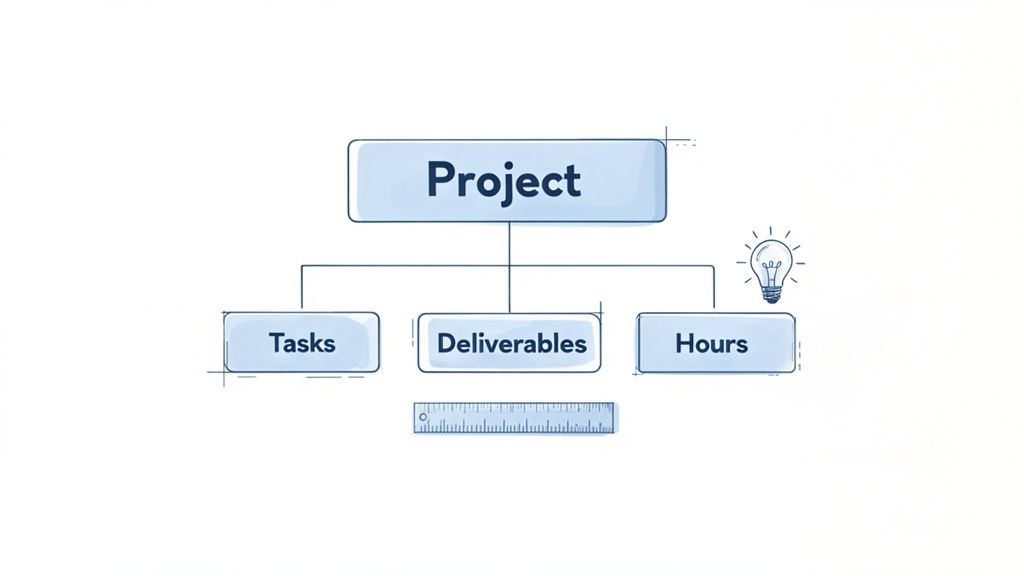
Ever felt overwhelmed by a massive grant-funded project? It's a common feeling. Imagine trying to build a new community center with just a pile of bricks and a vague idea of the final building. It would be chaotic and almost certainly doomed to fail.
That's what managing a grant can feel like without a solid plan. A WBS is the essential blueprint that brings order to the chaos, especially when you're juggling grant applications and program management. It turns a huge goal like "Launch a Youth Mentorship Program" into a clear, visual map of everything that needs to get done.
The Power of Seeing the Whole Picture
So, how does it work? The core idea is to start with your main project at the top and then break it down into major phases or deliverables. Then, you break those down into smaller sub-tasks, and you keep going until you have individual "work packages" that are easy to assign, track, and budget for.
This visual hierarchy gives incredible clarity to everyone involved, from your executive director to the newest program staff. It ensures all the work is directly connected to the project's main goals, much like a detailed table of contents guides a reader through a book. This approach is very similar to building a comprehensive Plan of Record, where every detail is documented so the entire team is on the same page.
To really get a handle on the WBS, it helps to see the core ideas laid out simply. This table breaks down the key concepts and what they mean for your day-to-day work.
WBS Key Concepts at a Glance
| Concept | What It Means for Your Nonprofit |
|---|---|
| Work Package | The smallest, most detailed level of the WBS. It's a specific task that can be assigned, estimated, and managed. |
| Deliverable | The tangible result of work, like a completed training manual, a hosted workshop, or a final report for a funder. |
| Decomposition | The process of breaking down the project into smaller, more manageable parts—from the big goal to tiny tasks. |
| Hierarchy | The tree-like structure that visually organizes the work, showing how small tasks contribute to larger outcomes. |
| The 100% Rule | A non-negotiable principle ensuring the WBS includes all project work—no more, no less. |
These components are the building blocks of a WBS that not only organizes your work but also makes your grant proposals far more compelling.
A foundational principle of any effective WBS is the "100% Rule." This rule mandates that the WBS must capture 100% of the work defined in the project scope—no more and no less. It ensures every deliverable is accounted for, preventing both scope creep and forgotten tasks.
Reducing Risk and Boosting Efficiency
For program managers juggling compliance and deadlines, a lack of structure is a recipe for disaster. The WBS provides that necessary framework.
In fact, adopting a WBS is proven to reduce project risks. According to project management benchmarks, its implementation can decrease overall project risks by as much as 30%. By mapping out every single step, you can spot potential bottlenecks, allocate your resources with precision, and build a grant proposal that funders can't help but feel confident in. You can see how a WBS reduces project risk and helps drive success.
Why a WBS Is a Game Changer for Nonprofits
Okay, so we know what a Work Breakdown Structure is. But why should your nonprofit actually bother using one? The truth is, a WBS isn't just another piece of project management jargon; it’s the tool that turns your big, inspiring mission into a concrete plan that funders can get behind.
Think of it this way: you have a powerful vision, but grant reviewers need to see a logical, step-by-step roadmap. A WBS provides exactly that, showing them you’ve thought through every detail. This clarity has a direct impact on your most precious resources—time and money. When every task is accounted for, you can allocate your budget and team more effectively, which helps prevent the staff burnout we see all too often in our sector.
Enhancing Budget and Team Alignment
One of the biggest wins you'll see is in your budget's accuracy. A WBS lets you build your budget from the ground up, tying specific costs like staff time or supplies directly to individual tasks. This is gold for grant applications. Instead of a vague, top-down estimate, you’re presenting a defensible budget that screams meticulous planning.
By breaking down a large grant project into its smallest components, a WBS creates a shared language and a single source of truth for the entire team. This alignment is critical for success, ensuring everyone is working toward the same, clearly defined objectives.
It also works wonders for team collaboration. A WBS naturally breaks down departmental silos because everyone—from the grant writer to the program coordinator—is looking at the same playbook. This shared picture minimizes confusion and keeps the team focused on what needs to get done. When people see exactly how their work fits into the bigger picture, it's a huge boost for morale and efficiency. You can find more great tips on nonprofit project management to build on this foundation.
Here’s a quick rundown of the benefits:
- Improved Grant Proposals: A WBS shows funders you have a realistic, well-thought-out plan, making your application far more compelling.
- Clearer Scope Definition: It’s your best defense against "scope creep," as it forces everyone to agree on what's included (and what's not) from day one.
- Simplified Reporting: When it's time to report back to funders, tracking your progress against the WBS makes the process straightforward and transparent.
Ultimately, a WBS is the framework that turns your passion into a practical plan. It gives you the roadmap to manage complex, grant-funded projects with confidence and deliver a much greater impact.
The Anatomy of a High-Impact Grant Proposal WBS
Alright, theory is great, but what does a Work Breakdown Structure actually look like for a real grant proposal? This is where we get practical. A solid WBS isn't just a checklist; it's the story of your project, showing a funder you've thought through every single step. It takes your big, ambitious goal and breaks it down into manageable, fundable pieces.
Before you can break anything down, though, you have to know exactly what you're working with. That means you first need to understand what is the project scope. Once those boundaries are crystal clear, the WBS brings it all to life.
Think of it in layers. At the very top, Level 1, you have the project itself. Let’s call it the "Community Literacy Program Grant Proposal." Simple enough.
From there, you start breaking it apart into the major project chunks, or the Level 2 components. For grant writers, the easiest and smartest way to do this is to align these components with the key sections of the grant application. This simple trick ensures your entire plan speaks directly to what the funder asked for.
Decomposing Grant Sections into Actionable Steps
Those Level 2 chunks are still way too big to be useful on their own. This is where the real magic happens: decomposition. You break those big pieces down into smaller, tangible steps that someone can actually own and complete.
Let's stick with our "Community Literacy Program Grant Proposal" example to see how this works:
- 1.1.1 Draft Statement of Need (Level 3)
- 1.1.2 Write Program Goals & Objectives (Level 3)
- 1.1.3 Outline Program Activities & Timeline (Level 3)
- 1.2.1 Collect Staff Salary & Benefit Data (Level 3)
- 1.2.2 Gather Vendor Quotes for Supplies (Level 3)
- 1.2.3 Draft Budget Justification Narrative (Level 3)
- 1.3.1 Collect Partner Letters of Support (Level 3)
- 1.3.2 Obtain Board Roster & Affiliations (Level 3)
- 1.3.3 Secure Audited Financial Statements (Level 3)
See that lowest level? Pieces like "1.1.1 Draft Statement of Need" have a special name: a work package. It's the most detailed level of your WBS—a specific piece of work you can assign to a team member and check off when it's done.
Deliverables vs. Tasks: A Critical Distinction
Here’s a point that trips a lot of people up: a WBS is deliverable-oriented, not task-oriented. It's a subtle but crucial difference. A deliverable is a tangible thing—a finished report, a signed letter, a finalized budget. A task is the action you take to create it, like writing, calling, or researching.
The WBS focuses on the "what," not the "how." A work package like "Collect Partner Letters of Support" is a deliverable. The individual tasks—emailing partners, making follow-up calls, and saving the final PDFs—are the "how" you get there.
Keeping this distinction in mind helps you create a clean, outcome-focused plan. And that's exactly what funders want to see—not your to-do list, but a clear roadmap of the concrete results you will produce.
When you lay it all out this way, you can clearly see how every single element—from budgets to people—connects directly to achieving your program goals.
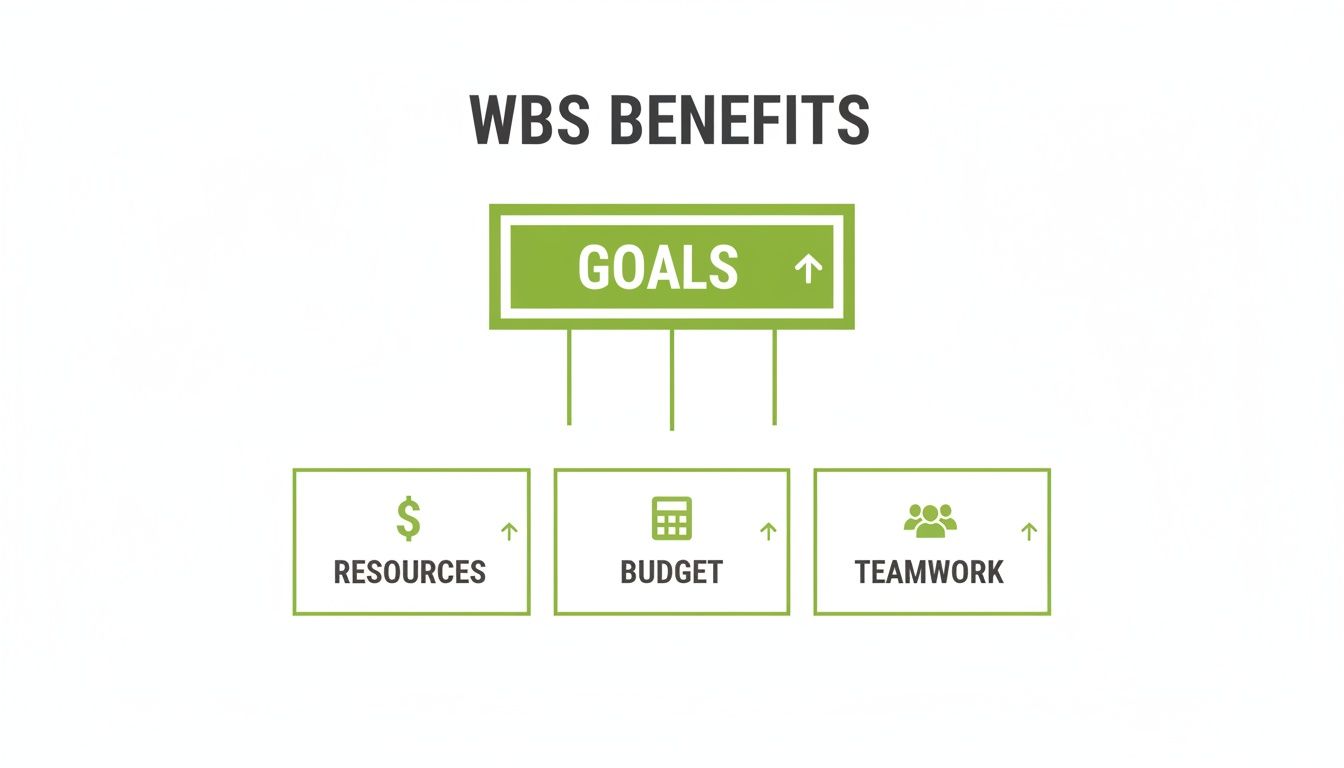
This hierarchical view makes it obvious that every resource you request and every assignment you make is tied directly to the project's main objectives. There's no fluff, just a clear, logical plan.
How to Create a WBS for Your Next Grant Application
Alright, so you understand what a WBS is in theory. Now, how do you actually build one? It might seem intimidating, but it’s really just a logical, step-by-step process. Let's walk through how to create a Work Breakdown Structure from scratch, turning that great program idea into a clear, fundable plan.
The key is to start big and work your way down to the nitty-gritty details. By following these steps, you’ll end up with a solid framework that not only keeps your team on track but also shows funders you’ve thought through every aspect of your proposal.
Step 1: Identify the Final Project Deliverable
First things first: what is the ultimate goal? Before you can break down the work, you need a crystal-clear picture of the final product. For a grant application, it’s pretty straightforward: your main deliverable is a complete, compliant, and submitted grant proposal.
This is the very top of your WBS, Level 1. Think of it as the single destination you’re navigating toward. Every other task and component you define from here on out must directly support this one overarching goal.
Step 2: Define Major Program Components
With your final deliverable locked in, it's time to identify the major chunks of work needed to get there. This becomes Level 2 of your WBS. For grant applications, there’s no need to reinvent the wheel—the funder has already given you a roadmap. Your best bet is to use their Request for Proposal (RFP) as your guide.
Structuring your WBS around the main sections of the grant application is a game-changer. It makes the entire process intuitive and practically guarantees you won't miss a single funder requirement.
A typical grant proposal’s Level 2 components usually look something like this:
- Program Design and Narrative: This is the heart of the proposal, where you explain what you're going to do and why.
- Budget and Justification: All the financial pieces, from spreadsheets to the narrative explaining the numbers.
- Required Attachments: This is where you group all the supporting documents, like 501(c)(3) letters, board lists, and letters of support.
- Submission and Follow-Up: The final administrative hurdles to get the proposal submitted and confirmed.
Step 3: Decompose Components into Work Packages
Here’s where the magic happens. You’ll take each of those big Level 2 components and break them down into smaller, bite-sized tasks. We call these work packages, and they are the most detailed level of your WBS. A good rule of thumb is to keep breaking down the work until a task is small enough to be assigned to one person or a small team.
Let's take the "Budget and Justification" component as an example. You could break it down into these specific work packages:
- Collect staff salary and benefit data
- Gather vendor quotes for program supplies
- Calculate indirect costs
- Draft the budget justification narrative
This is the level where a WBS goes from a nice idea to an incredibly practical tool. It clears up any confusion about who is doing what and creates a concrete action plan. In the high-stakes world of nonprofit fundraising, a missed deadline can mean a lost opportunity. A detailed WBS is your insurance policy; projects that use them often finish 25% faster and 20% under budget. You can find out more about the data behind WBS efficiency statistics and how it impacts project management.
Step 4: Introduce the WBS Dictionary
To make your WBS truly effective, you’ll want to create a companion document called a WBS Dictionary. This simple tool adds all the important details that can’t fit on the visual chart itself.
A WBS Dictionary is a document that provides detailed information about each element in the Work Breakdown Structure. It clarifies the scope, deliverables, deadlines, and resources for each work package, ensuring everyone understands their responsibilities.
Think of it as the user manual for your project plan. For every single work package in your WBS, the dictionary entry might include:
- A quick description of the task
- The person or team responsible
- An estimate of the hours needed
- The final due date
- Notes on any other tasks that need to be finished first
Remember, building a WBS shouldn't be a solo activity. Get your program staff, finance team, and leadership in a room together. This collaboration not only ensures your plan is accurate but also gets everyone on the same page and invested in the outcome.
Common WBS Mistakes and Best Practices
Creating a WBS is part art, part science. While the process is straightforward, a few common slip-ups can make it less effective. Here’s a quick look at some frequent mistakes nonprofits make and how to steer clear of them.
| Common Mistake | Best Practice to Follow |
|---|---|
| Too Vague: Creating work packages that are too broad, like "Develop Budget." | Get Specific: Break it down into smaller, actionable tasks like "Gather Salary Data," "Get Vendor Quotes," and "Calculate Overhead." |
| Including Verbs: Phrasing WBS elements as actions (e.g., "Write the Narrative"). | Focus on Nouns/Deliverables: A WBS represents deliverables. Use nouns like "Final Narrative Draft" or "Completed Budget Spreadsheet." |
| Going Too Deep: Decomposing tasks into minuscule, hour-by-hour steps. | The 8/80 Rule: A good guideline is that a work package should take between 8 and 80 hours of effort. Any less is micromanaging; any more is too big. |
| Making it a Solo Job: One person creates the WBS in isolation. | Collaborate: Involve the entire project team (program, finance, development) to ensure accuracy, completeness, and team buy-in. |
| Forgetting the Dictionary: Creating the visual chart but skipping the detailed WBS Dictionary. | Document the Details: Always create a WBS Dictionary to capture assignments, deadlines, and dependencies. It’s the key to making the WBS actionable. |
By keeping these best practices in mind, you can avoid the common pitfalls and build a WBS that serves as a powerful, practical roadmap for your grant proposal success.
Connecting Your WBS to Budgets and Timelines
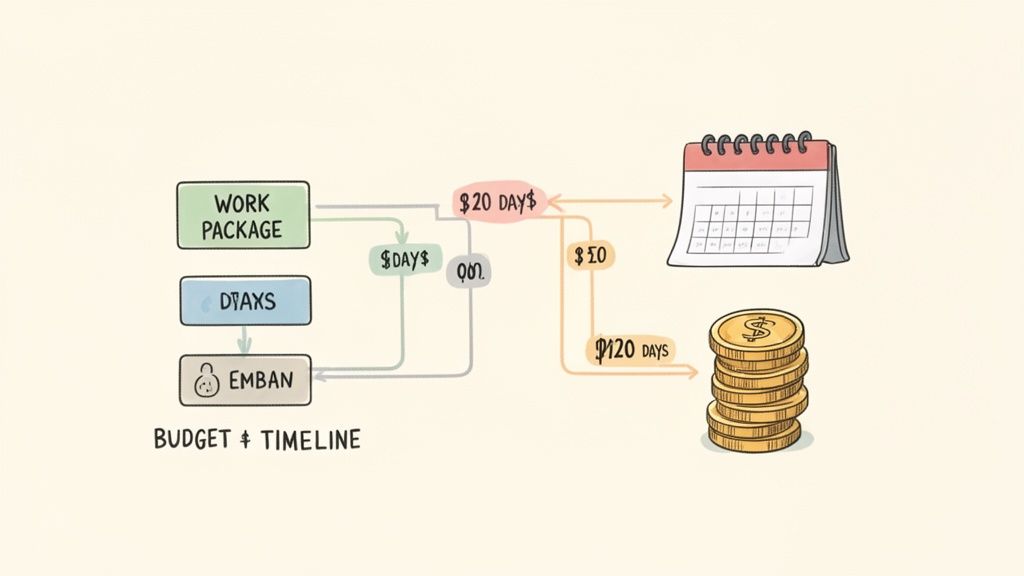
Here’s where your Work Breakdown Structure goes from a simple task list to the real engine driving your project plan. Its true power isn't just in listing what needs to get done, but in connecting each piece directly to your grant budget and project timeline.
This is how you turn an abstract plan into something concrete you can actually manage. By attaching a cost and a time estimate to every single work package, you’re essentially building a financial and scheduling map from the ground up. You stop guessing and start calculating.
From Work Packages to a Defensible Budget
The process itself is pretty straightforward. For each work package, you figure out exactly what resources it will consume. How many staff hours will it take? What specific supplies are needed? Will you need to pay a contractor?
When you add up these individual costs, you get a total project budget that is incredibly accurate. More importantly, it’s highly defensible.
If a funder questions a line item, you won’t be left scrambling. You can point directly to the specific work package it supports, showing them precisely how their money will be put to work. This direct connection is the key to writing a compelling Budget Justification narrative. For more on this, our guide on creating a grant budget template is a great place to start.
Building a Realistic Project Timeline
The exact same logic works for your project schedule. Once you estimate the time needed for each work package and map out their dependencies—what has to be finished before something else can begin—you can build a realistic project timeline.
This bottoms-up approach helps you avoid the classic mistake of setting arbitrary, top-down deadlines. Your timeline becomes a direct reflection of the work itself, making it a reliable guide for your team and a trustworthy schedule to present to funders.
By linking every dollar and every hour to a specific project component, the WBS provides unparalleled clarity. It shows funders you have a meticulous, data-driven plan for stewarding their investment and achieving the promised outcomes.
This level of detail makes a huge difference in the quality of your proposal. For an executive director at a small nonprofit, this structured thinking is non-negotiable. Without it, nonprofits can waste 20-30% of their grant preparation time on endless revisions. But with a solid WBS in place, teams have been shown to slash that wasted time by 40%, which often leads to submitting 15% more proposals annually.
Beyond just planning, your WBS becomes the backbone for careful resource management and cost control throughout the grant period. To stay compliant and make the most of your funding, it's crucial to explore best practices for time tracking for grant reporting. This integration makes post-award tracking practically seamless, turning your proposal into your day-to-day project playbook and making funder reports much simpler.
Common Questions About Using a WBS in Nonprofits
It's one thing to understand a concept like the Work Breakdown Structure, but it's another to actually put it to work. When you're trying to fit a new tool into the fast-paced, often unpredictable world of a nonprofit, questions are bound to pop up.
Let's tackle some of the most common ones we hear from nonprofit leaders. My goal here is to give you straight, practical answers that will help you start using a WBS with confidence.
What Is the Difference Between a WBS and a To-Do List?
Think of a to-do list as your daily grocery list—it tells you what to grab, but not how it all fits into a complete meal. It’s a simple, linear list of tasks, great for day-to-day organization but not for managing a whole grant-funded project.
A Work Breakdown Structure, on the other hand, is the recipe. It’s a hierarchical chart that shows you how every single task connects to a larger deliverable, and how all those deliverables come together to achieve your project's main goal. The key difference is that a WBS shows the relationship between all the pieces, giving you a complete picture that a simple list just can't provide.
How Detailed Should Our Grant Proposal WBS Be?
You're aiming for clarity, not complexity. You need enough detail to accurately estimate time and resources, but not so much that you're tracking every five-minute phone call. A fantastic rule of thumb is the "8/80 Rule."
This guideline suggests that the smallest piece of work on your WBS—a "work package"—should take somewhere between 8 and 80 hours to complete. For a grant proposal, this might look like "Draft Program Goals Section" or "Gather Financial Audit Documents." It creates manageable chunks of work that are big enough to matter but small enough to assign and track effectively.
The right level of detail in your WBS provides clarity without creating unnecessary complexity. Focus on creating manageable work packages that a single person or small team can own from start to finish.
Can We Use the WBS After the Grant Is Awarded?
Absolutely! In fact, you'd be missing out on one of its biggest benefits if you didn't. The WBS you build for your proposal shouldn't just be a planning document; it should be a living tool for getting the work done.
Once you’re funded, that WBS becomes the backbone of your project implementation plan. It's your roadmap for assigning tasks, tracking progress against deadlines, and reporting back to your funder. This smooth transition from proposal to execution is exactly what funders love to see—it proves you had a solid, well-thought-out plan from the very beginning.
Do We Need Special Software to Create a WBS?
Not at all, especially when you’re just starting. The power of the WBS is in the thinking behind it, not the software you use to create it. You can build an incredibly effective WBS with tools you already have.
Here are a few simple ways to get going:
- Spreadsheets: Programs like Excel or Google Sheets are perfect for creating a WBS in an outline or list format.
- Word Processors: The outline view in Microsoft Word or Google Docs is a surprisingly good tool for building a text-based hierarchy.
- Whiteboards: For a team brainstorming session, nothing beats grabbing some sticky notes and visually mapping out your project on a whiteboard.
Down the road, you might find that dedicated project management software helps, but it’s definitely not a prerequisite. Start simple and prove the concept first.
At Fundsprout, we believe a solid plan is the foundation of every successful grant. Our AI-powered platform helps you move from planning to execution by turning grant requirements into structured outlines and actionable tasks, ensuring your team stays on track and your mission gets funded. Discover how to build winning proposals and manage your grants seamlessly at https://www.fundsprout.ai.
Try 14 days free
Get started with Fundsprout so you can focus on what really matters.