What Is Prospect Research? a Guide for Fundraisers
Discover what is prospect research and how it boosts fundraising. This guide explains core concepts, methods, and steps to find your next major donors.

Abdifatah Ali
Co-Founder
If you're asking what is prospect research, you're probably feeling one of two things right now. Either your team has a long donor list and no confidence about who deserves real attention, or you're trying to grow major gifts with limited staff time and too many educated guesses.
That tension is normal. Small nonprofits feel it sharply because every meeting, call, and proposal takes time you don't have. When fundraising starts to feel like chasing whoever might respond, prospect research becomes less of a luxury and more of a discipline. It helps you stop treating every name the same and start making better decisions about where relationship-building is most likely to matter.
From Guesswork to Gratitude An Introduction
A development coordinator pulls a donor list before a board meeting. One trustee wants to pursue wealthy names in town. Another points to loyal event attendees. Someone else suggests running a wealth screen and seeing what comes back. By the end of the meeting, the team has plenty of opinions and no clear standard for deciding who merits a call, a visit, or more cultivation.
That is usually the moment prospect research starts to matter.
Prospect research is the practice of gathering and testing information so your team can judge which donors are realistic major-gift prospects, which ones need more relationship-building, and which ones should stay in a different fundraising track for now. The point is not to collect trivia about people. The point is to make better decisions with limited time.
In many shops, the old shorthand was simple: find people with money. That approach was always incomplete, and it is less reliable now. Public data is fragmented. Privacy changes have limited what fundraisers can easily see online. Giving signals that used to be easy to spot are often scattered across databases, event records, board connections, and your own CRM notes. Good prospect research accounts for that reality. It helps teams validate a prospect from several angles, even when no single source gives a full picture.
That is why experienced fundraisers treat research as a judgment process, not a treasure hunt. A prospect may look promising because of visible wealth, but still have no connection to the mission, no giving pattern, and no relationship path into your organization. Another donor may never appear on a flashy list, yet show steady engagement, strong values alignment, and clear signs that a larger conversation makes sense.
A simple example makes the difference clear. One donor owns a successful local company and has never done more than attend one luncheon. Another has given modestly for five years, volunteers twice a year, and knows a board member well. If a small team treats those names as equal, staff time disappears fast. If the team researches both names with discipline, the second prospect often becomes the smarter near-term priority.
That shift changes the work.
Prospect research gives fundraisers a way to move from hunches and internal politics to documented reasoning. It helps answer practical questions such as:
- Who deserves personal outreach now
- Who needs more verification before entering a major-gifts portfolio
- Who shows interest but not enough evidence yet
- Who belongs in annual giving, events, or stewardship instead
For a new development coordinator, that is the clearest answer to what prospect research is. It is a repeatable way to qualify opportunity, reduce wasted effort, and set up more conversations that can lead to real gratitude instead of another round of guessing.
The Three Pillars of Prospect Research
The easiest way to understand prospect research is to stop thinking of it as a list-building exercise. It's a scoring workflow.
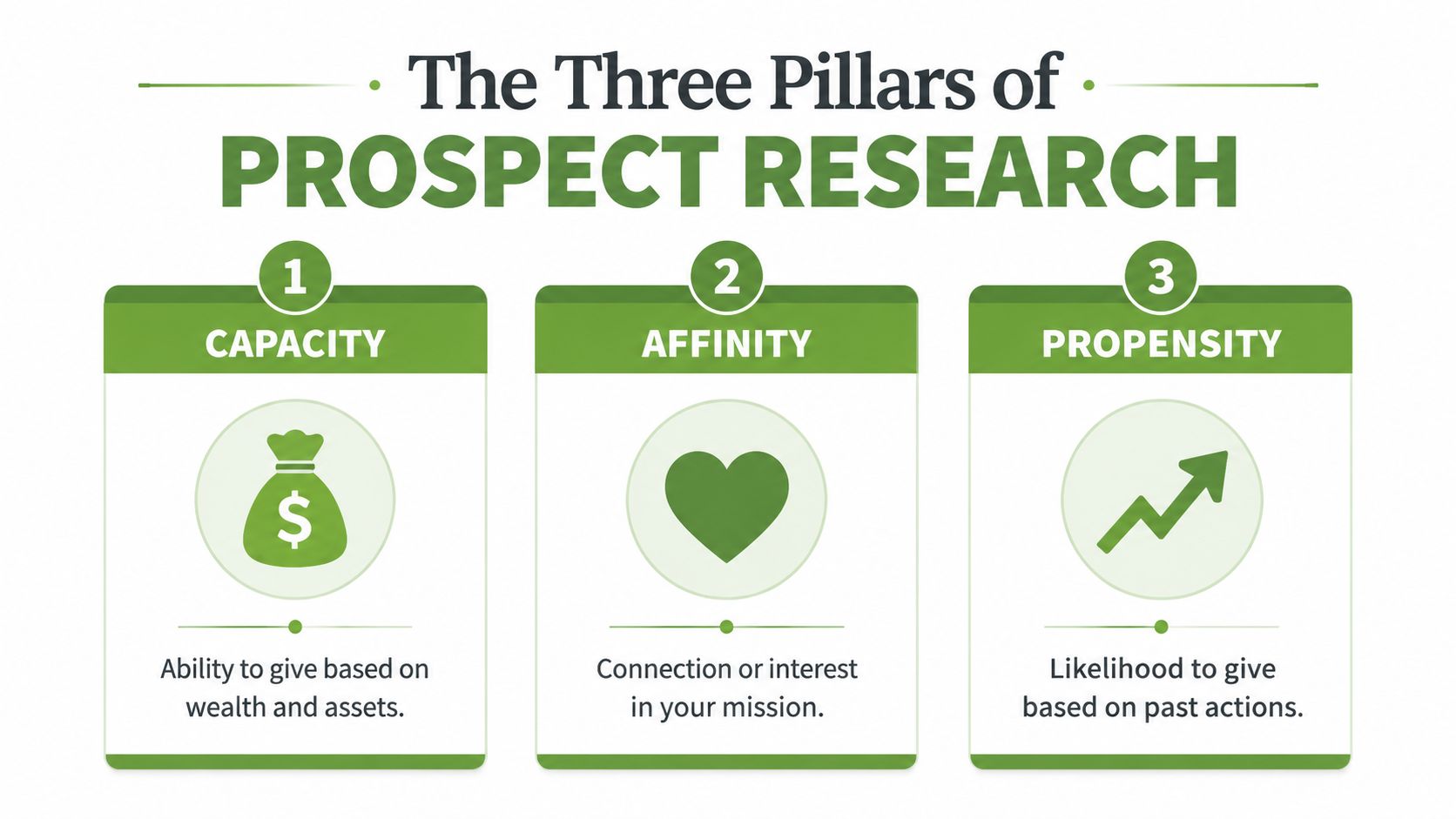
The core model comes down to three signals: capacity, affinity, and propensity. Giving Docs explains that prospect research combines those signals to prioritize outreach, and the strongest prospects are the ones who score well across all three dimensions.
Capacity means ability
Capacity is the prospect's ability to give.
Fundraisers usually infer it from markers such as real estate, stock holdings, business affiliations, and political giving. Capacity tells you whether a major-gift conversation is even plausible. It doesn't tell you whether the donor will care.
A simple mistake new fundraisers make is overvaluing capacity because it's easier to spot than the other two pillars. A prominent title, a known business, or visible assets can look persuasive. But capacity alone often leads to dead ends.
Affinity means connection
Affinity is the prospect's connection to your mission.
That can show up through volunteering, event attendance, board service, shared values, a family experience tied to your cause, or visible support for similar organizations. Affinity often makes the difference between a cold prospect and a warm one.
Here's the practical test: if a gift officer asked, “Why this organization?”, could you answer in a sentence grounded in evidence? If not, the affinity case is still weak.
Propensity means likelihood
Propensity reflects a person's demonstrated inclination to give.
That usually comes from prior donation history. Someone who has supported charitable work before, especially in patterns that resemble your campaign or cause area, is easier to qualify than someone with no visible giving behavior.
Here, many teams sharpen their judgment. A prospect may have moderate capacity but strong affinity and clear propensity. That person can outperform a much wealthier name who has no visible philanthropic behavior and no relationship context.
A quick working model
Think of the three pillars this way:
| Pillar | What you're asking | Typical clues |
|---|---|---|
| Capacity | Can this person make a meaningful gift? | Real estate, business roles, stock holdings, political giving |
| Affinity | Do they care about causes like ours? | Volunteering, event attendance, mission alignment, board service |
| Propensity | Do they tend to give? | Prior donation history and other philanthropic behavior |
Practical rule: If only one pillar is strong, keep researching. If two are strong, consider cultivation. If all three are strong, move that prospect up your list.
What works is balance. What doesn't work is chasing wealth alone.
Why Prospect Research Is a Fundraising Game-Changer
Prospect research changes fundraising because it changes where your team spends attention.
Without research, teams default to reactive work. They answer inbound interest, send broad appeals, and let the calendar dictate outreach. That keeps activity high, but it rarely builds a deliberate major-gift pipeline. With research, a fundraiser can say, “These are the people we should cultivate this quarter, these are the board connections we should activate, and these asks should wait.”
It protects your most limited resource
For most nonprofits, the scarce resource isn't donor names. It's fundraiser time.
A development director, executive director, or board member can only carry so many meaningful relationships well. Prospect research helps you reserve that energy for the people most likely to respond to thoughtful cultivation. It also saves newer staff from spending weeks pursuing names that were never qualified in the first place.
That discipline improves downstream work too. A better-qualified prospect list leads to better meetings, cleaner portfolios, and more realistic solicitation planning. Teams that want stronger stewardship also benefit because qualification sets up more relevant follow-up. If you're refining relationship management after the first gift, this guide to mastering donor stewardship is useful alongside prospecting work.
It improves the ask, not just the list
Research doesn't only help you find people. It helps you decide how to approach them.
If a prospect has ties to a specific program, a board relationship, and visible support for similar causes, your ask strategy should reflect that. If their giving appears seasonal, your timing should reflect that. If there's no relationship pathway yet, stewardship and cultivation should come before solicitation.
That kind of planning sits inside broader nonprofit fundraising best practices, but prospect research is often the missing operational layer. It connects donor information to actual moves management.
Here's a helpful overview if you want a visual explanation before training a colleague or board member:
It creates a pipeline instead of a wish list
A wish list is a collection of names you hope might help. A pipeline is a ranked set of prospects with next steps.
That difference is what makes prospect research so valuable. It moves fundraising away from vague optimism and toward a repeatable system. When a team knows who is qualified, who needs more information, and who is ready for personal outreach, major gifts stop feeling accidental.
When a nonprofit says major gifts are “hard to predict,” the problem is often weak qualification, not lack of generosity in the market.
Building Your Prospect Research Workflow
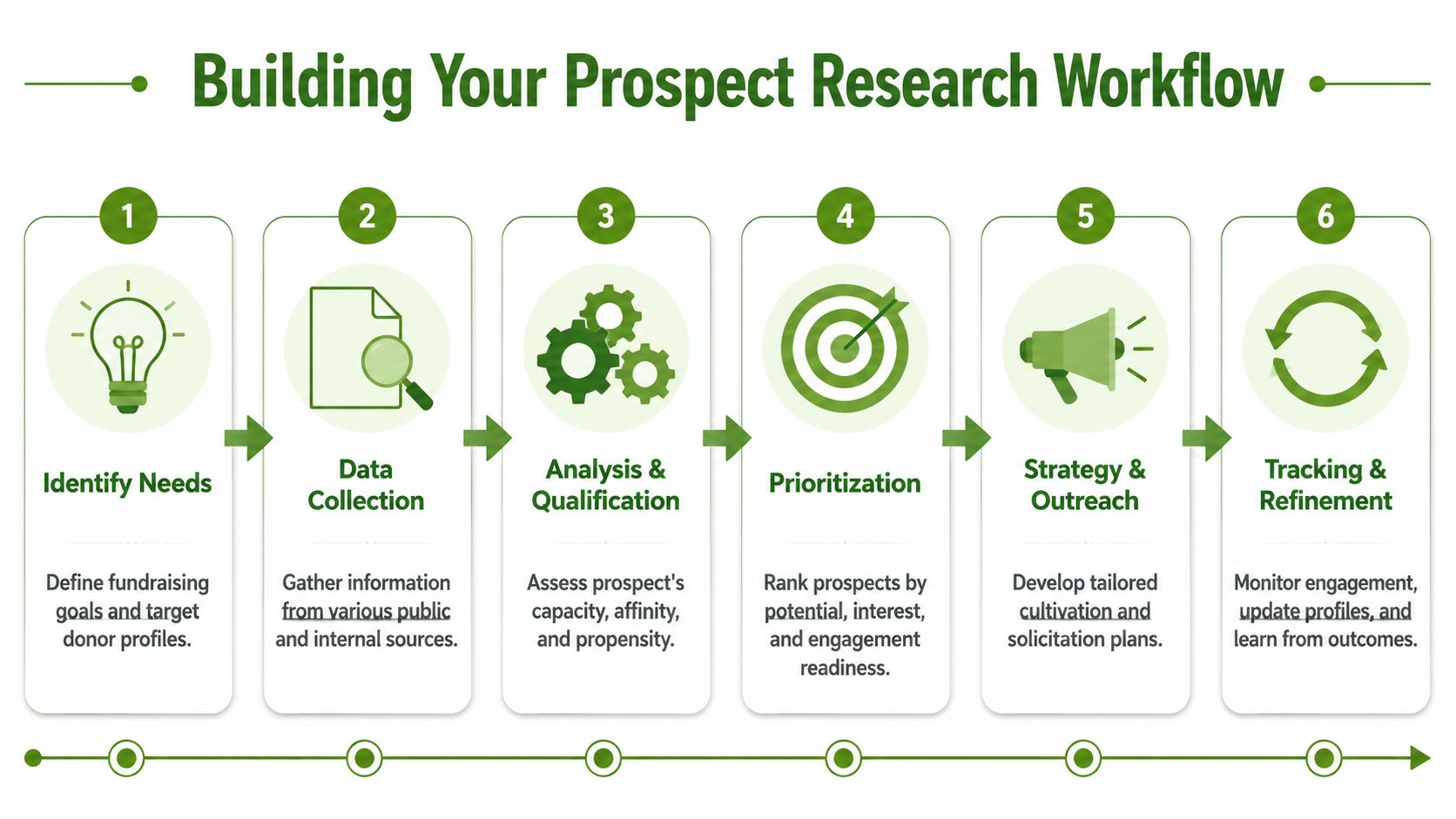
A practical workflow matters most on the day a gift officer asks, “Who should I call this week?” If your answer lives in three spreadsheets, two inboxes, and one board member's memory, research has not become operations yet.
Good prospect research creates a decision trail your team can use. For small nonprofits, that usually means a short process, clear fields, and a habit of recording what you know, what you suspect, and what still needs to be checked. That discipline matters more now because donor signals are more fragmented than they used to be. Public giving is less visible, privacy settings hide useful clues, and wealth markers without relationship context can send a team in the wrong direction.
CCS Fundraising's prospecting guidance reinforces a sound practice: build a ranked pipeline, record solicitation status and next steps in a structured way, and use research to shape ask size, timing, and sequencing. The useful lesson is not the template itself. It is the operating principle. Research should help a fundraiser choose the next action with more confidence, even when the file is incomplete.
Start with a workable pool
Begin with names that already have some context around them.
That pool often includes repeat donors, lapsed donors with a strong past connection, former board members, volunteers, event attendees, family foundation contacts, and people introduced by staff or trustees. I would take a warm name with thin public data over a cold name with flashy wealth indicators almost every time. Warmth gives your team a path to action.
For many organizations, the best first list includes:
- Existing donors: People with a giving history you can review
- Network referrals: Names surfaced by board, staff, or campaign volunteers
- Engaged participants: Volunteers, advocates, or attendees who keep showing up
- Institutional prospects: Foundations or corporate funders that align with a program area. If your team also pursues grants, a shortlist from grant discovery platforms nonprofits use to identify funders can sit alongside your individual prospect list without replacing it
Qualify with evidence, not impressions
The next step is validation.
A prospect profile should separate confirmed facts from assumptions. “Owns multiple properties” is different from “likely major donor.” “Serves on the committee with our board chair” is different from “ready for an ask.” New coordinators often feel pressure to make the file sound complete. A better habit is to mark uncertainty clearly and keep going.
Use a simple qualification sheet that answers five questions:
| Field | Why it matters |
|---|---|
| Capacity notes | Tests whether a larger ask is plausible |
| Affinity notes | Shows whether the mission fits the prospect's interests |
| Propensity notes | Adds evidence of giving behavior or philanthropic intent |
| Relationship pathway | Identifies who can make the introduction or add credibility |
| Open questions | Shows what must be verified before cultivation or solicitation |
That last field is where modern prospect research gets more honest. Some files will stay incomplete for a while. A privacy wall, a common name, or limited public records can block easy confirmation. In those cases, the right move is often “cultivate and learn more,” not “guess bigger.”
Rate prospects in a way your team will actually use
A rating system should support decisions, not create busywork.
Small teams usually do well with a short score for capacity, affinity, and relationship strength, followed by an overall priority such as ready, cultivate, watch, or pause. Keep the scale plain enough that two staff members would rate the same prospect similarly.
A useful rating points to a next move, an owner, and a timetable.
If your team cannot explain why a prospect is ranked near the top, the rating needs work. I have seen organizations lose months chasing names that looked wealthy on paper but had no credible link to the mission, while quieter prospects with real access and real interest sat untouched in the database.
Turn research into an ask plan
Once a prospect rises to the top tier, write a short plan tied to action.
Use what you know about the prospect's connection, visible interests, prior giving behavior, and timing cues. Be selective about which signals matter. A large donation to a university campaign twenty years ago may be less useful than a recent gift to a local human services nonprofit, or a current leadership role in a cause-adjacent organization. Public research methods borrowed from fields like OSINT for B2B sales can help staff verify affiliations and surface context, but fundraising teams still need to interpret that information carefully and ethically.
For each top prospect, document:
- Objective: The relationship outcome you want next
- Connector: The person best positioned to open the door
- Offer: The program, campaign, or funding need that fits
- Timing: Why this moment makes sense
- Next step: The specific action, owner, and date
That plan should be short enough to survive a busy week. If it takes half an hour to update one record, nobody will keep it current.
Keep the system maintainable
The best workflow is the one your team updates consistently.
A spreadsheet can work if ownership is clear and review happens every week. A CRM is better when staff enter notes the same day, use standard fields, and close the loop after meetings. What breaks a workflow is usually not lack of software. It is overdesign.
Set a review rhythm. Decide who can change ratings. Require next steps on top prospects. Mark unverified information clearly. Those simple rules keep the pipeline useful, even when your team is working with imperfect information and incomplete public signals.
Common Data Sources and Research Methods
The “research” part of prospect research sounds mysterious until you break it into sources. Most of the time, you're combining internal knowledge with public information and then checking whether the pieces tell a coherent story.
That's why experienced fundraisers don't rely on one data point. A single clue can mislead you. Several clues that point in the same direction are far more useful.
Start inside your own organization
Your first research source is usually your own database.
Look at giving history, event attendance, volunteer participation, committee service, notes from prior meetings, lapsed donor records, and who knows whom. Even a messy CRM often holds the earliest signs of affinity. The person who has shown up repeatedly, introduced a friend, or responded to a program update may be more promising than the stranger with a stronger wealth profile.
Internal records can also reveal what not to do. If a donor was previously solicited for the wrong program, or if a relationship cooled after staff turnover, that context matters.
Add external public records carefully
External research fills in what your internal files can't show.
Common sources include public records, SEC filings, business affiliations, real estate information, news coverage, archived web content, and visible civic or nonprofit involvement. These sources help you understand whether a prospect's public profile aligns with the internal signals you're seeing.
A useful mental model comes from open-source intelligence. In the commercial world, teams use public digital traces to build a clearer picture before outreach. This explainer on OSINT for B2B sales is a good parallel because the underlying habit is similar: gather what is publicly available, verify it, and avoid overconfident conclusions from thin evidence.
Build a profile, not a scrapbook
The goal isn't to collect facts for their own sake. The goal is to answer practical questions.
Use your research to build a profile like this:
- Who are they really connected to? Board, staff, peer donors, alumni, community leaders
- What causes seem to matter to them? Not everything they've touched, just the themes that repeat
- What signals suggest capacity? Real estate, business roles, filings, or public financial markers
- What still needs verification? Old employer data, unclear family links, conflicting addresses
If your nonprofit also pursues institutional funding, it's worth separating donor prospecting from grant prospecting. The research habits overlap, but the targets differ. A resource on grant discovery platforms for nonprofit funding can help teams keep those workflows distinct.
Public information can support a fundraising decision. It shouldn't replace judgment, conversation, or relationship context.
The ethical line
Use publicly available information and handle it with restraint.
A prospect profile should help your team make respectful decisions. It should not become a dossier filled with irrelevant personal details. If a piece of information doesn't improve cultivation strategy, ask size, or relationship planning, you probably don't need it.
Trust matters in fundraising. Research should make your outreach more thoughtful, not more invasive.
Tools and Compliance in the Modern Era
The old version of prospect research was simpler. Pull some public records, run a screening, review the wealth signals, and build a target list. That still exists, but it isn't reliable enough on its own anymore.
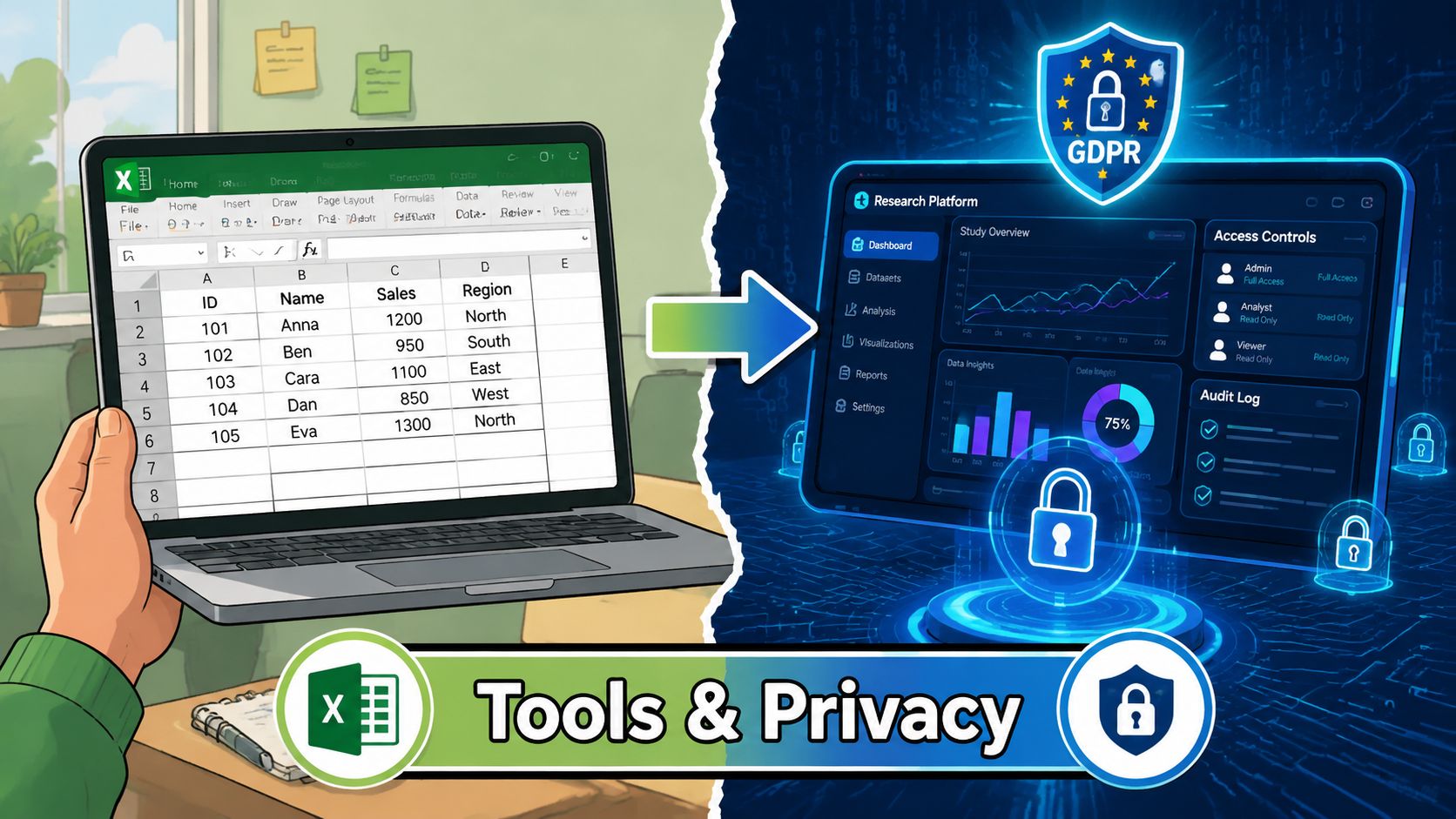
The modern challenge is fragmentation. Records are spread across systems, some signals age quickly, and privacy rules have changed what teams can access consistently. Kindsight's discussion of modern prospect research makes this point clearly: nonprofits increasingly rely on public, third-party, and digital traces such as social media, SEC filings, real-estate records, and archived web pages, while privacy rules and platform restrictions are making those traces harder to access or use consistently across markets.
What that means for small nonprofits
It means you should be skeptical of apparent certainty.
A stale employer record may overstate current capacity. A property record may belong to someone with the same name. Social signals may disappear or shift. Wealth indicators can conflict with observed giving behavior. Older “wealth screening plus manual lookup” advice is becoming less dependable than it sounds, especially for teams that don't have dedicated research staff.
That doesn't make prospect research useless. It makes validation more important.
A practical validation sequence looks like this:
- Check recency: How current is the record?
- Check identity: Are you confident this is the right person?
- Check consistency: Do multiple sources point in the same direction?
- Check relevance: Does the information affect cultivation strategy?
Choosing tools without overbuying
At the low end, a spreadsheet and disciplined note-taking can handle early-stage research. At the next level, a nonprofit CRM can centralize relationships, tasks, and gift history. More specialized tools can help synthesize external data, monitor changes, or screen portfolios.
If you're evaluating infrastructure, this comparison of CRM software for nonprofits is a practical place to start. Some teams also use adjacent tools for grant prospecting and funding research. For example, Fundsprout is an AI-powered grant success platform that helps nonprofits find funding opportunities, analyze requirements, and manage proposal workflows. That's a separate use case from donor prospect research, but it matters for organizations trying to coordinate multiple revenue streams with a small staff.
You should also be realistic about data collection methods. Teams sometimes look at resources about social media data APIs to understand how digital signals are gathered, but nonprofit fundraising work still needs a conservative standard for privacy, permissions, and data handling.
Compliance is part of research quality
Compliance isn't just legal review at the end. It starts when you collect the data.
Use tools your organization understands. Record where information came from. Limit access to sensitive records. Avoid pulling in personal details that don't support fundraising decisions. If a board member asks how a profile was built, your team should be able to explain it clearly.
The strongest modern prospect research programs aren't the ones with the most data. They're the ones with clean enough data, documented enough process, and cautious enough judgment to support good decisions.
Your First Steps in Prospect Research
Start smaller than you think you should.
If your organization tries to research everyone at once, the project will stall. The better move is a short pilot that produces a few useful decisions quickly.
A practical starting plan
Review your closest supporters first
Pull your most loyal existing donors and read their records carefully. Look for signs of deeper commitment, relationship pathways, and any public information that adds context. Familiar names are easier to validate than cold prospects.Bring in one decision-maker and one connector
Sit down with your executive director and a board member who knows the community well. Ask simple questions: Who knows this person? What do we know firsthand? What are we assuming? That conversation often surfaces warmer paths than solo desk research.Choose only two prospects for active planning
Write a short profile for each. Include what you know, what still needs verification, who might open the door, and one next action. Keep it narrow enough to ensure someone follows through.
The first goal isn't to build a perfect research system. It's to prove that better qualification leads to better fundraising decisions.
If you stay disciplined, you'll start noticing the difference fast. Meetings get more focused. Board conversations get more concrete. Your team stops asking, “Who should we go after?” and starts asking, “What's the right next move for this prospect?”
Fundsprout helps nonprofits build a clearer funding pipeline on the grant side of development work. If your team is juggling donor cultivation alongside foundation, local, state, or federal opportunities, Fundsprout offers AI-assisted grant discovery, eligibility screening, proposal planning, and compliance tracking so you can manage both relationship-based fundraising and institutional funding with more structure.
Try 14 days free
Get started with Fundsprout so you can focus on what really matters.