New Visions Foundation: A Grant Seeker's Complete Guide
Your guide to the New Visions Foundation. Learn to distinguish it from others, understand its grants, and write a winning proposal with tools like Fundsprout.

Abdifatah Ali
Co-Founder
You’re probably here because you found “new visions foundation” in a database, on a list, or in a conversation with a board member, and now you’re trying to answer the first question that matters.
Which one?
That confusion wastes real time. I’ve seen teams build a prospect brief around the wrong organization, draft an LOI for a nonprofit that doesn’t make grants, or chase a name match instead of a mission match. With New Visions, that risk is higher than usual because several unrelated organizations use nearly identical names.
If you’re an executive director or development lead, the right move isn’t to start writing. It’s to sort the entities, verify the funder, and only then decide whether the opportunity deserves staff time.
Which New Visions Are You Looking For?
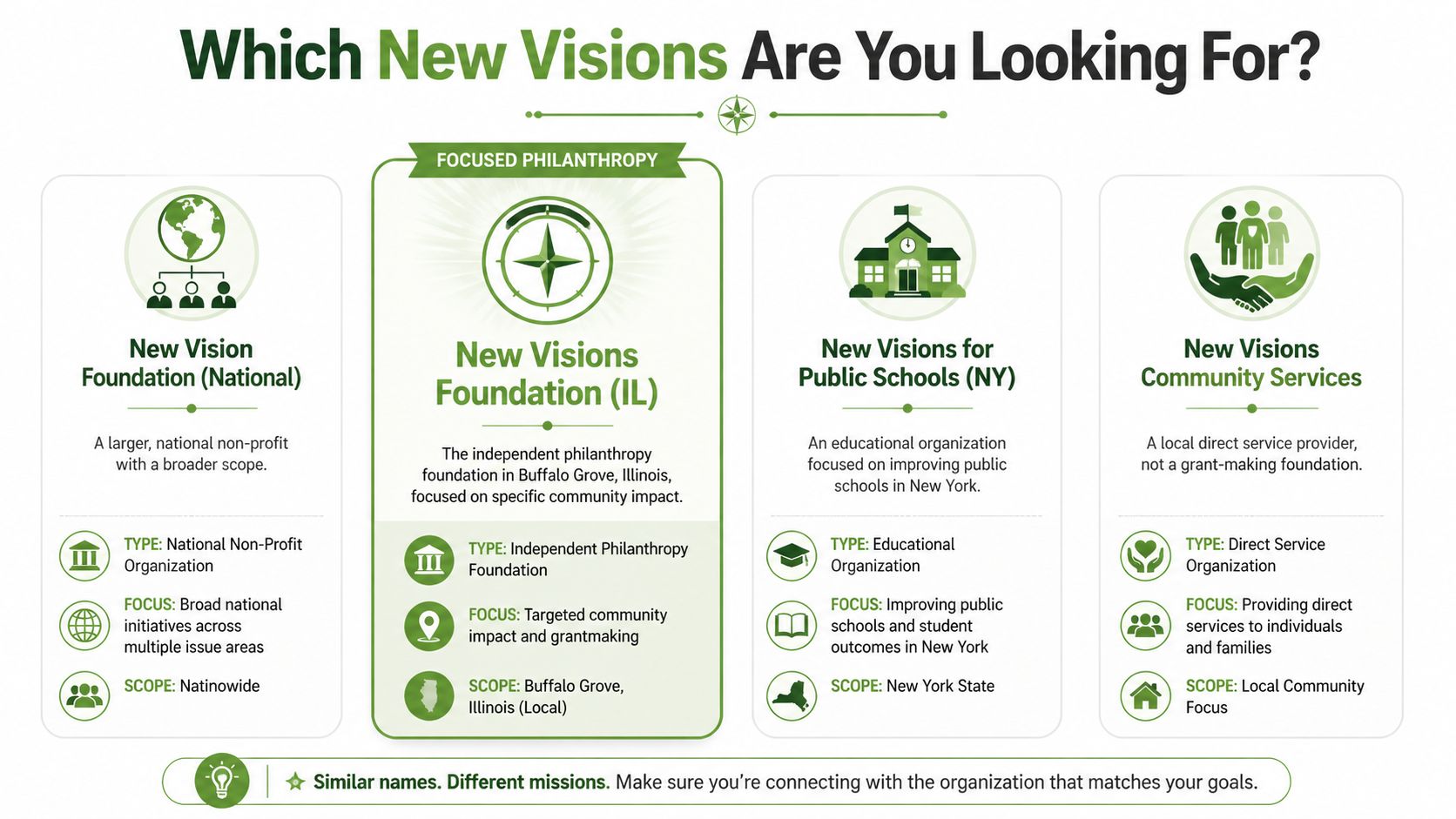
The name new visions foundation sounds specific. It isn’t. It can point to a grantmaking foundation in Illinois, a large education nonprofit in New York City, a youth-focused nonprofit in Minneapolis, or a similarly named organization that should trigger a risk review before you go near it.
That’s the first practical lesson. Name similarity is not prospect qualification.
The fast way to separate them
Use four identifiers before you invest a single hour:
- Entity type. Is it a grantmaker, an operating nonprofit, or a direct service provider?
- Geography. Where is it based, and where does it operate?
- Mission language. Economic reform and sustainability is not the same as school improvement or coding instruction.
- Tax and profile details. EIN, legal name, and foundation profile matter more than branding.
Here’s the cleanest way to unpack the main organizations grant seekers confuse.
| Organization Name | Primary Focus | Geographic Focus | Key Identifier |
|---|---|---|---|
| New Visions Foundation | Grantmaking in economic reform, education, peace, and sustainability | Buffalo Grove, Illinois | Independent philanthropy foundation, EIN 36-4291720 |
| New Visions for Public Schools | Educational nonprofit improving public school outcomes | New York City | Large operating nonprofit, not the Illinois foundation |
| New Vision Foundation | Coding and digital literacy for disadvantaged youth | Minneapolis, Minnesota | Program operator with local youth economic mobility focus |
| Brand New Vision Foundation | Separate Minnesota entity tied to a public fraud investigation | Saint Paul, Minnesota | Due diligence red flag, not a routine foundation prospect |
One of the easiest mistakes is treating New Visions for Public Schools like a funder because the name sounds foundation-like. It isn’t the same entity. It has operated for over 35 years, reports $34,971,943 in total revenue, and holds a 4-star Charity Navigator rating, which makes it a substantial NYC education nonprofit, not the Illinois grantmaking foundation you may be researching (New Visions for Public Schools track record).
What this means for your pipeline
If your team is building a funder list, don’t let similar names sit in the same bucket. Create separate records and tag them by type.
Practical rule: If two organizations share part of a name, assume nothing. Verify legal identity before you assess fit.
A solid prospecting workflow usually includes a quick screen like this:
- Confirm the legal name from a foundation profile or tax record.
- Check whether it gives grants or delivers programs directly.
- Map the geography to your service area.
- Read the mission language as written instead of translating it into your own priorities.
- Drop mismatches early so your team can focus on real prospects.
If your current process relies on broad keyword searches, it helps to tighten how you build your list in the first place. A curated approach to find grants for nonprofits reduces this kind of confusion before it reaches the proposal stage.
Decoding the New Visions Foundation (IL) Mission
Once you isolate the Illinois entity, the next question is simple. Does your work fit the way this foundation thinks about change?
The New Visions Foundation in Buffalo Grove, Illinois was established in 1999 and focuses its grantmaking on economic reform, education, peace, and sustainability. Its published strategy emphasizes both public outreach and the development of actionable models for societal change, which means it isn’t looking only for compassionate programming. It’s looking for work that can influence culture, systems, or public understanding while also showing a practical path forward (New Visions Foundation profile).

Read the mission as a filter, not a slogan
A lot of applicants treat foundation mission statements as soft branding. That’s a mistake here.
This funder’s interests aren’t broad charitable categories. They’re frames for social change. If you run a program that delivers useful services but can’t explain how your work advances a wider model, influences public thinking, or creates something others can adopt, your proposal will probably feel flat.
Three implications follow from that.
- Direct service alone may not be enough. Your work may need a visible pathway from service delivery to a larger change effort.
- Education has to mean more than instruction. If you operate in education, your proposal should show how your approach affects systems, norms, or access.
- Sustainability and peace require specificity. Generic language about community wellbeing won’t carry the case.
What the dual focus looks like in practice
The phrase “public outreach and actionable models” gives you a useful reading lens.
Public outreach means the foundation may respond to organizations that can communicate beyond a closed beneficiary group. That could mean public education, community engagement, field-building, or visible dissemination of lessons. Actionable models means your work should not stop at ideas. It should create a replicable practice, a tested framework, or a concrete intervention others can use.
If your proposal can’t answer both questions, “Who learns from this?” and “What can someone do with it?”, the fit is probably weak.
A sharper self-assessment
Before you pursue new visions foundation, pressure-test your alignment with questions like these:
- Does your program sit inside one of the stated pillars? Economic reform, education, peace, or sustainability should be obvious from the first paragraph.
- Can you show a theory of change with a clear cause-and-effect chain? The foundation’s framing points toward organizations that can connect activities to broader shifts.
- Are you building a model, not just running a service? Foundations with this orientation want evidence that your work can travel beyond one site or one cohort.
- Do you communicate with public audiences? Outreach matters here. Quiet impact with no external expression may not match the foundation’s worldview.
What tends to work and what usually doesn’t
Strong alignment usually comes from organizations that combine mission clarity with strategic ambition. They know the difference between “we help people” and “we help people through a model that can change how this issue is addressed.”
Weak alignment usually shows up in familiar ways:
| Often stronger | Often weaker |
|---|---|
| A clearly named reform, education, peace, or sustainability effort | A broad community benefit pitch with no direct tie to stated priorities |
| A program plus a way to share, teach, or spread the model | A service request with no field-facing dimension |
| A proposal that names the practical change mechanism | A narrative built mostly around need and urgency |
If you can’t draw a straight line from your work to both mission pillar and change model, save your team the time. This is one of those prospects where disciplined restraint is part of good grantsmanship.
Grant Types Eligibility and Focus Areas
Teams tend to prioritize the wrong initial inquiry. They ask, “Can we get funded?” The better question is, “Are we even an eligible, believable fit?”
With new visions foundation, the public information gives you a mission frame, but not a detailed open call menu. That means your decision has to rest on fit logic, not wishful thinking. When the grantmaker’s profile is limited, the burden shifts to the applicant to avoid overreaching.
Start with the non-negotiables
Use a go or no-go screen before discussing strategy internally.
- Mission fit: Your work should sit directly inside economic reform, education, peace, or sustainability.
- Organizational status: If you’re pursuing foundation support, your entity structure and charitable standing need to support philanthropic funding.
- Program relevance: You need a real programmatic connection, not a loose thematic overlap.
- Geographic credibility: Even when a foundation’s giving area isn’t fully spelled out, your location and community context should make sense for the prospect.
If two or more of those are shaky, don’t force it.
A useful contrast from Minneapolis
The clearest lesson about focus comes from a different but similarly named organization. The New Vision Foundation in Minneapolis centers its work on coding and digital literacy for disadvantaged youth in its local area. That’s a strong reminder that specific intervention plus specific geography often drives real funding decisions, and a mismatch is usually the fastest route to rejection (New Vision Foundation Minneapolis overview).
That example matters because many nonprofits pitch foundations as if category overlap is enough. It isn’t. A workforce nonprofit may hear “education” and assume fit. A peacebuilding organization may hear “sustainability” and stretch the case. Reviewers notice that immediately.
How to interpret likely support areas
Without inventing grant categories that haven’t been published, it’s still fair to infer where your request is more likely to land well.
A stronger request usually has these traits:
- It’s attached to a defined initiative. Foundations with a strategic mission often respond better to a clearly scoped body of work than to vague unrestricted appeals.
- It shows organizational capacity. If you claim a model for societal change, your staffing, partnerships, and execution plan should support that claim.
- It links program work to broader influence. Training, convening, public education, research translation, or model demonstration can strengthen your case.
A weaker request usually has one of these problems:
- The ask is generic. “Support our mission” without a sharp strategic frame rarely helps.
- The geography feels accidental. If your work has no meaningful tie to the funder’s likely context or interests, it reads as list-driven fundraising.
- The intervention is too broad. Foundations can’t fund every good idea. They fund work that fits their lane.
A proposal doesn’t fail only because the writing is weak. It often fails because the eligibility decision was weak.
The practical call
If your organization operates in one of the foundation’s named priority areas and can describe a concrete model with public-facing relevance, it may deserve cultivation.
If your argument depends on translating your work into their mission through several layers of interpretation, that’s your answer. Move on.
Navigating the Application and Funder Vetting
Applying to a foundation is only half the job. The other half is deciding whether the funder belongs in your portfolio at all.
A disciplined development shop treats grant seeking as mutual evaluation. You’re not just asking whether you qualify. You’re asking whether this relationship is stable, legitimate, and reputationally safe.
The application side still matters
Even when the process looks straightforward, a foundation application usually tests four things:
- Can your team follow instructions?
- Can your budget hold up to scrutiny?
- Can your outcomes be stated clearly without exaggeration?
- Can your organization document its own claims?
For a prospect like new visions foundation, I’d expect a standard progression. Initial outreach or a short inquiry first, fuller materials only if there’s signs of alignment, then due diligence on programs, leadership, and financials. If your organization can’t produce a current budget narrative, program summary, and concise theory of change quickly, the problem isn’t the form. It’s readiness.
A practical operating guide for staff who need to tighten that process is this resource on how to apply for grants.
The part most nonprofits skip
Nonprofits often vet grantees less than foundations vet nonprofits. That’s backwards.
The cautionary example here is the 2025 federal raid on Brand New Vision Foundation in Saint Paul, linked in reporting to the Feeding Our Future fraud scandal. The reporting states that the entity received over $2.5 million and that its revenue spiked 500% in one year, both major red flags for anyone assessing organizational credibility or funding relationships (report on the federal raid and red flags).
That doesn’t mean every similarly named organization is suspect. It means name similarity can hide very different risk profiles, and your team needs a habit of verification.
Don’t let urgency erase judgment. A promising prospect can still be a bad partner.
What to check before you engage
I recommend a short risk screen for any new institutional prospect, especially one discovered through a database or referral.
| Check | What you’re looking for | Why it matters |
|---|---|---|
| Legal identity | Exact organization name, location, tax profile | Confirms you’re researching the right entity |
| Organizational role | Grantmaker or operating nonprofit | Prevents category errors |
| Financial pattern | Stable, explainable revenue and activity | Flags unusual jumps or inconsistencies |
| Public history | News coverage, regulatory issues, leadership visibility | Surfaces reputational risk |
| Program logic | Real alignment between their mission and your work | Avoids chasing cosmetic matches |
Many scandals look obvious in hindsight because no one paused long enough to test the basics. A dramatic revenue jump, unclear vendors, thin public records, or mission drift should slow you down.
A short explainer can help teams think about the mechanics of the application process while keeping risk management in view:
What sophisticated teams do differently
The best development teams don’t just maintain an opportunity pipeline. They maintain a qualified pipeline.
That means they’ll decline to pursue a prospect when:
- The funder identity can’t be cleanly verified
- The source of funds raises concerns
- The mission fit depends on strained interpretation
- The organization’s public record creates avoidable risk
That restraint protects your staff time, your audits, and your reputation with other funders.
Writing a Proposal That Resonates
Strong proposals don’t just argue need. They prove that your organization can convert money into disciplined action.
That matters even more when you’re approaching a mission-driven funder with a broad societal frame. Reviewers need to trust your strategy, but they also need to trust your stewardship. If either side is weak, the narrative won’t land.
Lead with the right kind of story
For new visions foundation, the most persuasive narrative usually has three parts working together:
- A clear problem frame tied directly to one of the funder’s stated priorities
- A practical model that shows how your organization responds
- A stewardship signal that tells the reviewer you handle money with care
A common mistake is spending all your persuasive energy on community need and almost none on execution discipline. Need gets attention. Stewardship gets approval.
Why financial storytelling matters
Financial credibility isn’t a side note. It’s part of the case.
One of the clearest examples comes from New Visions Homeless Services, which reports that 93% of its budget goes directly to programs and services. Used well, a metric like that creates immediate trust because it signals efficiency and mission focus (New Visions Homeless Services financial overview).
You may not have that exact metric, and you shouldn’t imply one you can’t document. But the lesson is still practical. Reviewers respond when a nonprofit can explain, plainly and specifically, how resources move toward mission.
What reviewers want to feel: “This team knows what it’s doing, and I won’t have to worry about sloppy follow-through.”
What to include in your financial narrative
A good budget section doesn’t dump numbers. It interprets them.
Try building it around these elements:
Resource allocation
Explain where grant funds go in operational terms. Staff time, program delivery, outreach, evaluation, and administration should connect to activities the reviewer already understands from the narrative.Controls and accountability
State how your organization tracks spending, who reviews reports, and how program leaders coordinate with finance staff. Simple beats ornate here.Impact and sustainability
If the grant supports a model, explain how the work continues, scales, or informs future operations without making speculative promises.Consistency with the proposal story
If your narrative says outreach matters, your budget should show outreach effort. If your narrative says replication matters, your budget should show documentation or dissemination.
What weak proposals do
Weak proposals usually fail in one of these ways:
- They confuse passion with precision.
- They describe activities but not decision logic.
- They provide a budget, but not a spending story.
- They sound customized on page one and generic by page three.
If your team struggles to keep narrative, scope, and approvals aligned across drafts, a practical guide to proposal and contract automation is worth reviewing. The value isn’t speed alone. It’s reducing version confusion and making sure what finance, programs, and development approve is the same document.
The tone that tends to win
Don’t oversell. Don’t inflate. Don’t write as if certainty is the same thing as credibility.
Write like an operator. Name the problem, name the intervention, show the logic, and make the budget readable. When a proposal feels calm, documented, and internally consistent, it carries more authority than a dramatic narrative ever will.
Use Fundsprout to Find and Win Grants
The hard part of grant seeking isn’t one isolated task. It’s that everything connects.
You need to identify the right entity when several share a name. You need to screen for mission fit before your team chases a dead end. You need to vet the funder so you don’t walk into reputational risk. Then you need to translate your own work into a proposal that’s accurate, well-scoped, and compliant.
That’s exactly where a platform-based workflow starts to outperform scattered spreadsheets and saved browser tabs.
Solve the name confusion first
When a search term like new visions foundation points to multiple organizations, the first job is disambiguation. You need to know whether you’re looking at a grantmaker in Illinois, an operating nonprofit in New York, or a local direct-service organization in Minnesota.
A discovery tool is useful when it doesn’t just surface names, but helps screen by program focus, geography, and organization type. That cuts out one of the most expensive errors in fundraising, which is building a cultivation path around a prospect that was never a real fit.
A practical place to start is the Fundsprout discovery workflow, which is built around matching opportunities to your nonprofit’s programs, service area, and capacity instead of relying on loose keyword hunting.
Turn qualification into a system
Most organizations don’t have a grant pipeline. They have a list.
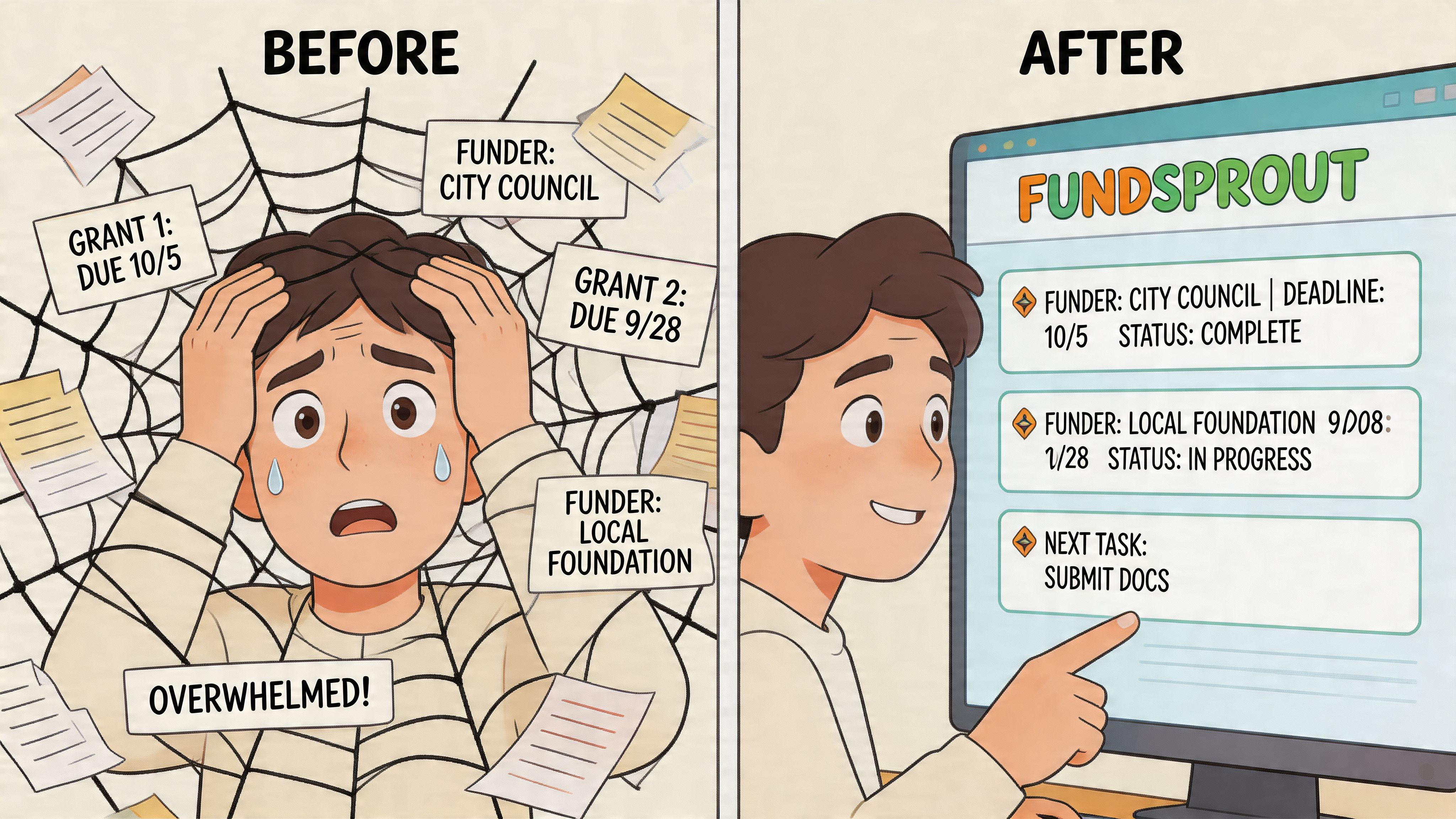
A real pipeline sorts opportunities by priority, tracks where each one stands, and makes qualification visible. That matters because the same prospect can look promising to one staff member and completely misaligned to another unless the screening criteria are explicit.
A stronger workflow usually includes:
- Program matching so opportunities reflect what you deliver
- Geographic screening so local or regional restrictions are caught early
- Capacity checks so your team doesn’t pursue grants it can’t administer well
- Deadline visibility so proposal timing matches staff bandwidth
That structure is especially useful for smaller nonprofits where one person may be covering development, communications, and reporting at the same time.
Vet opportunities before they become liabilities
The due diligence issue matters just as much as discovery.
When similarly named organizations can include both legitimate funders and entities associated with public scandal, your team needs a habit of checking the opportunity, not just the amount attached to it. Competitive intelligence and profile review help you catch signs that a prospect deserves extra scrutiny.
That’s where a modern grants workflow helps in a non-obvious way. It centralizes what your team has learned about the funder, what documents support that assessment, and what concerns have already been flagged. That’s better than relying on memory or a note buried in someone’s inbox.
Good grant strategy isn’t only about finding more funders. It’s about rejecting the wrong ones faster.
Make proposal development less fragile
Even strong organizations lose time in the handoff between program staff, finance, and development.
One person has the outcomes. Another has the budget assumptions. Someone else has the old boilerplate. Then the deadline shows up, and the team is still reconciling versions. That’s where structured proposal tools help. An RFP analyzer can turn requirements into a working outline. A writing assistant can draft sections in your organization’s voice using approved documents and existing impact language. Version control matters because it keeps people from editing against stale drafts.
The point isn’t to automate judgment. It’s to reduce preventable friction.
Useful workflow support usually includes:
Requirement extraction
Turn dense guidelines into checklists, narrative prompts, and document requests.Writing support tied to your materials
Draft against your actual program language, uploaded files, and approved data instead of generic templates.Task planning
Assign responsibilities, see what’s missing, and track what has to happen before submission.Reporting continuity
Keep an audit trail so renewal and post-award reporting don’t start from zero.
Why this matters for executive directors
If you lead a nonprofit, your interest probably isn’t in grant tech for its own sake. You want fewer wasted pursuits, fewer deadline scrambles, and cleaner decisions about where your team should spend time.
That’s the primary advantage of a connected system. It helps your staff move from random opportunity chasing to disciplined grant portfolio management. It reduces the odds of confusing one New Visions entity for another. It supports cleaner application workflows. It also gives your team a better way to preserve institutional memory when staff turnover happens.
For small development shops, that can be the difference between a reactive grants calendar and a credible funding strategy.
Fundsprout helps nonprofits find aligned funding, screen eligibility, organize proposal work, and keep reporting documentation in one place. If your team is tired of chasing lookalike prospects, rebuilding proposals from scratch, or relying on spreadsheets to manage deadlines, explore Fundsprout.
Try 14 days free
Get started with Fundsprout so you can focus on what really matters.