Mastering Letters of Inquiry Grants and Winning Proposals
Learn to write winning letters of inquiry grants. Our guide offers proven strategies, expert tips, and real-world examples to secure nonprofit funding.


Abdifatah Ali
Co-Founder
Think of a letter of inquiry for a grant as your opening handshake. It's that first, crucial introduction to a potential funder—a concise summary that tests the waters before you dive into the deep end of writing a full, exhaustive proposal.
It's your chance to see if there's a spark, saving you countless hours and letting you focus on the foundations most likely to get behind your mission.
Why Your LOI Is Your Most Powerful Fundraising Tool
 We've all been there: staring at a federal grant application that feels like a 100-hour commitment. The sheer amount of work is intimidating, especially when you know there's no guarantee of success. This is exactly why the Letter of Inquiry (LOI) isn't just a preliminary step; it's your most valuable tool in the fundraising game.
A great LOI is more than just a request for cash; it's a bridge. You're telling a powerful, data-backed story about the problem your organization is tackling and the people you're fighting for. By keeping it brief, you show respect for the funder's time and prove you're organized and ready to get to work.
The Strategic Value of an LOI
Starting with an LOI shifts your whole fundraising mindset from a high-stakes bet to a smart, calculated approach. Instead of sinking precious resources into applications that are probably a long shot, you can build a solid pipeline of funders who are genuinely interested. The LOI acts as a filter, weeding out the poor fits from the get-go so you can pour your energy where it truly counts.
This strategic filtering is a game-changer.
- It saves you countless hours. No more grinding away on massive proposals for funders whose priorities just don't match yours.
- It helps build relationships. An LOI can open a direct line of communication with program officers, giving you a chance to connect and get priceless feedback.
- It dramatically increases your success rate. If a funder invites you to submit a full proposal, you've already cleared the first major hurdle. Your odds just went way up.
A well-crafted LOI is the ultimate time-saver. It’s a low-investment tool that yields high-value intelligence, telling you which doors are worth knocking on and which you should walk past.
A Gateway to Diverse Funding
Learning to write effective letters of inquiry grants is a core skill that strengthens your entire fundraising operation. While an LOI is a specific tool for foundations, it fits into a much larger picture of financial support. Taking the time to understand the 10 essential sources of funding for nonprofits will help you build a more robust and diversified financial foundation.
Beyond just LOIs, looking at the bigger picture of fundraising is key to long-term success. Getting familiar with the 12 best ways to raise money for charity can show you how different income streams can complement each other, boosting your organization's financial stability. The LOI is often the very first step in unlocking one of the most important of these streams.
The Anatomy of a Compelling Letter of Inquiry
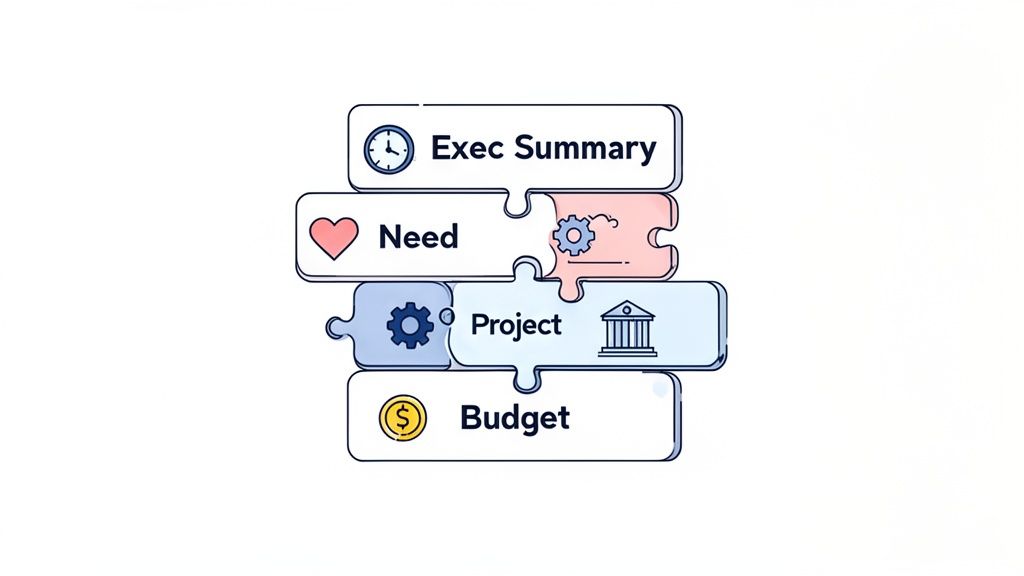
Think of an LOI less like a form and more like the opening chapter of a great story. It's your first, and often only, chance to convince a program officer that your project is worth their time and attention. Each section has a distinct role to play, and getting them right is the key to moving from the “maybe” pile to the “yes, tell me more” pile.
Let's break down the essential building blocks that turn a simple letter into a powerful conversation starter.
The Opening: Your 30-Second Pitch
Right out of the gate, you need to be direct. Program officers are juggling dozens of requests, and they appreciate clarity. Your first paragraph should immediately answer the big questions: who you are, what problem you’re tackling, how much you need, and what you’ll do with it.
Don’t save the funding request for the end. Putting it front and center shows you’re confident and you respect their time.
For example:"On behalf of the Green Shoots Initiative, I am writing to request a grant of $25,000 to expand our 'Urban Roots' program, which provides fresh, locally grown produce and nutritional education to 500 food-insecure families in the Northwood community."
In one sentence, the funder knows the organization, the ask, the project, and the impact. That’s the kind of hook that makes them want to keep reading.
The Statement of Need: Where Data Meets Heart
Now that you have their attention, it’s time to build the case. Why does this project need to happen? The most powerful arguments blend hard data with human connection. Statistics show the scale of the problem, but a short, relatable story makes it real.
Instead of just dropping a statistic like "25% of children in our city face food insecurity," frame it with a narrative.
For families in the West End neighborhood, food insecurity isn't just a statistic—it's the daily stress of choosing between rent and groceries. One in four children go to bed hungry, a number that represents real kids like 7-year-old Maria, who told our staff that school lunch is often her only guaranteed meal of the day.
This approach transforms a cold fact into an urgent, human problem. It connects with the funder on an intellectual level and an emotional one, which is incredibly persuasive.
The Project Description: Clarifying the What and How
You’ve established the problem; now it’s time to introduce your solution. This is where you lay out your plan in clear, straightforward terms. Avoid jargon and get right to the point: what will you do, who will benefit, and what results do you expect?
Your goal here is to build confidence. You want the funder to finish this section thinking, "Okay, this plan makes sense, and they know how to execute it."
A solid project description always touches on:
- Key Activities: What will you actually do? (e.g., "Conduct 12 monthly community gardening workshops.")
- Target Population: Who are you serving? (e.g., "Low-income seniors aged 65+ living in zip code 12345.")
- Measurable Outcomes: How will you know if you succeeded? (e.g., "Increase participants' daily fruit and vegetable consumption by 50% within six months.")
Clarity here shows your project is well-conceived and ready to launch.
Organizational Background: Building Trust and Credibility
So, why is your organization the one to solve this problem? This is your chance to quickly build credibility. Briefly touch on your mission, history, and key accomplishments, especially those that relate to the project you're proposing.
You don’t need your full origin story. Just hit the high points that prove you have the experience and expertise to get the job done. Mentioning your track record or key staff qualifications can make a huge difference.
And it works. According to the experts at Funding for Good, nonprofits that master the LOI can see a 50-60% success rate in being invited to submit a full proposal. For well-established programs, that number can even jump to 90%.
The Budget Snapshot: Showcasing a Solid Financial Plan
Finally, let's talk about money. An LOI doesn’t need a detailed, line-item budget, but it does need a clear snapshot. This should include the total project cost, the amount you’re requesting from this specific funder, and a quick mention of any other funding you've secured or are seeking.
This transparency shows you've done your homework and have a realistic financial strategy. It also signals that your project has a broad base of support, which is always a plus for funders.
Key Components of a Grant Letter of Inquiry
To help you keep track of these moving parts, here’s a quick-glance table summarizing what each section of your LOI needs to accomplish.
Think of these components as the essential ingredients. When combined thoughtfully, they create a persuasive narrative that makes a funder eager to learn more. To see these elements in action, check out a complete sample grant letter of inquiry.
How to Customize Your LOI for Each Funder
Sending a generic, one-size-fits-all LOI is the fastest way to get your request tossed. It’s the fundraising equivalent of “spray and pray,” and funders can spot it a mile away. It tells them you haven’t bothered to understand their mission, and it pretty much guarantees you’ll end up in the rejection pile.
Real success in grant-seeking comes from careful, thoughtful customization. This isn't about just swapping out a name in the salutation; it's about transforming your letter from a generic ask into a tailored conversation. You're showing the funder you’ve done your homework and that a partnership between your organizations just makes sense. A customized LOI feels less like a solicitation and more like an invitation to collaborate on a shared goal.
Become a Funder Detective
Before you even think about writing, your first job is to become an expert on the foundation you're approaching. This deep dive goes way beyond a quick skim of their mission statement. You need to get inside their world—understand their priorities, their funding history, and the specific language they use to talk about their work.
Here’s where you should start digging:
- Their Website: Zero in on the "About Us," "Mission," and "Priorities" pages. Look for keywords that pop up again and again. Do they talk about "systemic change," "community empowerment," or "evidence-based practices"? Jot those down.
- Past Grantees: This is one of the most powerful clues you can find. Who have they funded before? If you see a consistent pattern of funding after-school arts programs, your proposal for a new community garden might be a tough sell, no matter how great the project is.
- Annual Reports and 990s: These documents are an absolute goldmine. They often break down specific projects that received grants, the exact amounts awarded, and sometimes even include stories that reveal what truly gets the program officers excited.
This isn't busy work. You’re gathering the intelligence you need to frame your project in a way that will genuinely resonate with the funder’s core identity.
Mirror Their Language and Priorities
Once you’ve got a handle on the funder's worldview, you can start to mirror their language and draw a clear, unmissable line between your project and their stated goals.
For instance, if a foundation's website is filled with phrases like "sustainable solutions," you should weave that exact language into your letter. Instead of saying your project "helps people long-term," you would reframe it to describe how it provides a "sustainable solution to food insecurity."
The goal is to make it incredibly easy for the program officer to see your project as a natural extension of their own work. Your LOI should feel like it was written specifically for them—because, in a very real sense, it was.
Let's imagine you're pitching the same project to two very different funders:
- A small community foundation focused on local youth: Your LOI would highlight the direct, immediate impact on children in their specific county. You’d probably use personal stories and focus on tangible, community-level benefits.
- A large, national foundation championing systemic change: For this audience, you’d frame the exact same project differently. You would emphasize its potential as a replicable model, its data-driven approach, and how it addresses the root causes of a broader social issue.
The project hasn't changed, but the story you tell is customized to fit each funder's unique lens.
Why This Customization Matters
Diving into foundation grant dynamics reveals a stark reality. While the overall success rate for full proposals can be anywhere from 10-30%, the LOI stage is where you can really stack the odds in your favor.
An analysis from Candid Learning found that the small percentage of massive foundations handling over 1,000 applications a year only funded 11% of them. This underscores a crucial point: targeting smaller, more aligned foundations with a personalized LOI often gives you much better odds than chasing the mega-funders.
Customizing your letter is your best strategy for navigating this incredibly competitive landscape. It shows you’re a serious, thoughtful applicant who respects the funder’s work and is looking to build a real partnership. This strategic effort is what separates the successful grant seekers from those who feel like they’re perpetually stuck in the application cycle. It's the difference between hoping for a match and actually creating one.
Common LOI Mistakes That Will Get You Rejected
Knowing what to put in your letter of inquiry is only half the battle. Knowing what to avoid is just as important.
Sure, everyone knows to check for typos. But many promising LOIs get tossed aside for subtler mistakes—the kind that quietly tell a program officer your organization isn't quite ready for their investment. Let's get past the obvious and talk about the real deal-breakers.
These are the missteps I see time and time again, and they usually come from not quite grasping the funder's point of view in a sea of intense competition.
Ignoring the Funder's Instructions
This is, hands down, the biggest unforced error in grant seeking. When a foundation asks for a two-page LOI in 12-point Times New Roman with one-inch margins, they aren't making a suggestion. It's the first test, and it's an easy one to pass.
Before you type a single word, print out the guidelines. Get out a highlighter. Treat it like a sacred text.
- Length: If they say two pages, they mean two pages. Not two and a paragraph.
- Attachments: Send only what they ask for. Your beautiful annual report will go straight into the recycling bin if it wasn't requested.
- Submission: If the portal is the only way, don't try to be clever and email it to the program officer directly.
Following the rules shows you respect their process. It proves you're capable and detail-oriented enough to manage their money responsibly. It's the simplest way to signal your competence right out of the gate.
Using Vague Language and Insider Jargon
Program officers are drowning in proposals. They read hundreds of these things. They simply don't have the time or energy to decode your vague platitudes or industry-specific acronyms. Your job is to make your work crystal clear to an intelligent person who doesn't live and breathe your mission every single day.
Let's look at a real-world example of what not to do:
Vague & Jargony (Before): "Our organization will leverage synergistic partnerships to facilitate empowerment paradigms for at-risk youth, addressing systemic inequities through a holistic service delivery model."
I have no idea what that means. It’s a sentence full of buzzwords that says absolutely nothing. A program officer is just left wondering, "What do these people actually do?"
Now, let's try that again.
Clear & Compelling (After): "We partner with local high schools to provide one-on-one mentorship and career readiness training for 150 students facing housing instability, helping them secure paid internships and develop financial literacy skills."
See the difference? The second version is specific, it's measurable, and it's free of jargon. It paints a clear picture of the project and its results. That’s what makes it persuasive.
Failing to Make a Clear, Direct Ask
This one might surprise you, but it’s shockingly common: burying the funding request or, even worse, leaving it out entirely. Some people feel it's impolite to talk about money right away. In grant writing, it's essential. Funders need to know exactly what you want and what you'll do with it.
Don't make them dig for it. State your request—the dollar amount—clearly, usually right up front in the first or second paragraph. A direct ask shows you're confident in your project and you respect the reviewer's time.
A fuzzy LOI that doesn't state a clear funding amount forces the program officer to do detective work. In a stack of a hundred other letters, yours is the one that gets put aside for later… which often means never.
This clarity is non-negotiable because the grant world is tough. The data shows that even for a full proposal, the success rate is only around 10-30%. Some federal grants can take up to 200 hours to write. And one study of 69 funders found that a whopping 87% had success rates under 50%.
As a breakdown from Grants Plus explains, the top reasons for rejection are almost always misalignment or failure to follow the rules—precisely the problems a strong, clear LOI is designed to prevent.
Avoiding these common pitfalls shifts your LOI from being just another piece of paper to a compelling case for investment. You'll come across as professional, clear-headed, and respectful of the funder's mission—dramatically boosting your odds of getting that coveted invitation to submit a full proposal.
How Modern Tools Can Build a Smarter LOI Workflow
If you’re on a small nonprofit team, you know the grant cycle grind. It often feels like you're juggling a dozen different tasks at once—prospect research, writing, reporting—and struggling to keep up. This is where the right tools stop being a "nice-to-have" and become absolutely essential for turning chaos into a manageable, effective system.
Instead of sinking countless hours into manually searching for funders, new platforms can do the heavy lifting for you. For instance, tools like Fundsprout analyze your programs and location, then match you with a curated list of foundations and government agencies that are already funding work just like yours. This hands you a solid pipeline of prospects, freeing you up to focus on what really matters: building relationships and telling your story.
Let Technology Handle the Tedious Stuff
So you've found a promising funder. Great! Now comes the part where you have to dissect their guidelines and figure out exactly how to structure your LOI. This is another spot where smart tools can save you a ton of headaches. An RFP analyzer, for example, can instantly scan the funder's requirements and spit out a clear outline for your letter.
Think of it as your digital checklist. It ensures you hit every single point the funder is looking for, which helps you avoid some of the most common pitfalls that get LOIs tossed in the "no" pile.
The infographic below shows a few of the classic mistakes that a more structured, tool-assisted approach can help you sidestep.

As you can see, an LOI can easily get rejected because of vague language, too much jargon, or failing to follow the funder's specific rules. These are exactly the kinds of unforced errors that a good system helps prevent.
Create Stronger, More Consistent Narratives
The biggest time-saver of all? Getting help with the actual writing. Modern writing assistants can generate draft sections for your letters of inquiry grants by learning from your organization's existing materials.
Simply upload your past proposals, annual reports, and impact data. The tool absorbs your voice and mission, then produces a first draft of your project description or organizational background that already sounds like you. This not only makes the writing process faster but also keeps your messaging consistent across all your applications.
The real win here isn't just about speed—it's about capacity. By automating the repetitive tasks, a small team can suddenly manage a much larger, more strategic grant-seeking operation. It truly levels the playing field.
You’re never starting from a blank page. Instead, you get to step in as the editor, refining and personalizing a solid draft while the tool handles the initial grunt work.
From First Draft to Final Report
An efficient workflow doesn't end when you hit "send." The right system will help you manage the entire grant lifecycle with much more clarity and control.
Here’s what that can look like:
- Visual Timelines: See your entire application schedule at a glance. Planning tools can map out every deadline, so you know exactly what needs to be done and when, preventing those last-minute scrambles.
- Centralized Tracking: Ditch the messy spreadsheets. A central dashboard lets you track the status of every submission in real-time—from LOI sent to proposal invited and the final decision.
- Easier Reporting: When it comes time to report back to the funder, many platforms can auto-populate templates by pulling data directly from your project records. This simplifies compliance and makes renewals much smoother.
By bringing all these moving parts into one place, you build a smarter grant-seeking machine. The strategic use of AI for grant writing isn't about replacing people. It’s about empowering them to focus on strategy, relationships, and impact—so you can spend less time on paperwork and more time moving your mission forward.
Your Questions About Letters of Inquiry Answered
Stepping into the world of grant writing means you're going to have questions, especially when it comes to the Letter of Inquiry. It often feels like there are unwritten rules you’re supposed to know. Getting clear on a few of these common sticking points can make all the difference, boosting your confidence and your results.
Let’s break down some of the most frequent questions I hear from grant seekers. Think of this as a practical field guide—just straightforward answers to help you spend less time guessing and more time crafting a letter that gets noticed.
How Long Should a Letter of Inquiry Be?
This is easily the most common question, and thankfully, the answer is simple: keep it short. The gold standard for a letter of inquiry is two to three pages, max. Go any longer, and you’re practically begging the reviewer to skim—or worse, skip.
Program officers are often buried under a mountain of submissions. A brief, powerful summary that makes a compelling case is far more effective than a long-winded document that hides the good stuff. Your goal here is to give them a "thumbnail sketch" of your project, not the entire blueprint.
A punchy two-page LOI that makes a funder say, "I need to know more," is infinitely better than a five-page novel that has them muttering, "Get to the point."
Of course, if a funder gives you specific page or character limits, you follow them. Period. Ignoring their instructions is the fastest way to signal you don't pay attention to detail, which is a massive red flag.
Should I Contact a Program Officer Before Sending an LOI?
Whenever you possibly can, yes. Absolutely. A quick, respectful conversation before you submit can be a game-changer. It’s not about schmoozing; it's about being strategic.
First, a quick call or email helps you confirm your project actually fits their current priorities. Foundation websites aren't always up-to-the-minute, and their focus can shift. A five-minute chat can save you weeks of work on an LOI that was doomed from the start.
Second, it turns a cold submission into a warm introduction. Suddenly, you’re not just another name in a pile of papers. You're a real person with a real mission they’ve already spoken to.
To pull this off, you have to be prepared.
- Do your homework first. Your questions need to be sharp and show you’ve already read their website and guidelines thoroughly. Don't ask something you could have found in their FAQ.
- Respect their time. Be brief and get right to it. State your purpose, ask your key questions, and let them get back to their day.
- Listen more than you talk. This is a golden opportunity to get intel. What language do they use? What aspects of a project seem to excite them?
This little bit of proactive outreach shows you're serious and professional, helping your LOI stand out before it even lands in their inbox.
What Happens After I Submit My LOI?
And now, the waiting game. Once you hit "send," the timeline for a response can be all over the map. Some foundations are quick; others take months.
Your first stop should always be their grant guidelines, as many funders will outline their review process and decision dates there. You might get an automated receipt, but don't panic if you don't.
If a foundation has a specific decision deadline and you haven't heard anything after it passes, it’s perfectly fine to send a polite, brief follow-up email. A simple, professional note asking for a status update shows you’re still engaged.
Whether you get a "yes" or a "no," treat it as a learning experience. An invitation to submit a full proposal means your approach worked. A rejection is just part of the process—grant seeking is a numbers game, after all. If the funder is open to it, you can sometimes even ask for feedback to help you strengthen your next application.
Ready to stop guessing and start winning? Fundsprout is your all-in-one AI platform for grant success. We help you find perfectly matched funders, generate compelling proposal drafts in your organization's voice, and manage every deadline with ease. Discover how much more you can achieve at https://www.fundsprout.ai.
Try 14 days free
Get started with Fundsprout so you can focus on what really matters.