A Guide to Writing a Letter of Intent for Grants
Learn how to write a compelling letter of intent for grants. Our guide shares proven tips and real-world examples to help you secure the funding you need.

Abdifatah Ali
Co-Founder
A letter of intent for grants, often called an LOI, is your first formal introduction to a funder. It’s a short, high-level document you send before diving into a full-blown grant proposal. The whole point is to give a foundation a quick snapshot of your project and see if it’s something that piques their interest.
Why Your Grant Letter of Intent Matters

Think of an LOI as your strategic first handshake. Before you pour countless hours into a massive grant application, this short letter acts as a crucial pre-screening step. It’s not just a formality; it's a time-saver for everyone involved. For grantmakers drowning in applications, a solid LOI is their go-to tool for quickly sorting through the noise and finding projects that genuinely fit their mission.
This preliminary step has become the norm. By 2023, over 70% of foundation and government grant programs had made the LOI a required first step. This shift just goes to show how essential it is for managing the flood of requests and making sure only the best-matched applicants move forward. You can dig into more grant application trends at OpenGrants.io.
The Two-Way Benefit of an LOI
The LOI is really a mutual filtering process. It’s your chance to make a strong first impression without the back-breaking work of a full proposal. A crisp, compelling letter immediately signals that you've done your homework and respect the funder's time.
From the funder's perspective, it provides a quick, digestible summary of your project's potential. It lets them answer a few core questions right away:
- Does this project actually fit our strategic focus?
- Is this organization’s mission in line with ours?
- Is the budget request in the right ballpark for the work described?
- Does this idea seem well-thought-out and achievable?
A compelling Letter of Intent doesn't just ask for funding; it starts a conversation. It shows a funder not just what you want to do, but why your project is a perfect match for their mission, inviting them to learn more.
LOI vs. Full Proposal At a Glance
It's absolutely critical to understand that an LOI isn't just a shrunken-down proposal. It serves a completely different purpose and needs its own strategic approach. The table below breaks down the main distinctions to help you focus your efforts correctly at each stage.
While a full proposal gets into the nitty-gritty of methodology, evaluation plans, and detailed budgets, the LOI is all about the big picture. You’re focusing on the core problem, your innovative solution, and why your organization is the perfect one to make it happen. Nailing this distinction is the first step toward getting that coveted invitation to apply.
Anatomy of a Winning Letter of Intent

A great letter of intent for grants isn't just a summary; it's a carefully crafted argument. Think of it like building a bridge. On one side, you have your amazing project. On the other, the funder's mission. Your LOI is the structure that connects the two, piece by piece.
Every single word has to count. When you’ve only got a page or two, there’s simply no room for fluff. From your opening sentence, your job is to show the funder you’ve done your homework and have a project that perfectly aligns with what they care about.
Your Introduction and Statement of Need
You have to hook the reader from the very first line. Get straight to the point: state who you are, what project you’re pitching, and exactly how much funding you need. It’s not rude; it’s respectful of the reviewer’s time and shows you know what you’re asking for.
From there, you pivot to the statement of need. This is your chance to create a sense of urgency. Don’t just describe a problem—prove it exists with compelling data. The key is to frame the issue in a way that resonates with the foundation's specific interests. For example, if they focus on local youth development, don't use generic national statistics. Instead, talk about the high school dropout rate in the three zip codes your program serves.
The strongest statements of need make the problem feel both significant and solvable. They convince the funder that an issue exists, that it's within their power to help, and that your organization has the right approach.
The Project Description and Organizational Fit
Once you’ve established the "why," you have to explain the "what" and "how." This is your project description. In this section, you'll briefly walk them through your key activities, who you'll be helping, and what you expect to achieve. The goal here is clarity, not getting bogged down in every minor detail.
A grant reviewer should be able to quickly grasp:
- What you’ll do: Describe the core activities in simple, action-oriented language.
- Who you’ll serve: Clearly define your target population.
- What will change: Explain the tangible, measurable results you expect to see.
Right after that, you need a quick paragraph on your organizational background. This is where you build trust. Briefly touch on your mission, your history of success with similar work, and why your team is the one to get this done. This section answers the reviewer’s unspoken question: "Why should we trust you with our money?"
The Budget Summary and Closing
Your budget summary should be a quick, high-level snapshot, not a detailed spreadsheet. Simply state the total project cost and the specific amount you’re requesting in this LOI. Make sure the number feels right for the scope of the project you've described. For a deeper dive into financial planning, our grant budget template is a fantastic resource.
Finally, bring it home with a confident and professional closing. Reiterate your interest in partnering with them and clearly state what you hope the next step will be—usually an invitation to submit a full proposal. Be sure to include the direct contact information for the best person on your team to answer questions. A strong, clear ending leaves the reviewer with a positive final impression.
Telling a Compelling Story with Your Data

A truly great letter of intent for grants does more than just list facts. It wraps those facts in a story that makes a funder feel connected to your work. Think of your numbers and statistics as the skeleton of your argument—essential, but they need a narrative to bring them to life. Your goal is to make the problem you're tackling feel real, urgent, and personal.
Many grant writers fall into the trap of using broad, national statistics. While those numbers can set a scene, they rarely hit home. A funder in Boise probably won't be moved by a national average that feels abstract and distant. You need to bring the problem into their backyard by localizing your data. This demonstrates a genuine, on-the-ground understanding of the community you serve.
Grounding Your Narrative in Local Reality
To make a convincing case, you have to dig for data that reflects the specific challenges your community faces. Don't just tell them "many students struggle with literacy." Show them.
You can uncover some surprisingly potent local data from places like:
- Local Government Reports: City health departments, school districts, and county planning commissions are goldmines for this stuff.
- Community Foundations: These groups often commission their own needs assessments to guide their funding.
- University Research Centers: Local colleges and universities are constantly studying social and economic issues right in their own communities.
For example, instead of citing a national poverty rate, you could say: "In the three neighborhoods our program serves, the child poverty rate is 32%, more than double the state average, according to the latest City Planning Commission report." See the difference? That detail creates a powerful sense of place and urgency. This is a core part of building out your case, which you can learn more about in our guide on what is a needs statement.
Your data shouldn’t just inform; it should provoke. Frame your numbers as a story about real people, and position the funder as a character who has the power to help write a better next chapter.
Weaving Data into Your Project's Story
Once you've gathered your local stats, the real art is in weaving them smoothly into your narrative. The numbers shouldn't feel like a data dump. They should be the evidence that backs up every claim you make, connecting the problem you've described directly to the solution you're offering.
For instance, you might write something like: "With 45% of our high school graduates needing remedial math courses before they can even start college, our after-school STEM tutoring program is designed to close that specific gap." That sentence doesn't just drop a statistic; it immediately ties it to an actionable solution.
This approach really works. We've seen that a well-crafted LOI that aligns closely with a funder’s priorities can boost your chances of getting invited to submit a full proposal by around 15%.
When you frame your data within a compelling story, you elevate your letter of intent from a simple summary to a powerful invitation. You're showing the funder not just a problem to be fixed, but a tangible opportunity to make a measurable difference in a community they care about.
Common LOI Mistakes to Avoid
Even the most incredible project idea can get torpedoed by a clumsy letter of intent. I’ve seen it happen. A few common, completely avoidable errors can land your LOI straight in the "no" pile before the reviewer even gets to the heart of your proposal. Knowing what not to do is just as critical as knowing what to include.
The absolute biggest mistake? Sending a generic, one-size-fits-all letter. Believe me, funders can spot a copy-and-paste job from a mile away. It immediately says you haven’t bothered to understand their specific mission or what they actually care about funding, which makes it incredibly easy for them to dismiss your request.
Another classic blunder is simply ignoring the funder's instructions. If they ask for a two-page limit, don’t send three. If they want a specific heading, use it. This isn't just about blindly following rules; it's about signaling that you are a detail-oriented, reliable partner who can be trusted with their money.
Vague Plans and Disconnected Budgets
In a letter of intent for grants, clarity is king. Grant reviewers are often sifting through dozens, if not hundreds, of these letters. They don't have the time or energy to decipher vague language or connect dots that you should have connected for them. A project description loaded with jargon and broad, fuzzy goals is a massive red flag.
For instance, avoid saying something like, "we will empower the community." Instead, show them how: "Our program will deliver weekly financial literacy workshops to 150 low-income residents, leading to a measurable increase in personal savings and debt reduction." See the difference?
This problem often spills over into the budget. Your funding request needs to be a direct, logical extension of the activities you just described. A big, round number dropped in without context can make your whole plan feel unrealistic or, worse, poorly thought out.
- The Mistake: Asking for $50,000 for a "youth outreach program."
- The Fix: Asking for $50,000 to fund a year-long mentorship program for 75 at-risk teens, specifically covering mentor stipends, curriculum materials, and transportation costs.
Losing the Reviewer with Poor Writing
Dense, academic writing is another common tripwire. Remember, the person reading your LOI might not be an expert in your specific niche. Your job is to make your project's importance crystal clear to a smart, but generalist, audience. Think of it less like a technical paper and more like a compelling, direct conversation.
"Many LOIs fail not because the idea is weak, but because the writing is unclear. If a reviewer has to re-read a sentence three times to understand it, you've already lost their momentum and their confidence."
Finally, and I can't stress this enough, proofread like your funding depends on it—because it just might. Typos and grammatical errors scream unprofessionalism. They subtly suggest a lack of care that can make a funder wonder if you have the attention to detail required to manage a complex grant. A polished, error-free letter respects their time and builds your credibility from the very first word.
Managing Your Submission and Next Steps
https://www.youtube.com/embed/WOFVfOYYDmg
You’ve poured your heart and mind into crafting a powerful letter of intent. That’s a huge accomplishment, but the job isn't quite done yet. A clean, organized submission process is just as critical as the words on the page. I've seen far too many great organizations get so wrapped up in the narrative that they fumble the final handoff, leading to a frantic, last-minute rush that can sink their chances before they even start.
Treat the submission deadline as absolute. Missing it, even by a few minutes, almost always means you’re out of the running for that funding cycle. This isn't a friendly suggestion; for most funders, the letter of intent for grants is a hard-and-fast eligibility gate. In fact, for 70% or more of competitive grants, this is a firm rule. You can find more detail on the importance of grant LOI deadlines on GrantBoost.io.
What to Do After You Hit ‘Submit’
Once your LOI is sent, the waiting game begins. But this isn't the time to sit back and do nothing. Use this period to actively prepare for what comes next, whether it’s an invitation to submit a full proposal or a polite "no, thank you."
- Prepare for a 'Yes': Start outlining what a full proposal would look like. Begin gathering key documents—things like audited financial statements, a list of your board members, and key staff bios. Having these ready means you can hit the ground running if you get the go-ahead.
- Plan for a 'No': If a rejection comes through, don't just file it away. See it as a learning opportunity. If the funder offers feedback, take it graciously. If they don't, circle back in a few months to see who they did fund. This can give you invaluable clues about their priorities for the next cycle.
A rejection is rarely a reflection on the importance of your work. It's usually about a mismatch in priorities or simply a lack of available funds. Think of it as data that helps you find a better-aligned funder next time.
It's also worth remembering that many LOIs get tripped up by simple, avoidable mistakes. Things like generic, copy-paste language or fuzzy project goals can get you moved to the "no" pile instantly.
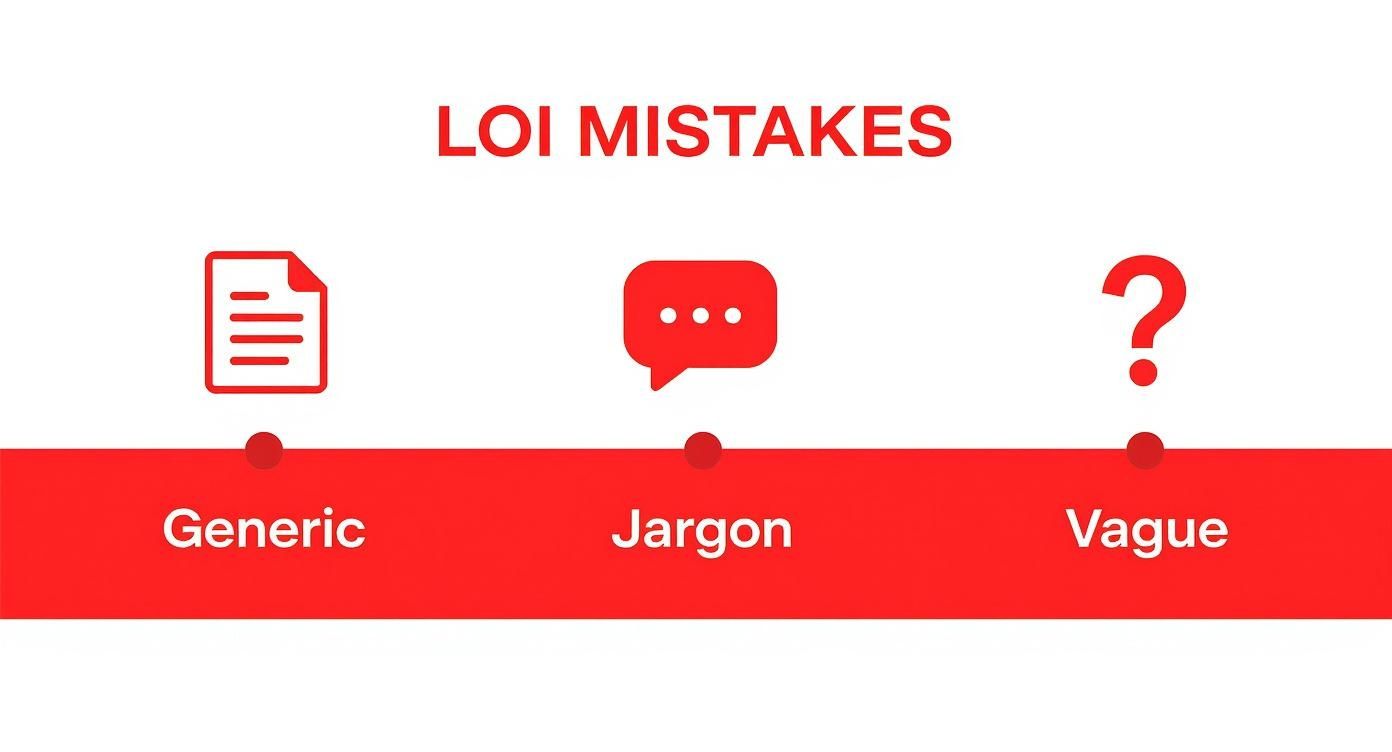
This just goes to show how easily a fantastic project can be undermined by a few common missteps in the LOI itself.
Stay Organized and Look to the Future
No matter the outcome, keep meticulous records. Log the submission date, the funder's response, and any notes or feedback you received. This builds an internal knowledge base that becomes incredibly valuable over time. This kind of tracking is a cornerstone of effective fundraising, and you can learn more by exploring our guide on grant management best practices.
Whether you're celebrating an invitation or analyzing a rejection, every LOI you send is a win. It sharpens your story, deepens your insight into the funding world, and helps you refine your process for the next great opportunity.
Frequently Asked Questions About Grant LOIs
Even with a great plan, a few questions always seem to pop up when you're in the middle of writing a letter of intent for grants. Let's tackle some of the most common ones I hear from grant seekers. My goal here is to give you direct, no-nonsense answers to help you get this done with confidence.
Think of this as a quick chat to clear up some of the confusion. Every question here is a common roadblock, and once you get past it, the whole process feels a lot more manageable.
How Long Should a Grant Letter of Intent Be?
Keep it brief. That’s the golden rule. Your LOI should almost always land between one and three pages. Honestly, most funders love a tight, powerful one-pager because it shows you can get straight to the point. Brevity is a sign of respect for their time.
Before you write a single word, though, check the funder’s guidelines for any specific length requirements. If they don't list one, a well-organized two-page letter is a very safe bet. Go any longer, and you really risk losing their attention.
A classic mistake is treating the LOI like a miniature proposal, cramming in every last detail. Remember, your goal isn't to answer every possible question. It's to pique their interest so they want to invite you to tell them more.
Is a Letter of Inquiry the Same as a Letter of Intent?
Yes, basically. In the grant world, you'll see "Letter of Inquiry" and "Letter of Intent" used interchangeably. Both are short, preliminary documents designed to see if a funder is interested before you invest the time in a full-blown application.
The key is to mirror the funder's own language. If their website asks for a "Letter of Inquiry," then call it a "Letter of Inquiry." It’s a small thing, but it immediately shows you’re paying close attention.
Should I Contact a Funder Before Sending an LOI?
If you can, you absolutely should. A quick chat with a program officer can be one of the smartest moves you make. It’s your chance to start building a real relationship and get clarity on questions that will help you shape the perfect letter.
A good conversation can help you:
- Confirm your project truly aligns with their current funding priorities.
- Get a little inside scoop on what the review committee is really excited about.
- Show them you’re professional and serious about your work.
But there's a huge caveat here. If a funder’s guidelines say "no calls" or anything similar, you have to respect that. Ignoring a direct request like that is a massive red flag and a fast track to the "no" pile.
What Should I Do If My LOI Is Rejected?
Getting a "no" stings, but it’s not just a rejection—it's feedback. First, take a close look at the letter or email they sent. Did they give you any specific reasons? Sometimes you get lucky and they offer a clue.
If they don't, and if they seem open to contact, think about sending a very brief, polite email. Thank them for the opportunity and ask if they’d be willing to share any insights that could strengthen your applications in the future. Many won't reply, but some will, and that information is gold.
Use this as a learning moment. A rejection isn't always a judgment on your project's quality; more often, it's about a mismatch in priorities. Take an honest look at your alignment with that funder and use what you’ve learned to find others who are a much better fit.
Ready to stop guessing and start winning? The AI-powered tools at Fundsprout can help you find funders who are a perfect match and write compelling LOIs in a fraction of the time. Our RFP analyzer and writing assistant help translate funder priorities into persuasive language, freeing you up to focus on your mission. Find out how Fundsprout can help.
Try 14 days free
Get started with Fundsprout so you can focus on what really matters.