How to Write Grants for Nonprofits and Win More Funding
Learn how to write grants for nonprofits with our definitive guide. Discover proven strategies for research, writing, and submitting proposals that win funding.

Abdifatah Ali
Co-Founder
Securing grant funding is a marathon, not a sprint. The real secret to winning proposals isn't just about persuasive writing; it's about the deep, foundational work you do long before you ever type a single word of an application. Think of it in three key stages: getting your house in order (becoming grant-ready), finding funders who genuinely care about your mission (alignment), and then—and only then—telling a powerful, data-driven story about your impact.
Laying the Foundation to Become a Grant-Ready Organization
I've seen it time and time again: the difference between a nonprofit that consistently wins grants and one that’s always scrambling is rarely the writing itself. It’s the prep work. This is what we call becoming “grant-ready.”
Being grant-ready means you can pivot and respond to an opportunity quickly and professionally, without the last-minute panic of digging for documents. Funders can spot a well-prepared organization from a mile away. It signals that you're not just passionate, but also a responsible steward of their potential investment.
Gather Your Essential Toolkit
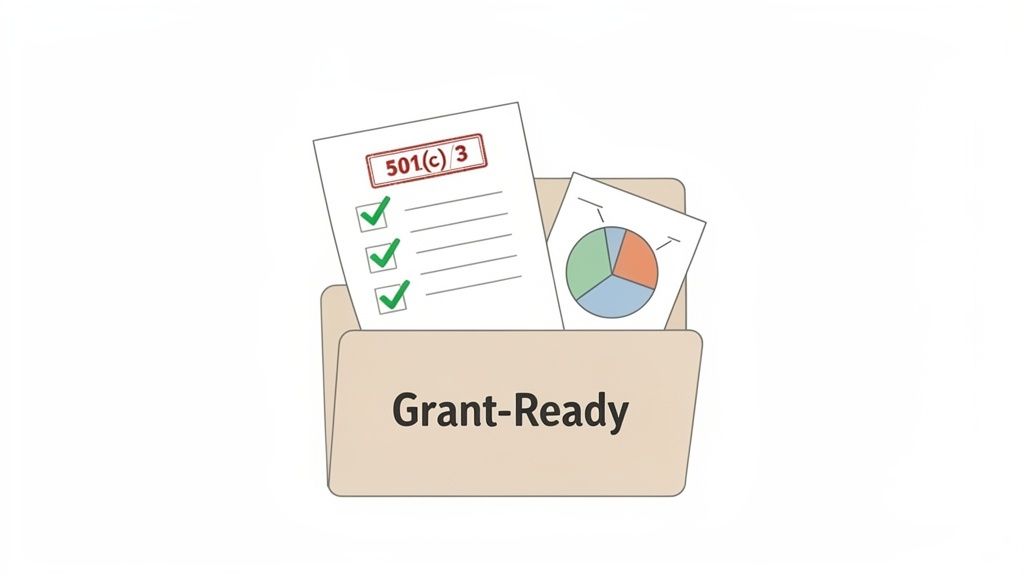
Imagine having a go-to “grant writing toolkit”—a neatly organized digital folder with every core document a funder might ask for. When a perfect grant opportunity appears, you're not wasting precious hours hunting for last year’s financial audit; you’re spending that time crafting a narrative that truly resonates.
Here’s what every nonprofit’s toolkit should contain:
- The Basics: Your official 501(c)(3) determination letter, a current list of your board of directors (including their affiliations), and your annual operating budget.
- Program Details: Clear, compelling descriptions of your key programs. Who do you serve? What activities do you run? What measurable outcomes do you achieve?
- Financial Proof: Your most recent audited financial statements and your IRS Form 990. These are non-negotiable for proving your financial health.
- Your Story: Pre-written, concise versions of your organization's history, your mission and vision statements, and brief bios for your key leadership team.
This simple journey—from defining your purpose to gathering the proof and building a strategy—is the absolute bedrock of successful grant seeking.
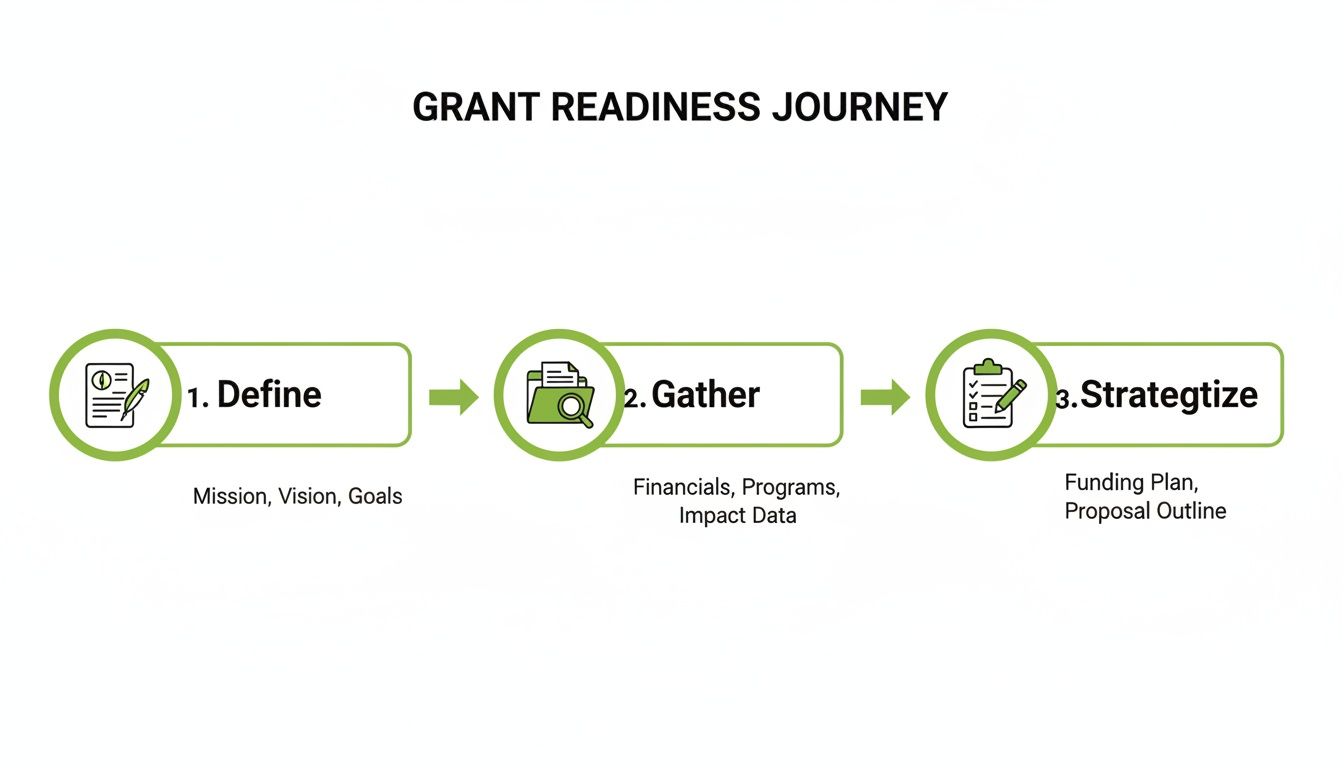
It’s a straightforward path, but one that moves you from internal clarity to strategic, fundable action.
From Document Gathering to Strategic Planning
With your documents organized, the real work begins: strategic alignment. This is where you ensure every grant proposal you send out tells the same consistent, powerful story about where your organization is headed. A strong plan of record is an incredible asset here, acting as a north star for all your funding requests.
Remember, consistency is your friend. Grant success is often a numbers game built on persistence. In fact, research shows that nonprofits submitting six or more grant applications a year see a 95% success rate in landing at least one of those grants. Preparation makes this possible. You can’t achieve that volume if you’re reinventing the wheel every single time.
The goal isn't just to write a grant; it's to build a sustainable grant-seeking system. A well-organized toolkit and a clear strategy are your best tools for turning opportunities into funding.
To help you get started, here's a quick checklist of the essentials you'll want to have on hand. Having these ready to go is the first, most important step.
Your Grant Readiness Checklist
Once this checklist is complete, you're in a powerful position.
A strong public profile can also make a huge difference in how funders perceive you. Exploring some proven digital marketing strategies for nonprofits can help demonstrate community support and engagement, which complements your grant proposals beautifully. By investing this time upfront, you’re not just applying for money—you’re positioning your nonprofit to confidently compete for it and win.
Finding Funders Who Want to Say Yes
I’ve seen it time and time again: chasing the wrong grant is the single biggest drain on a nonprofit's time and energy. It’s a frustrating cycle. You can write the most beautiful, compelling proposal in the world, but it will get a polite "no" if it lands on the desk of a funder who isn't a perfect match.
The real goal isn't just to find funders with deep pockets. It's to find the ones who are actively searching for an organization exactly like yours.
This part of the process is all about quality over quantity. Instead of casting a wide, generic net and hoping for the best, you're going to learn how to pinpoint the foundations and government agencies whose missions are so aligned with yours that they actually want to say yes.
Looking Beyond the Obvious Keywords
Starting your search in a grant database with broad terms like "youth services" or "environmental protection" is a recipe for overwhelm. You'll get thousands of results, most of them totally irrelevant. True alignment means you have to dig a lot deeper.
Start by brainstorming a list of highly specific keywords that really describe what you do. Think less about categories and more about impact.
- Who you serve: Don't just say "at-risk youth." Get specific: "mentoring programs for first-generation high school students."
- Where you operate: Go beyond your city. Include your county, specific neighborhoods, or even congressional districts.
- What you do: Instead of "homeless services," try "transitional housing for veterans" or "job skills training for homeless single mothers."
- Your unique approach: Use terms that set you apart, like "trauma-informed care," "arts-based therapy," or "project-based learning." These can unlock funders interested in specific methodologies.
This level of detail is your secret weapon for cutting through the noise. It helps you find funders who have a proven history of supporting projects with a similar scope and focus. For a deeper dive, our guide on how to find grants for nonprofits is a great resource for building out a targeted prospect list.
How to Decode a Funder's Priorities
Once you have a shortlist of potential funders, it’s time to put on your detective hat. Their website and Request for Proposal (RFP) are packed with clues about what they truly care about. Don't just skim the eligibility checklist—you have to read between the lines.
Pay close attention to the language they use. If a foundation's mission statement is full of words like "innovation," "scalability," and "systemic change," they're probably not looking to cover your ongoing operational costs. They want groundbreaking projects with the potential for wide impact.
A funder's list of past grantees is your most valuable piece of intelligence. It tells you exactly who they've said "yes" to before. If their recent awards all went to large, national organizations and you're a small, local nonprofit, it might not be a competitive fit, even if the mission aligns.
Assessing Your Competitiveness Before You Write
Before you pour dozens of hours into an application, you need to do an honest self-assessment. Being a "good fit" isn't enough. You have to be a competitive fit.
Ask yourself these tough questions:
- Capacity: Can we actually manage this grant and all its reporting requirements? Applying for a $500,000 federal grant when your annual budget is $75,000 is a major red flag for reviewers.
- Track Record: Do we have the data, the testimonials, and the success stories to prove our program works? Funders are risk-averse; they need to see solid evidence of past impact.
- Alignment Score: On a scale of 1 to 10, how perfectly does our project match every single priority in the RFP? If you’re not hitting at least an 8, your time is probably better spent on another opportunity.
This vetting process might feel slow, but trust me, it’s what separates successful grant-seeking teams from burnt-out ones. It ensures that when you finally sit down to write, you're doing so with a genuine shot at success. Modern AI platforms can also automate a lot of this legwork, delivering a ranked pipeline of funders based on a deep analysis of your programs, which saves your team an incredible amount of time.
Telling a Story That Gets Funded
Think of your grant proposal as more than just a request for funding. It's a story. You're connecting a real-world problem to a tangible solution, and your organization is the hero poised to make it happen. From the executive summary to the budget, every section is a chapter that should draw the reader in, making it impossible for them to say no.
This is where you'll weave together compelling data, genuine passion, and airtight logic. Your job is to show the funder not just what you do, but why it matters—and why your approach is the one they should back.
Hook Them with a Powerful Needs Statement
The needs statement (sometimes called the problem statement) is the heart and soul of your proposal. Its entire purpose is to create a sense of urgency. If this section doesn't grab the reviewer and convince them that a significant, pressing problem exists, the rest of your proposal is already on shaky ground.
This statement has to be built on a foundation of solid evidence. Steer clear of broad generalizations like, "many children in our community are struggling." That doesn't tell the reviewer anything concrete. Instead, you need to quantify the problem with hard data.
For example, instead of that vague statement, try this:
"In the past two years, the youth unemployment rate in our county has surged by 15%, impacting over 2,500 young adults, according to the latest Bureau of Labor Statistics report. This growing gap leaves them without a viable path to economic self-sufficiency."
See the difference? This approach immediately establishes credibility and frames the problem in real, measurable terms. You're telling the funder exactly what's broken and for whom, which perfectly sets the stage for your brilliant solution.
Lay Out Your Plan: Methodology and Outcomes
Okay, you've established the problem. Now, the methodology section is where you explain exactly how you're going to fix it. This isn't the place for vague promises or lofty goals. It's a detailed blueprint of your program's activities, timeline, and the people who will make it happen.
Break your project down into clear, logical steps. Let's say you're proposing that job skills program. Your methodology might include:
- Participant Recruitment: We'll reach our target population by partnering with local high schools and community centers, focusing our outreach on at-risk youth.
- Curriculum Delivery: The program consists of an 8-week training curriculum covering resume writing, interview skills, and financial literacy, all led by our two experienced career counselors.
- Internship Placement: We will match every participant with a local business for a 100-hour paid internship, giving them critical hands-on experience.
This level of detail shows the reviewer you’ve thought through every aspect of execution. To really drive it home, tie each activity to a measurable outcome. The best outcomes are SMART: Specific, Measurable, Achievable, Relevant, and Time-bound.
A strong grant proposal doesn't just promise to "help people." It promises to "provide 200 hours of job readiness training to 50 high school graduates over 12 months, with a 70% job placement rate within six months of program completion."
Build a Budget That Inspires Confidence
Your budget isn't just a list of expenses—it's the financial expression of your project. Every single line item must directly support the activities you described in your methodology. A well-crafted budget narrative justifies each cost and proves you're a responsible steward of the funder's money.
Don't just list "Supplies - $2,000." Break it down and tell the story: "Workshop materials for 50 participants, including binders, workbooks, and printing, at a cost of $40 per participant." This transparency builds trust and answers the reviewer's questions before they can even ask them. It shows you've done your homework.
Grant writing success rates can climb as high as 90% for proven programs with existing funders but often hover around 30-40% for new initiatives, according to insights from Funding for Good. This really underscores how building trust through clear budgets and strong relationships is the cornerstone of sustainable funding.
As a final tip, don't be afraid to get a little help. Modern AI writing assistants can be incredibly useful for generating a solid first draft of these narrative sections. By analyzing your program data and existing documents, they can help structure a compelling needs statement or outline your methodology, freeing you up to focus on the human touch—refining the content with your organization's unique voice and strategic insights.
Writing a Proposal That Reviewers Will Champion
You've mapped out your narrative and built a rock-solid budget. Now comes the final, crucial layer: the writing itself. You have to remember, grant reviewers are often slogging through hundreds of applications on a tight deadline. They simply don't have the time to wade through dense, jargon-filled paragraphs to figure out what you're trying to say.
Your job is to make their job easy. The goal is to write with such clarity, conviction, and professionalism that backing your proposal feels like the most obvious, logical choice they can make. This isn't about using fancy words; it's about choosing the right words to tell a story that’s both emotionally compelling and factually undeniable.
Speak Their Language and Be Direct
One of the fastest ways to lose a reviewer is to use your internal shorthand. The acronyms and phrases that are common knowledge in your office can be completely meaningless to an outsider. Your writing needs to be accessible to a smart, engaged person who knows nothing about your day-to-day operations.
At the same time, you need to write with authority. Using an active voice is absolutely essential for this. It makes your sentences shorter, more direct, and far more powerful. The passive voice, on the other hand, can come across as weak and noncommittal.
It’s a subtle but significant difference. Take a look:
See the shift? The active voice examples aren't just clearer—they position your organization as the one driving the action. This small change in phrasing builds a powerful sense of competence, which is exactly what funders want to see.
Quantify Your Impact to Make It Real
Abstract goals are incredibly difficult to fund. Concrete, measurable impact is what gets a grant-maker's attention. Funders need to see precisely what their investment will accomplish. This means ditching vague descriptions for specific, quantified outcomes.
Avoid broad statements like, "We will help at-risk youth in our community." Instead, anchor your goals with real numbers that tell a story.
- Vague: "Our program will improve literacy for elementary students."
- Specific: "Our program will provide 150 third-grade students with 60 hours of one-on-one reading tutoring, aiming to increase their reading proficiency by one full grade level."
Being this specific does two critical things. First, it makes your goal feel tangible and achievable. Second, it gives you a clear benchmark for success that you can report on later, which builds trust for future funding.
A reviewer should never have to guess what your program actually does or who it serves. Every claim should be supported by a number, a timeline, or a specific, measurable result.
From Bland to Brilliant: Before-and-After Examples
Sharpening your writing is all about making every single word count. You have to trim the fat and swap out generic phrases for vivid, impactful language. This is a non-negotiable skill when you're learning how to write grants for nonprofits effectively.
Here are a few before-and-after examples to illustrate how small tweaks can have a massive impact:
Example 1: Describing the Problem
- Before: "There is a problem with food insecurity in our area that affects many families."
- After: "Over 15,000 households in our county face food insecurity, meaning 1 in 4 children go to bed hungry on any given night."
Example 2: Outlining the Solution
- Before: "Our organization will give people the tools they need to find employment."
- After: "We will equip 200 unemployed adults with job-readiness skills through an intensive 12-week training program and personalized career coaching."
Example 3: Stating the Outcome
- Before: "Participants will feel more confident and prepared for the workforce."
- After: "Upon completion, we project that 75% of participants will secure full-time employment within 90 days, increasing their average household income by 30%."
These aren't just writing improvements; they are strategic upgrades to your argument. By replacing ambiguity with hard evidence, you make it incredibly easy for a grant reviewer to see the profound value in your work and confidently give you that "yes."
Managing the Post-Submission Process
You’ve clicked “submit.” It’s a huge relief, but don’t close the file just yet. What you do after sending in your grant application is just as important as the proposal itself. This is where you move from applicant to partner, showing the funder you’re professional, organized, and ready for a long-term relationship.
How you handle this delicate waiting period speaks volumes. It’s your chance to prove you’re a reliable organization they can trust with their investment. Honestly, this follow-through can make all the difference, not just for this grant, but for every conversation you’ll have with them down the road.
The Art of Strategic Follow-Up
The big question is always, "Should I follow up?" My answer is a firm but careful yes. The key is getting the timing and tone just right.
As soon as you submit, send a quick, polite email confirming you’ve sent it. This isn’t a sales pitch; it's a simple professional courtesy to acknowledge receipt and thank them for the opportunity.
Here’s a simple script I’ve used that you can adapt:
"Dear [Funder Contact Name],
This is just a quick note to confirm that we've successfully submitted our proposal, '[Project Title],' through your online portal. We are so grateful for the opportunity to be considered for your support and look forward to hearing from you.
Best,
[Your Name]"
After that first touchpoint, it’s a waiting game. Resist the temptation to follow up again and again. Funders are busy people with a process to follow. If they've given you a decision date, mark it on your calendar and don’t reach out before then. If there’s no timeline, a polite check-in after 8-12 weeks is generally fine.
Responding to the Decision Gracefully
Whether it's a "yes" or a "no," your response is a critical moment. How you handle the news cements your reputation and sets the stage for your next interaction.
If You Win the Grant:
- Show Your Gratitude: Immediately send an enthusiastic thank-you note to your program officer. They're your champion.
- Clarify Next Steps: Ask about the grant agreement, reporting schedule, and any other compliance details. Show them you’re ready to get to work.
- Acknowledge Them (with permission): Always ask how they’d like to be recognized. A simple social media post or a mention in your newsletter can go a long way.
If Your Proposal is Rejected:
- Still Say Thank You: A gracious thank-you for their time and consideration leaves a lasting positive impression. Don't burn bridges.
- Ask for Feedback: Politely inquire if they'd be willing to share any reviewer comments. This is grant-writing gold.
- Keep the Door Open: Ask about their next funding cycle and reiterate your interest. A rejection often means "not right now," not "never."
Turning a rejection into a learning opportunity is one of the most valuable skills in this field. The feedback you get is a direct roadmap for how to improve.
Turning Insights into Action
Every single grant cycle, win or lose, provides you with priceless data. Your job isn’t done until you’ve logged the outcome and dissected the experience. This is where solid grant management practices become your secret weapon.
Even a simple spreadsheet can be a powerful tool. Track this info for every application you send:
- Funder Name & Contact
- Submission Date
- Project & Amount Requested
- Decision Date & Outcome
- Reviewer Feedback (if you get it!)
Over time, this log becomes your institutional memory. You’ll start to spot patterns—maybe you have a higher success rate with local foundations, or perhaps a specific program consistently gets positive feedback. For organizations juggling multiple applications, adopting some formal grant management best practices can transform this tedious task into a massive strategic advantage.
Ultimately, the post-submission process is about playing the long game. Every interaction, every piece of feedback, and every outcome is a building block for a stronger, more sustainable funding strategy.
A Few Common Questions I Hear About Grant Writing
Even with a great process, grant writing is one of those fields where you learn a lot by doing—and sometimes by making mistakes. To help you skip a few of the hard lessons, I've pulled together answers to some of the questions I hear most often from nonprofit leaders just starting out.
Getting a handle on these practical concerns can save you a ton of time and help you avoid the common slip-ups that can sink an otherwise solid proposal.
How Long Should a Grant Proposal Take to Write?
This is the classic "it depends" scenario, and the range is wider than you might think. A simple letter of inquiry or an application to a small local foundation might only take 15-20 hours to pull together, especially if you have your core language ready to go.
On the flip side, a major federal grant is a different beast entirely. It’s not an exaggeration to say these can take over 100 hours of focused work, involving everyone from your program staff to your finance team. This is exactly why getting "grant ready" upfront is so important—it slashes the time you spend scrambling for documents with every new application.
What’s the Single Most Important Part of a Grant Proposal?
If you ask ten grant pros this question, you might get a few different answers, but most of us will eventually land on the Needs Statement (sometimes called the Problem Statement). This is where the magic happens. It’s your chance to hook the reader and prove your work is absolutely essential.
Think of it this way: If you don't convince the funder that a real, urgent problem exists—and that your nonprofit is the right one to tackle it—nothing else in the proposal matters. A weak needs statement makes an amazing project feel irrelevant.
Should a Smaller Nonprofit Just Hire a Grant Writer?
Bringing in a professional can be a smart move, particularly if your team is already wearing too many hats. For a small organization without a dedicated development staffer, a freelance grant writer offers instant expertise and can help you go after bigger, more complex grants you couldn't manage on your own.
A couple of things to remember if you go this route:
- How They Get Paid: Reputable grant writers always work on a fee-for-service basis. This could be an hourly rate, a flat project fee, or a monthly retainer. They never work for a commission or a percentage of the grant money awarded. Professional fundraising associations consider that highly unethical.
- Growing Your Own Talent: The alternative is to invest in training for someone already on your team. It's a fantastic long-term strategy that builds your organization's grant-seeking muscle from the inside out.
Why Do Most Grant Proposals Get Rejected?
It's a frustrating truth, but most rejections aren't because the project idea was bad. They happen because of simple, avoidable mistakes that get the application disqualified before it's even seriously reviewed.
These are the usual suspects that get a proposal tossed on the "no" pile right away:
- Didn't Follow Directions: This is, hands down, the biggest reason for rejection. If they ask for 12-point font and a 5-page limit, that's what you give them. Ignoring the rules screams "I don't pay attention to detail."
- It's a Bad Match: The project simply doesn't fit the funder's mission or stated priorities. This is a dead giveaway that you didn't do your homework.
- The Budget is a Mess: The numbers don't add up, the costs seem inflated, or there's no clear explanation for what the money will be used for. A confusing budget destroys a funder's confidence in your ability to manage their money.
- The "Why" is Weak: The needs statement fails to make a compelling case for why this project is critical, right here and right now.
- You Didn't Define Success: The proposal is full of lofty goals but offers no concrete, measurable outcomes to show what will be different after the grant period.
Taking the time to research funders carefully and proofread your application obsessively can eliminate nearly all of these common killers. It gives your proposal a real fighting chance to be read by a human who can say "yes."
Accelerate your entire grant lifecycle with Fundsprout. Our AI-powered platform helps you find perfectly matched funders, generate compelling proposal drafts in your organization's voice, and manage deadlines and reporting with ease. Stop scrambling and start winning at https://www.fundsprout.ai.
Try 14 days free
Get started with Fundsprout so you can focus on what really matters.