How to Get Grants for Nonprofits a Complete Guide
Learn how to get grants for nonprofits with this complete guide. Discover proven strategies to find funders, write winning proposals, and secure funding.


Abdifatah Ali
Co-Founder
Before you even think about writing a grant proposal, you have to get your own house in order. Funders are looking for more than a good idea; they're looking for a stable, trustworthy partner. This is all about laying a solid foundation so that when you do ask for money, you’re seen as a credible and impactful investment.
Build Your Grant-Ready Foundation
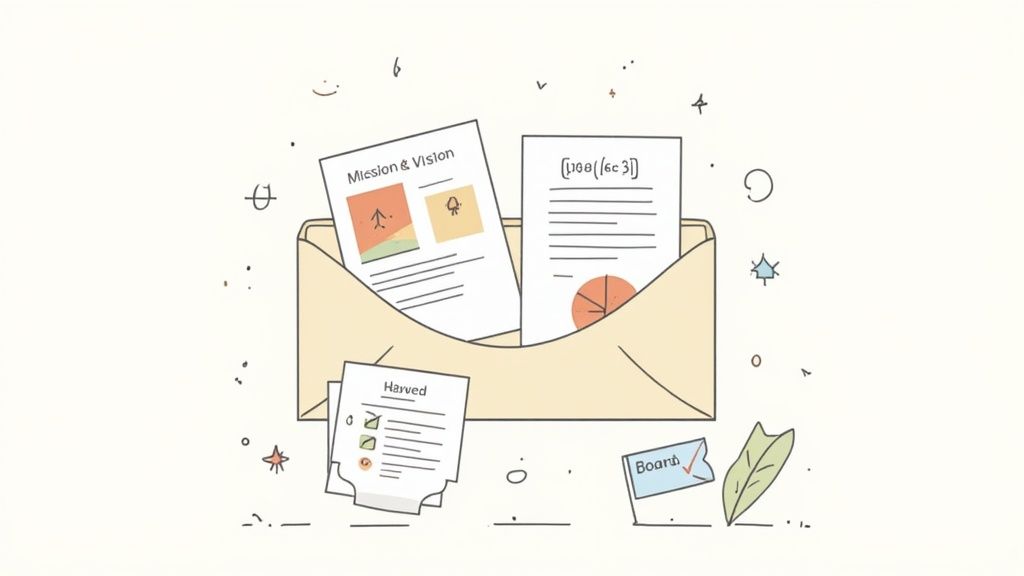
Long before a check is written, grant reviewers are vetting your organization for signs of stability and competence. They need to feel confident that their money will be managed responsibly and actually make a difference. This prep work isn't about the grant application itself—it's about building the organizational bedrock that makes a winning proposal possible.
Think of it this way: you're proving that your nonprofit is a professional operation, not just a passionate side project.
Solidify Your Mission and Vision
Your mission and vision aren't just feel-good statements for your website. They are the absolute core of your grant applications. They need to be sharp, clear, and compelling.
A powerful mission statement quickly answers what you do, who you serve, and why it matters. It’s your elevator pitch—the thing that tells a funder in seconds if your work aligns with their priorities. Your vision, on the other hand, paints a picture of the world you’re trying to create. It’s the ultimate impact of your work.
If these statements are vague or full of jargon, your entire grant proposal will feel weak and unfocused.
Gather Your Essential Documentation
Funders want to trust you, but they verify with paperwork. Having all your key documents organized and ready to go is a non-negotiable part of the process. It shows you’re professional, transparent, and saves you from the frantic, last-minute search for a document that can derail an entire application.
Your "grant-ready" toolkit should always contain:
- IRS 501(c)(3) Determination Letter: The official proof of your nonprofit status. No exceptions.
- List of Board of Directors: Make sure to include their professional affiliations. This showcases strong community leadership and oversight.
- Organizational Annual Budget: This needs to be a clear, comprehensive picture of all your income sources and expenses.
- Most Recent Audited Financials or Form 990: This is your proof of fiscal health and accountability.
A disorganized document library is often the first red flag for a grant reviewer. Having these files updated and stored in a shared, accessible location ensures your team can respond to requests quickly and consistently.
Define and Track Measurable Outcomes
These days, funders see themselves as investors. They expect a return on their investment, and that return is measurable impact. Simply saying you're "doing good work" isn't going to cut it anymore. You have to prove it with data.
Start by defining specific outcomes for your programs. What tangible change will happen because of what you do? How are you going to track it? Whether it's the number of kids who can read at grade level, the reduction in shelter intake, or the acres of wetland restored, your outcomes must be quantifiable.
This data is what gives your grant proposal teeth. For example, instead of saying you "help the homeless," you can state, "We will transition 50 individuals from chronic street homelessness to stable housing within 12 months." That level of specificity shows you have a real plan and are serious about accountability. A detailed budget is essential for this, and you can explore our nonprofit program budget template to get a head start on connecting your financial needs to your goals.
Find Funders Aligned with Your Mission
The single biggest mistake I see nonprofits make is chasing any and every grant opportunity they find. It’s a classic “spray and pray” approach, and it rarely works. The key to successful grant seeking isn’t just finding funders with money—it’s about finding funders whose mission and priorities genuinely overlap with yours. This is where your real work begins.
You need to become a bit of a detective. Your goal is to identify foundations, corporations, and government agencies that have a proven history of supporting organizations like yours. This alignment is what transforms a generic proposal into a compelling request that a program officer actually wants to read.
Start with Smart Prospect Research
Your search for the right funders should start with a broad net, then quickly narrow down to the most promising prospects. Gone are the days of flipping through giant directories. Today, powerful online databases are your best friend.
A good place to start is with a comprehensive, free tool like the FundSprout Grant Database. It gives you a feel for what's out there. As you get more serious, investing in a paid subscription service can pay for itself many times over by saving you countless hours of manual research.
Comparing Top Grant Research Platforms
Choosing the right tool depends on your team's size, budget, and how deep you need to go. Here’s a quick breakdown of some of the most popular options to help you decide.
No matter which platform you choose, the goal is the same: build a list of potential funders whose priorities, geographic focus, and typical grant size match what you're looking for.
Vet Funders Thoroughly Before You Write a Word
Once you have a promising list, it's time to dig deeper. A funder’s website is just the starting point. You need to look past the marketing language and find concrete evidence that they are a good fit.
Review their annual reports and previously funded projects. Do they fund organizations of your size and budget? Do they support general operating costs or only specific projects? Reaching out for a brief introductory call can be a game-changer. It puts a human face on your application and gives you a chance to ask clarifying questions before investing dozens of hours in writing.
Leverage Public Records for Insider Knowledge
Here’s a powerful strategy that many nonprofits overlook: analyzing a foundation’s public tax records. Every private foundation is required to file a Form 990-PF with the IRS, and these documents are publicly available. This form is a goldmine.
It’s where you can see exactly which organizations they funded, the precise dollar amount of each grant, and any specific program areas they supported. This tells you far more than their website’s broad mission statement. Analyzing a few years of 990s reveals patterns in their giving, their average grant size, and whether they tend to fund the same groups repeatedly or are actively seeking new partners.
This research prevents you from asking a foundation that typically gives $5,000 grants for a $50,000 award—a common mistake that immediately signals you haven't done your homework.
Build Genuine Relationships with Program Officers
The final, and perhaps most crucial, step is moving beyond digital research to human connection. Program officers are the gatekeepers, but they are also your potential allies. Their job is to find great nonprofits that can help their foundation achieve its goals.
Before submitting a "cold" proposal, always try to initiate contact.
- Send a brief introductory email. Explain your mission and ask if your program aligns with their current funding priorities.
- Request a short phone call. Respect their time. Have a 2-minute summary of your project and one or two specific questions ready to go.
- Attend funder events. Many community foundations or corporate givers host informational sessions or "meet the funder" events. Show up.
This personal touch can transform your application from just another document in a pile into a proposal from an organization they know and understand. It builds invaluable rapport and often yields feedback that can dramatically strengthen your eventual submission.
Writing a Grant Proposal That Wins Funding
After all the research, prospecting, and relationship-building, it all comes down to the proposal. This document is your single best shot at convincing a funder that your mission is worth their investment. A winning proposal isn't just a dry collection of facts; it's a story that connects a real-world problem with your unique solution and proves you're the right organization to see it through.
So many nonprofits shoot themselves in the foot by using generic, copy-and-paste language. This is a huge mistake. Grant reviewers read hundreds, sometimes thousands, of these. They can spot a recycled, uninspired proposal from a mile away. You want them to feel like you wrote this specifically for them—because you understand their goals and are the perfect partner to help achieve them.
The Core of a Compelling Grant Narrative
Think of your proposal like building a house. Every section has a job to do, and each part has to be strong on its own while fitting together perfectly with the others to create a solid, convincing structure.
Let's break down the essential components:
- Executive Summary: This is your elevator pitch on paper. It's often the first—and sometimes only—part a busy reviewer reads. It needs to be a powerful, one-page snapshot of the entire proposal: the problem, your solution, what you're asking for, and the impact you’ll deliver. Write it last, but put it first.
- Statement of Need: This is where you grab their attention and create a sense of urgency. Use a mix of hard data, compelling stories, and third-party evidence to paint a vivid picture of the problem you're tackling. Why does this matter right now? Who is being left behind? What happens if nothing is done?
- Project Description: Now you get to show them your brilliant solution. Clearly walk them through the activities you'll undertake, the timeline for getting it all done, and who will be leading the charge. The reviewer should be able to close their eyes and visualize exactly how your program will work.
The real magic happens when you weave quantitative data (the "what") with qualitative storytelling (the "why"). Numbers show the scale of the problem, but a personal story creates an emotional hook that makes the issue—and your solution—unforgettable.
From Vague Ideas to Measurable Impact
Funders aren't interested in vague promises anymore. They want to see a concrete plan for how you'll measure your success. Saying you want to "improve literacy" won't get you funded. You need specific, measurable, achievable, relevant, and time-bound (SMART) objectives.
A fantastic tool for this is a logic model. It's basically a simple chart that visually connects the dots between your inputs (resources like staff and money), activities (what you'll do), outputs (the direct results, like "100 children attended tutoring"), and outcomes (the meaningful change that happens, like "75% of those children improved their reading scores by one grade level").
A well-crafted logic model is proof that you've thought through every step and are focused on results.
Building a Budget That Tells Your Story
Your budget isn't just a spreadsheet; it's the financial version of your proposal narrative. Every single number must connect directly to an activity you described earlier. If you say you’re running 12 workshops, your budget better have costs listed for the facilitator, materials, and venue for those 12 workshops.
A rock-solid budget always includes:
- Personnel Costs: Break down salaries by the percentage of time each person will spend on this specific project. Don't forget to include fringe benefits like taxes and healthcare.
- Direct Project Expenses: These are the tangible costs of running the program—things like supplies, software, printing, and travel.
- Indirect Costs (Overhead): This covers the essential administrative costs that keep the lights on, like rent, utilities, and accounting. Check the funder’s guidelines carefully, as many cap this at a specific rate, often around 10-15%.
The budget narrative is where you explain the why behind the numbers. Instead of just a line item for "$1,200 - Printing," you'd explain, "This covers printing 2,000 full-color informational brochures for distribution at 15 community outreach events." This level of detail shows you're a responsible and thoughtful planner.
Getting started from a solid framework can make all the difference. To help you build a complete and persuasive proposal, take a look at our detailed guide and nonprofit grant proposal template.
The Final Polish Before You Hit 'Submit'
Don't even think about submitting until your proposal has been thoroughly reviewed. A single typo or formatting error can signal carelessness and damage your credibility.
My rule of thumb? Get at least two sets of fresh eyes on it—people who weren't involved in writing it.
One should be your meticulous proofreader, hunting for typos, grammar mistakes, and formatting issues. The other should be your "big-picture" reader—maybe a board member or a colleague from another department. Ask them the most important question: "After reading this, would you give us the money?"
Finally, create a checklist from the funder’s guidelines and physically check off every required attachment: your 501(c)(3) letter, board list, budget, financial statements, etc. Missing a single document is one of the easiest—and most frustrating—ways to get disqualified before your proposal is even read.
Streamline Your Application and Submission Process
A brilliant proposal can be completely torpedoed by a disorganized, last-minute scramble to hit "submit." I've seen it happen. A chaotic process is a recipe for errors, missed deadlines, and a ton of unnecessary stress for your team. Honestly, building a practical system to manage your grants pipeline is just as critical as the writing itself.
Think of this system as your command center. It turns the tangled, multi-step process of applying for grants into a smooth, manageable workflow, ensuring nothing ever slips through the cracks. It’s all about being proactive, not reactive.
Create a Centralized Grants Calendar
First things first: you need a grants calendar. And I don't just mean a list of due dates. This should be a strategic tool that maps out your entire year of grant-seeking. It has to be a living document that everyone involved in fundraising can see and use.
A truly effective grants calendar tracks way more than just the final submission date. It needs to include milestones for every single stage of the application.
- Internal Deadlines: This is huge. Set firm dates for the first draft, budget completion, final review by leadership, and gathering all those necessary attachments. You have to work backward from the funder's deadline to build a timeline that’s actually realistic.
- Key Funder Dates: Make sure to note the Letter of Intent (LOI) due date (if there is one), the full proposal deadline, and when they expect to notify applicants.
- Reporting Timelines: The moment you win a grant, add the interim and final report due dates to your calendar for the following year. Don't wait.
This simple flowchart breaks down the core of any grant proposal. It all starts with the need, which dictates your plan, and that plan translates directly into your budget. They're all connected.
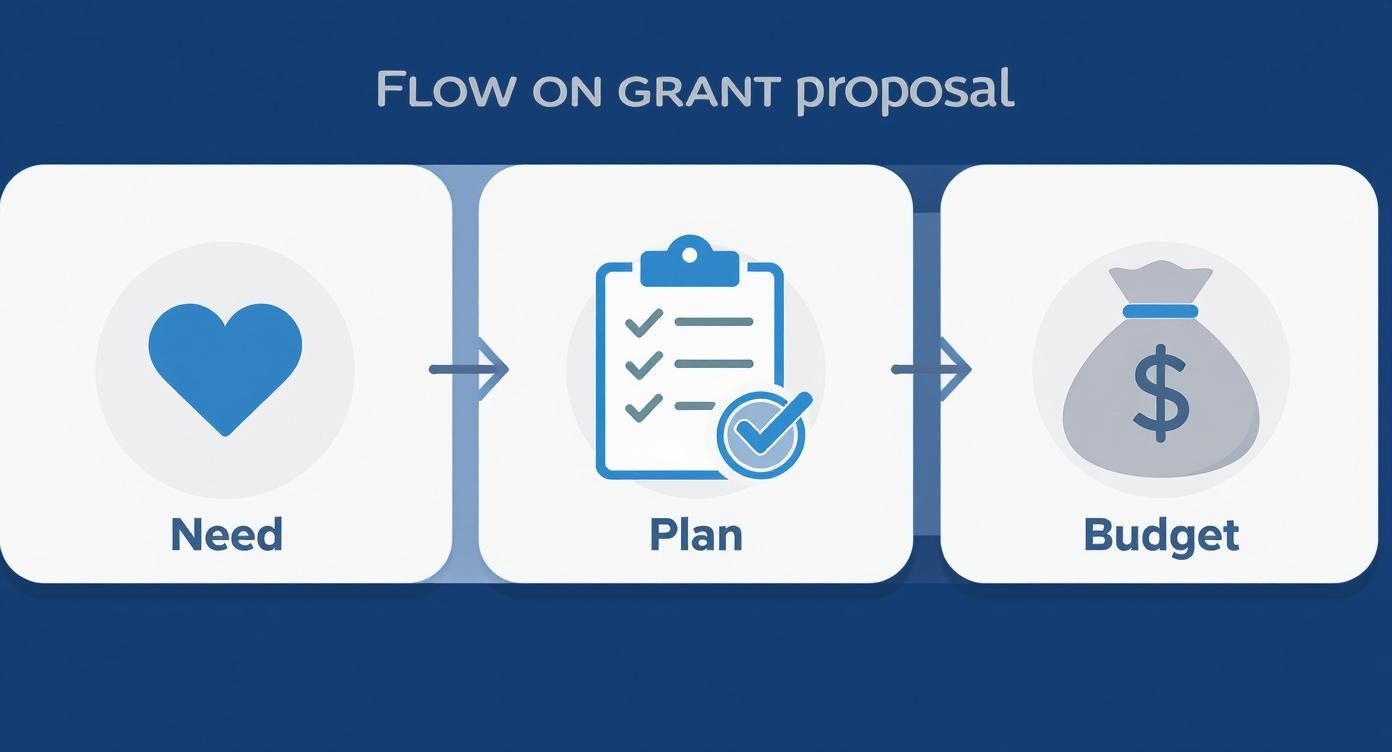
As you can see, a successful proposal doesn't just appear. It flows logically from a clearly defined need to a well-thought-out plan, all supported by a justifiable budget.
Navigating the Submission Maze
Getting a grant proposal submitted is rarely as simple as emailing a PDF. Almost every funder has its own online portal, and each one comes with its own set of quirks. Underestimating the technical side of submission is a common—and costly—mistake.
Government portals like Grants.gov are notoriously complex. They often require multiple registrations (like getting set up in SAM.gov) that can take weeks to process. I can't stress this enough: do not wait until the last minute. Start the registration process the moment you decide to pursue a federal grant.
Foundation portals can be tricky, too. Many of them won't save your work automatically. A pro tip is to always write and edit your narrative sections in a separate Word or Google Doc, then copy and paste them into the online form. This has saved me from losing hours of work after a browser crash more times than I can count.
I always tell my clients to submit their application at least 24 to 48 hours before the deadline. That buffer is your safety net against unexpected tech glitches, slow server uploads, or the site crashing from everyone else trying to submit at the last second.
Your Post-Submission Strategy
What you do after you hit "submit" says a lot about your organization's professionalism. The work isn't over; you've just moved into a new phase of the relationship.
Most funders will send an automated email confirming they received your application. If you don't get one within 24 hours, it's perfectly fine to send a brief, polite email to the program officer just to be sure.
And now, you wait. This is the hard part. Resist the urge to constantly check in for updates. They have a review process, and they will get in touch when a decision is made.
Handling Acceptances and Rejections with Grace
Getting that award notice is an incredible feeling. Your very first move should be to send a prompt, personal thank-you note to the program officer and the foundation. Then, clarify the next steps for signing the grant agreement and how the funds will be disbursed.
A rejection stings, but it’s also an invaluable learning opportunity. It is both professional and highly recommended to send a polite email thanking the funder for their time and consideration. In that same email, ask this crucial question: "Would you be willing to share any feedback that might help us strengthen our proposals in the future?"
Not every funder will have time to respond, but the ones who do will give you pure gold. Their feedback can reveal weaknesses in your program design, budget, or narrative that you can fix for your next application. This simple, proactive step turns a "no" into a strategic advantage for securing the next grant.
Cultivate Funder Relationships for Long-Term Support

Winning a grant isn't the finish line—it's the starting block. The moment that award letter arrives, the real work of building a long-term partnership begins. This process, often called grant stewardship, is what separates a one-time win from a reliable, renewable source of funding for years to come.
Think of your foundation funders with the same care you give your top individual donors. Foundations are staffed by people who are personally and professionally invested in making a difference. Your job now is to show them their investment is paying off and build the kind of trust that makes renewing their support an easy decision.
Fulfill Your Promises with Excellent Reporting
That grant agreement you signed is more than just paperwork; it’s your contract. It spells out exactly what you promised to deliver and the deadlines you need to hit. Meeting these obligations is the absolute baseline for a healthy relationship, but to truly stand out, you need to go beyond just checking the boxes.
Your reports are a golden opportunity to tell a compelling story of impact, not just list activities. Weave together hard data and human narrative to bring your work to life.
- Showcase Successes: Don't just report that you served 50 people. Share a powerful anecdote about one of those individuals and how their life has changed. Connect that personal story directly back to the larger data points.
- Be Honest About Challenges: No project ever goes exactly as planned. Being transparent about a roadblock and explaining how your team is adapting shows incredible maturity. It builds far more trust than pretending everything is perfect.
- Visualize Your Impact: A picture really is worth a thousand words. Include high-quality photos, powerful quotes from participants, or even a link to a short video. Help the program officer see the results of their investment.
A great grant report does more than fulfill a requirement; it reinforces the funder’s belief in your mission. It should be an engaging, transparent account of your progress that leaves them feeling proud of their investment in your organization.
Keep Funders Engaged Beyond the Report
Don't let your communication go silent between reporting deadlines. Proactive, personalized engagement throughout the year shows the funder you see them as a genuine partner, not just an ATM. These small touchpoints are what build a real connection and keep your organization top-of-mind.
A few simple ideas can make a huge difference:
- Send a brief, personalized email with a great photo when your program hits a key milestone.
- Add your program officer to your monthly e-newsletter list so they can see the good news as it happens.
- Invite them for a site visit to see the program in action and meet the people they are helping.
These gestures aren't time-consuming, but their impact is huge. They shift the dynamic from a transaction to a true partnership built on shared goals. This consistent communication is a core part of learning how to get grants for nonprofits, as it lays the groundwork for future requests and makes the renewal conversation feel natural and expected.
Got Questions? We’ve Got Answers About Grant Seeking
Diving into the world of grants can feel like learning a whole new language. I’ve seen countless nonprofit leaders get bogged down with the same handful of questions about timelines, common pitfalls, and whether they even stand a chance.
Let's clear up some of that confusion. Here are the straight-up answers to the questions I hear most often from organizations just starting their grant-seeking journey.
How Long Does It Really Take to Get a Grant?
This is the big one, and the honest answer is: it's all over the map. There’s no magic number because every funder plays by its own rules.
A local community foundation, for instance, might review applications on a quarterly cycle and get back to you within two or three months. On the other hand, if you're tackling a big federal grant, you need to be prepared to play the long game. Those can easily take six to twelve months from the day you hit "submit" to the day you see a notification. This is exactly why you can't wait until you're desperate for cash; building a grant calendar well in advance is non-negotiable.
What are the Biggest Mistakes People Make?
I see the same grant-killing mistakes over and over. They’re almost always avoidable, yet they’re the top reasons great programs go unfunded.
Here are the most common ways nonprofits shoot themselves in the foot:
- Ignoring the instructions: This is the easiest way to land in the "no" pile. If they ask for 12-point font, a 3-page limit, and three specific attachments, you give them exactly that. No exceptions.
- Mission misalignment: Chasing money from a funder whose priorities don't genuinely match your work is a waste of your time and theirs. It’s like trying to fit a square peg in a round hole.
- A fuzzy budget: Your budget has to tell a story. If a reviewer can't draw a straight line from your budget items to your proposed activities, it signals a lack of clear planning.
- The "copy-paste" proposal: Funders can spot a generic, recycled proposal from a mile away. It tells them you aren’t truly invested in their partnership.
One of the smartest things you can do is have a brief conversation with a program officer before you write a single word. It shows initiative, clarifies their priorities, and can save you from making a critical mistake that would have been obvious had you just asked.
Can a Brand-New Nonprofit Actually Get a Grant?
Yes, absolutely—but you have to be strategic. It’s true that many foundations want to see a track record and a few years of financial history before they'll write a check. This can definitely feel like a disadvantage when you're just starting out.
The key is to start local. Community foundations are your best bet, as they're often specifically looking to support new and emerging organizations addressing needs in their own backyard.
Since you can't lean on a long history, you have to prove your viability in other ways. Showcase a strong, connected board of directors, present a rock-solid strategic plan, and provide proof of early community support, like grassroots fundraising wins or a successful individual donor campaign.
Finding the right funders and juggling all these moving parts can easily become a full-time job. Fundsprout uses AI to build a ranked pipeline of perfectly matched grant opportunities for you. It also helps you write compelling proposals in your organization's unique voice and tracks every single deadline, so you can stop chasing paperwork and get back to your mission. See how it works at https://www.fundsprout.ai.
Try 14 days free
Get started with Fundsprout so you can focus on what really matters.