7 Winning Grant Application Example Resources for 2026
Unlock funding with our deep dive into a top grant application example for federal, state, and foundation proposals. Learn to write winning grants now.

Abdifatah Ali
Co-Founder
Staring at a blank grant application can feel overwhelming. You know your mission is critical, but how do you translate that passion into a proposal that funders can't ignore? The secret isn't just about what you write, but how you write it. The most successful grant writers learn by deconstructing what works, and finding a high-quality grant application example is the first step.
This guide moves past generic advice, providing a deep, strategic analysis of real, funded proposals. We will dissect powerful examples from a variety of sources to give you a replicable blueprint for success. You will see firsthand how to structure a compelling narrative, present data effectively, and perfectly align your project with a funder's specific priorities.
Each entry in this list provides more than just a link; we break down the strengths of each sample, complete with screenshots and direct access. You'll gain specific, tactical insights into what makes a proposal stand out, whether you're applying to a federal agency like the NIH or a local family foundation. We'll also touch upon tools like Fundsprout, which help turn complex requirements into a clear, actionable plan.
This resource is designed to solve a fundamental problem for fundraising teams: the uncertainty of what a winning application actually looks like. Instead of guessing, you’ll be equipped with proven models and actionable takeaways. Let’s transform your next application from a daunting task into a confident, strategic step toward securing the resources your community deserves.
1. The Federal Gold Standard: NIH/NIAID Sample Applications
For anyone navigating the complex world of federal research funding, the National Institute of Allergy and Infectious Diseases (NIAID) offers a resource that is nothing short of a revelation. This isn't just a guide or a template; it's a library of complete, successful grant applications provided by the National Institutes of Health (NIH), the largest public funder of biomedical research in the world. Accessing this collection feels like getting a behind-the-scenes pass to see exactly what a winning submission looks like.
What makes this an essential resource is the inclusion of the corresponding summary statements, the official peer-review feedback. You don't just see the application; you see how expert reviewers evaluated it, what they praised, and where they identified weaknesses. This pairing provides a rare, 360-degree view of the federal grant review process.
Deep Dive: Analysis and Strategic Takeaways
The NIAID library is a masterclass in federal grant writing. By dissecting these successful proposals, you can reverse-engineer the strategies that led to funding. It provides an exceptional grant application example for scientific research proposals.
Strategic Insight: The most powerful feature is the direct link between the submitted application and the reviewer's summary statement. This allows you to identify the exact language, data presentation, or experimental design that resonated with the review panel.
Actionable Takeaway: Before writing your Specific Aims page, download two or three funded R01 applications in your field. Pay close attention to the first page and then read the corresponding reviewer comments on the "Significance" and "Approach" sections. Note the powerful, declarative sentences used to frame the project's importance and feasibility. This is your model for a compelling opening.
Key Features Breakdown:
- Multiple Mechanisms: The library covers a wide range of grant types, from the R01 (Research Project Grant) and R21 (Exploratory/Developmental) to career development "K" awards and small business "SBIR/STTR" grants.
- Critical Attachments: It's not just the core research strategy. You get to see how successful applicants structured their biosketches, managed human subjects' sections, and presented complex data in tables and figures.
- Free and Open Access: There are no fees, subscriptions, or access requirements. This government resource is freely available to the public, leveling the playing field for researchers at all institutions.
How to Use This Resource Effectively
To get the most value, don't just read one application. Download several from the same funding mechanism you are targeting. Create a "swipe file" of compelling phrases for describing project impact or innovative methodologies. Pay particular attention to how applicants address potential problems or alternative strategies, a key section often scrutinized by reviewers. This direct access to proven examples makes the NIAID library the first and best stop for any serious applicant seeking NIH funding.
Website: NIH/NIAID Sample Applications
2. The Federal Gold Standard: NIH/NIAID Sample Applications
For anyone navigating the complex world of federal research funding, the National Institute of Allergy and Infectious Diseases (NIAID) offers a resource that is nothing short of a revelation. This isn't just a guide or a template; it's a library of complete, successful grant applications provided by the National Institutes of Health (NIH), the largest public funder of biomedical research in the world. Accessing this collection feels like getting a behind-the-scenes pass to see exactly what a winning submission looks like.
What makes this an essential resource is the inclusion of the corresponding summary statements, the official peer-review feedback. You don't just see the application; you see how expert reviewers evaluated it, what they praised, and where they identified weaknesses. This pairing provides a rare, 360-degree view of the federal grant review process.
Deep Dive: Analysis and Strategic Takeaways
The NIAID library is a masterclass in federal grant writing. By dissecting these successful proposals, you can reverse-engineer the strategies that led to funding. It provides an exceptional grant application example for scientific research proposals, even for those outside of biomedicine, because it demonstrates a rigorous, evidence-based narrative structure.
Strategic Insight: The most powerful feature is the direct link between the submitted application and the reviewer's summary statement. This allows you to identify the exact language, data presentation, or experimental design that resonated with the review panel.
Actionable Takeaway: Before writing your Specific Aims page, download two or three funded R01 applications in your field. Pay close attention to the first page and then read the corresponding reviewer comments on the "Significance" and "Approach" sections. Note the powerful, declarative sentences used to frame the project's importance and feasibility. This is your model for a compelling opening.
Key Features Breakdown:
- Multiple Mechanisms: The library covers a wide range of grant types, from the R01 (Research Project Grant) and R21 (Exploratory/Developmental) to career development "K" awards and small business "SBIR/STTR" grants.
- Critical Attachments: It's not just the core research strategy. You get to see how successful applicants structured their biosketches, managed human subjects' sections, and presented complex data in tables and figures.
- Free and Open Access: There are no fees, subscriptions, or access requirements. This government resource is freely available to the public, leveling the playing field for researchers at all institutions.
How to Use This Resource Effectively
To get the most value, don't just read one application. Download several from the same funding mechanism you are targeting. Create a "swipe file" of compelling phrases for describing project impact or innovative methodologies. Pay particular attention to how applicants address potential problems or alternative strategies, a key section often scrutinized by reviewers. This direct access to proven examples makes the NIAID library the first and best stop for any serious applicant seeking NIH funding.
Website: NIH/NIAID Sample Applications
3. Institute of Museum and Library Services (IMLS) — Sample Applications
For community-focused nonprofits, museums, libraries, and cultural organizations, the Institute of Museum and Library Services (IMLS) provides an invaluable window into successful project funding. The agency posts a collection of funded applications from its various grant programs, offering a specialized look at what resonates with reviewers in the cultural and educational sectors. This resource is a practical blueprint for crafting proposals centered on public service, community impact, and program evaluation.
What sets the IMLS collection apart is its direct relevance to organizations outside of hard science or biomedical research. These applications demonstrate how to build a compelling narrative around community needs, educational outcomes, and audience engagement. In some cases, IMLS also provides reviewer comments or panel guidance, giving applicants a rare glimpse into the specific criteria that led to a successful award.
Deep Dive: Analysis and Strategic Takeaways
The IMLS library is a masterclass in building a community-centric grant proposal. By examining these funded applications, organizations can learn to frame their local projects in a way that meets federal standards for planning, execution, and measurement. This makes it an outstanding grant application example for any nonprofit focused on programmatic work.
Strategic Insight: The strength of these examples lies in their clear, logical structure, particularly in the work plans, logic models, and evaluation sections. They show how to connect a project's activities directly to measurable community outcomes, a critical skill for any program-based grant.
Actionable Takeaway: Before outlining your project’s activities, download a funded application from a relevant IMLS program like "Museums for America" or "National Leadership Grants for Libraries." Go directly to the "Schedule of Completion" or "Work Plan" section. Note how successful applicants break down a multi-year project into specific, time-bound, and measurable tasks. Use this as a model to build your own project timeline, ensuring every activity has a clear purpose and deadline.
Key Features Breakdown:
- Program-Specific Examples: The library is organized by IMLS grant programs, allowing you to find examples directly related to your project type, whether it's for collections stewardship, digital inclusion, or community memory projects.
- Emphasis on Planning Tools: These applications are excellent models for creating schedules, defining performance measures, and articulating intended outcomes. They show these planning documents in the context of a full, successful proposal.
- Free and Publicly Accessible: Like other federal resources, the IMLS sample applications are available to everyone at no cost. This provides essential support for smaller institutions that may lack dedicated grant-writing staff.
How to Use This Resource Effectively
To make the most of this library, focus on the application's narrative and structure. Look for proposals from organizations of a similar size or scope to your own. Pay close attention to the language used to describe the community being served and the problem the project aims to solve. Create a file of effective phrases for articulating public value and impact. This direct access to successful proposals is an essential step for any cultural or community organization seeking federal support.
Website: IMLS Sample Applications
4. National Endowment for the Humanities (NEH) — FOIA Sample Grant Application Narratives
For nonprofit leaders and program managers in the arts, culture, and education sectors, the National Endowment for the Humanities (NEH) provides a uniquely valuable resource. Through Freedom of Information Act (FOIA) requests, the NEH has made a collection of successful grant application narratives publicly available. These aren't simplified templates; they are the actual, complete narrative portions of funded projects, offering a candid look at what convinces NEH review panels.
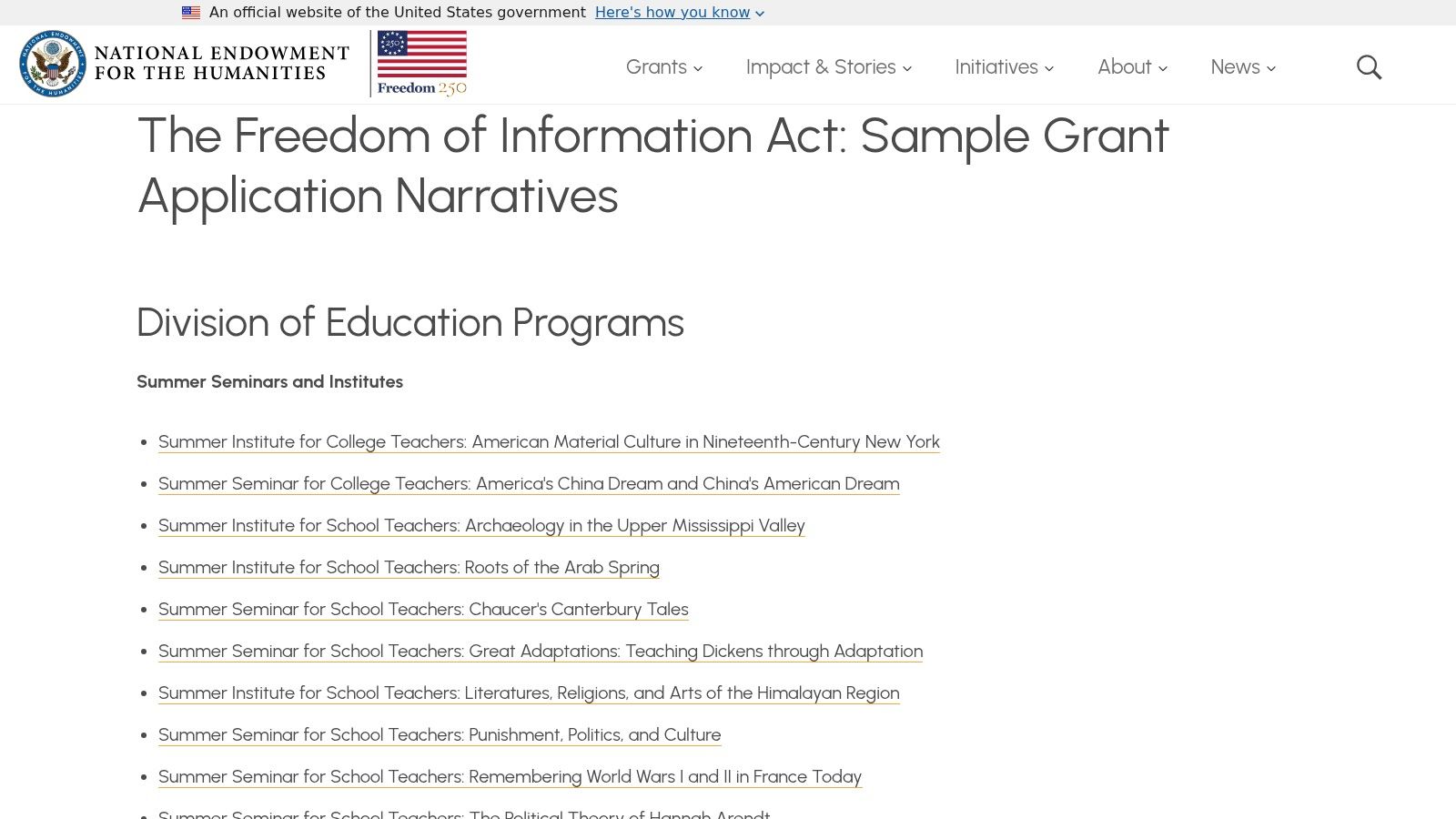
What sets this collection apart is its focus on the humanities, providing clear examples for projects that often struggle to quantify their impact in the same way a scientific study might. You get to see how successful applicants weave a compelling story, detail complex partnerships with universities or cultural organizations, and lay out a clear, actionable work plan. This is a practical grant application example for anyone working on public-facing educational or cultural programming.
Deep Dive: Analysis and Strategic Takeaways
The NEH library is a goldmine for understanding how to frame qualitative impact and community benefit. By reviewing these narratives, you can learn the specific language and structural approaches that resonate with funders focused on cultural and educational outcomes.
Strategic Insight: Many of these samples excel at demonstrating institutional collaboration. They show exactly how partnerships with universities, libraries, museums, and tribal nations are described, not just as a list of names but as integral parts of the project's design and execution.
Actionable Takeaway: Find a funded narrative from a program similar to yours, like "Public Programs" or "Preservation and Access." Scrutinize the "Work Plan" and "Partnerships" sections. Note how they assign specific roles, create timelines, and describe the contributions of each partner. Use this as a model to move your own partnership descriptions from a vague mention to a concrete, convincing plan.
Key Features Breakdown:
- Real-World Narratives: Access the complete, unedited narrative PDFs that secured funding, showing how applicants addressed prompts for project scope, work plan, and personnel.
- Program Diversity: Examples span a wide range of NEH divisions, including Education, Preservation, Public Programs, and Research, making it relevant for many types of humanities projects.
- Free and Direct Access: As a government resource compiled via FOIA, these files are available to anyone without cost or subscription, directly from the NEH website.
How to Use This Resource Effectively
To maximize the value of this library, focus on the alignment between the project description and the NEH's stated mission. Pay close attention to how applicants articulate the project's significance to the humanities. This is critical for shaping your own project’s core message and will be invaluable for strengthening the argument in your Statement of Need. Although some files are older or have redactions, the core strategic content remains highly instructive. They demonstrate how to write for a specific federal agency's selection criteria, a skill transferable to any funding application.
Website: NEH FOIA Sample Grant Application Narratives
5. National Endowment for the Arts (NEA) — Sample Narratives (program‑specific)
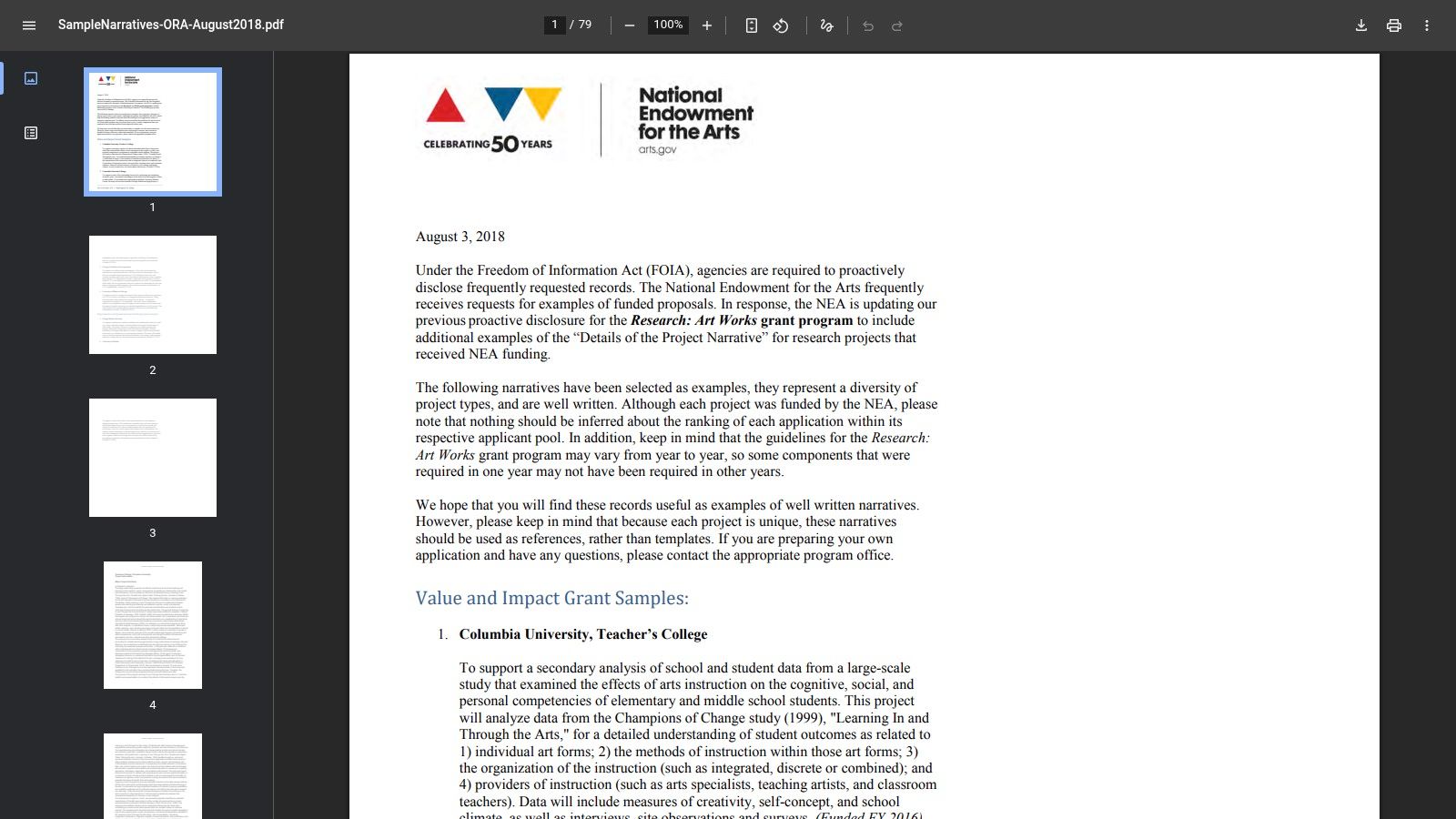
For grant writers in the arts and cultural sector, the National Endowment for the Arts (NEA) provides a uniquely focused resource. Instead of full applications, the NEA offers curated excerpts of high-scoring proposal narratives. This collection is a masterclass in how to write with precision and power, directly addressing federal review criteria in a compelling, data-supported way. It’s the perfect grant application example for anyone needing to translate artistic vision into fundable project plans.
Accessing these samples feels like a direct coaching session from a seasoned program officer. The documents highlight exactly what makes a project description, an evidence-of-impact statement, or an evaluation plan successful in the eyes of NEA reviewers. For organizations struggling to quantify the public benefit of their work, these examples are an invaluable guide.
Deep Dive: Analysis and Strategic Takeaways
The NEA's narrative excerpts are a clinic in persuasive, criteria-driven writing. By studying how funded applicants structure their arguments, you can learn to frame your own project not just as artistically meritorious but also as a sound investment with clear public value and measurable outcomes. This is especially useful for arts-based research projects.
Strategic Insight: The strength of this resource is its targeted focus on the narrative. These examples demonstrate how to use headings that mirror the funder's review criteria, a simple but effective strategy for making a reviewer's job easier and ensuring all required points are addressed.
Actionable Takeaway: Before writing your project narrative, download the NEA sample PDF and the guidelines for your target NEA program. Create an outline for your narrative using the exact headings from the guidelines (e.g., "Project Description," "Evidence of Artistic Excellence," "Public Benefit"). Then, use the sample narratives to see how successful applicants have structured their paragraphs and presented data under those same headings.
Key Features Breakdown:
- Criteria-Driven Examples: The excerpts are specifically chosen to showcase how to effectively answer the core questions of a federal arts grant, particularly regarding project rationale and public benefit.
- Concise Writing Models: These samples are excellent models of how to be direct and impactful within strict character or word limits, a common challenge in grant applications.
- Free and Open Access: As a federal resource, these documents are completely free to download and use without any registration, making them accessible to organizations of all sizes.
How to Use This Resource Effectively
To get the most from these samples, use them as a structural guide rather than a content template. Note the active language, the integration of statistics to demonstrate need or impact, and the clarity of the evaluation plans. Be aware that guidelines change, so always cross-reference the examples with the most current application instructions for the specific NEA program you are targeting. This practice ensures your proposal is both well-written and fully compliant.
Website: NEA Sample Application Narratives
6. Candid Learning — Sample Documents (Foundation and Corporate Proposals)
For nonprofits seeking funding from foundations or corporations, Candid Learning provides an indispensable collection of real-world documents. Unlike dense academic or federal proposals, this library offers something far more relatable for community organizations: successful proposals written for private funders. Candid, a long-trusted authority in the nonprofit sector, curates this collection, giving grant writers a peek into the exact documents that secured funding.
What sets this resource apart is its focus on the complete application package for foundation grants. You're not just looking at a narrative; you're seeing the cover letters, budgets, and letters of inquiry (LOIs) that went with it. This provides a holistic view of what it takes to persuade a program officer, moving beyond theory into practical, proven application.
Deep Dive: Analysis and Strategic Takeaways
Candid's library is a masterclass in foundation-focused storytelling and financial justification. By studying these materials, nonprofits can learn how to frame their community impact in a way that resonates with private grantmakers. This repository is an excellent source for a community-based grant application example.
Strategic Insight: The most valuable aspect is the collection of non-technical, narrative-driven proposals. They demonstrate how to blend data with compelling stories to make a powerful case for support, a skill essential for foundation fundraising.
Actionable Takeaway: Find a sample proposal for a project similar in scope to your own. Focus on the budget and the budget narrative. Note how the funded organization aligned their financial request directly with project activities and outcomes. Use this as a model to ensure your own budget tells a clear, convincing story of fiscal responsibility.
Key Features Breakdown:
- Complete Packages: Access includes full proposals, LOIs, cover letters, and detailed budgets, showing how all pieces of a submission should work together.
- Diverse Examples: The collection features a variety of nonprofit types, from arts and culture to human services, offering relevant models for many different missions.
- Free and Reputable: The core sample documents are free to access (though some site features may require a free account). As a leading nonprofit data organization, Candid's resources are widely respected and reliable.
How to Use This Resource Effectively
To maximize its value, go beyond just reading the main proposal. Pay close attention to the accompanying letters of inquiry; these are often the first and most critical hurdle in foundation grantseeking. Compare the concise language of the LOI to the more detailed narrative in the full proposal. Also, take note of how successful organizations structure their project budgets to be both clear and comprehensive. For a deeper dive into structuring your proposal, this nonprofit grant proposal template offers a solid framework to build upon. This direct access to successful peer examples makes Candid's library a crucial stop for any nonprofit grant writer.
Website: Candid Learning Sample Documents
7. Non-Profit Guides (NPGuides) — Free Foundation and Government Sample Proposals
For small nonprofits or teams just beginning their grant-seeking journey, Non-Profit Guides (NPGuides) is a foundational resource. It cuts through the complexity by offering straightforward, complete sample proposals for both foundation and government grants. Unlike academic archives, this site is designed for the practitioner in a small shop who needs to see a finished product without wading through dense jargon or highly specialized scientific content.
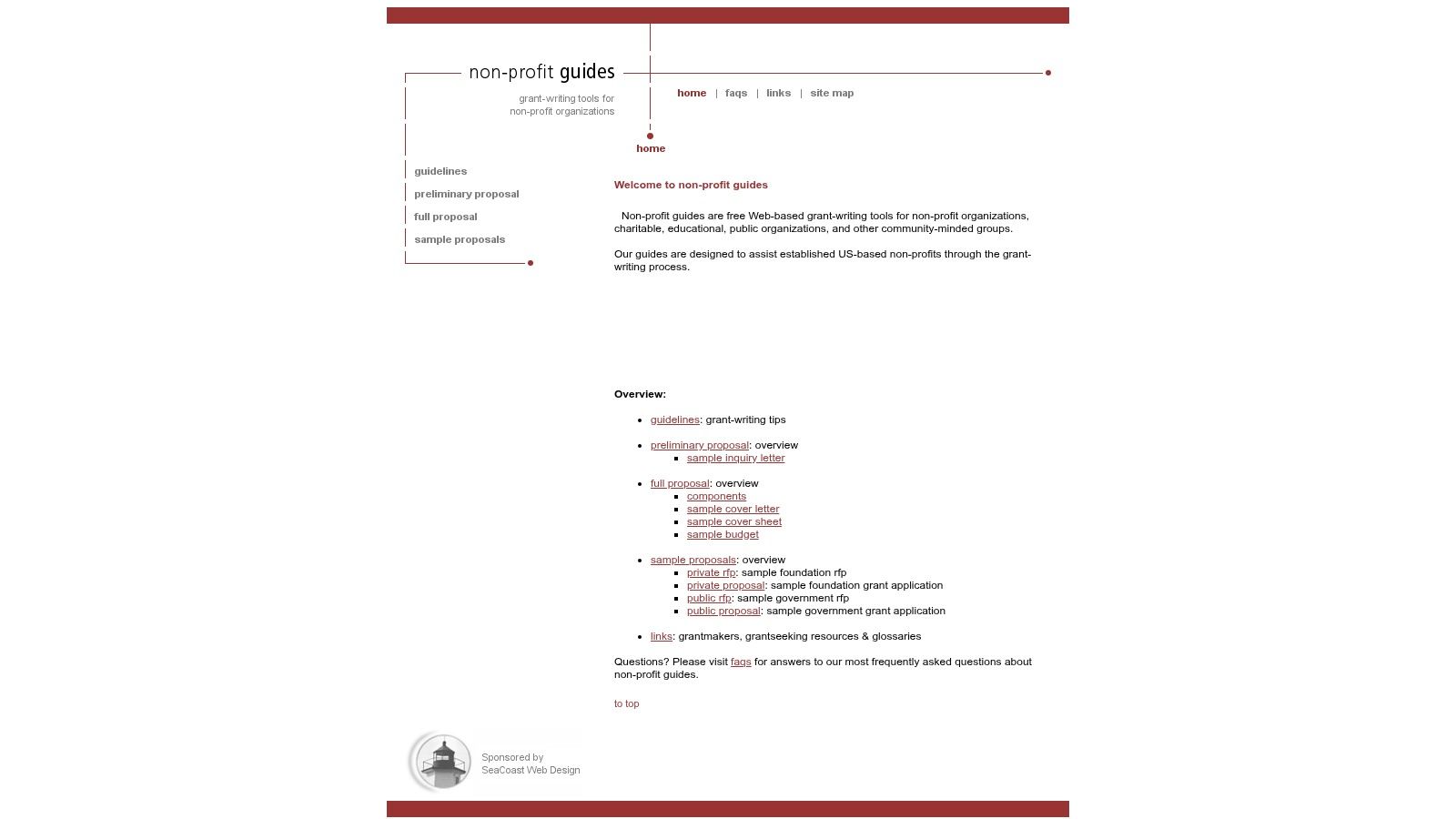
What makes NPGuides so valuable for newcomers is its focus on the entire submission package. It doesn’t just provide the narrative; it includes crucial companion documents like sample cover letters, budgets, and even the original Request for Proposals (RFPs). This holistic approach helps users connect the dots between the funder’s request and the nonprofit’s response, demystifying the entire process from start to finish.
Deep Dive: Analysis and Strategic Takeaways
NPGuides serves as a practical blueprint for constructing a standard nonprofit grant proposal. By examining its materials, you can quickly grasp the fundamental structure and language expected by many funders, making it an excellent grant application example for community-based programs.
Strategic Insight: The site's strength is its simplicity. The proposals are clear, concise, and follow a classic problem-solution-impact framework that is easy to replicate. They demonstrate how to tell a compelling story without overly academic or technical language, a key skill for connecting with foundation program officers.
Actionable Takeaway: Download the "Sample Foundation Proposal" and its corresponding budget. Use the narrative structure as a direct outline for your own draft, replacing the example's content with your program's details. Pay special attention to how the budget justification connects line-item costs directly back to the activities described in the proposal narrative. This alignment is critical for building credibility.
Key Features Breakdown:
- Public and Private Examples: The site offers distinct examples for both foundation (private) and government (public) grants, allowing users to see the differences in tone, detail, and formatting required for each.
- Complete Submission Packages: You get more than just the core proposal. Access to sample RFPs, cover letters, and budgets provides a comprehensive view of all required materials. As AI tools become more integrated in nonprofit operations, these templates can also serve as excellent training data. Beyond crafting proposals, AI can also streamline legal documentation; a free AI contract generator, for example, offers another dimension of AI assistance.
- Free and Unrestricted Access: All materials on NPGuides are available for free without any registration or sign-up, making it an accessible starting point for organizations with limited budgets.
How to Use This Resource Effectively
Use NPGuides as your initial template generator. Focus on the sample government proposal to understand the formal, structured requirements of public funding. Then, review the foundation proposal to see how to write with a more narrative, story-driven approach. While the visual design is dated, the core content provides a solid, time-tested framework for building your first few grant applications. Think of it as the essential "how-to" guide before you move on to more specialized examples.
Website: Non-Profit Guides
Comparison of 7 Sample Grant Applications
| Resource | Implementation Complexity 🔄 | Resource Requirements ⚡ | Expected Outcomes ⭐ / 📊 | Ideal Use Cases 💡 | Key Advantages ⭐ |
|---|---|---|---|---|---|
| Fundsprout | Moderate to High — onboarding + data integration 🔄 | Paid subscription; document uploads; staff time for setup ⚡ | High: faster drafting, prioritized pipeline, improved compliance ⭐⭐⭐📊 | Small nonprofits, dev teams, orgs without dedicated grant writers 💡 | AI matching, RFP analysis, writing assistant, compliance automation ⭐ |
| NIH/NIAID — Sample Applications | Low — straightforward access; technical interpretation needed 🔄 | Free access; time to review technical examples ⚡ | Very high for federal research alignment; deep insight into review scoring ⭐⭐⭐📊 | Biomedical researchers preparing NIH proposals; studying review critiques 💡 | Actual funded apps paired with reviewer summaries; gold‑standard models ⭐ |
| IMLS — Sample Applications | Low — curated program examples 🔄 | Free access; moderate review time for program specifics ⚡ | Good for clear logic models, workplans, evaluation sections ⭐⭐📊 | Museums, libraries, community‑serving nonprofits planning federal/site programs 💡 | Program‑specific funded narratives with reviewer feedback ⭐ |
| NEH — FOIA Sample Narratives | Low — downloadable narratives; some redactions 🔄 | Free access; occasional older/partial files ⚡ | Strong models for humanities scopes, partnerships, work plans ⭐⭐📊 | Humanities projects, public programming, preservation proposals 💡 | Real funded narratives showing fit to humanities criteria ⭐ |
| NEA — Sample Narratives | Low — program‑specific excerpts 🔄 | Free PDFs; verify current program instructions ⚡ | Good for concise, criteria‑driven arts narratives and impact claims ⭐⭐📊 | Arts and cultural organizations crafting project rationale and evaluation 💡 | Clear examples of concise writing and evidence of public benefit ⭐ |
| Candid Learning — Sample Documents | Low — curated, non-technical samples 🔄 | Free access (account optional); practical editorial tips ⚡ | Practical transferable outcomes for foundation/corporate proposals ⭐⭐📊 | Nonprofits seeking foundation/corporate proposal templates and examples 💡 | Diverse sample docs plus editorial context and best‑practice tips ⭐ |
| Non‑Profit Guides (NPGuides) | Very Low — ready templates and step‑by‑step guides 🔄 | Free access; minimal time investment ⚡ | Reliable basic proposals and templates for beginners ⭐⭐📊 | Small organizations or newcomers needing simple, usable examples 💡 | Straightforward, free templates covering public and private proposals ⭐ |
Your Action Plan for Crafting a Winning Grant Proposal
Reviewing a strong grant application example is an excellent first step, but the true goal is turning those insights into your next funded proposal. The journey from inspiration to submission requires a methodical approach. The examples and tools we've explored provide a clear road map. You now have access to successful federal applications from the NIH and NEA, foundation proposals via Candid, and structured guides from NPGuides. The key is to move from passive reading to active deconstruction and creation.
From Analysis to Action: Your Step-by-Step Workflow
Simply admiring a well-written proposal is not enough. To create your own compelling application, you must break down the winning formula and apply it to your organization's unique story.
Select a Relevant Model: Begin by choosing a sample that aligns with your immediate needs. Are you applying for a federal grant from an agency like the IMLS or NEH? Or are you targeting a local foundation? Select a
grant application examplefrom our list that mirrors your funder type, project scope, and organizational size. A small community arts program should model a different proposal than a national scientific research initiative.Deconstruct and Annotate: Don't just read the example; dissect it. Print it out or use a digital annotation tool to highlight key sections. Ask critical questions:
- How does the applicant frame the problem or need?
- What specific, persuasive language do they use in the project narrative?
- How do they connect their activities directly to their stated outcomes?
- Notice how the budget narrative justifies every line item and reinforces the project’s feasibility. This is a critical step where many applications falter.
Template Your Structure: Based on your analysis, create a reusable outline. This isn't about copying content but about replicating a winning structure. Your template should include placeholders for essential components: the executive summary, statement of need, project description, evaluation plan, and budget. This framework becomes your starting point for all future applications, saving you from reinventing the wheel each time.
Strategic Drafting and Refinement
With a solid plan and structure, the writing process becomes more focused and effective. This is where you can combine strategic insights with powerful tools to build your application efficiently.
Draft with Efficiency:
Use your core organizational information and a tool like Fundsprout to generate a comprehensive first draft. This initial pass ensures all required components are present and logically ordered, freeing you from the anxiety of a blank page. The goal here is speed and completeness, establishing a strong foundation upon which you can build.
Refine with Precision:
Once the basic draft is complete, you can invest your time where it matters most. Focus on strengthening your project's unique vision and clarifying its impact. Polish your evaluation plan to demonstrate clear, measurable outcomes. To build a robust and convincing budget that demonstrates long-term sustainability, consider how skilled Financial Analysts can contribute to your financial modeling and projections. Every sentence should be scrutinized to ensure it serves the ultimate goal: convincing the reviewer that your project is a worthy investment.
By combining the strategic analysis of a great grant application example with smart, purpose-built tools, you transform your grant writing process. You move from a state of overwhelm to one of control, ready to articulate your mission with clarity and confidence. The resources are in your hands; now is the time to build your organization's next success story.
Ready to turn these insights into your next funded proposal? Stop staring at a blank page and let Fundsprout generate a complete first draft in minutes. Using the strategies from the best grant application examples, you can create a strong foundation and focus your energy on what makes your project unique. Try Fundsprout today and accelerate your path to funding.
Try 14 days free
Get started with Fundsprout so you can focus on what really matters.