Freelance Grant Writer: Your Ultimate Hiring Guide for 2026
Find, vet, and hire the perfect freelance grant writer for your nonprofit. Our 2026 guide covers costs, contracts, alternatives, and red flags to avoid.

Abdifatah Ali
Co-Founder
Your program team is asking for funding. Your board wants more grants. Your development staff is already stretched. So you're considering hiring a freelance grant writer and hoping that person will solve the problem quickly.
That can work. It can also waste money if you hire the wrong person, expect miracles, or use a weak process.
A strong freelance grant writer can absolutely help your nonprofit win more of the right opportunities. But they are not a magic pen. They can't fix a vague program model, missing budgets, no outcomes data, or a leadership team that answers questions three days before deadline. If you want this hire to pay off, you need to understand what the role is, what it should cost, how to vet talent, and when a freelancer is the wrong model altogether.
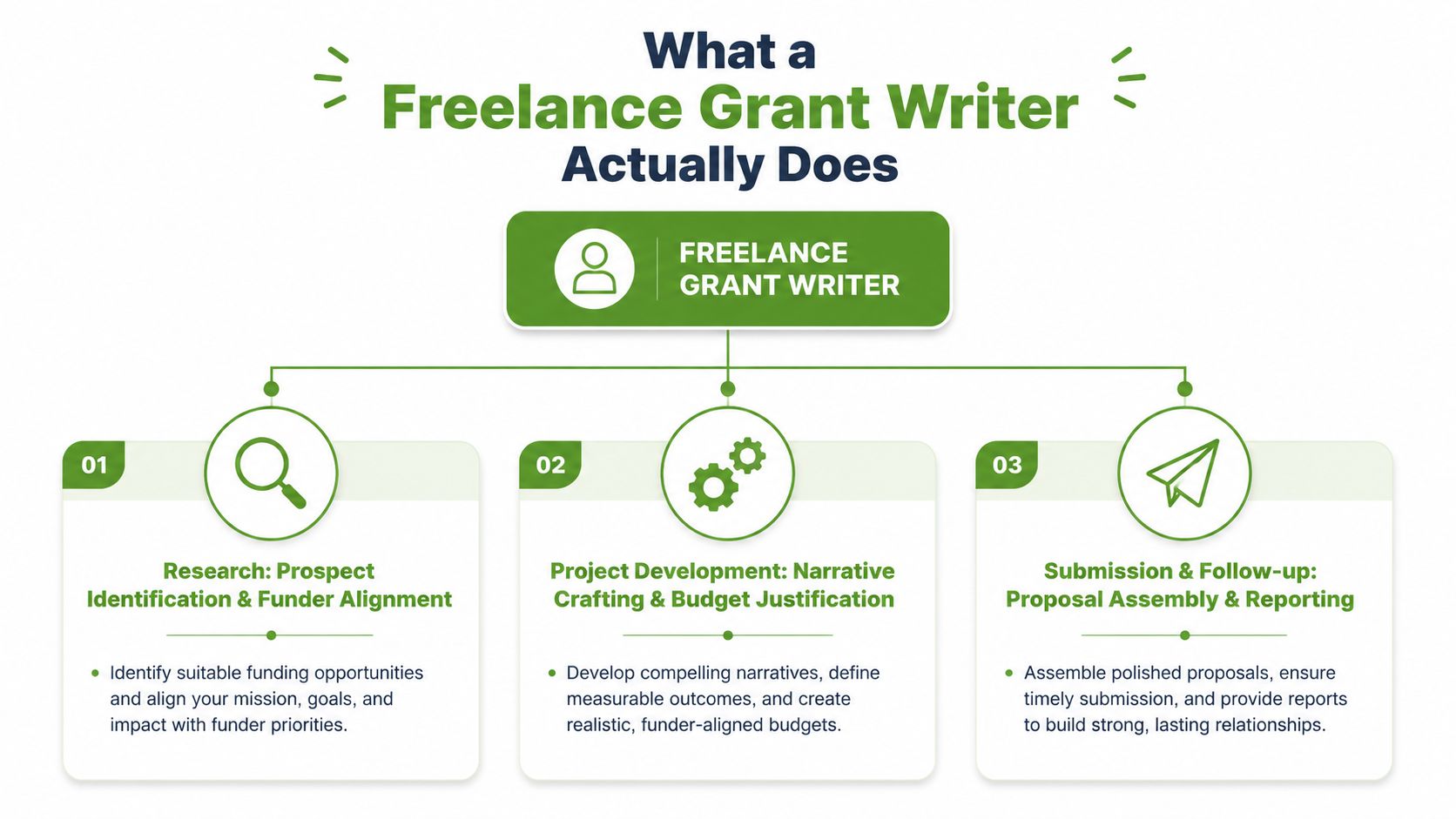
What a Freelance Grant Writer Actually Does
A freelance grant writer is not just a person who fills out applications. The good ones operate as a strategic funding partner.
They translate your organization to funders. That means they need to understand your mission, your programs, your numbers, and your capacity, then package all of that in a way that matches what a foundation or agency is looking to fund. That translation job is why the role extends far beyond writing.
According to Learn Grant Writing's breakdown of the freelance role, a freelance grant writer needs technical, managerial, and entrepreneurial skills, because the work spans funding research, proposal development, and post-award reporting across the full grant cycle.
Research comes first
If a writer starts drafting before confirming fit, that's a red flag.
A serious freelancer researches prospects, eligibility, funder priorities, deadlines, and required attachments. They don't chase every open opportunity. They filter aggressively and look for alignment between your work and the funder's stated interests.
That same discipline matters outside traditional nonprofits too. If you're working with social ventures, founders, or community projects that blend business and mission, this guide for indie hackers on charity fundraising is a useful reminder that funding strategy starts with fit, not activity.
Project management is half the job
Most failed grant processes don't fail because of weak prose. They fail because nobody owned the timeline, nobody gathered the attachments, and nobody reconciled the budget with the narrative.
A capable freelancer builds structure early. They identify what they need from your executive director, finance lead, program staff, and board. They know when to press for decisions and when to draft around ambiguity.
Practical rule: If the writer can't explain their intake process, document checklist, and review schedule, they're not ready to manage your grant pipeline.
For organizations new to the work, this grant writing for beginners resource can help your internal team understand the basic moving parts before you outsource anything.
Writing is the visible output, not the whole service
Yes, the freelancer writes. But good grant writing isn't decorative language. It's structured argument.
The writer needs to present a clear need statement, define the program, show how the work will be carried out, and align the budget to the actual activities. They also need to edit ruthlessly so every section answers the funder's question directly.
Here's what good looks like in practice:
- They clarify your case for support: They ask hard questions until the problem, population, and intervention are specific.
- They align narrative and budget: If your staffing, supplies, and timeline don't match the proposed work, they catch it.
- They protect your credibility: They follow directions exactly, keep language consistent, and remove unsupported claims.
If you hire a freelance grant writer expecting a wordsmith, you'll probably be disappointed. Hire one as a translator, project manager, and strategist, and you'll make a much better decision.
Budgeting for a Freelance Grant Writer in 2026
It's Monday morning. Your program director wants to chase a six-figure grant. Your finance lead is already stretched. Then the proposals from freelance grant writers land in your inbox, and the range is wide enough to make the decision feel arbitrary.
It isn't arbitrary. It's a scope problem.
Budgeting well starts with one question: what are you buying?
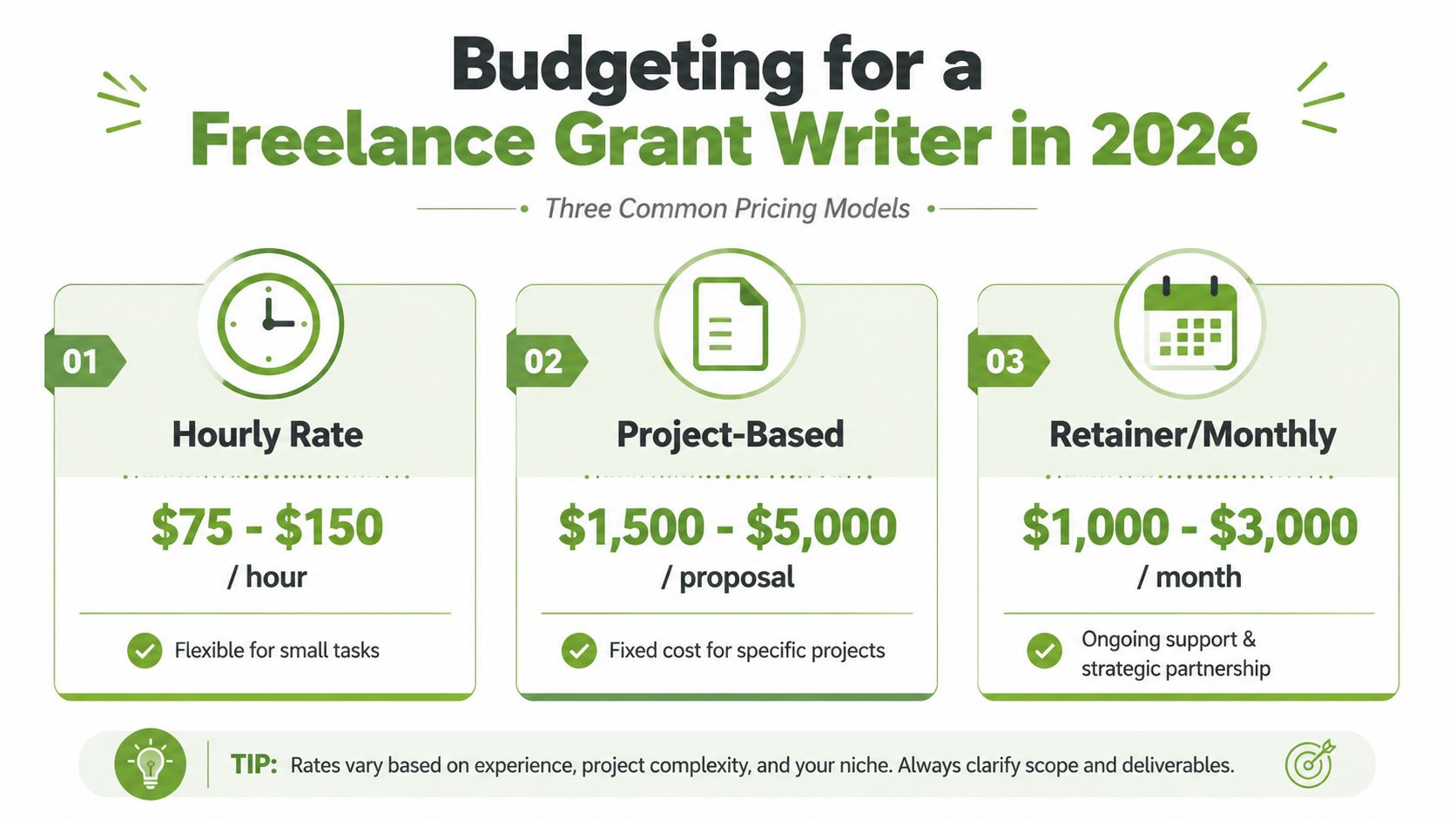
Instrumentl's analysis of grant writer pay and market demand shows a broad pricing range in the U.S. market, with newer writers charging less, experienced specialists charging more, and federal work sitting at the top end. That should not surprise you. A writer handling a short foundation proposal is selling a different service than a consultant managing a complex public funding application with multiple attachments, approvals, and budget revisions.
The pricing models that matter
Freelancers usually price work in three ways.
| Pricing model | How it works | Best use |
|---|---|---|
| Hourly | You pay for time spent on research, writing, revisions, and coordination | Good for grant edits, application reviews, prospect research, or unclear scope |
| Project fee | You agree on one fee for one defined deliverable | Best for a specific proposal with a clear deadline and clear boundaries |
| Retainer | You pay monthly for ongoing grant support | Best when you need pipeline management, recurring submissions, and regular strategic input |
Choose the pricing model that matches your internal capacity, not your wishful thinking.
Hourly work is useful when the assignment is still fuzzy or your team needs targeted help. Project fees work well if the deliverables are tightly defined. Retainers make sense when grants are not a one-off task but an ongoing revenue function.
Cheap proposals create expensive problems. If a low fee buys weak discovery, vague scope, or endless revision cycles, you will pay for it in staff time and missed deadlines.
Be especially careful with project pricing. A flat fee only protects your budget if the contract spells out what is included. Prospect research, planning calls, stakeholder interviews, logic model revisions, attachment review, budget alignment, portal entry, and post-submission follow-up all take time. If those items are missing from the scope, assume they are not included.
Before you request quotes, get your numbers straight with a grant budget template for organizing program and proposal costs. That one step will shorten revisions, improve pricing accuracy, and make you easier to work with.
Complexity drives cost
Word count is not the main driver. Coordination, strategy, and compliance are.
A small family foundation proposal may require modest research and a clean narrative. A government application may require multiple reviewers, formal attachments, precise budget categories, documented outcomes, and strict submission rules. The writing is only one piece of that workload.
Your price should rise when any of these conditions are true:
- The grant has complex guidelines: Government and technical applications require more coordination and more precision.
- Your internal materials are weak or incomplete: If the writer has to chase program details, clean up budgets, or translate a vague concept into a fundable plan, the fee should be higher.
- Multiple stakeholders need to approve drafts: More reviewers means more rounds of edits, slower turnaround, and more project management.
- You need strategic support, not just drafting: Senior consultants charge more because they shape the funding approach, pressure-test the case for support, and prevent bad-fit submissions.
This is also where the market is changing. You are no longer choosing only between a solo freelancer, an agency, or an in-house hire. AI-assisted platforms such as Fundsprout are changing the economics of grant work by reducing time spent on repetitive drafting, research support, and early-stage preparation. That does not eliminate the need for judgment. It does change what you should pay a human to do. Pay people for strategy, interpretation, review, and decision-making. Do not pay premium rates for tasks software can speed up.
This short video is worth reviewing before you approve a proposal from any consultant.
Set the budget based on complexity, internal readiness, and the level of judgment you need. That's the standard. Not the lowest quote, and not a promise about “win rate.”
Finding and Vetting Your Ideal Grant Writing Partner
Most nonprofits hire badly because they ask the wrong questions.
They ask, “What's your win rate?” They ask, “Can you help us get more grants fast?” They ask for confidence, not evidence. Then they end up with a smooth talker who knows how to sell but not how to manage a real proposal process.
The first thing to cut is the win rate question. A video discussion on evaluating grant writers points out that win rates are a flawed metric because they're often manipulated, context-dependent, and not standardized across the field. That's exactly right. A writer handling small local foundations is operating in a different world than one handling federal opportunities, startup nonprofits, or high-risk new programs.
Stop hiring on win rate. Start hiring on process, writing quality, judgment, and professionalism.
What to review instead
Ask for materials that show how the person thinks and works.
A credible candidate should be willing to discuss past work in a way that protects client confidentiality while still demonstrating skill. They should also be able to describe how they assess fit, what they need from staff, and how they handle conflicting input from leadership and programs.
Use this checklist:
- Writing samples: Look for clarity, structure, and persuasive logic. Don't obsess over jargon or polish alone.
- Process explanation: Ask how they move from prospect research to submission.
- Budget fluency: Have them explain how they reconcile numbers with the narrative.
- Communication style: Notice whether they answer directly, follow up on time, and ask smart questions.
- Mission alignment: You don't need someone from your exact subsector, but they should show genuine understanding of your work.
Interview questions worth asking
Weak interviews produce weak hires. Ask questions that reveal real operating habits.
Tell me how you decide whether a grant is worth pursuing.
You want selectivity, not indiscriminate enthusiasm.Walk me through your intake process for a new client.
A good answer includes documents, meetings, timeline, and decision points.How do you handle missing program data or late staff responses?
This tells you whether they can manage friction without becoming passive.What does a draft review process look like with leadership and program staff?
You need someone who can handle multiple voices.What makes a budget credible to a funder?
If they can't talk about budget alignment, move on.
Where to find serious candidates
Referrals still work best. Ask peer executive directors, development consultants, accountants who serve nonprofits, and regional nonprofit associations.
You can also use grant-specific communities and freelance platforms, but don't confuse availability with quality. A polished profile is not a vetting process.
The right freelancer won't just promise results. They'll show you how they reduce risk, improve fit, and keep your team organized.
If you only remember one thing from this section, remember this. Hire for disciplined thinking. Writing talent matters, but process is what keeps a grant from falling apart.
The Essential Onboarding and Contract Checklist
A strong hire can still fail if your onboarding is sloppy.
Freelance grant work depends on access, clarity, and speed. If the contract is vague and your internal files are scattered across inboxes, shared drives, and someone's desktop, you're setting the writer up to underperform.
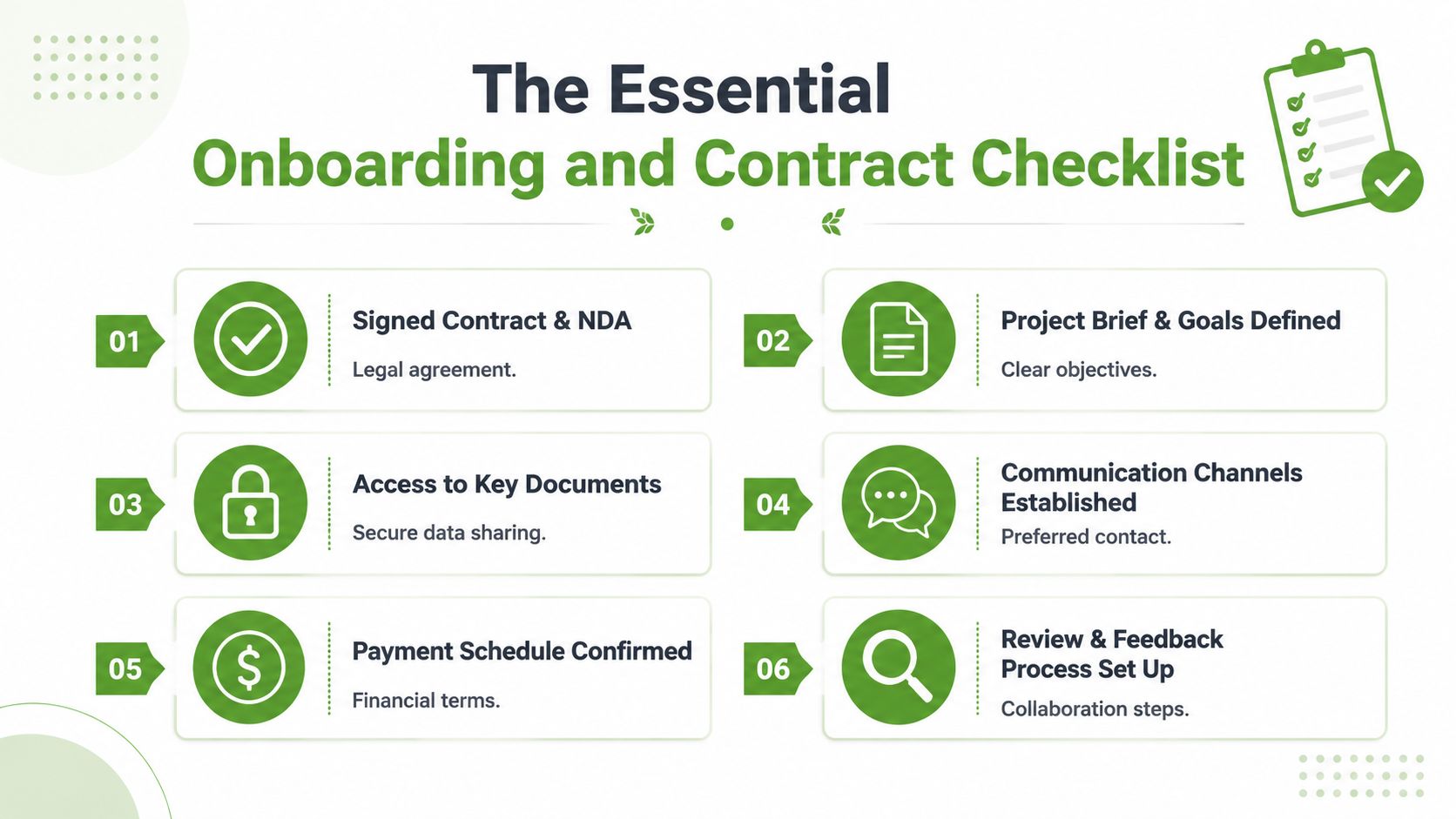
Put these terms in the contract
Don't rely on a friendly email agreement. Use a contract that spells out exactly how the relationship works.
- Scope of work: Define whether the freelancer is handling research, writing, editing, submission support, reporting, or all of the above.
- Payment terms: State deposit requirements, invoicing schedule, and what triggers additional fees.
- Ownership and confidentiality: Clarify who owns drafts, final proposals, supporting materials, and organizational data.
- Deadlines and responsibilities: Name who provides budgets, attachments, board lists, audits, and approvals.
- Termination terms: Decide what happens if either side ends the relationship mid-project.
Get the internal file set ready
Before kickoff, gather the documents the writer will need. Don't make them beg for basics.
Create one folder with the following:
- Core organizational documents: IRS letter, mission statement, strategic plan, board list, and recent financials
- Program materials: Logic models, outcomes data, evaluation summaries, client stories, and service descriptions
- Past grant materials: Prior proposals, reports, attachments, and reviewer feedback if available
- Brand and voice guidance: Boilerplate language, key messages, approved descriptions, and naming conventions
Assign one decision-maker
Too many nonprofits create a review committee with no real authority. That slows everything down.
Pick one internal lead who can gather feedback, resolve contradictions, and approve near-final drafts. Your freelancer needs access to multiple staff members, but they should not have to negotiate internal politics on their own.
A clean onboarding process does three things. It protects your budget, shortens turnaround time, and improves the quality of what gets submitted. That's worth the effort.
Choosing Your Grant Writing Model Freelancer, Agency, In-House, or AI
A freelancer is one option. It isn't always the best one.
Your real job is to choose the model that fits your funding volume, internal capacity, and tolerance for operational complexity. Sometimes that's a solo consultant. Sometimes it's an agency. Sometimes you need staff ownership. And sometimes an AI-assisted workflow is the fastest way to build capacity without adding headcount.

One reason this choice matters is that grant work involves a lot of labor that isn't visible in the final narrative. Human Services Edu's overview of grant writer responsibilities notes that freelance grant writers typically spend 60% to 70% of their time on non-writing work, including 30% on research, 25% on proposal development, and 15% on reporting and outcomes tracking. That means your model should support more than drafting. It should support the operational work around drafting.
Grant writing models compared
| Model | Cost Structure | Scalability | Best For |
|---|---|---|---|
| Freelancer | Hourly, project fee, or retainer | Moderate | Small to midsize nonprofits needing flexible expert support |
| Agency | Higher-fee contract or retainer | High | Organizations with multiple deadlines, complex deliverables, or need for bench strength |
| In-house | Salary plus employment overhead | Moderate to high, if volume justifies it | Nonprofits with consistent year-round grant activity and internal management capacity |
| AI-assisted platform | Subscription or platform-based support | High | Teams that want to strengthen internal capacity, organize inputs, and move faster |
When a freelancer is the right call
A freelancer makes sense when you need judgment without building a full department.
This is often the best fit for organizations with a real grant calendar but not enough volume to justify a staff role. It also works well when your programs are stable, your leadership is responsive, and you need a partner who can plug into your team quickly.
The downside is concentration risk. If the freelancer gets overloaded, disappears, or isn't as strong as they sounded in the interview, your pipeline suffers immediately.
When an agency or in-house team makes more sense
Agencies are useful when you need redundancy, more than one area of expertise, or support across many concurrent deadlines. You'll usually pay more, but you're buying process and capacity, not just one person's time.
An in-house grant writer is the better move when grants are central to your revenue plan and you can keep that person fully utilized. If the workload is inconsistent, though, you'll feel the cost quickly.
This is similar to the decision many professionals face when choosing a service model. This StoryCV resume comparison is about resumes, not grants, but it's a helpful example of the same core question: do you need bespoke expert service, internal ownership, or a smarter tool-assisted process?
Where AI fits now
AI is not a substitute for strategy, ethics, or program knowledge. It is useful for speed, organization, drafting support, requirement analysis, and reducing administrative drag.
If your team already knows the programs well but struggles to keep up with prospect research, document assembly, and first-draft production, AI-assisted systems can be a practical option. They can also help a staff member or consultant work faster and more consistently.
If you're evaluating this route, review what modern workflows look like in this AI for grant writing resource.
My opinion is simple. If you need external judgment and relationship management, hire a person. If you need repeatable internal capacity and faster execution, add technology. Many nonprofits will end up using both.
Common Questions About Working with Grant Writers
You finally find a grant opportunity that fits your mission. The deadline is close, your program lead is busy, your budget is still rough, and someone on the board asks, “Can't we just hire a grant writer to knock this out?” That question sounds simple. It usually isn't.
Here are the answers Executive Directors need.
Should we pay a grant writer on commission
No. Pay for the work.
Commission-based grant writing creates bad incentives and puts your organization on weak ethical ground. A grant writer should help you assess fit, tell you when an opportunity is a poor match, and write accurately about your capacity. Percentage-based compensation pushes in the opposite direction. It rewards submission volume and optimism, not judgment.
Use hourly, project, or retainer pricing. If a writer insists on contingency pay, move on.
How much lead time does a freelance grant writer need
Enough time to do the work well.
For a standard foundation proposal, give a freelancer at least several weeks if you want strong positioning, a clean budget narrative, internal review, and time to gather attachments without chaos. For government grants, complex collaborations, or new program requests, expect a longer runway. If you bring someone in a few days before deadline, you are paying for emergency drafting, not thoughtful grant development.
That distinction matters. Good grant work includes go or no-go judgment, question shaping, budget alignment, document collection, revision control, and final packaging. The writing is only part of it.
Who owns the proposal after the contract ends
Decide this before the first draft starts.
Your nonprofit should usually own the final submitted proposal, customized narrative language, attachments created for the project, and the institutional knowledge gathered during the engagement. The freelancer may keep their own templates, checklists, and internal process documents. That is standard.
Put the ownership terms in writing. If the contract is vague, fix it before you sign.
Can a freelancer fix weak program design
No.
A strong freelancer can spot problems fast. They can tell you your outcomes are fuzzy, your activities do not support the stated goals, or your budget does not match the plan. They can suggest better framing. They cannot supply leadership decisions your team has avoided making.
If your program model is weak, fix that first. A better writer will not rescue a confused project.
Is it okay to hire a newer freelance grant writer
Yes, in the right situation.
A newer freelancer can be a sensible choice for a smaller private foundation proposal with a clear scope, stable program, and responsive internal team. Do not make that same bet on a federal application, a major renewal, or a grant that covers core operating costs. In those cases, buy experience.
This is also where your hiring model matters. A newer freelancer with strong supervision and AI-assisted systems may outperform a more expensive solo writer who works inconsistently. An agency may give you more review capacity. An in-house writer may be better if grants are constant and central to revenue. Fundsprout-style AI support can help a solid internal team move faster, but it will not replace judgment about funder fit, program quality, or institutional readiness.
Should we judge a grant writer by win rate
No. This is one of the worst shortcuts in grant hiring.
Win rate sounds useful, but the number is usually meaningless without context. What types of grants were included? How selective were the funders? Did the writer choose the opportunities, or were they handed weak prospects? Were they writing renewals for an established organization or cold applications for a new program? Did they handle strategy and packaging, or only draft the narrative?
Ask better questions. Request writing samples. Review how the candidate assesses grant fit. Ask how they handle missing information, weak budgets, and unrealistic timelines. Ask what they do when the opportunity is wrong for the organization. That will tell you far more than a claimed success percentage.
What should our team have ready before hiring a grant writer
Come prepared, or expect delays and rewrites.
At minimum, have your program summary, current budget, leadership contacts, organizational boilerplate, recent financials, and a clear internal decision-maker ready. If those basics are scattered across inboxes and old folders, the freelancer will spend time chasing documents instead of improving the application.
A grant writer can add discipline to the process. They cannot substitute for it.
Conclusion Making Your Next Funding Move
A freelance grant writer can be a smart investment. They can also be the wrong answer if what you really need is internal discipline, more capacity, or a better system for managing grant work.
Choose based on reality, not wishful thinking. If you need flexible expertise for a defined set of opportunities, a freelancer may be the best fit. If you need redundancy and volume, look at an agency. If grants are central to your annual revenue strategy, build in-house capacity. If your team is capable but buried in research, drafting, and compliance work, an AI-assisted approach deserves a serious look.
Don't hire based on charisma. Don't hire based on win rate. Don't hire before your internal documents, budget logic, and decision-making process are in order.
Your next funding move should strengthen the organization, not just produce another proposal. Make the choice that gives your team a repeatable way to pursue the right grants well.
If your team needs a faster, more organized way to find relevant grants, break down requirements, draft stronger proposals, and stay on top of deadlines, take a look at Fundsprout. It's built for mission-driven nonprofits that want more than a writing tool. It helps you manage the full grant workflow with less chaos and better visibility.
Try 14 days free
Get started with Fundsprout so you can focus on what really matters.