Effective Communication Strategies for Nonprofits: Master Grant Success
Discover effective communication strategies to boost nonprofit funding and engagement, with practical steps to win grants and engage supporters.


Abdifatah Ali
Co-Founder
Effective communication is the lifeblood of any successful nonprofit. It's how you connect with funders, rally your board, inspire volunteers, and show the community you’re making a real difference. This isn’t about just blasting out emails; it’s about thoughtfully crafting messages that inspire action, demonstrate impact, and build the lasting relationships that fuel your mission.
The Blueprint for Winning Nonprofit Communication
For so many of us in the nonprofit world, communication can feel like a constant battle. We're fighting for attention against a tidal wave of noise, all while wrestling with tight budgets and even tighter deadlines. You’re not just competing with other great causes, but with everything else flooding your audience’s inbox and social media feeds.
This is exactly why a communication strategy isn't a "nice-to-have"—it's the core engine of your organization. Think of it as the invisible thread that ties your good intentions to tangible results, turning passion into secured grants, an engaged board, and a mobilized community.
This guide is designed to be your practical blueprint. We're skipping the high-level theory to get right into the real-world tactics that separate the nonprofits that struggle from the ones that thrive.
Why a Strategic Approach Matters
Without a plan, our communication efforts often become reactive and chaotic. One week, it’s a frantic push for a grant deadline. The next, it’s a quick volunteer appreciation post on Facebook. There’s no connecting thread, which leaves your audience confused and dilutes your message.
A strategic plan changes everything. It ensures that every single message—whether it’s tucked inside a formal grant proposal or shared in a quick social media update—reinforces your core mission and speaks directly to the person on the other end.
When you make this shift, communication stops being just another task on your to-do list and becomes your most powerful asset. It allows you to:
- Build Trust and Credibility: Consistent, clear communication signals to funders and supporters that you’re organized, reliable, and a responsible steward of their investment.
- Inspire Deeper Engagement: When people truly understand why you do what you do and see the results, they transform from passive followers into passionate advocates for your cause.
- Streamline Your Operations: A clear plan is a massive time-saver. It frees your team from constantly reinventing the wheel, allowing them to focus their energy on work that truly moves the needle.
A well-designed communication plan acts as a filter. It helps you decide what to say, who to say it to, and when to say it, making sure every ounce of effort is purposeful and drives your goals forward.
Ultimately, mastering these strategies is about earning the support your mission deserves. Let's walk through this together, moving from foundational principles to concrete tactics that will give you the confidence to communicate with clarity, purpose, and real impact.
Tailoring Your Message to Key Stakeholders
Great communication isn't about having one perfect message. It's about having the right message for the right person. If you send the exact same email to a major grant funder and a first-time volunteer, you're missing a huge opportunity to connect. It’s like trying to unlock different doors with the same key—it just won’t work.
To really get your message across and inspire people to act, you need to speak their language. Think about it: what gets a data-driven program officer excited is completely different from what inspires a community member to share your story on social media. Understanding these differences is the first step. Before you can tailor anything, you have to know how to identify your target audience and what makes them tick.
This is all about shifting your focus while keeping your core mission at the center of everything.
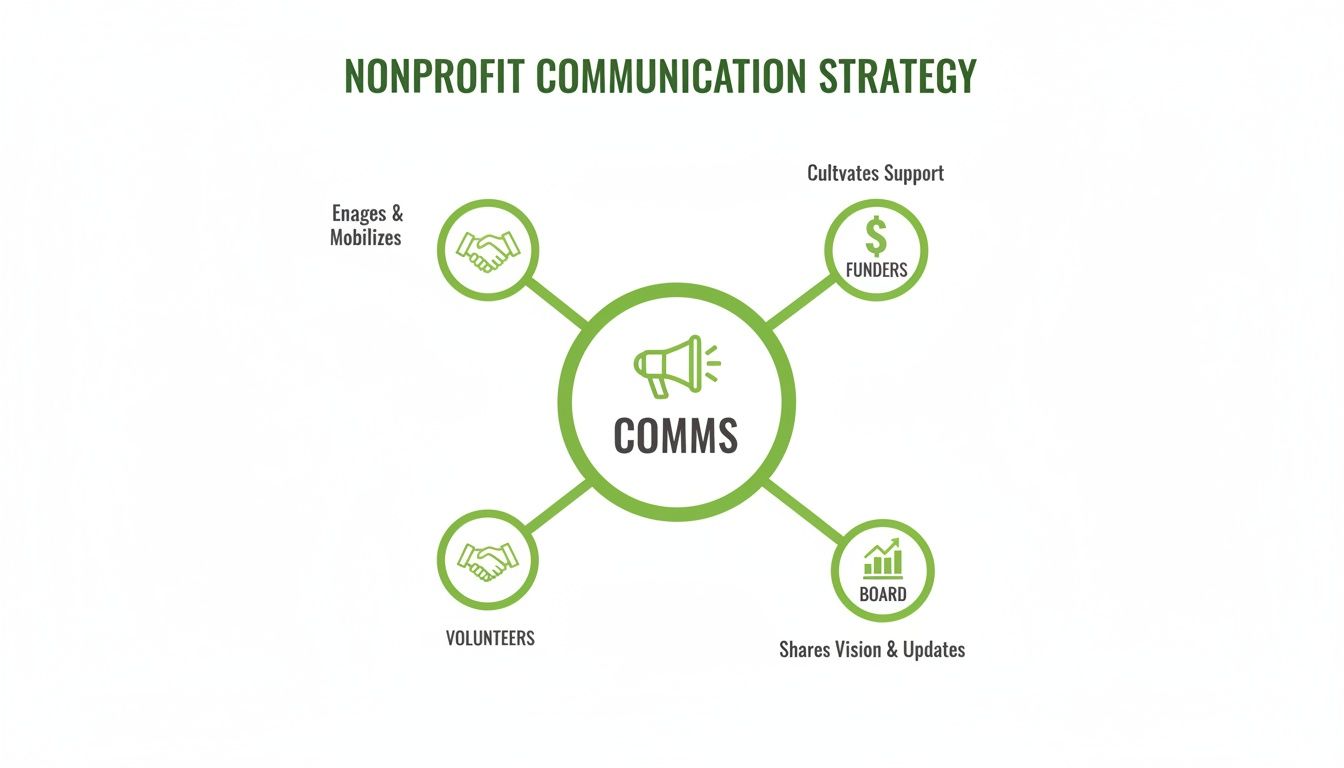
As you can see, the central message adapts. For funders, it’s about the financial investment and data. For your board, it's about strategy and governance. For your community, it’s about human connection.
To make this easier, here's a quick-reference guide for adapting your communication to different groups.
Audience Communication Matrix
This table breaks down how your goals, messages, and channels should change depending on who you're talking to.
Think of this matrix as your cheat sheet for making sure every message lands exactly as it should, with the people who need to hear it most.
Communicating With Grant Funders
Funders aren't just giving you money; they are investing in your mission. They expect to see a clear "social return" on that investment. Your communication needs to show them you’re a safe and effective bet.
This means leading with hard numbers and proven results. A touching story is great, but it has to be backed up by cold, hard facts.
- What they need: Concrete data, clear metrics, and logical, well-structured plans.
- What motivates them: Seeing their investment create measurable, lasting change that aligns with their foundation's goals.
- Tone to use: Professional, confident, and always data-informed.
For example, instead of saying, "Our program was a huge help to local kids," you need to be specific. "Our after-school tutoring program saw 87% of students improve their reading scores by at least one full grade level." That one sentence builds instant credibility.
Engaging Your Board of Directors
Your board is focused on the big picture: the health, sustainability, and future of the organization. They are the guardians of your mission, providing high-level governance and strategic direction.
They don't need to get lost in the day-to-day weeds. What they need is clear, concise information that helps them make smart decisions and represent the organization effectively.
Board members are steering the ship, not rowing the oars. Your job is to give them the map and the weather forecast—the key insights they need to navigate—not a detailed report on how the engine works.
Dashboards, executive summaries, and key performance indicators are your best friends here. Give them the highlights, frame the challenges, and propose solutions.
Connecting With Your Community
This is where the heart of your nonprofit lives. Your community—both the people you serve and those who support you—connects with your work on an emotional level. They are moved by powerful stories of change and the real-world impact you make.
Authentic storytelling is your superpower with this audience. While a funder wants a spreadsheet, your community wants to see the faces and hear the voices of the people you've helped. They want to feel like they are part of something bigger than themselves.
- What they need: Relatable stories, simple calls to action, and a sense of shared purpose.
- What motivates them: Feeling a personal connection to the cause and seeing proof that their support makes a real difference in someone's life.
- Tone to use: Passionate, empathetic, and inspiring.
Take a statistic from a grant report, like "provided 300 nights of shelter," and transform it. Tell the story of a single family who found safety and hope because of that shelter. That's how you build a loyal community that sticks with you.
Inspiring Your Internal Team
Never forget the audience closest to home: your staff and volunteers. These are the people on the front lines every single day. Good internal communication is the glue that keeps your organization strong.
Your team needs to feel seen, valued, and connected to the mission. They crave clarity on goals, recognition for their efforts, and frequent reminders of why their work is so important. When you communicate well internally, you boost morale, prevent burnout, and empower your team to become your best ambassadors.
Celebrate the wins—big and small. Be transparent about challenges. And most importantly, create real channels for feedback. A motivated, informed team is your most valuable asset.
Using Email to Build Funder Relationships
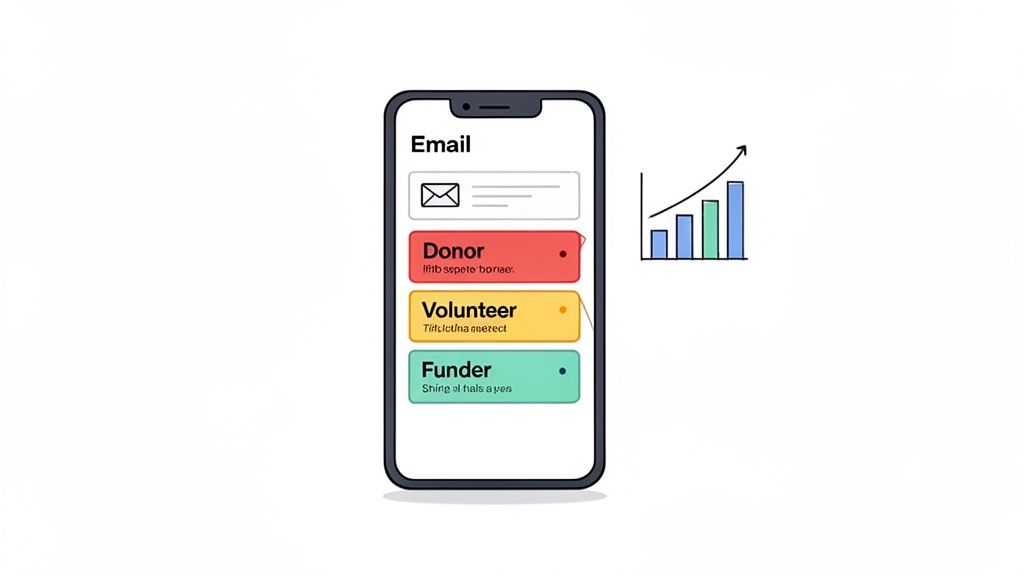
While flashy social media campaigns often get the spotlight, email is still one of the most powerful and reliable tools a nonprofit has. It’s a direct line to your supporters, giving you a unique chance to build genuine, lasting relationships with the people who make your work possible.
Think of your email list not as a megaphone for announcements, but as a room full of your most dedicated partners. Each person in that room deserves a conversation that feels personal and relevant.
The real magic of email happens when you deliver tailored, meaningful content at scale. Generic, one-size-fits-all email blasts just don't cut it anymore. Today's most successful strategies rely on segmentation—dividing your audience into smaller groups based on their interests, donation history, or how they engage with you. This is how you can talk to a major donor about a new capital campaign while, in the very same hour, send a heartfelt welcome to a first-time volunteer.
The data tells a clear story. A huge 48% of donors say email is their favorite way to receive updates and appeals. Personalizing your approach pays off, too; tailored subject lines are 26% more likely to be opened. Even better, simply having a donor's email address can boost their retention by 29%. That's a massive lift for your long-term stability.
Crafting Emails That Actually Get Opened
Let's face it: your supporters' inboxes are crowded. To stand out, every single part of your email needs a purpose, starting with the subject line. This is your first—and sometimes only—chance to make an impression. A good one is clear, sparks a little curiosity, and hints at the value inside without giving away the whole story.
Once they click open, the content has to deliver. Keep your message focused and your paragraphs short and scannable. Use compelling images and clear calls-to-action that tell the reader exactly what to do next. Whether you're sharing an impact story or asking for a donation, always lead with the "why"—the emotional heart of your mission—before you get to the "what."
To do this well, you need an organized database. If you're looking to get your contacts in order, our guide on the https://www.fundsprout.ai/resources/best-crm-software-for-nonprofits can help you find the right tool for the job.
More Than Just a Newsletter
A smart email strategy uses different kinds of messages for different moments in a supporter's journey. Each one plays a unique role.
- Impact Newsletters: These are your regular check-ins, designed to keep supporters in the loop and feeling engaged. Focus on great storytelling, share recent wins, and show the tangible results of their support.
- Fundraising Appeals: These are your direct asks for donations. They need to be clear, emotionally compelling, and create a sense of urgency without feeling pushy.
- Welcome Series: When someone new joins your list, don't just leave them hanging. Send a series of automated emails to welcome them, introduce your mission, and make them feel like a part of the community right away.
- Thank-You Notes: This is non-negotiable. A prompt, personal thank-you email after a donation reinforces their decision to give and is the first step in building a long-term relationship.
Your email strategy should feel like a thoughtful conversation that unfolds over time. Each message builds on the last, strengthening the funder's connection to your cause and making them feel like a valued partner, not just a transaction.
Avoiding the Spam Folder
Even the world's best email is useless if it never gets delivered. Two of the biggest threats to your success are low deliverability and subscriber burnout. To make sure your emails actually land in front of funders, it's crucial to implement strategies to boost inbox deliverability.
Simple habits, like cleaning your list regularly to remove inactive subscribers and making your unsubscribe link easy to find, can make a huge difference. By respecting your audience's inbox, you build the trust needed to turn your email list into a powerful engine for your mission.
Building Community and Impact on Social Media
For a lot of nonprofits, social media can feel like just one more thing on an endless to-do list. But if you see it as just another box to check, you’re missing the point. Social media isn’t just a marketing channel; it’s a digital campfire. It's where you can gather your supporters, share stories that matter, and build a real, shared sense of purpose. It’s one of the best ways to turn passive followers into a passionate, engaged community.
This means you have to go beyond just posting updates. The smart approach is to play to each platform's strengths. Think of LinkedIn as your digital boardroom—it’s the place for professional networking, sharing deep insights about your field, and finding corporate partners. On the other hand, Facebook and Instagram are your community hubs, perfect for the kind of rich, emotional storytelling that shows the human impact of your work.
Knowing this difference is everything. It lets you focus your energy where it will make the biggest impact.
From Vanity Metrics to Mission Impact
It's so easy to get caught up in the chase for "vanity metrics" like follower counts and likes. Those numbers can feel good, but they don't always add up to meaningful support for your mission. The real goal is to build genuine engagement—the comments, shares, and conversations that prove your message is actually connecting with people.
A great social media strategy is all about quality over quantity. It’s about creating content that sparks a real dialogue and builds relationships. This doesn't just make your community stronger; it gives you tangible proof to show funders that you have an active, dedicated base of support. The key is to shift your focus from broad reach to deep connection.
Your social media channels should be a two-way street. Instead of just broadcasting your message, ask questions, run polls, and actively respond to comments. This transforms your feed from a monologue into a vibrant community conversation.
The data shows this work pays off. While it takes time, social media is a vital communication strategy for nonprofits. Consider this: 25% of donations are inspired by social media, putting it nearly neck-and-neck with email, which drives 26%. Different platforms also have unique strengths; 48% of social donors give through Facebook, and LinkedIn has a solid 1.91% engagement rate for nonprofits. You can dig into more of these nonprofit marketing statistics to get the full picture.
Creating a Purposeful Content Calendar
A content calendar is your roadmap. It’s what keeps your communication consistent and strategic, making sure you’re not just hitting people with fundraising asks all the time. A balanced calendar keeps your feed interesting and genuinely valuable to your followers.
Here’s a simple framework to help you balance what you post:
- Impact Stories (40%): This is the heart and soul of your communication. Share personal testimonials, success stories, and behind-the-scenes looks at your work in action. Use powerful quotes and great photos or videos to make these stories come alive.
- Program Updates & Education (30%): Keep your community in the loop. Announce new initiatives, share helpful content related to your cause, and give updates on your projects. This builds trust and shows you’re getting things done.
- Community Engagement (20%): This is all about interaction. Shine a spotlight on your volunteers, thank donors by name (with their permission, of course), ask interesting questions, and share content from partners or supporters. This really cements that feeling of a shared community.
- Fundraising Appeals (10%): When you do ask for money, make it count. Your appeals will land so much better when they’re surrounded by consistent storytelling and engagement. Always tie your "ask" directly to a specific, tangible outcome they can help you achieve.
This balanced approach makes sure your social media presence serves your entire mission—building community, showing your impact, and, when the time is right, driving the financial support you need. When you start treating social media as a strategic tool for telling your story and building your community, the time you invest will turn your platforms into powerful engines for change.
Weaving Technology Into Your Outreach
For a lot of nonprofits running on a tight budget, new technology can feel more like a burden than a blessing. But the right tools aren’t just another line item on your expense sheet—they're a force multiplier, making every single communication effort more powerful and efficient. Technology is what lets you move past manual, time-sucking tasks and into smarter, automated outreach that builds real relationships at scale.
Think of your communication tools as a new team member who never sleeps. A good Customer Relationship Management (CRM) system, for instance, becomes your organization’s memory bank. It keeps a running log of every conversation and interaction with donors, board members, and volunteers. This gives you the full story of each relationship, so your outreach always feels personal and well-informed.
This kind of data-driven approach is the bedrock of any modern, effective communication strategy. It takes the guesswork out of your work and replaces it with real insight, letting you tailor every message with confidence.
Choosing the Right Tools for Your Mission
The trick is to find technology that solves a real problem you have, not something that just adds another layer of complexity for your team. Don't chase every shiny new app. Instead, focus on a few core tools that play well together and genuinely make your work easier.
Here are a few types of tech that tend to offer the biggest bang for your buck in the nonprofit world:
- Email Automation Platforms: These tools let you create communication sequences you can set and forget. Imagine a welcome series for new donors that goes out automatically, or reminders for an upcoming event that send themselves. It saves you countless hours while keeping your community engaged.
- Integrated Grant Management Systems: There are platforms built specifically to handle the entire grant process, from finding new opportunities and tracking deadlines to reporting on your outcomes. It keeps all that crucial information in one place so nothing slips through the cracks. You can learn more about how AI is helping with grant writing in our detailed guide.
- Social Media Schedulers: These tools let you map out your social media posts for the week or month ahead. This lifts the daily pressure of having to post something and helps you maintain a consistent, strategic voice online.
Technology’s true power for nonprofits isn't just about doing things faster. It's about freeing up your most valuable resource—your team's time—to focus on what really matters: building relationships, telling your story, and advancing your mission.
From Data to Deeper Connections
Putting a little money into communication tech pays dividends. The data backs it up. One study found that 86% of nonprofits said that tools like email automation helped them communicate and collaborate better with their stakeholders. Another 84% saw a direct improvement in their external communications. Given how important online support has become, this makes perfect sense. You can dig into more nonprofit marketing technology benchmarks to see the broader trends.
Ultimately, these platforms give you the raw data you need to make your outreach genuinely personal. A CRM can tell you exactly which donors gave to your last capital campaign, so you can send them a targeted report on its impact. An automated system makes sure you never miss a grant deadline or a chance to thank a supporter. By bringing the right technology into your workflow, you’re not just checking off tasks—you’re building a smart, cohesive system that powers your entire mission.
Crafting Winning Grant Proposals and Reports
Nowhere do all these communication principles come together more critically than in the high-stakes world of grant seeking. A grant proposal isn't just a form to fill out; it's one of your most powerful tools for persuading a funder that your mission is a smart, strategic investment. This is where your storytelling, hard data, and audience-specific messaging all need to sing in harmony.
Think of your proposal as a story, not a checklist. It has to answer the funder's three core questions, even if they're not explicitly asked: "Why this project? Why this organization? And why now?" A truly great proposal is a masterclass in persuasive communication, drawing a direct line between what you need and what the funder wants to achieve.
Every single section, from the executive summary down to the budget notes, must reinforce the same core narrative. Your data proves the problem is real, your program design shows you have the solution, and your mission provides the "why" that makes the investment feel not just logical, but essential.
Turning Data into a Compelling Narrative
In grant writing, data and stories aren't enemies—they’re partners. Numbers give your proposal the credibility it needs to be taken seriously, while stories forge the emotional connection that makes a program officer genuinely care about your work. The magic happens when you weave them together.
Here’s a simple but powerful way to do it:
- Lead with a Person: Start with a brief, compelling anecdote about one individual your organization has served. This immediately makes an abstract problem feel real and relatable.
- Zoom Out with Data: Once you’ve established that human connection, use data to show the scale of the issue. This proves the individual's story isn't a one-off but represents a significant, pressing need.
- Present Your Solution: With the problem clearly defined in both human and statistical terms, introduce your program as the direct, effective solution.
This approach transforms a dry request for funds into a compelling invitation. You’re asking the funder to step into the story and become a hero for your cause. For a deeper dive, take a look at our complete guide to writing grant proposals for nonprofits.
Communicating Impact in Funder Reports
The conversation doesn't end when you cash the check. In fact, what comes next is just as important. Funder reports are your chance to prove their investment was a wise one and lay the groundwork for future support. So many nonprofits miss this opportunity by submitting a dry list of activities and expenses.
A great funder report moves beyond simply stating what you did. It focuses on communicating what changed as a result of their investment, reinforcing their role as a vital partner in your success.
Instead of just saying, "we served 500 meals," tell them what that actually meant. Try this: "Your support enabled us to provide a nutritious meal each week to 500 community members. As a result, 78% of participants reported less food insecurity, giving them the stability to focus on finding employment."
See the difference? You're framing the data around the human outcome, making their contribution feel tangible, meaningful, and deeply impactful.
Frequently Asked Questions
It’s one thing to read about communication theories, but putting them into practice is another challenge entirely, especially when you’re already juggling a dozen other responsibilities. Let's tackle some of the most common questions that come up when nonprofit leaders start to build a more intentional communication strategy.
How Can a Small Nonprofit with No Dedicated Comms Staff Get Started?
For a small team, the secret isn't to do more—it's to do less, but better. Trying to be everywhere at once is a surefire path to burnout. Instead, start small and build momentum through consistency.
- Focus on One High-Impact Channel: Don't feel pressured to master Facebook, LinkedIn, a blog, and a podcast all at once. Where does your most important audience—say, your donors or community members—actually spend their time? Pick that one channel and really commit to it.
- Lean on Your Supporters: You likely have skilled volunteers in your network who would love to help. Ask for specific support, like drafting a monthly newsletter, designing a social media graphic, or giving a grant proposal a final proofread. Their expertise can be a massive lift.
- Create Simple Templates: Don't reinvent the wheel every time. Build a set of reusable templates for your most common communications, like emails, social media updates, and thank-you notes. This saves precious time and keeps your voice consistent.
The goal isn't to do everything. It’s to do a few critical things exceptionally well.
What's the Best Way to Measure Communication ROI?
Measuring the Return on Investment (ROI) for your communications isn't always a straightforward dollar-for-dollar calculation. It’s really about tracking the right signals to prove your efforts are building stronger relationships and pushing your mission forward.
You need to look past the "vanity metrics" like social media likes and focus on data that ties directly back to your organization's health.
- Donor Retention Rate: Are your newsletters and updates keeping donors engaged enough to give year after year? This is a huge indicator of success.
- Cost Per Acquisition: How much time and money did it take to get that new donor or volunteer from that last fundraising campaign?
- Website Conversions: Of the people who visit your website, how many are taking the next step? Are they signing up for your newsletter, registering to volunteer, or making a donation?
How Do We Communicate Bad News or a Crisis?
Handling a crisis or delivering bad news is one of the most critical tests of your organization's integrity. The trust you've built with your community is on the line, making honest and empathetic communication completely non-negotiable.
When things go wrong, your first instinct might be to control the message. Shift your thinking. Instead, focus on controlling the response. Lead with honesty, show you have a plan, and always put the people you serve first.
A simple framework can guide you through these tough moments:
- Acknowledge Promptly: Get out in front of the situation quickly. Silence creates a vacuum, and speculation will rush in to fill it.
- State the Facts Clearly: Explain what happened without hiding behind jargon or defensive language. Be direct. Be transparent.
- Show Empathy: Acknowledge how this situation is affecting your community, staff, and supporters. Show them you understand and care.
- Outline Your Plan: Clearly explain what you're doing right now to address the problem and what steps you’ll take to prevent it from happening again.
Ready to pair smarter communication with your grant-seeking efforts? Fundsprout is an AI-powered platform designed to help nonprofits find the right funders and craft compelling proposals with less stress. Discover how Fundsprout can help your mission succeed.
Try 14 days free
Get started with Fundsprout so you can focus on what really matters.