Mastering Development in Nonprofit: 2026 Strategy Guide
Unlock effective development in nonprofit. Explore core functions, team structures, KPIs, and build a sustainable fundraising program for 2026 success.

Abdifatah Ali
Co-Founder
You might be running a strong program and still feel like the organization is one bad month away from trouble. The staff is delivering. Clients are showing up. The board cares. But payroll, contracts, donor renewals, and the next grant deadline keep pulling your attention away from the mission you started to serve.
That tension is where many executive directors live.
The fix isn't to “fundraise harder.” It's to treat development in nonprofit work as an operating system. When development is working, it connects revenue to programs, programs to outcomes, and outcomes back to the next dollar. When it's weak, the organization lurches from appeal to appeal, with no reliable way to decide what deserves scarce staff time.
Your Mission Needs a Funding Strategy
A lot of nonprofit leaders were trained to build services, not revenue systems. They know how to run programs, respond to community needs, and lead staff through hard days. Then they become executive director and realize that every strategic decision sits on top of a funding decision.
That's why development can't be treated as an add-on. It's not the activity that happens after the core work. It's the function that keeps the core work possible.
The opportunity is bigger than many leaders assume. In 2024, total U.S. charitable giving reached $592.5 billion, with corporate giving at $44.4 billion and foundation giving at $109.81 billion, according to Kindsight's roundup of fundraising statistics. The practical takeaway is simple. Money is moving through multiple channels, and nonprofits need a system that can engage more than one of them.
Development is bigger than asking
If your funding plan depends on one gala, one annual appeal, or one heroic grant writer, you don't have a development system. You have a dependency.
A healthy development function usually does three things at once:
- Builds predictable revenue: Annual giving, recurring gifts, renewals, and repeatable grant work reduce panic.
- Creates strategic options: A diversified base lets you launch new programs, hire key staff, or weather a delayed payment.
- Translates mission into funder language: Donors, foundations, and corporate partners each need a different version of the same truth.
Practical rule: If a funding activity doesn't clearly connect to mission delivery, supporter relationships, or future revenue, it's probably noise.
For leaders who need a broader look at current nonprofit fundraising tactics, PledgeBox's 2026 nonprofit guide is useful because it shows how digital campaigns, community support, and platform choices fit into a wider fundraising mix.
The next move is to put your priorities on paper. A simple planning template like this fundraising plan format helps you stop treating revenue as a set of disconnected tasks and start managing it as part of operations.
Understanding What Nonprofit Development Really Is
Fundraising is one piece of development. It isn't the whole thing.
The easiest way to explain it is with a garden. Fundraising is the harvest. Development is the full cycle: choosing what to plant, preparing the soil, watering consistently, watching what grows, and deciding what needs more attention next season. If you only show up at harvest time, you'll always feel behind.
That distinction matters more now because the sector itself has changed. The number of U.S. nonprofit organizations grew by 36% between 2000 and 2023, as noted in this overview of nonprofit sector growth. More organizations means more competition for attention, more demanding funder expectations, and less room for improvised development.
What development includes
Development in nonprofit organizations usually combines several disciplines that are often split up too neatly on org charts:
- Revenue planning: deciding how much should come from individuals, grants, events, corporations, and other channels
- Relationship management: building trust with donors, funders, board members, and community partners
- Case for support: describing why the work matters and why your organization is positioned to do it
- Stewardship: showing people what their money made possible
- Systems and reporting: tracking activity, commitments, deadlines, and outcomes so the team can act on facts
A new executive director often inherits a list of funders and a folder of old proposals. That isn't a development program. A development program has rhythm, priorities, and rules.
What development is not
It's not chasing every grant you see.
It's not sending generic donation emails to everyone in your database.
It's not asking your board to “open doors” without giving them names, timing, or a clear purpose.
Development works when the organization earns trust over time, then makes clear, timely asks inside that trust.
Strong development also changes how leaders think about time. Instead of asking, “What money can we get this month?” the better question is, “What relationships and systems are we building that make next year less fragile?”
Exploring the Core Functions of Development
Nonprofit development gets fuzzy when everything is called fundraising. It helps to separate the main functions, because each one does a different job in the revenue mix.
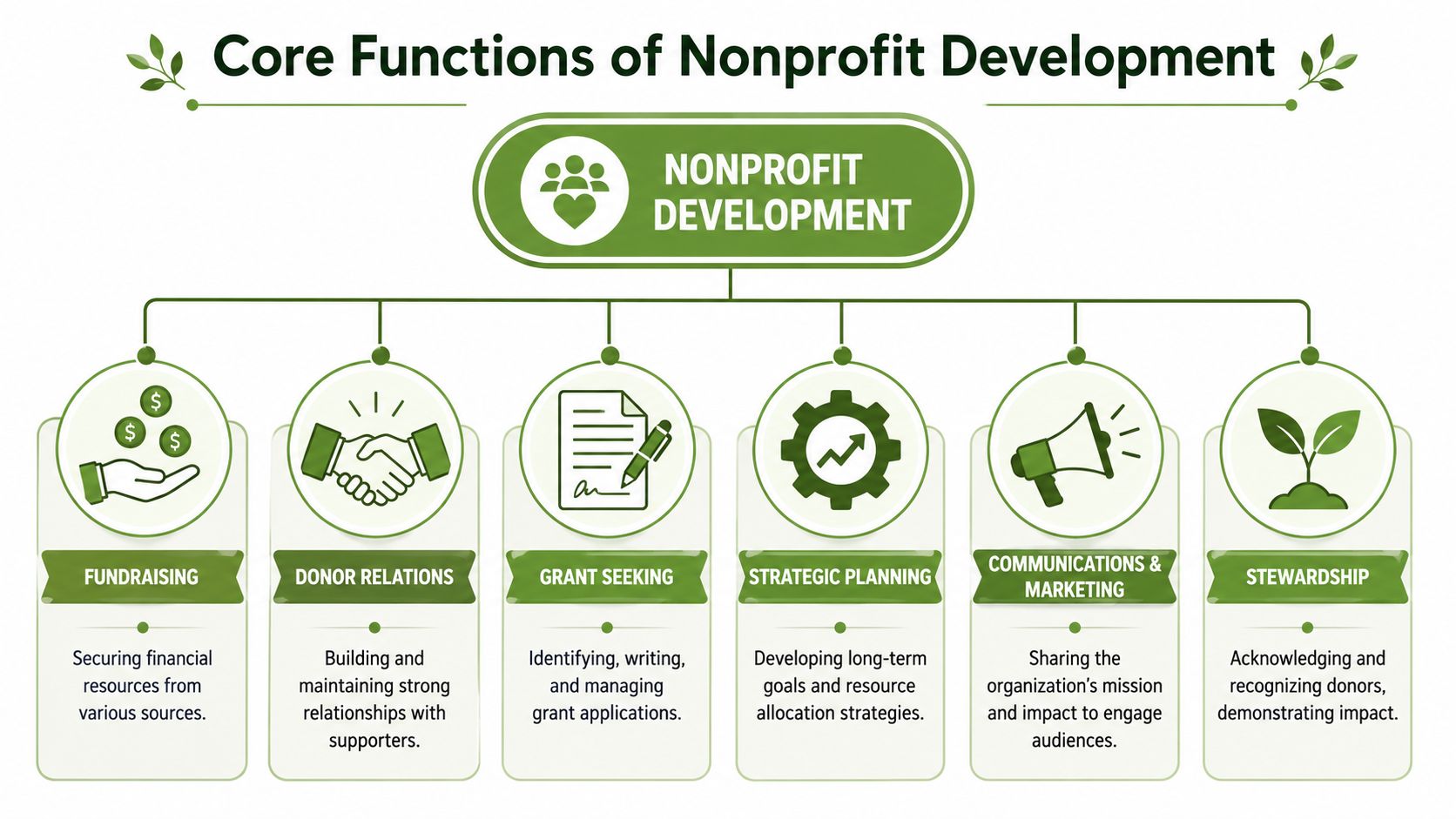
Individual giving and the annual fund
This is the broad base. It includes one-time gifts, recurring donors, direct appeals, online campaigns, year-end giving, and donor renewals. For most small nonprofits, these are the starting points for durable fundraising habits.
Individual giving does more than bring in money. It tells you whether your message resonates, whether your stewardship is working, and whether supporters believe your organization is worth backing again.
When leaders ignore this channel because major gifts or grants seem more urgent, they usually lose something important: a reliable pool of people who can be re-engaged quickly.
Major gifts and donor relations
Major gifts are less about volume and more about concentration. A smaller number of supporters can fund a program launch, capacity project, or strategic hire, but only if the organization has done the long work of relationship building.
Many teams grow impatient at this juncture. They ask too soon, or they never ask at all.
The work includes identifying people with genuine affinity for the mission, giving them direct access to leadership, sharing specific needs, and following through after the gift. A major donor doesn't want to feel like a transaction. They want confidence that the organization can use money well.
Grant seeking and institutional funding
Grant funding includes foundations, government opportunities, local public sources, and corporate philanthropy. This channel can be powerful, but it is often managed poorly because teams treat every application as a separate emergency.
A better approach is to think in portfolios:
| Function | What it's for | Common mistake |
|---|---|---|
| Foundation grants | Flexible or program support from mission-aligned funders | Applying without checking fit or reporting burden |
| Government grants | Larger, structured funding tied to strict requirements | Chasing awards without compliance capacity |
| Corporate support | Sponsorships, employee giving, or partnership-based support | Treating it like a logo request instead of a relationship |
Communications and stewardship
Development depends on communication, but not all communication is development. The newsletter that no one segments, the social posts with no call to action, and the impact report that arrives months late don't move revenue very well.
Useful communication supports three moments:
- Before the ask: It builds familiarity and trust.
- During the ask: It makes the need concrete and timely.
- After the gift: It closes the loop with results, gratitude, and the next step.
Events and partnerships
Events can help, but only when they serve a larger strategy. A breakfast, house party, site visit, or community fundraiser should deepen relationships or enable future giving. If the team spends weeks producing an event that generates little net value, the event was not development. It was labor.
The same is true of partnerships. Good ones extend reach, credibility, and funding access. Weak ones create meetings.
How to Structure Your Team and Measure Success
Most nonprofits don't start with a polished development department. They start with one person doing too much. Sometimes that person is the executive director. Sometimes it's an operations manager who inherited grants, donor thank-yous, and the gala.
That's normal. The mistake is assuming the only two options are “keep improvising” or “hire a full department.”
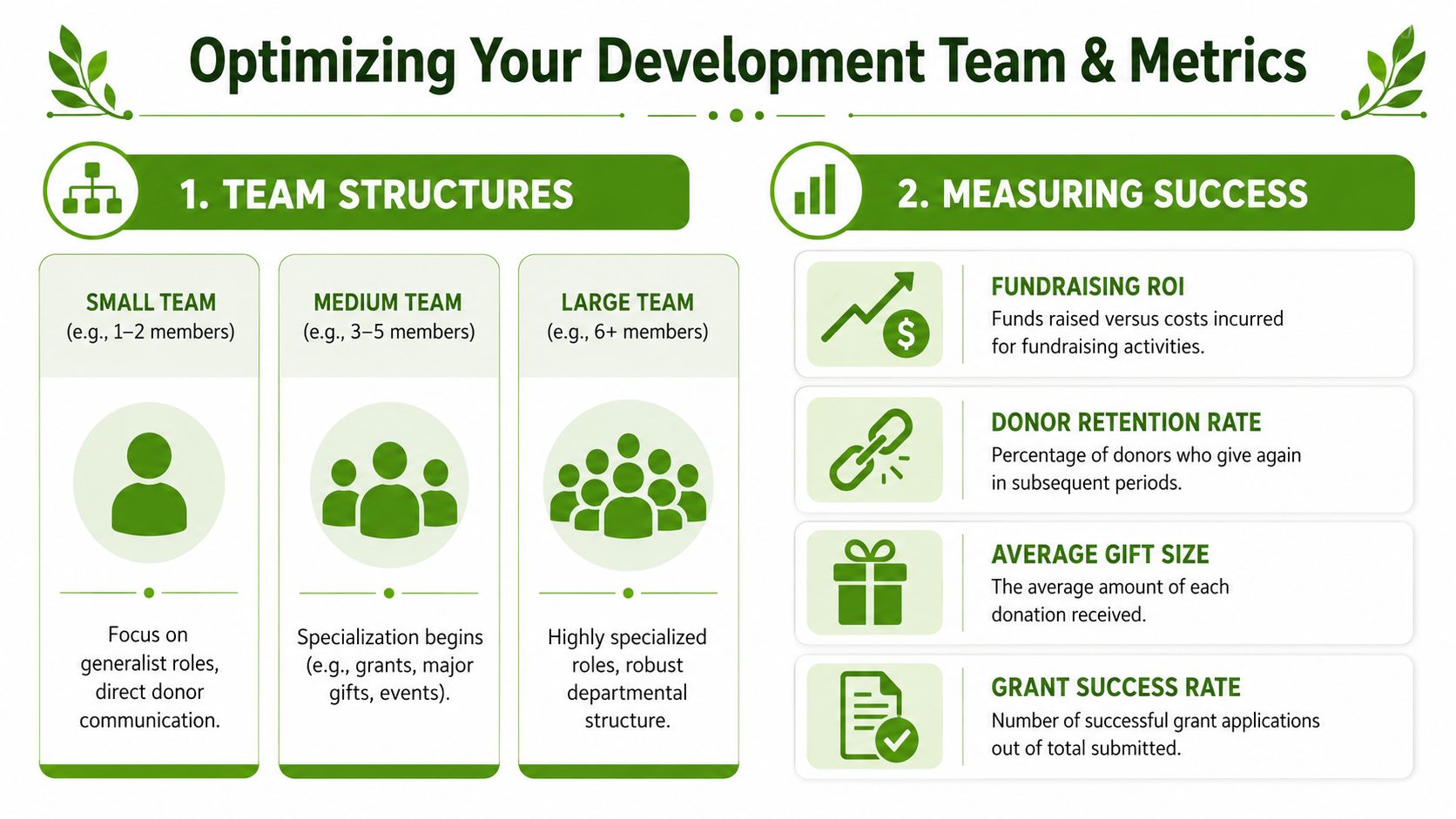
Team structures that actually scale
In the earliest stage, a generalist model often makes sense. One leader handles external relationships, one staff member manages calendars, records, and submissions, and program staff provide stories, outputs, and outcome data. It isn't elegant, but it can work if roles are clear.
As the organization grows, specialization starts paying off. Grants, donor communications, and major gifts require different rhythms and skills. If you need a reference point for role design, this nonprofit organizational structure resource is a useful way to think through reporting lines and who should own what.
A practical progression often looks like this:
- Founder-led or ED-led model: best when relationships are highly personal and revenue channels are still limited
- Generalist development manager: useful when someone needs to own the calendar, database, appeals, and grant coordination
- Specialized team: grants, individual giving, communications, and stewardship start separating once volume rises
What to measure every month
Development should be run as a data system, not a memory system. Jitasa's guidance on data in decision-making recommends tracking metrics such as total annual fundraising, average donation size, donor count, donor retention, donor lapse, and marketing conversion rates, then linking them to program and outcome data.
That matters because it creates a closed loop. You can see which campaigns convert, where donors are falling away, and whether your reporting supports renewal.
If you can't tell which activities produced revenue, retention, or stronger grant narratives, you're managing development by anecdote.
The dashboard a small team needs
You do not need a complex analytics environment to start. You do need consistency.
Track a short set of indicators that your team can review and act on:
- Donor retention: Are people giving again, or disappearing after the first gift?
- Average donation size: Is your message moving people toward larger support over time?
- Donor count: Are you broadening your base or leaning on the same names?
- Lapse patterns: Which segments have gone quiet and need re-engagement?
- Conversion by channel: Which email, event, referral, or campaign source brings in gifts?
- Grant pipeline status: Which opportunities are qualified, in progress, submitted, pending, or declined?
The point of measurement isn't reporting for its own sake. It's making better decisions before the next deadline arrives.
Overcoming Common Nonprofit Development Challenges
The hardest part of development isn't usually knowing what good practice looks like. It's doing good practice while the building is on fire.
Small teams deal with delayed reimbursements, thin staffing, donor fatigue, messy data, and board members who care sincerely but don't know how to help. Those problems are real. They also tend to get misdiagnosed.
Stop treating inconsistency as a motivation problem
When revenue swings wildly, leaders often respond with urgency. They send another appeal, schedule another event, or push staff to apply for more grants. The underlying issue is usually structural, not motivational.
Common structural problems include:
- Overreliance on one source: one foundation, one government contract, one annual event
- No qualification process: every opportunity enters the pipeline whether it fits or not
- Weak follow-up: donors hear from the organization only when money is needed
- Scattered ownership: nobody is clearly responsible for next steps, records, or stewardship
If this sounds familiar, the fix is to narrow focus before you expand effort.
Grant work should be a portfolio, not a series of emergencies
Many organizations often burn out. They chase grants reactively because each one looks like relief. But not every opportunity deserves a proposal.
That's a serious operational issue in a sector with broad economic reach. Nonprofits employed about 10% of the U.S. private-sector workforce in 2022, and a major challenge is moving from reactive to strategic grant fundraising, according to Southern Ag Today's discussion of nonprofit funding and capacity.
A practical grant screen should ask:
- Are we eligible on the first read?
- Does the funder want the kind of work we perform?
- Can we deliver the reporting, partnerships, and compliance required?
- What staff time will this consume before and after award?
- If we win, is the funding worth the operational load?
A grant that strains staff, distorts program design, or creates reporting you can't sustain may still be fundable. It just may not be worth pursuing.
Donor fatigue is often message fatigue
Teams say donors are tired when what they usually mean is the outreach has become repetitive, vague, or disconnected from visible outcomes. Donors can handle being asked. What they don't respond to is being asked without context.
That's why stewardship matters so much. Show progress. Share specifics. Make the next ask feel like a continuation of shared work, not a reset.
A Step-by-Step Framework for Your Development Program
Most development problems improve when the team works a repeatable cycle instead of reacting to the loudest deadline. You don't need a massive staff to do this. You need sequence.
A simple planning visual can help anchor that sequence.
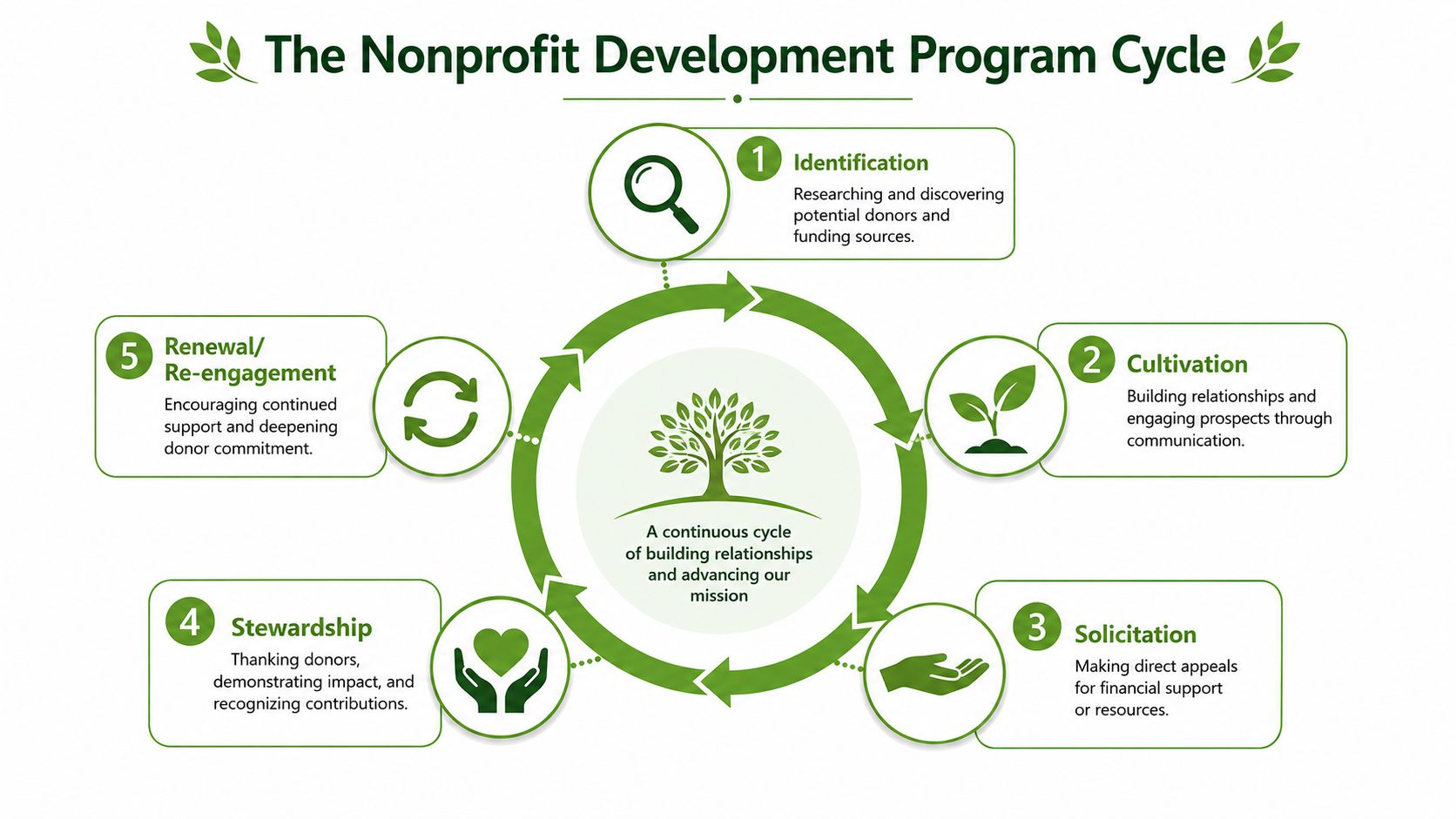
Assess and audit
Start with the truth, not the wish list. Review your current revenue by source, active funders, donor segments, lapsed supporters, reporting calendar, and proposal backlog. Look at what the team can manage.
Then examine your data foundation. Tech Impact describes a practical hierarchy for nonprofit data work as collect → move/store → explore/transform → aggregate/label → learn/optimize → AI in its article on the hierarchy of data needs for nonprofits. That sequence is useful because many nonprofits try to automate before they've cleaned records, centralized files, or established ownership.
Set goals that match capacity
A weak goal sounds like “raise more money.” A useful goal specifies channel, audience, timing, and operational limit.
Examples of useful goals:
- Renew known supporters: focus first on people and funders who already understand the mission
- Stabilize one channel: improve annual giving before launching a new event
- Build a qualified grant pipeline: target opportunities that fit geography, program design, and reporting capacity
You also need one document that defines what the organization is trying to execute across departments. A clear plan of record helps keep development, programs, finance, and leadership aligned on priorities instead of improvising in separate lanes.
A short explainer on donor cultivation and fundraising process can also be helpful when you need to align board and staff around shared language:
Build infrastructure before you scale
Infrastructure sounds boring until you don't have it. Then every ask takes twice as long.
Your essentials are straightforward:
- CRM discipline: one place for donor records, notes, tasks, and gift history
- Grant calendar: deadlines, attachments, approvals, and reporting dates
- Core narrative library: mission statement, case for support, program summaries, budget language, outcomes
- Document control: approved financials, board list, tax letter, audits, bios, and standard attachments
This is the point where tools can help. For grant-heavy teams, Fundsprout is one example of a platform that scans opportunities, screens eligibility, organizes timelines, and structures proposal work from application to renewal.
Execute, steward, and refine
Execution is the visible part. Appeals go out. Meetings happen. Proposals get submitted.
Stewardship is what keeps execution from becoming transactional. Thank people quickly, report with specifics, and log what you learn. Then review the cycle. Which channels took too much effort? Which messages landed? Which grants consumed time without strategic fit? Development gets stronger when the team adjusts while the learning is still fresh.
Practical Checklists for Small Development Teams
Small teams need tools they can use on a busy Tuesday, not a perfect system they'll implement someday. Checklists help because they reduce avoidable mistakes and create shared standards even when one person is wearing multiple hats.
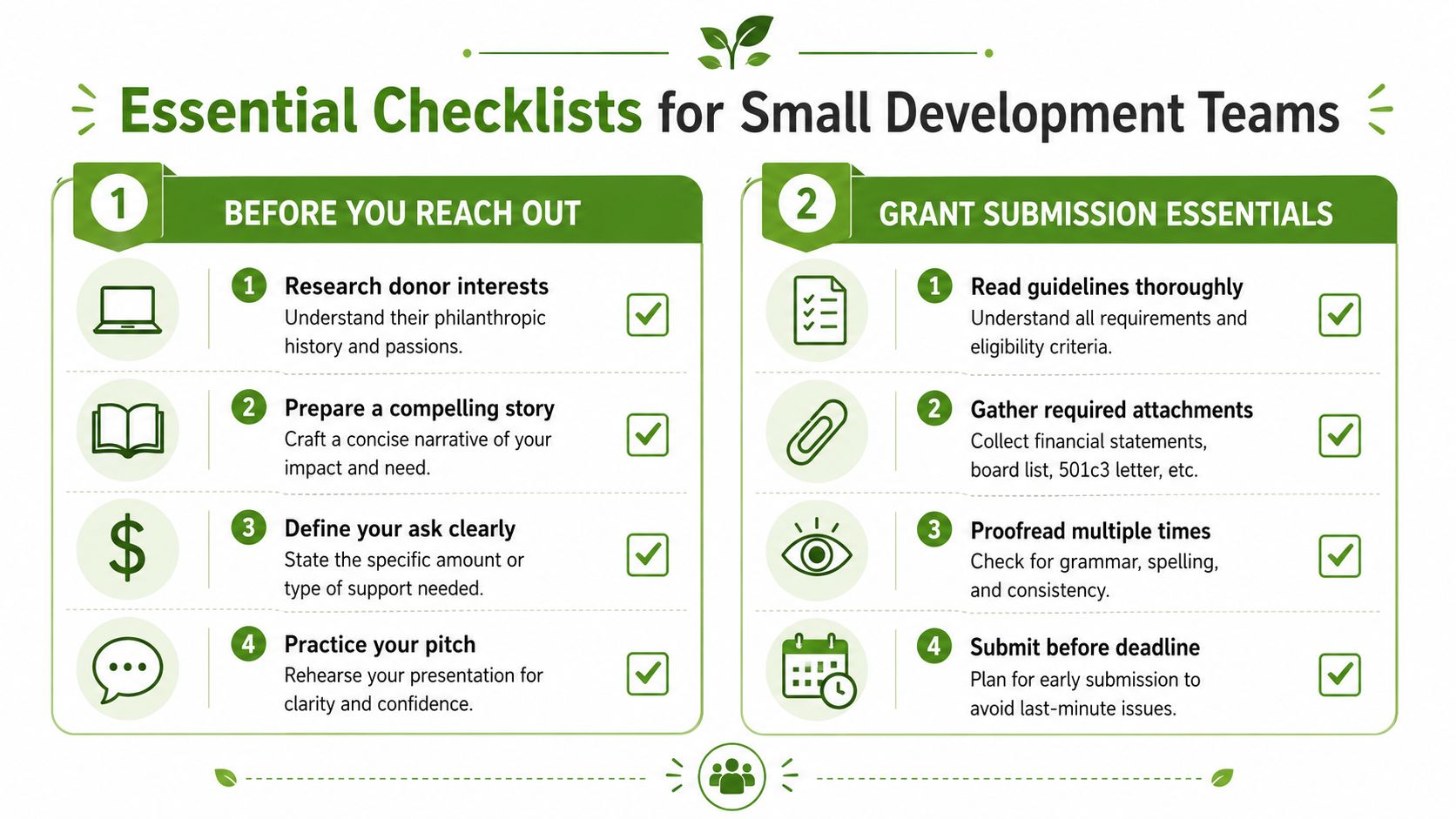
Annual fundraising campaign checklist
Before launching an appeal, confirm the basics:
- Audience is segmented: current donors, lapsed donors, board-linked prospects, and first-time supporters should not get the same message
- The ask is specific: name the need, the timing, and what support makes possible
- Follow-up is scheduled: reminder email, thank-you message, board outreach, and post-campaign reporting should already be on the calendar
- Results can be tracked: use consistent codes or tags so you know what worked
Grant opportunity vetting checklist
Before saying yes to a grant, pause long enough to protect staff capacity:
- Eligibility is confirmed: don't move forward on assumptions
- Mission fit is real: avoid reshaping the program just to match the notice
- Reporting burden is manageable: finance, program, and leadership should all be able to support compliance
- Required attachments exist: budgets, policies, letters, and partner documents shouldn't be a scramble
- Decision authority is clear: someone must own the final go or no-go call
If your records are spread across inboxes and spreadsheets, even basic checklists become harder to use. For teams comparing lightweight systems before they invest, this overview of optimizing revenue ops with free CRM is a practical place to start because it frames CRM choice around workflow, not just features.
Fundsprout helps nonprofits turn grant development from reactive work into a managed system. If your team needs a clearer pipeline for finding aligned opportunities, organizing proposal tasks, and staying compliant through renewal, you can explore Fundsprout to see how it fits your current process.
Try 14 days free
Get started with Fundsprout so you can focus on what really matters.