Winning the Bid with Your Cover Letter Request for Proposal
Craft a cover letter request for proposal that wins bids. Learn proven strategies, see real-world examples, and avoid common mistakes to stand out.

Abdifatah Ali
Co-Founder
Think of your RFP cover letter as the opening argument in a courtroom drama. It’s your first, best chance to capture the jury's attention, frame the narrative, and convince them before they even start digging through the evidence. This isn't just a piece of paper you stick on top of your proposal; it's a strategic move that sets the tone for everything that follows.
A well-crafted cover letter can transform a solid proposal into an unforgettable one.
Why Your RFP Cover Letter Is Your Most Important Page

It’s easy to treat the cover letter as an administrative box to check. A quick, generic intro, slap it on the front, and call it a day, right? That’s a massive missed opportunity.
Imagine being on the evaluation committee. You’re staring at a mountain of proposals, and your eyes are starting to glaze over. You're actively looking for shortcuts—reasons to move a proposal to the "no" pile. Your cover letter is the first thing they see, and it can be the difference-maker.
Think of it as the handshake before a big meeting. A generic, boilerplate letter is like a limp, disinterested handshake. It communicates a lack of effort and genuine interest. On the other hand, a sharp, personalized cover letter feels like a firm, confident greeting that says, "We're here, we're prepared, and we want to be your partner."
Setting the Stage for Success
The real magic of a cover letter request for proposal is its ability to prime the reader. Before they get lost in technical specs and pricing tables, you get to guide their thinking. You can:
- Echo Their Biggest Pain Point: Immediately show them you've been listening by referencing their core challenge right at the top.
- Create a Human Connection: Address the letter to a real person, not "To Whom It May Concern," and adopt a confident, collaborative tone.
- Tease Your Unique Value: Subtly plant the seed of your proposal's main theme—the single biggest reason you are the perfect choice.
In a crowded field, this first impression is everything. For example, in the architecture world, a dip in the American Institute of Architecture’s Billings Index below 50 means the competition for new projects gets fierce. When everyone is hungry, that initial connection point in your cover letter becomes absolutely critical.
A great cover letter doesn't just introduce the proposal; it tells the evaluator how to read it by highlighting the most important themes and demonstrating a deep understanding of their needs from the very first sentence.
This level of polish should extend to your entire submission. How you deliver the proposal package reflects on your organization's professionalism. Taking the time to learn about sending sales proposals securely ensures you maintain that sharp, competent image from start to finish.
In the end, learning how to write a compelling cover letter is a foundational skill in mastering https://www.fundsprout.ai/resources/how-to-respond-to-rfp and winning more bids.
Key Elements of a Winning RFP Cover Letter
This table breaks down the essential parts of a cover letter that grabs attention and makes a powerful first impression. Think of it as your cheat sheet for turning a simple introduction into a strategic tool.
By weaving these elements together, you're not just submitting a document; you're starting a conversation and building a case for why your organization is the only one for the job.
What Goes Into a Winning Proposal Cover Letter?
Think of your RFP cover letter not as a simple introduction, but as a strategic document. Every single element has a job to do, working together to turn a neutral reviewer into someone who’s genuinely interested in what you have to say. Let’s break down the anatomy of a letter that actually gets results.
It all starts with getting the basics right. Professional letterhead with your nonprofit’s name, logo, and contact info is a must. This isn’t just about looking good; it's a visual cue that establishes your credibility from the first glance.
Likewise, getting the date and recipient's details perfect is non-negotiable. If you can, always address the letter to a specific person—the contact listed in the RFP or a decision-maker you've identified. A generic "To Whom It May Concern" can come across as lazy and might weaken an otherwise solid proposal right out of the gate.
Nailing the Opening Hook
Your first paragraph is your moment to shine. You have just a couple of sentences to show you’ve done your homework and aren't just sending another cookie-cutter response. Skip the tired “Thank you for this opportunity” and lead with something that connects directly to their mission or the core challenge they’ve laid out.
For instance, instead of a passive opening, try something more engaging:
"Your RFP for a community wellness platform addresses a critical gap in preventative care—a challenge our team has been passionately working to solve for the past 10 years."
An opening like this instantly signals that you're on the same page. It positions your organization as a dedicated partner who understands the why behind their request, not just the what.
Making Your Case in the Middle
The body of your letter is where you connect their problem to your solution. Keep it tight and focused. Your goal is to highlight two or three key reasons why your organization is the perfect fit. Using bullet points here is a great way to make your main arguments pop off the page.
- Connect your experience to their goals. Don't just list what you do. Explain how your skills and past successes will directly help them achieve what they want to accomplish.
- Highlight your "win theme." What's the single most compelling reason they should pick you? Is it your innovative approach, your deep roots in the community, or your proven track record on similar grants? Make it clear.
- Offer up some social proof. A quick mention of a successful project or a powerful statistic can do wonders for building trust and backing up your claims.
This focused approach is essential. Funders are often buried in proposals, and a clear, compelling cover letter can make all the difference. In fact, research shows that 61% of RFP software users see a return on their investment within a year, proving that a more personalized and effective process leads to better results. You can explore the full analysis on proposal effectiveness to see how small improvements can have a big impact.
Closing with Confidence
End your letter just as strong as you started it. Reiterate your genuine excitement for the project and your confidence that your team can deliver what they need. Your call to action should be clear without being demanding.
Gently point the reader toward the next section, like the executive summary, where they’ll find more details. And finally, make sure the letter is signed by a senior leader—your Executive Director, CEO, or a program director. This signals that your proposal has the full weight of the organization's leadership behind it, which is a powerful final touch.
How to Adapt Your Message for Different Funders
Sending the same cover letter to a federal agency, a private foundation, and a corporate partner is a surefire way to land your proposal in the "no" pile. It's a rookie mistake. Each of these funders lives in a different world, with its own language, priorities, and definition of success. A generic message just screams that you haven't bothered to do your homework.
On the other hand, a carefully adapted letter shows you're a strategic partner who gets it. You understand their mission, respect their process, and know how your work helps them achieve their specific goals. Before you even think about writing, you have to know your audience inside and out.
Tailoring for Government Agencies
When you’re crafting a cover letter request for proposal for a government entity, think two words: compliance and competence. These folks are guardians of public funds, and their primary concern is mitigating risk. Your letter needs to project absolute precision and reliability.
- Mirror Their Language: Scour the RFP for keywords and phrases and use them verbatim. If the document talks about "at-risk youth populations," that’s exactly the terminology you should use.
- Reference Mandates: Directly connect your project to their public or legislative mandate. For example, you might write, "In alignment with the City of Springfield’s goal to reduce carbon emissions by 20%..."
- Emphasize Experience and Stability: Highlight your organization’s history of managing public funds responsibly. Show them you have the systems and track record to handle the grant with zero issues.
Keep the tone formal, direct, and respectful. This isn't the place for emotional appeals. Your job is to present your nonprofit as the safest, most qualified, and most dependable choice to get the job done.
The infographic below outlines the fundamental structure of a proposal letter, which serves as a great starting point for any funder.
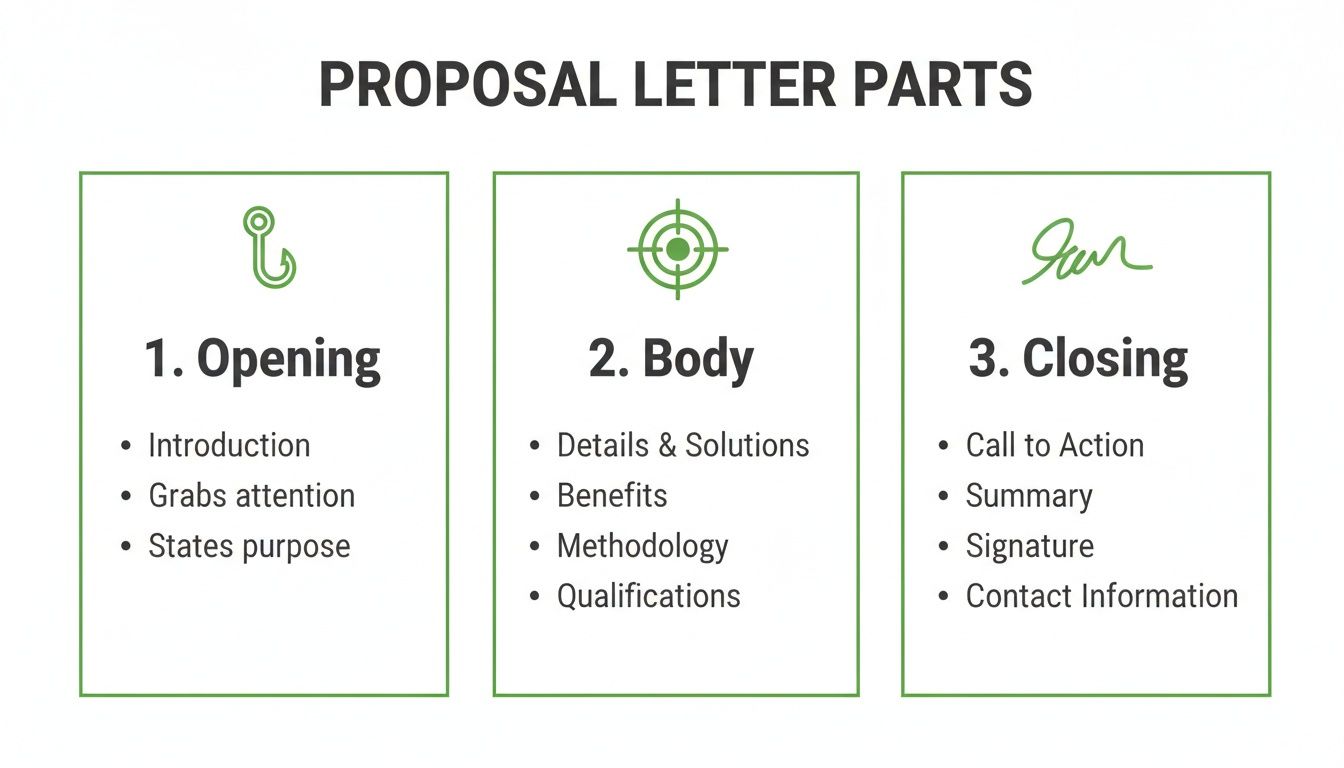
Remember, this is just the skeleton. The real magic happens when you infuse each section with content that speaks directly to the funder you're addressing.
Appealing to Private Foundations
Private foundations are all about the mission. They aren’t just funding a project; they are investing in a vision for a better world. Your cover letter needs to tell a story that connects the heart of your work to the soul of their foundation.
This is where you can be more passionate and narrative-driven. Instead of leading with dry facts, lead with shared purpose. Try something like, "Like The Hopewell Foundation, we believe that every child deserves a safe and nurturing start in life." This immediately frames your proposal as a true partnership. Highlighting this shared vision is crucial, and it’s a strategy that pays off as you find grants for nonprofits that are genuinely a good fit.
Think of it this way: your letter to a foundation is less about proving you can follow rules and more about proving you share their heart. Use this space to showcase your passion and the real, human impact of what you do.
Engaging Corporate Partners
When you’re approaching a corporation, you have to think like a business. Their motivations are often tied to brand value, employee engagement, and community goodwill—all part of their corporate social responsibility (CSR) strategy. Your letter must frame your proposal as a win-win partnership.
- Highlight the ROI: What’s the "return on investment" for them? Maybe it’s positive media coverage, an authentic connection to a new community, or a powerful volunteer opportunity for their team. Spell it out.
- Align with Brand Values: Show them how a partnership with you reinforces their brand identity. Does your work align with their commitment to sustainability, innovation, or community development?
- Speak Their Language: Ditch the jargon and talk about outcomes, metrics, and measurable impact. Use data and clear, business-focused language to make your case compellingly.
By customizing your message this way, you stop being just another applicant asking for money. You become a potential partner who understands what makes each funder tick—and that’s how you get your proposal moved to the top of the pile.
Common Mistakes That Get Your Proposal Rejected Instantly
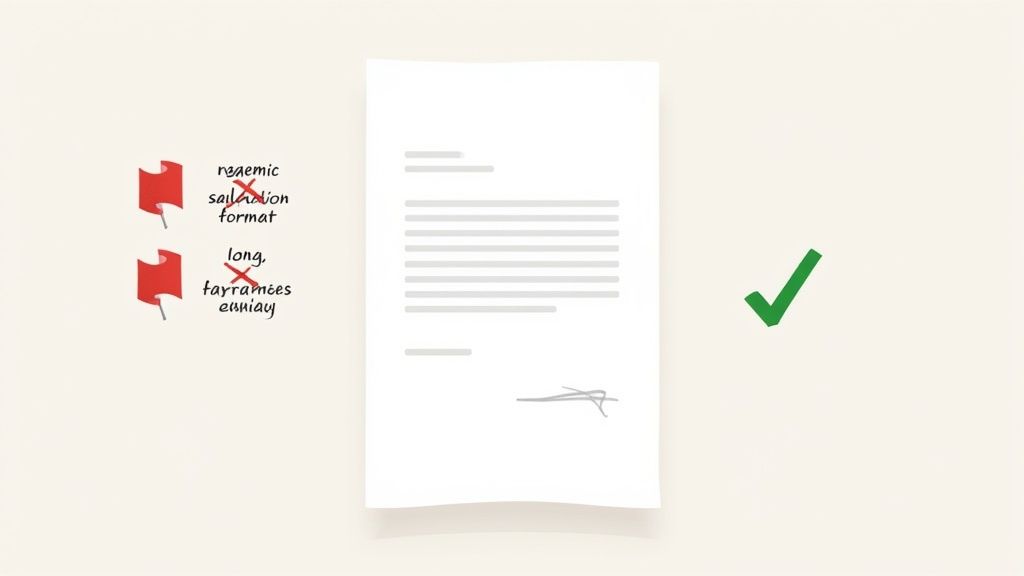
Knowing what not to do is just as crucial as knowing what you should do. After your team pours countless hours into crafting a proposal, the last thing you want is for a simple cover letter mistake to get it tossed aside. Remember, reviewers are often swamped and looking for any reason to narrow down the applicant pool. These common blunders are the fastest way to land in the "no" pile.
One of the most frequent—and easily avoidable—errors is failing to follow simple instructions. If the RFP specifies a one-page cover letter in a particular font, sending a two-page letter in a different style is a huge red flag. It tells the funder you either didn't read the requirements carefully or chose to ignore them. Neither one is a good look.
The Generic Salutation Graveyard
Starting your letter with "To Whom It May Concern" is the professional equivalent of a limp handshake. It’s an immediate signal that you haven't put in the effort and see this as just another application to blast out. Funders want to feel like you're seeking a partnership, not just adding them to a mailing list.
Spend five minutes on their website or on LinkedIn to find the name of the program officer or executive director. It's a tiny detail that makes a massive impact on that critical first impression. Your cover letter request for proposal needs to feel personal.
Real-World Scenario: A community foundation received two equally strong proposals. One was addressed to "Dear Evaluation Committee," while the other was addressed to the foundation's Executive Director by name. The personalized letter felt more respectful and engaged, giving that applicant an immediate edge.
Repeating Information Without Adding Value
So many cover letters just rehash the executive summary. This is a massive missed opportunity. It wastes the reader’s time and squanders your chance to forge a genuine connection. Your cover letter shouldn't just repeat the proposal; it should frame it. Think of it as your chance to speak directly to the funder’s mission in a more conversational tone.
Instead of just restating facts from the proposal, use this space to align your vision with theirs. Show them you understand the why behind their RFP, not just the what. This is more than just a nice touch; it’s a strategic advantage. In fact, research shows a tailored cover letter can boost your chances by 49%. Funders value it because it reveals your motivation (47%) and a bit of your organization's personality (23%). You can discover more insights about cover letter impact to see just how important this is.
Making Unsubstantiated Claims
Confidence is great, but empty bragging will get you nowhere. Your cover letter is the place to be persuasive, but every claim you make must be backed up by the evidence inside your proposal.
Avoid broad, unsubstantiated statements like "We are the leading provider of after-school programs." That doesn't mean anything without proof. Instead, tie your claims to concrete data.
- Weak: "Our solution is the best on the market."
- Strong: "Our unique mentorship model, detailed on page 12 of our proposal, has been proven to increase graduation rates by 15% in similar districts."
This approach grounds your claims in reality and, even better, directs the reviewer to the exact page where they can see the proof for themselves. By sidestepping these common mistakes, you give your proposal the fair and thorough review it truly deserves.
Using AI and Templates to Write Cover Letters Faster
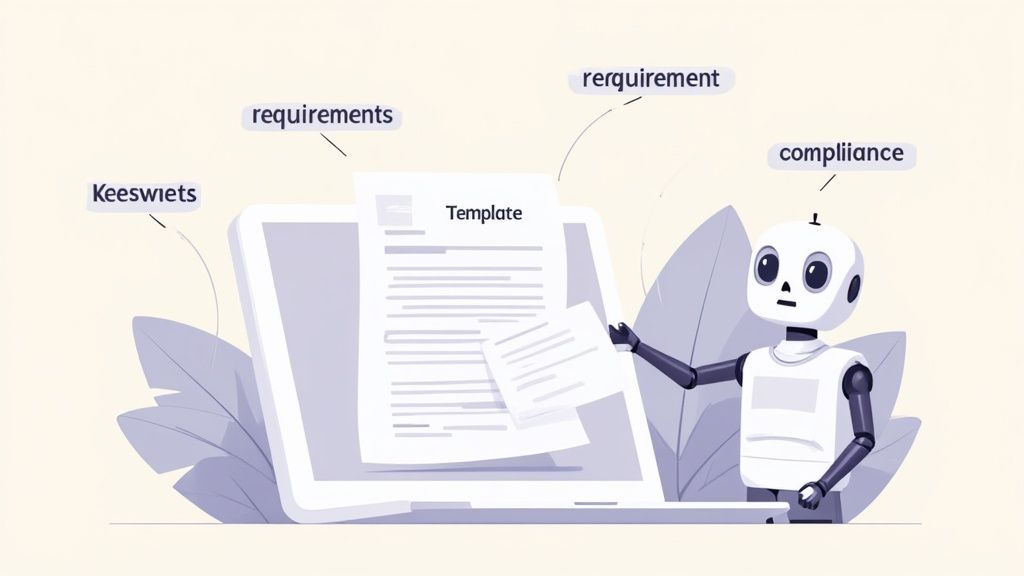
Staring at a blank page every time you need to write a proposal cover letter is a huge time sink. For busy nonprofit teams, the pressure to make each letter feel personal while juggling tight deadlines is a recipe for burnout and inconsistent work. This is where smart templates and AI tools can make a real difference, helping you build high-quality letters without reinventing the wheel every single time.
Think of these tools not as a replacement for your expertise, but as a powerful assistant. They give you a solid foundation to build upon, making sure all the critical pieces are there from the start. This approach helps you maintain a professional standard across all your proposals while freeing you up to add the human touch that truly resonates with funders.
Let Fundsprout’s RFP Analyzer Do the Heavy Lifting
Before you can write a great cover letter request for proposal, you have to know exactly what the funder wants. But manually combing through dozens of pages of a dense RFP to find the key requirements, evaluation criteria, and buzzwords is a tedious job. This is exactly what Fundsprout’s RFP Analyzer was built to eliminate.
Just upload the RFP document, and the tool gets to work, instantly pulling out and organizing the most important details. It will highlight direct quotes about the funder’s goals, flag any mandatory compliance language you can't afford to miss, and even list the specific criteria reviewers will use to score your proposal. It essentially creates a strategic cheat sheet for your cover letter.
With this analysis in hand, you can write an opening that speaks directly to the funder's stated problem or show how your approach aligns perfectly with their top priorities. No more guessing—just relevant, impactful messaging from the very first sentence.
Get a Head Start with the AI Writing Assistant
Once the RFP Analyzer has broken down the requirements, our AI Writing Assistant steps in. It takes that structured data and generates a solid, compliant first draft of your cover letter. Better yet, you can train the assistant on your organization’s past winning proposals and reports, so it learns to write in your unique voice.
This process can turn a task that used to take hours into one that takes just a few minutes. The AI often gets you 80% of the way there, weaving in the right terminology and hitting the funder’s key points right out of the gate.
Your team’s job then becomes focusing on that final 20%—adding the stories, insights, and personal touches that build a real connection. This blend of AI efficiency and human strategy is a massive advantage, particularly when you’re working with a small team. If you want to take your writing to the next level, a good AI text enhancer can help polish your final draft for maximum clarity and impact.
Using these tools strategically is a genuine game-changer. By automating the grunt work, you free up your team to craft more thoughtful, personalized cover letters in a fraction of the time. To see how these technologies fit into the bigger picture, check out our complete guide on https://www.fundsprout.ai/resources/ai-for-grant-writing.
Frequently Asked Questions About RFP Cover Letters
Even after you've polished every section of your proposal, a few nagging questions about the cover letter can pop up. It’s the first thing a funder sees, so you want to get it right. Let's walk through some of the most common questions I hear from nonprofits so you can submit your next proposal with total confidence.
How Long Should My Cover Letter Be?
This one’s easy. The golden rule is to keep it to a single page.
Funder review committees are swimming in paperwork. A rambling, multi-page cover letter is a red flag that the rest of your proposal might be just as dense and unfocused. A sharp, concise one-pager respects their time and shows you know how to get to the point.
Remember, the goal isn't to rehash your entire proposal. Think of it as the firm, confident handshake before the real conversation begins—it should hook them, frame the problem, and make them eager to read the detailed solution you’ve prepared.
Who Is the Best Person to Sign the Letter?
The signature on your cover letter request for proposal is more than just a name—it’s a signal of organizational commitment. It needs to come from a senior leader who has the authority to represent your nonprofit.
Here are a few great options:
- Executive Director or CEO: This is often the best choice. For significant, high-stakes proposals, a signature from the top shows the funder your entire organization is behind this project.
- VP or Program Director: If the RFP is for a specific program, having the head of that department sign can demonstrate direct expertise and oversight. It tells the funder that the person in charge of the work is personally invested.
- Primary Relationship Holder: Does one of your board members or executives already have a strong relationship with someone at the funding organization? If so, their signature adds a powerful personal connection that can make a real difference.
The right person is whoever can best communicate that your organization is serious and fully aligned with the proposal.
A signature from a senior leader isn't just a formality; it's a non-verbal cue that the proposal has been vetted and approved at the highest levels, adding an extra layer of credibility to your submission.
Is It Okay to Reuse a Cover Letter?
Let me be direct: absolutely not. It's one of the fastest ways to get your proposal tossed aside.
While starting with a basic template to ensure you include all the right components is a smart time-saver, sending a generic, copy-and-paste letter is a fatal error. Funders are experts at spotting boilerplate language, and it immediately tells them you haven't put much thought into their specific needs.
Every funder has its own mission, priorities, and even its own jargon. A personalized letter that directly references their goals and echoes their language proves you've done your homework. Taking the time to customize it is a simple but incredibly effective way to stand out from the competition.
Ready to eliminate the guesswork and create winning proposals faster? Fundsprout uses AI to analyze RFPs, generate compliant first drafts in your organization's voice, and keep your team on track. Discover how you can streamline your grant writing at https://www.fundsprout.ai.
Try 14 days free
Get started with Fundsprout so you can focus on what really matters.