A Guide to Consulting Services for Nonprofit Organizations
Unlock your mission's potential. Our guide to consulting services for nonprofit organizations covers when to hire, what to expect, and how to measure impact.


Abdifatah Ali
Co-Founder
You're probably reading this because something important is stuck.
Maybe the board wants a strategic plan before the next retreat. Maybe your development director is carrying a campaign, annual fund, and grant calendar at the same time. Maybe your CRM, donor database, and program reporting live in three different places, so every report turns into a spreadsheet rescue mission. You know the problem is real. What's less clear is whether bringing in outside help will solve it or just add another cost center to manage.
That's where good consulting earns its keep. Not by producing a slide deck that sits in a shared drive, but by helping a nonprofit make a hard change, faster and with less internal friction than it could alone.
I've seen consulting engagements go very well and very badly. The difference usually isn't the consultant's resume. It's whether the organization did the prep work, hired for the right reason, scoped the job tightly, and measured what happened after the engagement ended. Nonprofits don't have room for vague projects. Every consulting dollar has to do real work.
Why More Nonprofits Are Turning to Consultants
The pressure points are familiar. Revenue is uneven. Staff capacity is tight. The board wants clearer direction. Program leaders want better reporting. Development wants cleaner data. Operations wants fewer manual workarounds. All of those needs hit at once, and most nonprofits don't have extra bandwidth sitting on the bench.
That's one reason consulting has moved into the mainstream. The global nonprofit consulting service market was estimated at $11.4 billion in 2025 and projected to reach $22.8 billion by 2034, with strategic planning and fundraising consulting together making up more than 52% of revenues in 2025; small nonprofits were also the fastest-growing size segment at 8.9% CAGR. Those figures matter because they reflect where nonprofits feel pressure most acutely. Direction, funding, and sustainability.
What this shift really means
Consulting used to be treated like an occasional luxury. A board retreat facilitator. A campaign study every few years. A strategic plan when leadership changed.
That's not how many organizations use it now.
They use consultants to fill a capability gap without adding permanent headcount. They bring in an outside facilitator when board dynamics make internal leadership less effective. They hire technical specialists to clean up systems that staff have been patching together for years. They use focused outside help to keep critical work moving when regular staff are already overloaded.
A consultant should solve a problem your team can't solve quickly, objectively, or with the right level of skill using existing capacity.
Where consulting tends to work best
The strongest nonprofit consulting engagements usually have three traits:
- The issue is important enough to justify concentrated attention. A stalled campaign plan, weak grant systems, a merger discussion, or a broken data workflow usually qualifies.
- The work needs specialized judgment. Governance facilitation, prospect research design, evaluation frameworks, and CRM architecture aren't side tasks.
- Leadership is willing to act on the findings. If the organization wants validation but not change, consulting rarely pays off.
For many nonprofits, the decision isn't whether outside help feels ideal. It's whether the cost of delay is already higher than the cost of getting expert support.
When to Hire a Consultant vs When to Build In-House
The cleanest way to make this decision is to ask one question: are you solving a capacity problem or a capability problem?
A capacity problem means your team knows what to do, but can't absorb one more major initiative right now. A capability problem means your team doesn't yet have the specific skills, objectivity, or experience to do the work well.
That distinction matters because building in-house is often the right long-term move, but it's not always the right move this quarter.
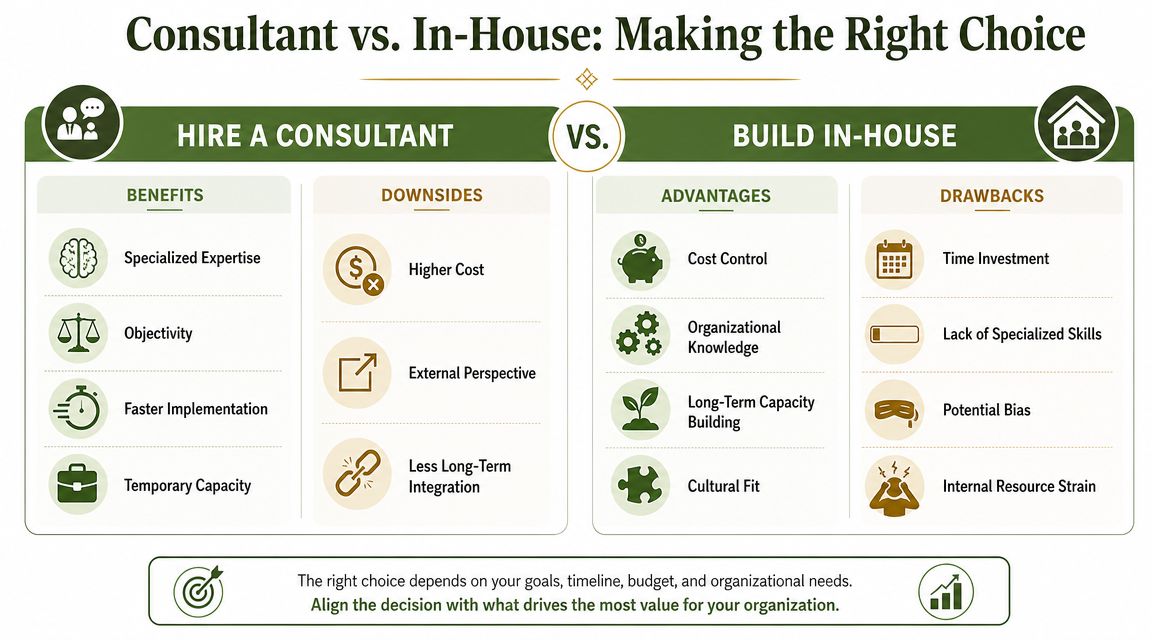
Signs you should hire a consultant
The case for external help gets stronger when the work has a clear endpoint, requires niche skill, or would benefit from neutrality. That includes campaign planning, executive search support, board facilitation, interim development strategy, systems selection, and evaluation design.
The workforce context also matters. One market study reports that 95% of nonprofit leaders are concerned about burnout and 50% face hiring difficulties. In practice, that means consultants are often a strategic response to staff strain, not a shortcut or a luxury.
Signs you should build in-house
If the need is ongoing, central to daily operations, and tied closely to institutional knowledge, staff capacity usually wins over external help. Major gifts management, grant stewardship, finance leadership, and recurring program evaluation are common examples.
Build in-house when:
- The function is permanent. If the work won't go away, repeated consulting fees can become a poor substitute for staff investment.
- Relationships drive results. Donor portfolios, funder relationships, and internal team management usually need continuity.
- You need embedded ownership. Some work fails when it sits outside the organization's daily habits.
Practical rule: Hire a consultant to accelerate, unblock, diagnose, or design. Hire staff to own, maintain, and improve over time.
What often goes wrong
Nonprofits sometimes hire consultants because they're hesitant to make a staffing decision. That usually creates confusion. The consultant gets treated like temporary staff, but without authority, onboarding, or a realistic scope.
The reverse mistake happens too. Organizations try to build everything internally, even when the task is specialized and urgent. Then the team loses months learning by trial and error while the underlying problem gets more expensive.
Key Types of Nonprofit Consulting Services Explained
Most leaders don't need a generic consultant. They need the right kind of specialist for the problem in front of them. The fastest way to sort the options is to define the stuck point first, then match the service type to it.
Fundraising and revenue consulting
This is what many people picture first, but it covers several very different jobs. A campaign consultant is not the same as a grant strategist. A donor communications advisor is not the same as a prospect research specialist.
Fundraising consulting makes sense when revenue has plateaued, donor systems are weak, campaign readiness is unclear, or the team needs a sharper strategy across annual giving, major gifts, institutional funding, or stewardship.
A strong engagement usually produces clearer segmentation, tighter messaging, stronger development processes, or a credible campaign plan. A weak one produces broad fundraising advice with no implementation path.
Strategic planning and governance consulting
This work is less about writing a polished plan and more about making organizational choices. What will you stop doing? What growth is realistic? What belongs at the board level versus the staff level? Where are governance practices slowing execution?
The best consultants in this category help leadership and the board make decisions they've been circling around for months. They don't just facilitate discussion. They force prioritization.
Technology and data consulting
This is one of the most underestimated categories in consulting services for nonprofit organizations. Many nonprofits think they need a new platform when they really need a better data strategy.
Tech Impact's guidance on nonprofit data strategy emphasizes documenting reporting needs and then defining the architecture, workflows, data mapping, and reporting tools needed to connect fragmented systems and improve visibility. That's the essential work. Software selection comes after.
If your reports rely on manual exports, shadow spreadsheets, and staff memory, the problem usually isn't just the tool. It's the underlying data design.
Evaluation and performance consulting
Some nonprofits need help proving impact, not because their programs are weak, but because their measurement approach is inconsistent. Evaluation consultants can help build outcome frameworks, reporting structures, and board-ready performance dashboards.
That becomes especially useful when leadership needs clearer information for funders, strategic planning, or resource allocation.
Operations, compliance, and risk consulting
Operations consulting solves the problems that subtly eat staff time. Workflow bottlenecks. Role confusion. Approval delays. Basic process design failures.
Risk and compliance consulting is different. It matters when contracts, privacy, licensing, documentation, or regulatory expectations create exposure. Communications planning can also fit here. If your organization is vulnerable to public controversy or fast-moving stakeholder pressure, it's worth reviewing PressBeat's crisis communication advice as part of operational readiness.
Common nonprofit consulting engagements
| Service Area | Common Problem Solved | Typical Project Example | Key Success Metric |
|---|---|---|---|
| Fundraising | Revenue has stalled or lacks a clear strategy | Campaign readiness assessment or grant strategy redesign | Stronger pipeline, clearer donor strategy, improved execution |
| Strategic planning | Leadership has too many priorities | Board and staff strategic planning process | Fewer priorities with clearer ownership |
| Technology and data | Systems don't connect and reporting is unreliable | CRM assessment and data workflow redesign | Faster reporting and better data visibility |
| Evaluation | Outcomes are hard to measure consistently | Program measurement framework | More decision-ready metrics for leaders and funders |
| Operations | Staff time is lost in inefficient processes | Workflow mapping and role clarification | Less duplication and smoother execution |
| Compliance and risk | Contracts, data use, or policies create uncertainty | Policy and risk review | Lower operational risk and clearer guardrails |
How to Assess Your Needs and Set a Realistic Budget
Most consulting failures start before the first call. The organization knows it's frustrated, but it hasn't translated that frustration into a defined problem.
The internal prep doesn't need to be complicated. It does need to be honest.
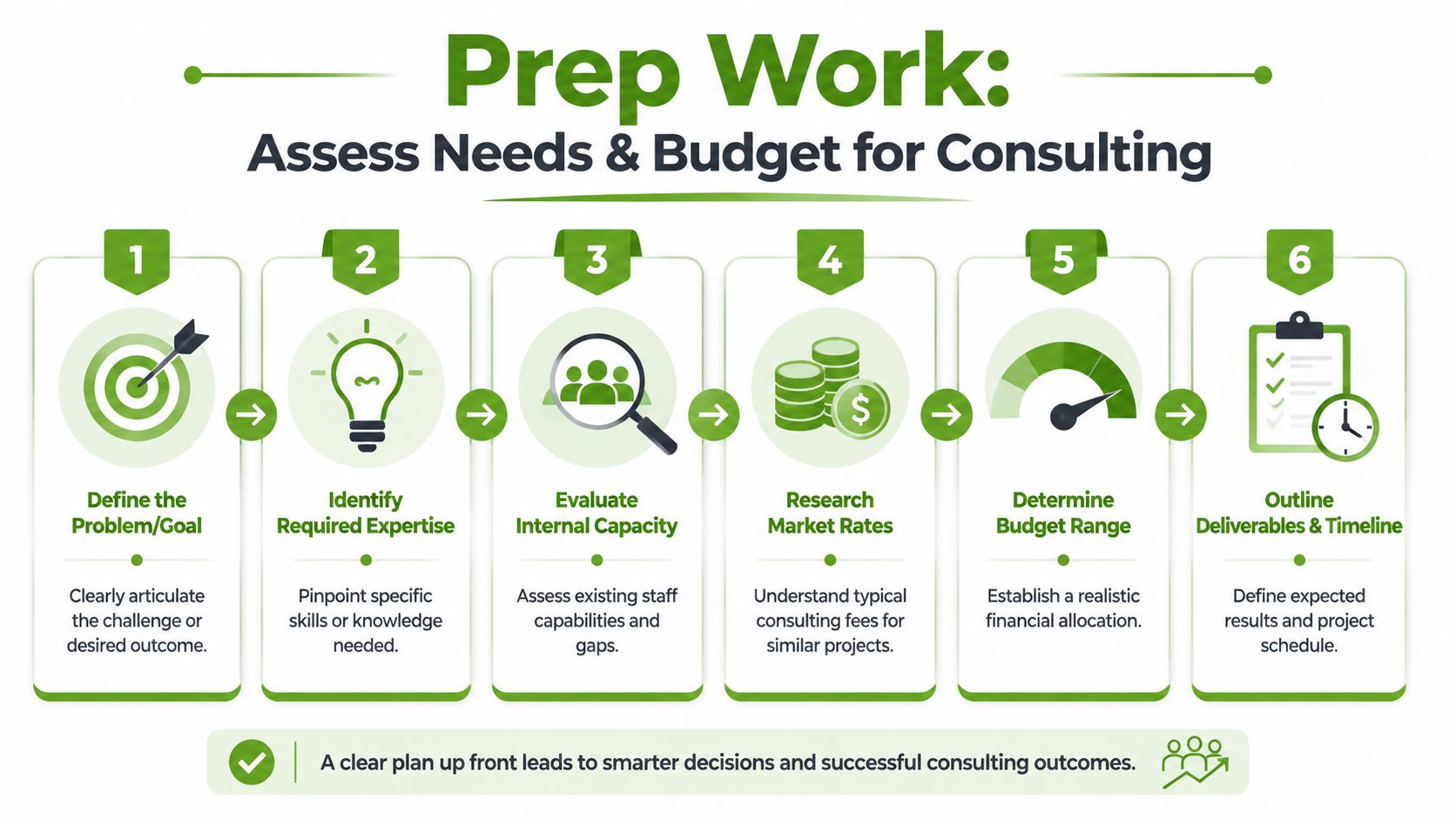
Start with the blocked outcome
Don't begin with “we think we need a consultant.” Begin with “what result are we failing to achieve?”
Good problem statements sound like this:
- We can't produce board-ready fundraising reports without manual cleanup.
- We're entering campaign planning without a shared case for support.
- Program and development teams define outcomes differently, so our funder reporting is inconsistent.
- We need a strategic plan, but leadership hasn't agreed on the decisions it should force.
That framing changes the procurement process. You stop shopping for impressive resumes and start looking for fit.
Use a simple internal brief
Before reaching out to anyone, write a one-page brief that answers these questions:
- What's the problem? Be specific.
- Why now? Name the deadline, risk, or opportunity.
- Who owns the project internally? One person needs decision authority.
- Who must be involved? Board, leadership, program staff, finance, development, IT.
- What deliverable would be useful? Plan, workflow map, dashboard design, campaign assessment, training, implementation support.
- What would success look like six months later? Better reporting, faster decisions, stronger revenue planning, cleaner systems.
For nonprofits building the financial side of that brief, this nonprofit budget example can help frame assumptions and cost categories.
Budget from value, not guesswork
A common mistake is setting a budget by picking a number that feels tolerable. A better approach is to ask what the unresolved problem is already costing you in staff time, missed opportunities, delayed decisions, or weak execution.
Consultants may price by hourly rate, fixed project fee, or retainer. The right model depends on the work. Fixed fees work well when the deliverables are clear. Retainers work when the need is ongoing but variable. Hourly arrangements can work for advisory support, but they require close management.
This walkthrough is a useful companion if your team needs help thinking through planning assumptions before scoping outside help.
Budget for staff time too. Even the best consultant can't compensate for an absent internal lead, slow approvals, or unavailable data.
Finding and Vetting the Right Nonprofit Consultant
A strong project brief makes the search easier, but it doesn't make selection automatic. Many consultants can sound credible in an introductory call. The core question is whether they can solve your problem in your environment, with your constraints.
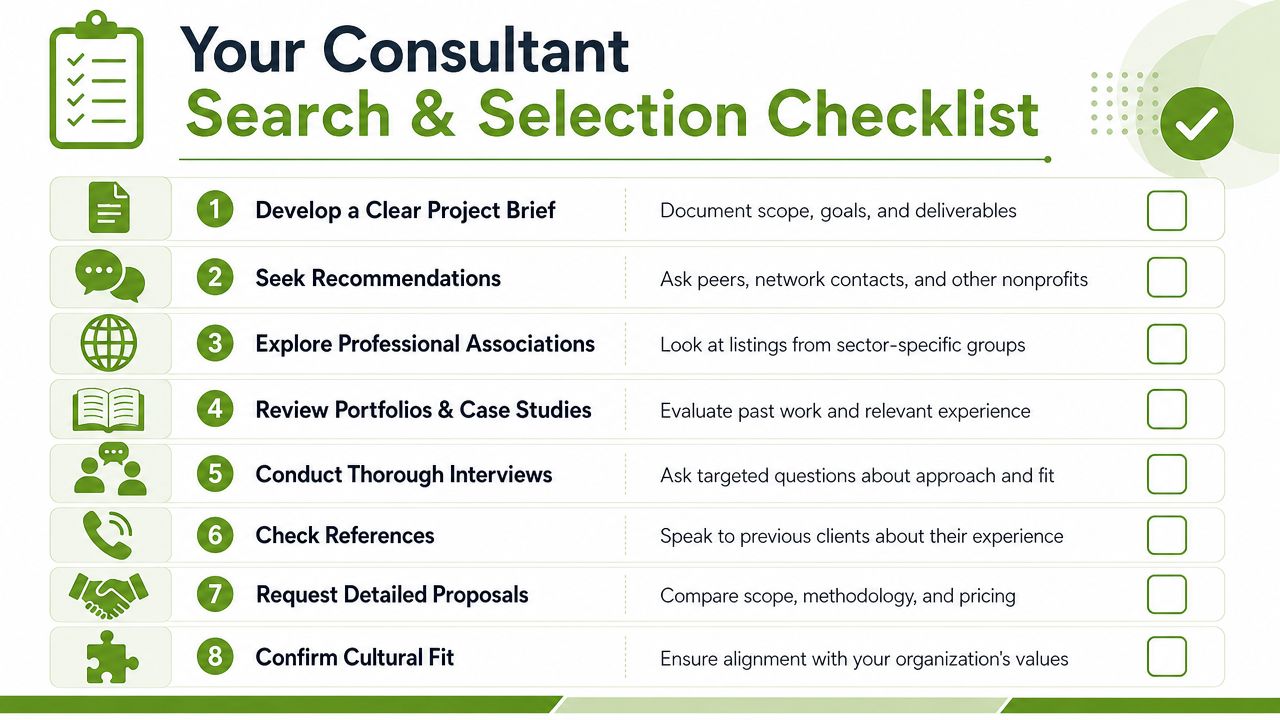
Where to look
Start with peer referrals. Executive directors and development leaders usually know who delivered and who produced a polished report with no follow-through. Then look at sector directories, conference speakers, and specialists who publish practical thinking in your area.
If your organization needs a formal procurement process, this guide to RFPs and RFQs can help shape the request and comparison criteria.
What to ask in interviews
The best vetting questions are about working style and judgment, not just credentials.
Ask things like:
- How do you diagnose the problem before proposing a solution?
- What information do you need from us in the first two weeks?
- What usually causes a project like this to stall?
- How do you handle disagreement between staff and board members?
- What will you expect from our team to keep the work moving?
- How do you transfer knowledge so we're not dependent on you afterward?
Listen for specifics. Good consultants can explain their process in plain language. Weak ones tend to stay abstract or overpromise.
How to compare proposals
Don't compare proposals on price alone. Compare them on clarity.
A useful proposal should spell out:
- The diagnosis of your problem. If two firms heard the same issue but framed it differently, that difference matters.
- The actual deliverables. “Support strategic planning” is vague. “Facilitate four planning sessions, synthesize stakeholder input, and produce a three-year implementation roadmap” is clear.
- The assumptions. How many interviews? Who provides data? How many revision rounds?
- The project management approach. Meeting cadence, decision points, and communication expectations.
Reference checks should be targeted. Ask former clients what the consultant was like when the project hit friction, not just whether they were pleasant to work with.
What fit really means
Cultural fit doesn't mean the consultant feels familiar or socially easy. It means they can work effectively with your board, leadership, and staff without creating avoidable resistance.
The right consultant should understand nonprofit pace, decision complexity, and stakeholder sensitivity. They should also be able to say hard things clearly. If they only tell you what you already know, they're not bringing much value.
Structuring the Engagement and Scope of Work
If I had to pick one document that predicts whether a consulting project will succeed, it would be the scope of work.
Not the proposal. Not the kickoff deck. The scope of work.
A vague scope creates almost every familiar consulting headache. Scope creep. Missed expectations. Endless revisions. Confusion about who owns what. Disputes over whether the project is done.
What must be in the scope
A workable scope of work should include five basics.
Objective
State the business problem and the intended result. Keep it concrete.Deliverables
Name exactly what the consultant will produce. Draft plan, final plan, board presentation, workflow map, CRM recommendations, training session, implementation memo.Timeline and milestones
Put dates or milestone triggers around interviews, drafts, review periods, and final delivery.Roles and responsibilities
Identify the internal project lead, decision-makers, data providers, and approval points.Fees and payment terms
Tie payment to milestones where possible. That protects both sides.
Contract terms nonprofits often overlook
The contract should do more than authorize payment. It should answer questions that become painful later if left vague.
Outside GC notes that nonprofits need to think through intellectual property ownership, third-party data licensing, insurance requirements, and privacy, tax, and registration rules when offering or procuring consulting services. Even if your project seems routine, these issues matter when the consultant is handling donor data, creating reusable materials, or using licensed tools and datasets.
Review these areas carefully:
- Confidentiality: What information can the consultant access, store, or share?
- Intellectual property: Who owns the work product at the end?
- Data use: Can third-party tools or datasets be used for the intended purpose?
- Insurance and indemnity: What coverage is required?
- Termination rights: What happens if the project stalls or either side wants out?
The best protection against scope creep
Scope creep usually doesn't start with bad intent. It starts when leaders say, “While we're at it, can we also…” and nobody checks that request against the contract.
Build a change-order habit early. If the nonprofit wants additional interviews, extra board sessions, or implementation support beyond the original plan, write it down, price it, and agree to it before the work expands.
That level of discipline doesn't make the relationship rigid. It keeps the relationship fair.
Measuring the Impact and ROI of Your Consulting Investment
If you don't define value at the end of the project, the board will default to one question: was this worth the money?
That's a fair question, but it needs a better framework than simple revenue comparison. Many consulting engagements create value through stronger systems, cleaner decisions, and better execution long before a financial return shows up.
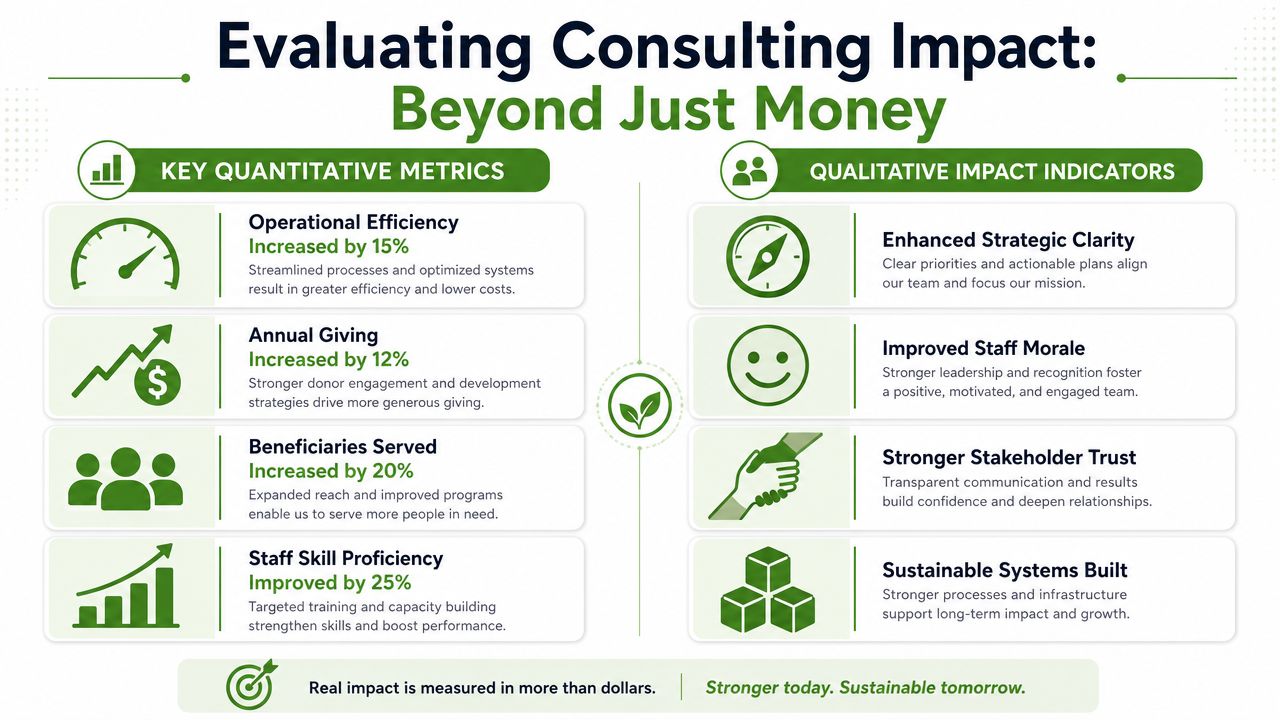
Use three lenses
Start with the scope of work and evaluate the engagement through three lenses.
- Financial impact: Did the work improve revenue readiness, grant competitiveness, campaign planning, cost control, or operational efficiency?
- Capacity gains: Did staff leave with better tools, clearer processes, or stronger decision discipline?
- Strategic progress: Did leadership make decisions that had been stalled? Is the board clearer on priorities and oversight?
Prosper Strategies' overview of nonprofit consultants notes the shift toward benchmarking, prediction, and standardized outcomes measurement that turns program and donor data into decision-grade metrics for boards and funders. That's the standard worth aiming for. Not “we liked the consultant,” but “we can now manage this area with better information.”
A practical post-project review
Hold a short debrief after the project closes. Include the internal lead, executive sponsor, and key users of the work product. Ask:
- What changed because of this engagement?
- What decisions are easier now?
- What did staff learn that they can carry forward?
- What still isn't resolved?
- Would we structure this engagement differently next time?
The best ROI often shows up in fewer workarounds, cleaner accountability, and faster decisions. Those gains are easy to feel and easy to underreport unless you name them directly.
A consulting engagement is successful when the organization is stronger after the consultant leaves, not busier while they're there.
If your consulting project involves grant strategy, proposal development, funding pipeline analysis, or post-award compliance, Fundsprout is one option to consider. It helps nonprofits identify relevant grants, analyze RFP requirements, draft proposal sections using organizational materials, track deadlines, and manage reporting workflows so outside consulting support can focus on judgment-heavy work rather than manual grant administration.
Try 14 days free
Get started with Fundsprout so you can focus on what really matters.