Books on fundraising: Essential Reads for Nonprofits
Discover books on fundraising every nonprofit should read. Find top titles on grant writing, donor relations, and fundraising strategy.


Abdifatah Ali
Co-Founder
Let's be honest, navigating the world of nonprofit fundraising can feel incredibly complex. But the right book can feel like having an expert mentor on call 24/7, ready to help you tackle anything. The very best books on fundraising don’t just give you templates; they share time-tested strategies for everything from grant writing and landing major gifts to building genuine, lasting donor loyalty.
They provide the strategic foundation—the core principles—that are absolutely critical for any nonprofit looking to grow sustainably.
Why Building Your Fundraising Library Matters

Curating a library of fundraising knowledge isn’t just about collecting books; it’s a strategic investment in your organization’s future. While modern tools give you speed and efficiency, these books provide the essential "why" behind what works. They teach the human-centric strategies and ethical frameworks that truly drive connection.
Think of it like this: the books are a master chef's proven recipes, and your software is the high-tech kitchen. The recipes give you the vision, and the kitchen helps you execute it with velocity.
The demand for this kind of accessible expertise is growing fast. In fact, the global book publishing market is expected to hit USD 120.07 billion by 2032. For nonprofit leaders on a tight budget, this is great news. It means there’s a wealth of invaluable knowledge out there, ready to help you master skills that directly boost your mission's funding.
Connecting Challenges to Knowledge
Every nonprofit hits a wall at some point. Maybe your grant win rate is frustratingly low, or your donor retention numbers keep dipping. Whatever your specific hurdle, there's a category of books that offers targeted solutions.
When you identify your biggest challenge, you can pick a book that speaks directly to that pain point. Suddenly, reading becomes a powerful problem-solving tool.
"Fundraising isn’t an obligation; it’s a privilege. You have an opportunity to invite others to invest in a cause that truly makes a difference."
This mindset shift is at the core of so many great fundraising books. They reframe fundraising from a list of chores into a chance to build real partnerships around a shared vision. That shift in perspective not only energizes your work but also makes your appeals far more authentic and compelling.
Not sure where to start? This table can help you pinpoint the right book category for your most pressing fundraising issue.
Solve Your Fundraising Challenge with the Right Book
Once you've found your focus, you can dive into a book that offers a clear path forward.
From Bookshelf to Action Plan
Of course, reading the book is just the first step. The real magic happens when you turn those insights into action. A well-chosen library becomes a well of strategies you can draw from every single day.
After reading about donor cultivation, for instance, you can immediately start building a more personal communication plan. After learning new storytelling techniques from a book, you'll be equipped to write more powerful and moving appeals for your next campaign.
To make your library a true asset, you might even consider using personal library software to organize books. Organizing your resources this way makes them easily accessible to your whole team. It transforms a static collection of books on a shelf into a dynamic knowledge base that actively powers your mission forward.
Essential Reads for Mastering Grant Writing
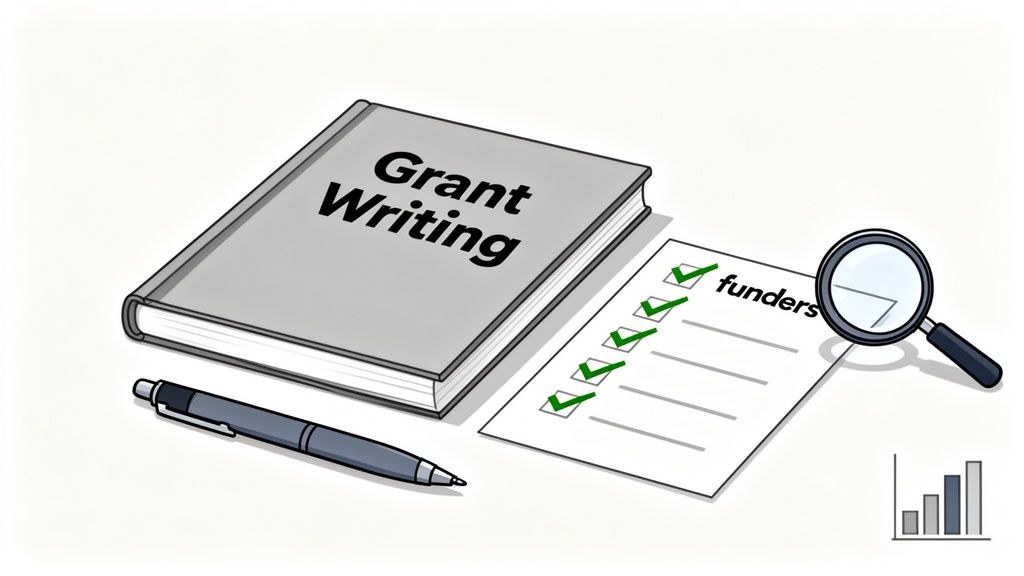
For so many nonprofits, grants are the fuel that keeps the engine running. Yet, the whole process of applying can feel like an intimidating, high-stakes game. The right books on fundraising can change that, turning grant writing from a dreaded task into one of your organization’s biggest strengths. They give you a solid framework for putting together proposals that don't just tick the boxes, but actually connect with foundation staff.
These books walk you through the entire journey, from start to finish. You’ll get a feel for how to spot funders who genuinely care about your cause, build real relationships with program officers, and tell a powerful story about the work you do.
Building Your Proposal From the Ground Up
The best grant writing guides take what seems like a huge, messy process and break it down into clear, doable actions. They show you how to write a needs statement that really grabs attention and makes your case, which is absolutely essential for getting noticed. You’ll also find solid templates for creating a budget that shows exactly how every dollar will lead to a tangible result.
What these books teach better than anything is how to strike the right balance between hard data and a human story. A successful proposal isn’t just a pile of statistics; it's a narrative about people, backed by proof. If you're just starting out, our own guide on grant writing for beginners is a perfect place to get your feet wet and learn these core skills.
The real goal of a proposal isn't just to secure funds; it's to build a funder's confidence in your ability to create change. A well-written grant shows them you have a clear vision, a solid plan, and the capacity to deliver on your promises.
This is especially important when you realize that many nonprofits see grant rejection rates of over 80%. The strategies you'll find in these books can give you a much better shot by teaching you what funders really look for, like clear impact data. That combination of expert knowledge and real-world application is how you win in a crowded field. If you're curious about the publishing world, you can read the full research about book publishing statistics.
Top Grant Writing Books to Add to Your Shelf
While there are tons of titles out there, a few really stand out because they’re packed with practical advice you can use right away.
- "Grant Writing for Dummies" by Beverly A. Browning: Don't let the name fool you. This is an incredibly thorough guide that takes you from finding the right opportunities all the way to handling the reporting after you’ve won the award. Its step-by-step format is perfect if you’re new to this, but it’s also a fantastic refresher for seasoned pros.
- "The Only Grant-Writing Book You'll Ever Need" by Ellen Karsh and Arlen Sue Fox: This book’s superpower is making the whole process less mysterious. It's loaded with detailed examples, checklists, and inside tips for handling the unique demands of both government and private foundation grants.
- "Storytelling for Grantseekers" by Cheryl A. Clarke: This one zooms in on what might be the most crucial—and most forgotten—part of any proposal: the story. It teaches you how to write a narrative that makes a funder feel emotionally connected to your mission and goals.
These books give you the strategic mind and the storytelling heart you need for a winning proposal. When you pair that human-centered knowledge with a tool like Fundsprout, you build a powerful system for finding grants, writing persuasive applications, and managing your entire pipeline from one cycle to the next.
Books for Cultivating Major Donor Relationships

While grants keep your programs humming along, major gifts are what truly build the runway for long-term growth and stability. Securing these game-changing donations is less about a single ask and more about mastering the art of building genuine, lasting relationships. The best books on fundraising in this arena get that.
They teach the entire journey, from finding the right people to providing the kind of meaningful, personalized follow-up that makes a donor feel like a real partner. Think of it like tending to a garden—it demands patience, understanding, and tailored care to help something incredible grow. This deeply human approach is the absolute soul of great fundraising.
It's a Relationship, Not a Transaction
Too many fundraisers treat a major gift like the finish line. The most experienced pros, and the books they learn from, see it as just one milestone in a much longer relationship. The real magic happens in the cultivation before the gift and the stewardship long after the check has cleared.
This means you have to get really good at listening. When you take the time to understand a donor's personal motivations and their connection to your cause, you can perfectly align their desire to give with your organization’s real-world impact.
"Fundraising isn’t an obligation; it’s a privilege. You have an opportunity to invite others to invest in a cause that truly makes a difference."
This shift in mindset—from obligation to opportunity—is everything. When you genuinely believe you're offering someone a chance to change the world, your whole approach becomes more confident, authentic, and effective.
Top Books for Major Gift Fundraising
Some books have earned their place on every fundraiser's shelf because they offer practical, actionable ways to do this relationship-focused work. They give you the strategies, scripts, and psychological insights needed to connect with donors on a much deeper level.
- "Making a Case Your Donors Will Love" by Jerold Panas: This is a masterclass in building a story so compelling that donors feel an urgent need to be a part of it. Panas shows you how to lay the emotional and intellectual groundwork that makes asking for a major gift feel like the natural, obvious next step.
- "Asking" by Jerold Panas: Once the case is solid, you still have to ask. This classic guide demystifies the whole process, stripping away the fear and awkwardness. It’s packed with practical advice and encouragement to help you make bold, respectful asks with confidence.
- "Donor-Centered Fundraising" by Penelope Burk: Burk's work is, frankly, revolutionary because it's backed by mountains of data. She proves that the key to keeping donors and inspiring them to give more is to focus relentlessly on their experience, provide amazing reporting, and make them feel absolutely essential to your success.
Putting These Insights into Practice
The wisdom in these books gives you a powerful roadmap. You'll learn how to spot potential major donors, shape your communication to their unique interests, and follow up in a way that proves their investment made a real, tangible difference.
This strategic, people-first approach is essential for any nonprofit that wants to be around for the long haul. To explore more tactics that drive this kind of engagement, check out our guide on nonprofit fundraising best practices.
Ultimately, these books on fundraising teach one core lesson: major gifts aren't a numbers game; it's a people business. It's about turning a donation into a partnership built on shared values and mutual respect. That's the kind of wisdom technology can support but never truly replace.
Building a Sustainable Fundraising Strategy
Running from one campaign to the next feels like you're constantly putting out fires, right? It’s a recipe for burnout. Simply asking for money whenever you need it isn't a strategy—it's a short-term fix that will leave your team exhausted and your funding unpredictable.
A true fundraising strategy is your plan to get off that hamster wheel. It’s about building a reliable system that brings in consistent revenue, letting you focus on your mission for years to come. This is where the right books on fundraising strategy become invaluable. They're not just about tactics; they're about shifting your entire perspective from daily tasks to a long-term, sustainable vision.
The Architecture of a Strong Fundraising Plan
These kinds of books help you build the entire framework for a healthy development program. They push you to answer the really big questions: What's the right mix of funding for us? How do we build a great fundraising team that actually sticks around? And how do we get everyone, from the board down, excited about philanthropy?
A solid plan means every grant proposal, every donor meeting, and every event has a clear purpose. You're no longer just throwing things at the wall to see what sticks. Instead, every action is a deliberate step toward a bigger goal. The best authors in this space challenge you to think like an architect, designing a diversified funding model that blends grants, major gifts, and maybe even some earned income so your organization can weather any storm.
A mindset shift is especially powerful when it comes to fundraising. You or your board members may think, “I have to” or “I should” when it comes to asking for money. What if you reminded yourself that you get to ask for money, or that you choose to ask because you believe deeply in the mission?
When your team sees their role as connecting passionate people with a meaningful cause, everything changes. Moving from a sense of obligation to one of opportunity is the key to building a positive and successful fundraising culture.
Essential Books for Strategic Thinking
To build this kind of big-picture thinking, a few books are absolute must-reads. They provide the frameworks you need to stop managing tasks and start leading a successful development program.
- "The Big Leap" by Gay Hendricks: This isn't your typical fundraising book, but it's one of the most important. Hendricks unpacks what he calls the "Upper Limit Problem"—our natural tendency to sabotage ourselves right as we're about to achieve a major breakthrough. If you're a leader trying to hit ambitious goals, this book is critical for developing the mindset to smash through those growth plateaus.
- "Essentialism" by Greg McKeown: Fundraisers are pulled in a million directions at once. McKeown's concept of "the disciplined pursuit of less" is the perfect cure for that feeling of being overwhelmed. This book gives you permission—and a method—to focus only on the few activities that deliver the biggest results for your mission. It’s all about cutting through the noise to lead with purpose.
- "Fundraising Bright Spots" by Robbe Healey, CFRE, ACFRE and Victoria B. Jones, CFRE: Instead of focusing on theory, this book is all about what’s actually working in the real world. Through practical case studies, it shows you the common threads that link highly successful fundraising programs. It’s a fantastic guide for figuring out your organization's unique strengths and building a strategy around them.
And if your strategy includes creating your own content, like an impact report or a guidebook, knowing the ins and outs of marketing a self-published book can be a game-changer for getting your mission in front of more people.
These books give you that crucial 30,000-foot view. They’ll equip you not just to raise more money, but to build a more resilient, focused, and mission-driven organization for the long haul.
Turning Knowledge into Action with Modern Tools
Reading the best books on fundraising gives you a solid foundation—the proven strategies and a deeper sense of what truly motivates donors. But knowing is only half the battle. The real magic happens when you pair that timeless wisdom with the right modern tools.
Think of it this way: the book is your blueprint, but software is the crew that brings your fundraising vision to life quickly and efficiently. Instead of just knowing you should personalize donor outreach, you can actually do it at scale.
This simple flowchart helps you zero in on the right book for your role, whether you need to focus on big-picture strategy or the nitty-gritty of daily fundraising.
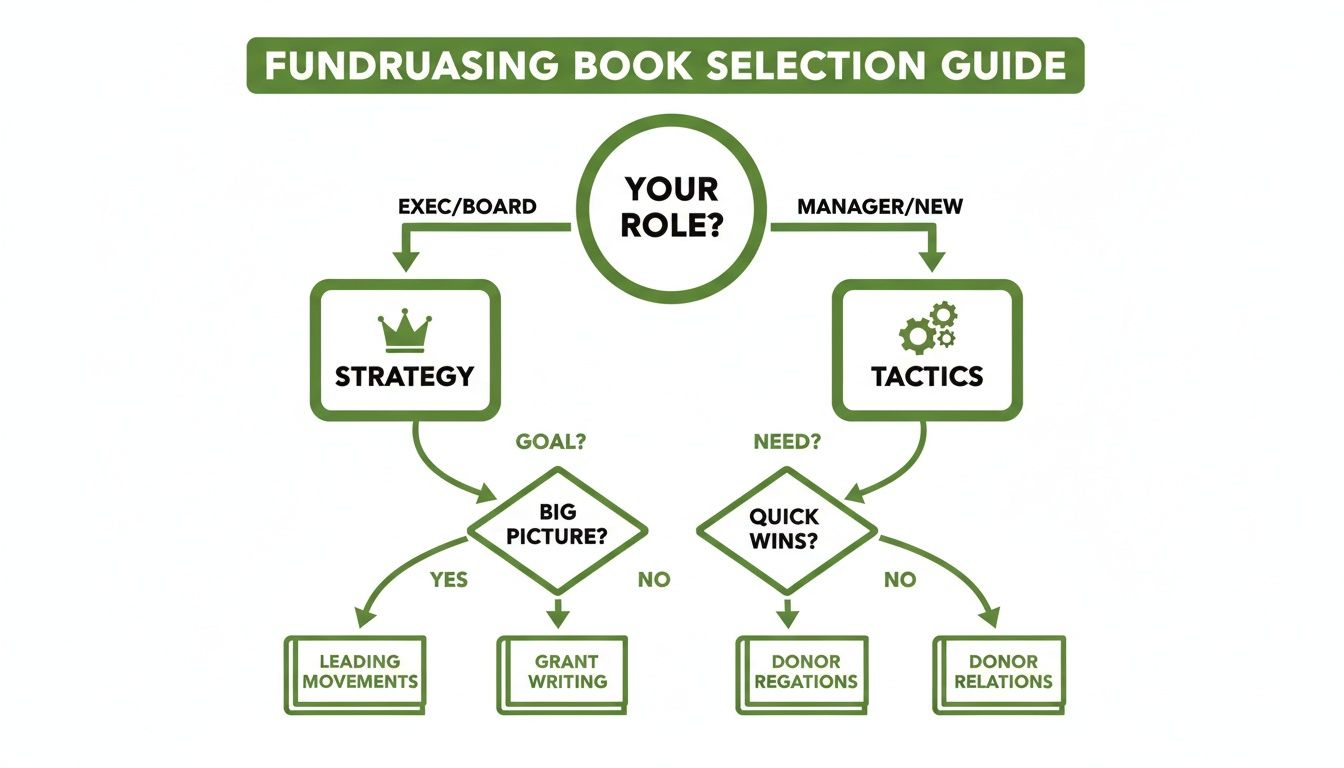
As you can see, leaders and board members should start with strategy, while frontline fundraisers and managers will get more out of tactical guides.
From Book to Action: A Practical Workflow
So, how do you put what you’ve learned into practice? Let's walk through a real-world example using a platform like Fundsprout. Imagine you just finished a book on data-driven prospecting and now have a new framework for identifying your ideal funders.
Input Your Strategy: Start by translating the book's "ideal funder profile" into specific search criteria. Instead of just looking for "education grants," you now know to search for foundations that have funded after-school STEM programs for middle schoolers, specifically in your county.
Build a Dynamic Pipeline: Now, use a grant discovery tool to run that highly specific search. The software instantly combs through thousands of opportunities, delivering a ranked list based on your exact criteria. Your book's theory just became an actionable pipeline in minutes, not weeks.
Analyze and Prioritize: The right platform will automatically screen for eligibility and give you a competitive overview. You can quickly see which funders are the best match, review their giving history, and confirm your mission aligns with their priorities. This helps you focus your energy where it will count the most.
This workflow takes a powerful concept from a book and makes it a manageable, repeatable process.
A book gives you the recipe for finding the right ingredients. A grant success platform goes to the market for you, finds the highest-quality options, and lines them up on your counter, ready for you to start cooking.
Supercharge Your Storytelling with AI
Another universal theme in fundraising books is the power of a great story. A compelling narrative is what connects a donor's heart to your mission's impact. But let's be honest—crafting that perfect narrative for every grant application, email, and report is incredibly time-consuming.
Here’s how to put your new storytelling skills into action without burning out:
Master the "Why": A book like Storytelling for Grantseekers teaches you the architecture of a compelling narrative—the emotional hooks, the structure, and the call to action. This human insight is, and always will be, your most valuable asset.
Accelerate the "How": Once you have the strategic direction, use an AI writing assistant to create a first draft. By feeding the AI your past proposals, impact reports, and program data, it learns your organization's voice. It can then help you produce narrative sections that are already on-brand and mission-aligned.
Refine and Personalize: The AI handles the heavy lifting, freeing you up to do what you do best: add nuance, emotion, and personal touches. You can spend your time perfecting the story, not staring at a blank page.
If you're curious to learn more, our guide on using AI for grant writing offers even more practical tips. This blend of human strategy and machine efficiency ensures the powerful storytelling principles you learned are applied consistently across all your fundraising, helping you make a bigger impact.
Beyond Books: Alternative Learning for Fundraisers
Reading the best books on fundraising gives you an incredible strategic foundation. But let's be honest, your professional growth can't stop there. To keep up with the fast-moving world of philanthropy, you really need a complete "learning stack" that layers deep, book-based knowledge with more current, dynamic sources of information.
I like to think of it as diversifying your learning portfolio. The books are your long-term, foundational investments—the solid index funds. But podcasts, blogs, and online communities? Those are the individual stocks that give you real-time insights into what's happening right now.
Tune In with Fundraising Podcasts
Podcasts are a game-changer for learning on the go. You can turn your commute or a quiet afternoon of data entry into a serious professional development session. They offer timely interviews and fresh perspectives you simply won’t find in a book published two years ago.
Here are a couple of ways to find the right ones for you:
- For tactical advice: Look for shows that interview frontline fundraisers about what’s working for them today. These episodes are goldmines for practical tips on everything from email subject lines to new donor event ideas.
- For big-picture thinking: Seek out podcasts that feature nonprofit leaders and thinkers discussing where philanthropy is headed. These conversations can spark new strategies and help you see your work from a 30,000-foot view.
Learn from Blogs and Online Communities
While you can listen to podcasts, fundraising blogs give you scannable, tactical advice you can put into action immediately. Some of the most influential fundraisers and consultants share their best stuff on their blogs, giving you free access to expertise that can solve a specific problem you're wrestling with today.
And then there are online communities—whether on LinkedIn, Facebook, or dedicated forums. These offer something uniquely powerful: your people.
Having a network of peers to ask questions, share wins, and vent frustrations is invaluable. It’s a real-time, collaborative learning environment where you can get immediate feedback on an idea or find solidarity when facing a tough challenge.
These communities are the digital water cooler, connecting you with fundraisers from all over the world. They’re a space to build real relationships and tap into the collective wisdom of people who are in the trenches right alongside you.
Finally, don't sleep on practical templates and toolkits. Countless organizations offer downloadable resources like appeal letter templates, budget worksheets, and campaign checklists. While books on fundraising teach you the why behind these documents, a great template can save you hours of work, helping you put that knowledge into practice that much faster. By building out this complete learning stack, you’ll always have the right resource for the job, from deep strategic thinking to quick, effective execution.
A Few Common Questions About Fundraising Books
You've got the reading list, but a few practical questions might still be bouncing around in your head. Let's tackle some of the most common ones I hear from fellow nonprofit pros.
I'm a New Fundraiser. Which Book Should I Start With?
If you're just getting your feet wet, you need a map of the whole territory, not a deep dive into one specific corner. That's why I always point new fundraisers to "Fundraising for Dummies."
Don't let the title fool you—it’s an incredibly smart, accessible overview of the entire fundraising landscape. It walks you through everything from grant writing and annual appeals to major gifts and events. You'll finish it with a solid grasp of how all the pieces fit together.
The goal for a beginner isn't to become an expert overnight. It's to build a foundational understanding of the fundraising ecosystem. A comprehensive guide like this gives you that crucial 30,000-foot view, so you can then decide where you want to zoom in next.
How Can I Possibly Find Time to Read With My Schedule?
I get it. This is the perennial challenge in our line of work. The secret isn’t finding huge, uninterrupted blocks of time—it’s building a small, consistent reading habit.
Here are a few tricks that have worked for me and my teams:
- The 15-Minute Rule: Just commit to 15 minutes a day. That’s it. Have a book open next to your coffee in the morning or read a few pages to decompress before logging off. It all adds up.
- Audiobooks Are Your Friend: The ability to learn while you're driving, walking the dog, or stuffing envelopes is a game-changer. Most popular books on fundraising are available in audio format.
- Start a Mini Book Club: Grab one or two colleagues and agree to read a chapter a week. It creates accountability and gives you a chance to bounce ideas off each other. You’ll be surprised how much you learn from someone else's perspective on the same material.
Are Older Fundraising Books Still Relevant?
Absolutely. While the tools we use have changed dramatically, the core principles of what motivates people to give—psychology, trust, and authentic connection—are timeless. The classics give you the "why" behind what works.
The best fundraisers I know blend the old with the new. They read the foundational books to master the art of donor relationships, then use modern tools like CRMs or AI assistants to put those time-tested strategies into practice more effectively.
How Do I Justify Buying These Books for Our Team?
When you ask for budget approval, frame this as a direct investment in your organization's sustainability, not an "expense." It’s low-cost professional development with a potentially massive return.
Try calculating the ROI. You could walk into your ED's office and say, "If we invest $150 in these books on grant writing and major gifts, and they help us improve our success rate by just 5%, that could mean tens of thousands of dollars in new funding this year." That’s a conversation that gets attention.
Ready to put all this knowledge into action? Fundsprout is an AI-powered platform designed to help you find grant opportunities, draft compelling proposals, and manage your funding pipeline from start to finish. Discover how Fundsprout can accelerate your mission.
Try 14 days free
Get started with Fundsprout so you can focus on what really matters.