Finding the Best Fundraising Software for Small Nonprofits in 2026
Discover the best fundraising software for small nonprofits. Our 2026 guide helps you compare features, pricing, and find the right tool to fuel your mission.


Abdifatah Ali
Co-Founder
For a small nonprofit, the best fundraising software isn't about having the most bells and whistles. It’s about finding an affordable tool that does exactly what you need, whether that’s a solid donor CRM, a simple online donation page, or an all-in-one platform that juggles a bit of everything. Your budget, your team's size, and your biggest fundraising headaches will point you to the right solution.
Why the Right Fundraising Software Is Your Nonprofit's New MVP

It’s a familiar scene for many small nonprofits: overflowing binders, a patchwork of messy spreadsheets, and hours of valuable time spent on manual data entry instead of building real relationships with supporters. When you’re buried in administrative tasks, you can’t focus on the mission.
This is where the right software stops being an expense and becomes your most valuable player. Think of it this way: fundraising with spreadsheets is like trying to water a community garden with a single watering can. You can get the job done, but it’s slow, exhausting, and you can only reach so many plants. Good software is like installing an irrigation system—it handles the heavy lifting automatically, so you can focus on planting seeds and cultivating growth.
A Digital Force Multiplier for Lean Teams
For small teams, a good platform does more than just organize data; it multiplies your impact. By automating the tedious work and unlocking insights about your donors, it frees your team to focus on strategy, outreach, and the mission-driven work that truly matters.
This shift from manual effort to strategic fundraising is happening everywhere. The global market for nonprofit fundraising software was valued at USD 3.7 billion in 2023 and is expected to climb past USD 9.5 billion by 2033. That explosive growth tells a clear story: these tools are no longer a luxury but an essential part of a modern nonprofit's toolkit. You can explore the full market analysis from Research and Markets to see the trends for yourself.
The best fundraising software for small nonprofits isn't the one with the most features. It's the one that solves your biggest problem simply and effectively, giving you back your most valuable resource: time.
This guide will walk you through the software landscape, starting with a quick look at the main categories you'll encounter.
A Quick Guide to Fundraising Software Types
Before we get into the details, it helps to understand the main types of fundraising software out there. Each is built for a different job, and knowing the difference is the first step in finding what your organization actually needs. This table gives you a quick orientation.
| Software Type | Primary Function | Best For Small Nonprofits That... |
|---|---|---|
| Donor Management & CRM | Centralizes all supporter data, tracks interactions, and manages relationships. | Need a single source of truth for all donor information and history. |
| Online Donation Platforms | Provides secure, branded pages for collecting one-time and recurring gifts. | Want to make online giving simple, fast, and accessible for supporters. |
| Grant Management Platforms | Manages the entire grant lifecycle from research and writing to reporting. | Rely on institutional funding and need to track complex deadlines. |
Decoding the Different Types of Fundraising Platforms
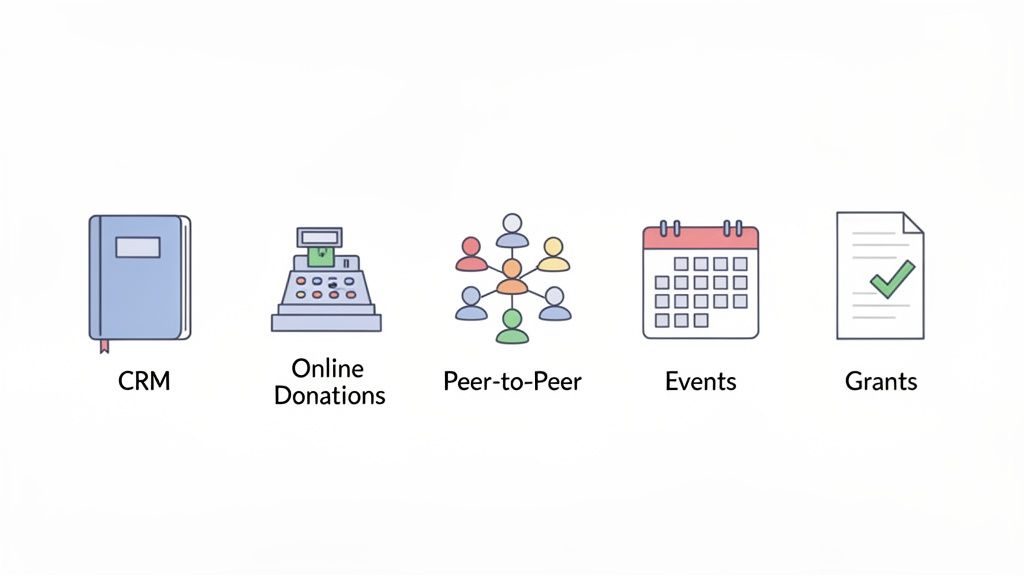
Stepping into the world of fundraising software can feel overwhelming. The market is crowded with tools that all seem to promise the world, using a jumble of acronyms and overlapping features. To find the right fit for your small nonprofit, you first have to understand what these different tools actually do.
Let’s cut through the noise. Instead of getting bogged down in technical jargon, we'll break down the main categories based on the real-world problems they solve. Think of it like building a workshop for your mission—you need the right tool for the right job.
Donor Management and CRMs: The Relationship Hub
At the very core of any successful fundraising operation is a Donor Management platform, more commonly known as a CRM (Customer Relationship Management) system. This is your nonprofit’s brain. It’s built to hold every shred of information about your supporters in one organized place.
Think of it as a shared memory for your entire team. It remembers every donation, event registration, volunteer shift, and conversation you’ve had with each person. This lets you move beyond generic “Dear Friend” emails and start building genuine, lasting relationships—the key to keeping donors engaged for years to come.
A good CRM helps you find answers to game-changing questions:
- Who are our most loyal donors from the past three years?
- Which supporters came to our last event but haven't made a gift this year?
- How many brand-new donors did our last social media push bring in?
For a small nonprofit, a CRM turns a messy spreadsheet of contacts into a living, breathing community. It’s the foundation for everything else you do.
Online Donation Platforms: The Digital Donation Jar
If a CRM is your relationship hub, an Online Donation Platform is your always-on, always-open digital donation jar. Its main job is to make giving money to your cause as easy as possible. These tools create the branded, mobile-friendly donation forms where your supporters can make one-time gifts or set up recurring donations.
Today's platforms do more than just process credit cards. They often include smart features to encourage more giving, like suggested donation amounts, campaign progress thermometers, and the option for donors to cover the processing fees. With 63% of donors now preferring to give online, having a smooth and trustworthy donation page is no longer optional.
The best online donation tools make giving feel effortless. A supporter's impulse to help can vanish in a matter of seconds, so a fast, secure, and mobile-friendly experience is absolutely critical.
Peer-to-Peer Fundraising Tools: The Campaign Multipliers
Peer-to-Peer (P2P) fundraising tools give your most passionate supporters the power to become fundraisers themselves. This software lets individuals launch their own personal fundraising pages connected to your main campaign. We see this all the time with charity 5Ks, birthday fundraisers, or giving day challenges.
These platforms essentially turn your supporters into a volunteer fundraising force, pushing your message far beyond your own network. It’s all about social proof. A recommendation from a friend is often far more powerful than an email from an organization. P2P is a fantastic way to engage your community and find new donors who trust the people they know.
Event Management Software: The Virtual (and Physical) Coordinator
From online auctions and virtual galas to in-person workshops and fun runs, Event Management Software is built to handle all the moving parts. These platforms take care of ticketing, registration, communicating with attendees, and processing payments for your fundraising events.
For a small team, event logistics can be a huge time sink. This kind of software keeps all your attendee and donor information in one spot, saving you from the headache of juggling separate tools for ticketing, emails, and donation tracking. It ensures every person who engages with your event is captured in your CRM for follow-up later on.
Grant Management Platforms: The Focused Toolkit
Finally, we have Grant Management Platforms. These are highly specialized tools designed for one very specific, high-stakes purpose: winning and managing grants from foundations and corporations. While you can use a general CRM to note a few deadlines, it just doesn't have the muscle to handle the complex grant lifecycle.
These platforms are built to help with everything from researching potential funders and tracking application documents to managing reporting deadlines and collaborating on proposals. For any nonprofit that depends on grant funding, a dedicated system like Fundsprout is a must-have. It takes you from a chaotic web of spreadsheets to an organized, effective workflow—which is crucial when a single missed deadline can mean losing out on thousands of dollars.
How to Choose a Platform Without Breaking Your Budget
For a small nonprofit, every single dollar counts. The pressure to pick the right fundraising software can be immense, but it doesn't have to be a source of anxiety. The real trick is to look past the sticker price and find a platform that genuinely adds value without slowly draining your resources.
Making a smart choice really comes down to five key areas that affect both your budget and your team’s ability to succeed. By thinking through each of these, you can confidently find the best fundraising software for your small nonprofit—one that feels like it was made just for you.
Look Beyond the Subscription Price
That monthly or annual fee you see advertised? That's just the tip of the iceberg. The true cost of any software is a combination of the subscription, transaction fees, support packages, and any add-ons you might need down the road. A "free" platform might look appealing, but it could take a big slice of every donation. On the other hand, a paid platform with lower processing fees might actually save you money over the year.
Always get a complete picture of the costs. Ask about:
- Transaction Fees: What percentage do they take for credit card processing?
- Platform Fees: Does the company charge its own fee on top of the standard processing fee?
- Hidden Costs: Will you be charged extra for setup, migrating your data, or getting priority support when something goes wrong?
Understanding the total cost of ownership is everything. You can explore various pricing structures to get a feel for how different models stack up and what truly fits your budget.
Honestly Assess Your Staff Capacity
I've seen it happen time and again: a small nonprofit invests in a complex, powerful system only for it to become expensive "shelfware." The most feature-packed software is completely useless if your team doesn't have the time or the technical chops to actually use it.
Get real about your team’s comfort with technology and how much time they can realistically dedicate to training and management. A tool that's too complicated creates more headaches than it solves. Often, the smartest move is to pick a simpler platform that is fantastic at solving your one biggest fundraising challenge, whether that's simplifying online donations or finally getting your donor data organized.
Prioritize Essential Integrations
Your fundraising software is not an island. It has to play nicely with the other tools you depend on every day, like your email marketing platform (think Mailchimp) or your accounting software (like QuickBooks). If they don't connect seamlessly, your team will be stuck in the miserable loop of manually exporting and importing spreadsheets—a process that’s both tedious and a recipe for errors.
Before you sign any contracts, make a list of your must-have tools and get confirmation that the new software integrates with them. This is the key to a smooth workflow and having a single source of truth for your data.
Ensure the Reporting Proves Your Impact
How do you know if your fundraising is actually working? You need good data. Strong reporting isn't a "nice-to-have"; it's a non-negotiable. Your software must make it easy to track key metrics and pull clean reports that show your board, donors, and funders the incredible impact you're making.
The right software doesn’t just collect data; it helps you tell a story with it. You should be able to instantly see who your top donors are, which campaigns performed best, and how your donor retention is trending over time.
This isn't just about looking good. This data is what allows you to make smart, strategic decisions and focus your limited resources where they'll make the biggest difference.
Match the Tool to Your Fundraising Focus
Different software is built for different jobs. A platform that shines for peer-to-peer campaigns will be a frustrating dead-end if your funding primarily comes from grants. This is where you need to think about how donors actually behave today. For instance, 32% of donors get their giving inspiration from social media, and email drives another 30% of engagement. At the same time, the average mobile gift is now $79 and growing. These stats show why you need a system that can track engagement from all directions. You can influence your software choice on Double the Donation by digging into more donor statistics.
Ultimately, you have to align the software’s strengths with your core fundraising activities. If you run a lot of galas and events, you need top-notch event management features. If individual giving is your organization's lifeblood, a powerful CRM is what you need. And if grants are your main focus, a specialized platform built for that unique workflow will always give you the best results.
Comparing the Top Fundraising Software Categories
When it comes to picking fundraising software, small nonprofits often get stuck looking for one perfect tool that does it all. The reality? There isn't one. The secret is to understand what each type of software does best and match it to where your money actually comes from.
Let's break down the main categories—CRMs, online donation tools, and specialized grant platforms—to see how they stack up. Think of it like hiring staff: you wouldn't hire a grant writer to manage your social media, or an event planner to do your accounting. You need the right specialist for the right job.
Donor Management and CRMs: The Relationship Hub
A donor management platform, or CRM (Customer Relationship Management), is the heart of your individual donor fundraising. It’s your digital Rolodex, but so much smarter. Its real power is in giving you a complete picture of every person who supports you. It tracks their donation history, volunteer activity, and even which emails they open.
If your organization runs on donations from individuals, a CRM is essential. It lets you see who your most loyal supporters are, send targeted appeals to specific groups, and make sure everyone gets a timely, personal thank you. But where they fall short is with the complex, multi-step world of grant applications. A CRM can note a deadline, but it isn’t built to manage the detailed workflow of writing a proposal, gathering attachments, and tracking follow-up reports.
Online Donation Tools: The Digital Collection Plate
If a CRM is your relationship hub, a simple online donation tool is your digital collection plate. These tools are all about one thing: making it incredibly easy for someone to give you money.
They provide clean, branded donation pages that work beautifully on a phone, capturing that burst of generosity when someone feels inspired by your work. For small nonprofits focused on grassroots campaigns, giving days, or a straightforward year-end appeal, these tools are brilliant. The tradeoff is that they are purely transactional. They process payments efficiently but don't offer the deep relationship-tracking of a CRM or the heavy-duty project management needed for grants.
Grant Success Platforms: The Specialist's Toolkit
Grant success platforms are a completely different animal. While CRMs go broad and donation tools keep it simple, these are precision instruments built for one high-stakes purpose: winning and managing grants from foundations and government agencies.
The grant lifecycle—from prospect research and proposal drafting to tracking deliverables and submitting compliance reports—is a unique and complex workflow. General-purpose CRMs often handle this poorly, treating a $100,000 grant proposal like just another calendar entry.
This is exactly why a specialized tool like Fundsprout is so effective. It’s designed from the ground up to manage the chaos of the grant-seeking process. For any nonprofit where grants are a major slice of the funding pie, this focused approach provides a much stronger return. It turns a frantic mess of spreadsheets, scattered documents, and missed deadlines into a calm, organized, and strategic operation.
As you weigh your options, don't forget to check how well a platform plays with your other essential software. For example, seamless QuickBooks integrations are a huge time-saver, ensuring your fundraising data flows directly into your accounting system without tedious manual entry.
To help you visualize the tradeoffs, here's a direct comparison of the software categories.
Fundraising Software Category Comparison for Small Nonprofits
This table compares the pros, cons, and typical costs of different software categories to guide your decision-making process.
| Software Category | Key Strengths | Common Limitations | Typical Price Range for Small NPOs | Best Suited For |
|---|---|---|---|---|
| Donor CRM | Manages all individual supporter relationships; great for segmentation and personalized outreach. | Weak on project management for complex grants; can be overly complex for simple needs. | $50 - $250/month | Nonprofits focused on individual giving and building a large donor base. |
| Online Donation Tool | Simple, fast, and optimized for online gift conversion; easy for donors and staff to use. | Limited relationship tracking; not built for managing events or grants. | $0 - $100/month (+ processing fees) | Organizations needing to quickly and easily accept online donations for campaigns. |
| Grant Platform | Manages the entire grant lifecycle with precision; tracks deadlines, proposals, and reports. | Highly specialized; not designed for managing thousands of individual donors. | $100 - $400/month | Nonprofits where grant funding is a significant part of their revenue strategy. |
Ultimately, the right choice boils down to your fundraising mix. If you're building a large base of individual donors, a CRM is your starting point. If you want to dig deeper into that, our guide on the best CRM software for nonprofits is a great next step. But if grants are your focus, a specialized platform is the only way to go. Pinpointing your primary funding source is the single most important thing you can do to choose the right tool for your mission.
When a Grant Success Platform Is Your Smartest Investment
Your Donor CRM is fantastic for keeping track of individual givers, but it starts to fall apart when you try to shoehorn the grant process into it. Using a general-purpose CRM to manage grants is a bit like trying to assemble a Swiss watch with a wrench and a pair of pliers. You might get a few pieces to fit, but it’s going to be a frustrating, inefficient mess, and you’re likely to break something critical.
The grant lifecycle is its own unique beast. It’s a world of prospecting, intricate proposal writing, tracking deliverables, and submitting detailed compliance reports. This isn't just data entry; it's a complex project management challenge that generic software simply wasn't built for.
From Chaos to Clarity with a Specialized Tool
Picture this: you’re running a small environmental nonprofit. You’ve got a steady stream of individual donations, but you know that securing larger grants is the only way to truly scale your impact. Right now, your grant-seeking "system" is a chaotic mix of spreadsheets, random calendar alerts, and documents scattered across multiple folders. Sound familiar?
You burn hours scrolling through foundation databases, only to find most opportunities are a poor fit. Then, a perfect RFP (Request for Proposal) finally lands in your inbox, but your excitement quickly turns to dread as you see the mountain of requirements and the tight deadline. This is exactly where a dedicated grant success platform like Fundsprout completely shifts the dynamic.
Instead of that manual grind, Fundsprout’s AI gets to work, scanning thousands of opportunities to bring you a curated list of grants that are a perfect match for your specific programs and service area. Suddenly, you discover a local foundation you’d never even heard of with a brand-new initiative that aligns perfectly with your mission. This is more than a time-saver; it’s about uncovering the hidden-gem funding you would have missed entirely.
AI-Powered Writing That Conquers Writer's Block
Okay, you’ve found the perfect grant. Now you have to write the proposal. The RFP is dense, complicated, and a little intimidating. Your old process involved spending hours just trying to create an outline from scratch.
With Fundsprout, you just upload the RFP. Its AI instantly breaks down the requirements and generates a complete project outline, mapping out every required section and even suggesting a timeline. What felt like an overwhelming task becomes a clear, step-by-step plan.
But the real breakthrough comes when it’s time to write. You’re staring at that blank "Project Narrative" section, feeling that all-too-familiar writer's block creep in. This is where Fundsprout’s writing assistant becomes your co-pilot. You feed it your past successful proposals, annual reports, and program data, and it helps you draft powerful new sections in your organization's own authentic voice.
A grant success platform isn't just a fancy calendar for deadlines. It's an intelligent partner that actively helps you find funders, write compelling proposals, and manage your reporting—solving the core nonprofit challenges of too little time, overwhelming complexity, and the dread of a blank page.
This process isn't about letting a robot write for you; it's about amplifying your own expertise. The AI can suggest better phrasing, pull the right statistic from a report you uploaded three months ago, and double-check that you've answered every part of a funder's question. It handles the tedious work, freeing you up to focus on the high-level strategy and storytelling that truly wins grants. To dig deeper into how these systems operate, you can learn more about grant management software for nonprofits and their specific advantages.
Finally, when you win the award and it's time to report back, the platform helps automate much of that process, too. It can auto-populate funder templates with the data you've been tracking all along, creating a clean audit trail and making compliance a breeze. This doesn't just save you hundreds of hours; it builds trust with your funders and paves the way for your next renewal. For any nonprofit that depends on institutional funding, a specialized tool like this isn't a luxury—it's the smartest investment you can make.
Your 60-Day Software Implementation Plan
You’ve done the hard work and picked your new software. That’s a huge win! But let's be honest, a new tool is only as good as its launch. A messy rollout can turn that exciting investment into a source of daily frustration for your team.
To make sure your new platform is an asset from day one, you need a plan. This 60-day timeline breaks down the entire process into clear, manageable steps. Whether you're setting up a focused grant tool like Fundsprout or a full-blown CRM, this roadmap will help you get it done right.
Phase 1: Planning and Preparation (Days 1-15)
The first two weeks are all about laying the groundwork. It's tempting to jump right in, but trust me, a little patience here will save you massive headaches later. Your goal is to build a solid foundation for everything that follows.
First things first, pull together your implementation team. Even if it's just two people, this group will own the project from start to finish. Make sure to name one person as the project lead—they'll keep the train on the tracks and be the main point of contact for the software company.
Next, it’s time to tackle your most important asset: your data.
- Audit Your Data: Go through your current spreadsheets and databases. What information is absolutely essential to bring over? What's old, irrelevant, or can be archived?
- Clean Your Data: This is, without a doubt, the most critical step. Get rid of duplicate contacts, fix typos, and standardize your formatting (like making all state entries a two-letter code, e.g., "NY" not "New York").
- Map Your Data: Grab a piece of paper or open a simple document and draw out which data from your old system goes into which field in the new one. This simple map is a lifesaver.
A successful software launch is 90% preparation and 10% execution. Taking the time to get your data clean and organized before you migrate it is the single most important thing you can do for long-term success.
Phase 2: Configuration and Training (Days 16-45)
With your squeaky-clean data ready to go, you can start building out the new system and getting your team comfortable with it. This phase is all about configuration and hands-on training.
Start by migrating your data into the new platform. Most providers have support teams to help with this, but you should always run a test import with a small sample of your data first. This helps you spot any mapping errors before you move everything over. Once the data is in, it's time to set up your donation forms, customize automated thank-you emails, and assign user roles and permissions.
For grant-focused teams, it helps to visualize your workflow and set up the software to match it.
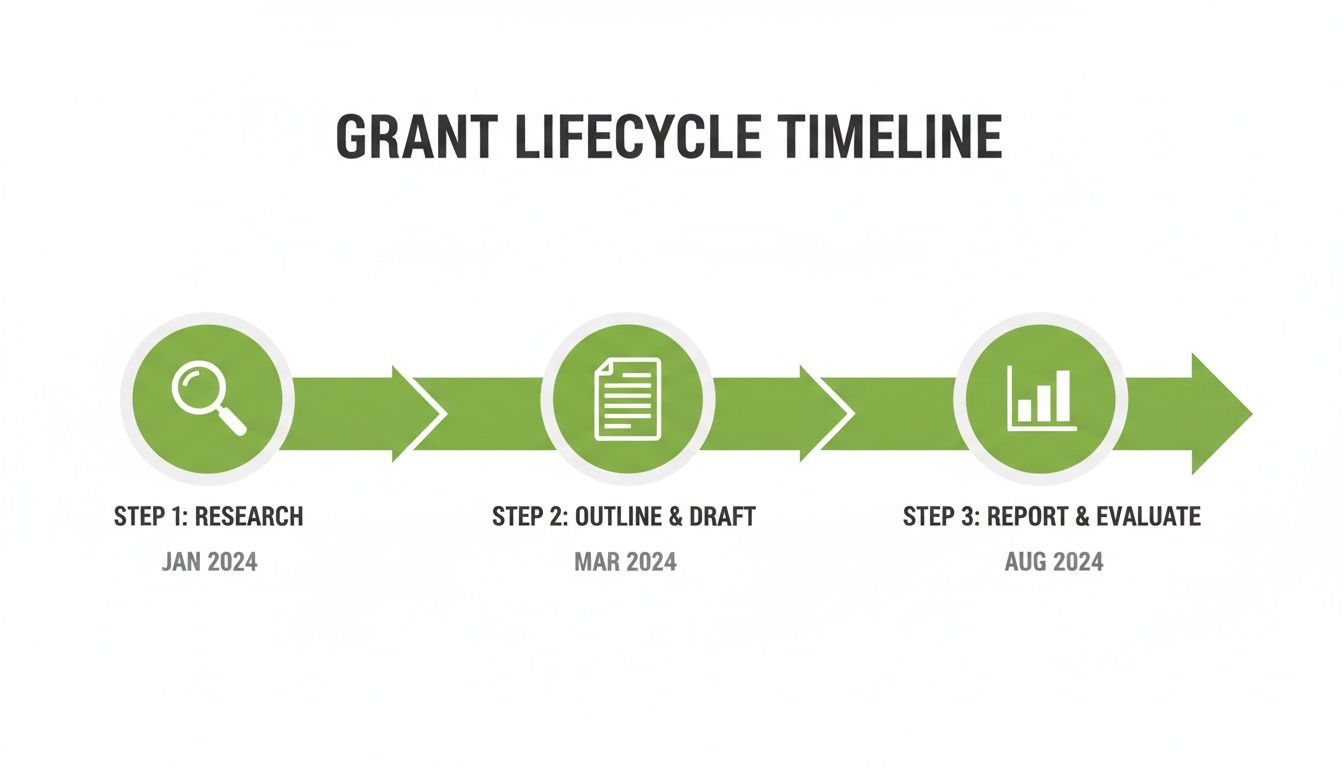
Seeing your process laid out like this—from initial research to final reporting—makes it much easier to configure the software to support how your team actually gets work done.
Now, get training on the calendar. Don’t just send a link to a video library; make the sessions interactive. Here’s a pro-tip: start with a pilot group of 2-3 power users. Let them work in the system for a few days to identify any confusing spots or bugs before you roll it out to everyone else.
Phase 3: Launch and Review (Days 46-60)
Alright, this is it! The final two weeks are about going live and making sure the system is working perfectly. It's time to officially launch the new software and retire those old spreadsheets for good. Announce the launch, celebrate the milestone with your team, and take a moment to appreciate the accomplishment!
For the next couple of weeks, keep a close eye on everything. Are donations processing smoothly? Is data flowing correctly between your integrated tools? At the end of the 60 days, schedule a review meeting. This is your chance to get feedback from the team, troubleshoot any lingering issues, and highlight some early wins to keep the momentum going.
Your Fundraising Software Questions, Answered
If you're digging into fundraising software for the first time, you probably have a few questions. That's completely normal. Let's walk through some of the most common ones we hear from small nonprofits.
How Much Should We Budget for Fundraising Software?
This is the big one, isn't it? A solid rule of thumb is to set aside 2-5% of your annual fundraising revenue for your software and any associated fees.
It’s tempting to see this as just another line item in the expense column, but it's much more helpful to think of it as an investment. The right tool gives you back countless hours by automating tedious tasks and can even help you spot new donation opportunities, paying for itself many times over.
Can We Actually Get By With Free Fundraising Software?
Yes, you absolutely can—especially when you’re just getting your sea legs. Free platforms are a fantastic way to run your first few campaigns without a big financial commitment.
Just go in with your eyes open. Think of it like a starter apartment; it’s perfect for a while, but you’ll eventually outgrow it. As your donor list expands, the limits of "free" tools—like basic reporting, minimal donor tracking, and sometimes surprisingly high transaction fees—start to become real roadblocks. A paid tool often becomes the smarter, more cost-effective choice sooner than you'd think.
How Do We Get Our Donor Data Out of Spreadsheets?
Getting your data out of Excel and into a new system is one of those non-negotiable steps. Get this wrong, and you'll be dealing with headaches for months. Think of it like packing before a big move—a little organization upfront saves a world of pain later.
Here’s a simple process to follow:
- Audit and Clean: Comb through every line. Get rid of duplicate contacts, fix typos in names, and correct any obvious errors. This is your spring cleaning.
- Standardize Your Fields: Make sure your data is consistent. For example, decide if you're using "NY" or "New York" and apply it everywhere. Consistency is king.
- Export as a CSV: Once it's clean and tidy, save the file as a CSV. This is the universal language that almost every software platform understands for importing data.
Ready to master your grant funding? Fundsprout provides the specialized AI tools to find matched funders, write winning proposals, and manage compliance, ensuring your small nonprofit can secure the big grants you need to grow. Discover how Fundsprout can transform your grant-seeking process.
Try 14 days free
Get started with Fundsprout so you can focus on what really matters.