AI grant proposal writing: Master Techniques to Secure Funding
Discover AI grant proposal writing strategies to find funding, craft compelling narratives, and streamline nonprofit grant workflows.

Abdifatah Ali
Co-Founder
If you've spent any time in the nonprofit world, you know the grant writing grind. It's a mountain of research, painstaking compliance checks, and the ever-present pressure to tell a story that moves funders to act. For many, especially smaller teams, it’s an overwhelming cycle that can burn out even the most passionate staff.
But things are starting to change. We're seeing a real shift where artificial intelligence is stepping in to handle the heavy lifting. Think of it as a force multiplier for your fundraising team. Instead of getting bogged down in administrative tasks, you can focus on strategy, relationships, and the core of your mission. We've seen teams slash their proposal preparation time by up to 50%.
The New Frontier in Nonprofit Fundraising
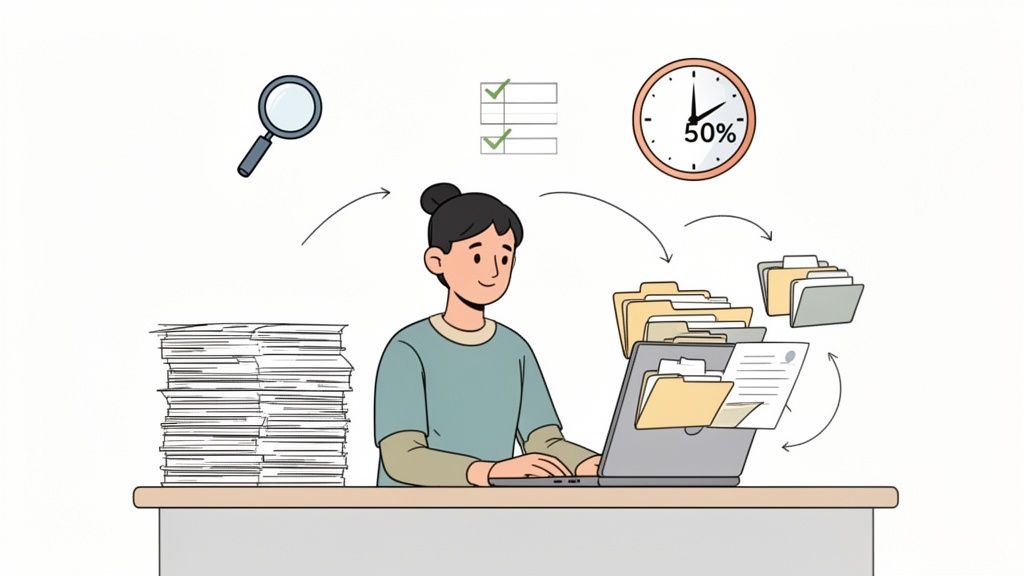
For years, grant writing has been a manual, almost artisanal process. You're hunched over a laptop for hours, sifting through databases, and trying to pull together compelling language from scratch. This isn't just inefficient; it's a major roadblock to securing the funds needed to keep the lights on and programs running.
AI isn't just a buzzword here; it's becoming a core part of the modern nonprofit toolkit. The market for AI-Assisted Grant Writing hit USD 1.15 billion in 2024, which shows just how many organizations are embracing this to stay competitive. Platforms like Fundsprout are designed specifically to automate the most draining parts of the process, freeing up your team to do what they do best. You can read more about this growing market here.
Key Benefits of Integrating AI
The real magic here isn't just speed; it's about working smarter. Bringing AI into your workflow unlocks some serious strategic advantages.
- Spot-On Prospect Matching: Instead of you manually searching through endless databases, AI algorithms can instantly scan and pinpoint funders whose priorities perfectly match your mission. You get a pre-vetted list of high-potential opportunities.
- Bulletproof Compliance and Accuracy: Let's be honest, nobody enjoys triple-checking font sizes and attachment naming conventions. AI can automatically scan an RFP and flag every single requirement, virtually eliminating the risk of getting disqualified over a small mistake.
- Better, More Consistent Narratives: The AI can learn from your past successful grants. It analyzes what worked and helps generate first drafts that sound like you, ensuring your organization’s voice is consistent and compelling.
The big win here is that AI lets grant professionals be strategists, not just administrators. Instead of wrestling with a 50-page RFP, you can spend your time building genuine connections with program officers and honing the powerful stories that actually win grants.
To get a better handle on how this all works, it’s worth exploring some of the top AI content creation tools out there. They give you a good sense of the technology powering these specialized grant writing platforms.
To really see the difference, let’s compare the old way of doing things with a more modern, AI-assisted approach.
Traditional vs AI-Powered Grant Writing Workflows
This table breaks down how AI transforms each stage of the proposal process, turning a marathon into a series of manageable sprints.
As you can see, it's not about replacing the human element but enhancing it. The grant writer is still in the driver's seat, but now they have a much more powerful engine to get them where they need to go.
Finding Relevant Funding Opportunities with AI
Let's be honest, spending days sifting through grant databases with broad keyword searches is a soul-crushing task. It feels productive, but more often than not, it just leaves you with a long list of funders who aren't a great fit. It's a huge waste of your most valuable resource: time.
But what if you could flip that script? AI-powered prospect research turns this tedious chore into a strategic, data-driven advantage. Instead of you hunting for grants, the right tools hunt for you, acting like a dedicated research assistant that never sleeps. They continuously scan federal, state, local, and foundation databases to find not just any opportunity, but the right one.
This isn't just a niche idea; it's being fueled by some serious investment. Global AI investment for startups hit a staggering USD 284 billion in 2024, and generative AI is expected to grab 35% of 2025's projected USD 310 billion. This massive influx of cash is directly improving the tools available to us in the nonprofit world, especially as 78% of organizations now report using AI in some capacity. You can discover more about these empowering AI statistics and see just how deeply they're shaping our sector.
Configuring Your AI for Precision Prospecting
The real magic of using AI for grant research is its ability to understand the nuances of your work. You’re not just telling it to look for "food security grants." You're teaching it the specific DNA of your organization and programs to pinpoint funders who are a perfect match for your mission.
Think of it as building a detailed profile of your ideal funding partner. It all starts by getting granular with your eligibility filters and search parameters.
- Geographic Focus: Go beyond just your state. Specify your service area down to the city, county, or even the exact zip codes you serve to weed out funders who don’t support your region.
- Programmatic Alignment: Don't stop at general categories. Use detailed keywords that describe your specific interventions, like "urban youth gardening," "senior meal delivery," or "after-school nutrition education."
- Funding History: Have the AI analyze a funder's past giving patterns. Does their typical grant size align with your budget? Do they tend to fund brand-new programs or only established ones?
- Organizational Capacity: Be realistic. Set filters based on your nonprofit’s annual budget, years in operation, and staff size to make sure you only see grants you’re actually eligible to win.
The best AI grant platforms don't just spit out a list; they deliver a ranked and scored pipeline. Each opportunity gets a "match score" based on how well it aligns with your criteria, letting you instantly focus your energy on the highest-probability grants.
A Real-World Scenario: Community Food Bank
Let’s see how this works in practice. Imagine you're the development director for a mid-sized community food bank. Your big goal for the year is to launch a new mobile pantry service for underserved rural areas.
Manually, you’d be stuck for days searching terms like "rural hunger," "food access," and "mobile food programs," and then cross-referencing everything. It would be a nightmare.
With an AI platform like Fundsprout, the whole process looks different.
- Define the Project: First, you input the core details of your mobile pantry idea—its goals, the specific population you want to serve (like low-income seniors in three particular rural counties), and the total project budget of $75,000.
- Set Up Alerts: Next, you create a new search profile using keywords like "mobile pantry," "rural food insecurity," and "senior nutrition." You then apply strict geographic filters for only your target counties.
- Refine with Weighting: This is where it gets smart. You can tell the AI that "geographic focus" is the most critical factor, even more so than "program alignment." This teaches the system to prioritize local foundations over large national ones, even if a national funder has a broader interest in hunger.
Within minutes, the AI gives you back a prioritized list. The top result might be a small family foundation that exclusively funds projects in one of your target counties and has a history of giving grants in the $50k-$100k range for new initiatives. This is a golden opportunity you might have completely missed with a generic database search.
You can even set up competitive intelligence alerts to see which other local nonprofits are getting money from your target foundations. This gives you a much clearer picture of the funding landscape and helps you move from simply finding grants to building a true, intelligent funding strategy.
Turning RFPs into Practical Outlines
Staring down a dense, 50-page Request for Proposal (RFP) can be completely overwhelming. I’ve been there. Before you even write a single word, you're faced with hours of work just to figure out what you’re supposed to do. Manually dissecting those documents for every requirement, deadline, and formatting rule is a grind, and one tiny mistake can get your proposal tossed out before it’s even read.
This is exactly where AI tools provide immediate, practical relief. Think of them as a high-speed administrative assistant. They can chew through the entire RFP in seconds and spit out a clear, actionable plan. Instead of spending an afternoon with a highlighter and a notepad, you get a structured outline that becomes the backbone of your whole project. This isn't just about saving time; it's about building a solid foundation from the very beginning.
Extracting Key Requirements with Simple Prompts
The best part about using an AI assistant for this is how straightforward it is. You can use direct, conversational questions—or prompts—to pull out the most important information from that tangled mess of an RFP. This helps you quickly build a comprehensive checklist of everything the funder wants to see, so you aren't scrambling at the last minute for a missing detail.
Here are a few prompts I’ve found incredibly useful for deconstructing an RFP:
- To get the core sections: "Based on the attached RFP, generate a hierarchical outline for the proposal narrative, including all required sections and subsections."
- To identify constraints: "List all specified word count or character limits for each section mentioned in this document."
- To flag compliance items: "Create a checklist of all compliance requirements, like formatting rules (font size, margins), required signatures, and specific document naming conventions."
- To list attachments: "Generate a complete list of all required attachments, such as financial statements, letters of support, and staff bios."
Think of this process as creating an instant project blueprint. The AI translates the funder's jargon into a simple to-do list. It seriously reduces the mental strain on your team and cuts down on the risk of human error.
From Outline to Action Plan
Okay, so the AI has helped you whip up a detailed content outline. Great. But an outline is only useful if it’s tied to actual tasks and deadlines. This is the next place AI can help you bridge the gap between planning and doing, and it can do it remarkably fast.
The diagram below shows how AI fits into the early stages of the funding workflow, helping you move from setup to identifying the best prospects.
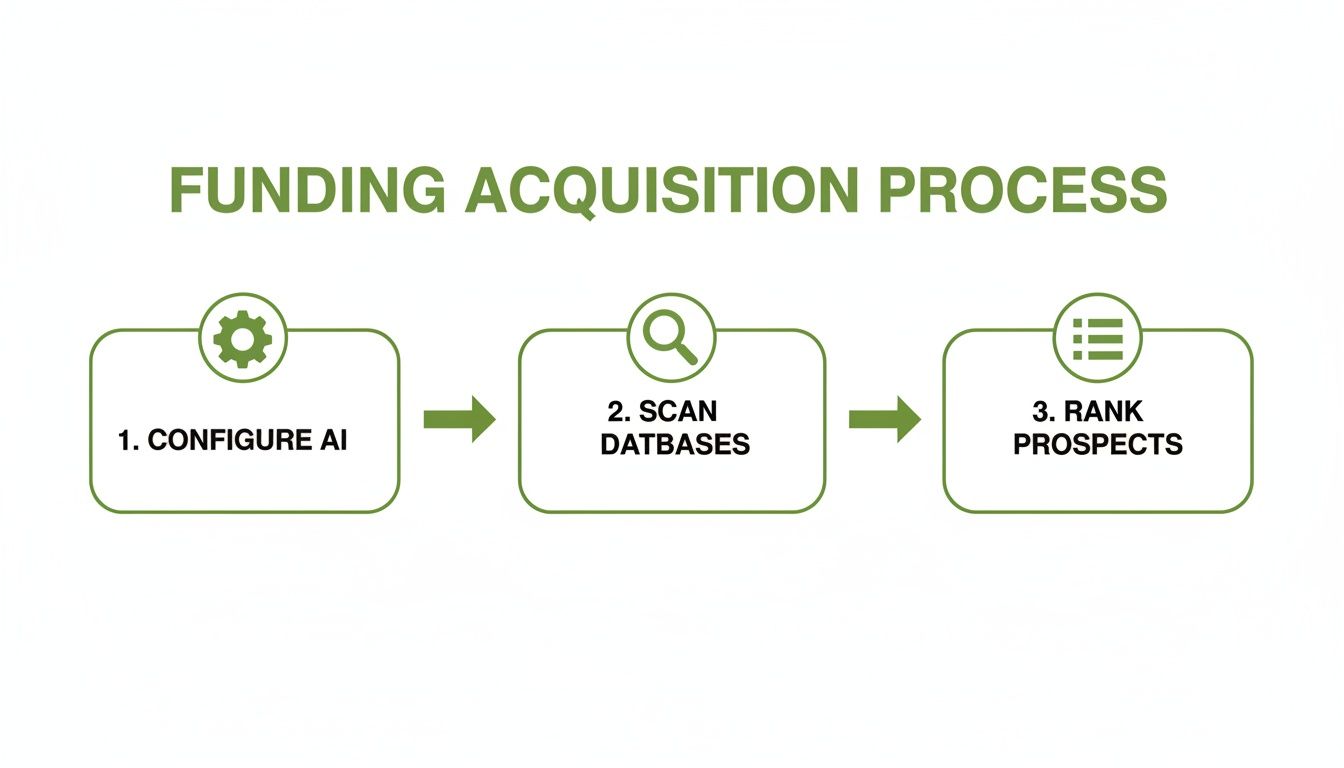
This kind of automated front-end work means that by the time you're breaking down an RFP, you already know it’s a strong potential fit, making your outlining efforts that much more valuable.
With your outline ready, you can ask the AI to take that final step in setting up the project. For a deeper look at structuring your proposal, our guide on how to respond to an RFP offers some extra strategies.
A really powerful follow-up prompt can turn your content checklist into a full-blown work plan.
Example Prompt:
"Using the outline created from the RFP and a final submission deadline of October 31st, generate a project timeline. Assign tasks to Team Member A (Narrative), Team Member B (Budget), and Team Member C (Attachments). Include suggested internal deadlines for first drafts, review cycles, and final approvals, working backward from the due date."
With a single command, you get a collaborative timeline that keeps everyone on the same page. It ensures every piece of the puzzle—from drafting the statement of need to chasing down that last letter of support—is scheduled and tracked. It just sets your team up for a much smoother, less stressful writing process.
Crafting Persuasive Narratives in Your Voice
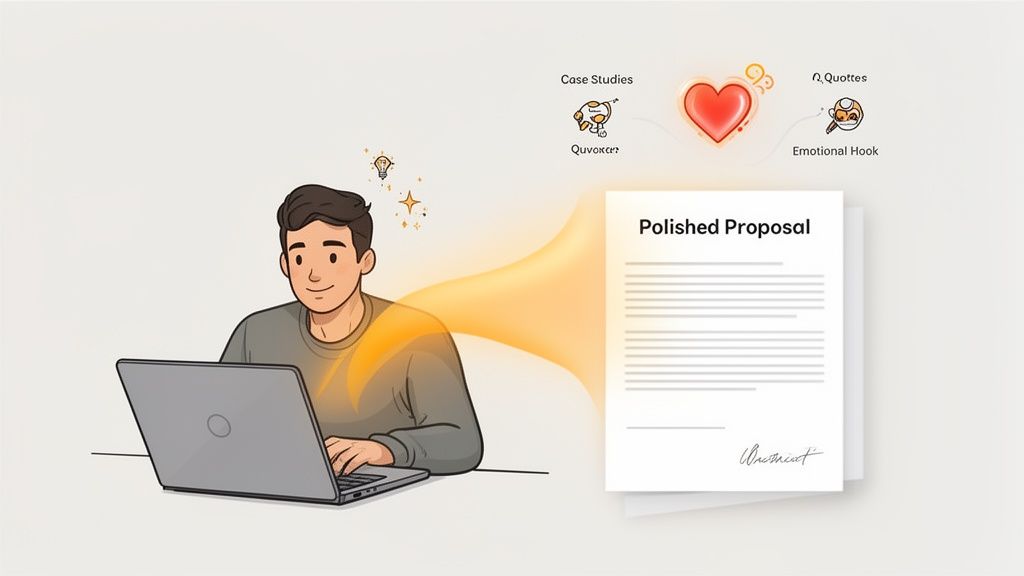
Let's be honest, the real soul of any grant proposal is its story. The statement of need, the methodology, the summary of your impact—this is where you make a genuine connection with the people reading your application. An AI can spit out a technically perfect draft, but it’s going to fall completely flat if it doesn't have your organization's unique voice and passion.
This is where the magic really happens—in the partnership between you and the machine. Your job is to take that structured, AI-generated text and breathe life into it, transforming it into a compelling narrative about your mission. It’s all about blending the AI’s incredible speed with your team’s authentic human touch.
Teaching the AI to Sound Like You
The best AI grant writing platforms don't just pull from a generic language model; they actually learn from you. You can feed the AI your past successful proposals, annual reports, impact statements, and even your website copy. In doing so, you're creating a custom model that gets your specific terminology, your tone, and your style.
This training process is absolutely crucial for getting drafts that feel authentic. An AI that has learned from your materials is leagues ahead of one starting from scratch—it’s much more likely to capture the subtle nuances of how you talk about your work.
This "human-in-the-loop" approach is more important than ever. A recent Candid survey found that only 10% of foundations are currently open to accepting grant applications created entirely by generative AI. Funders are making it clear they want authenticity and a real human touch in the storytelling. For your team, this means AI is a phenomenal assistant for building the framework, but you're still the one who needs to layer in the real stories and data that will actually resonate.
Guiding AI with Targeted Prompts
Once the AI has a good handle on your voice, you can start directing it to draft specific sections using targeted prompts. Remember, the quality of what you get out is directly tied to the quality of what you put in. Vague instructions will always lead to generic results.
To make sure your proposals sound engaging and truly reflect who you are, it’s worth mastering the art of prompting AI to write like a human.
Here are a few examples of how you can steer the AI for different parts of your proposal.
Sample AI Prompts for Grant Narratives
These examples show how to give the AI enough context to produce a relevant, high-quality first draft.
The more specific you are with your instructions, the less editing you’ll have to do later.
From First Draft to Final Story
Think of an AI-generated draft as your starting point, not the finished product. The most important work your team does happens during the review and editing phase. This is where you weave in those irreplaceable human elements that connect with reviewers on a personal level.
A grant proposal should feel like it was written by people who are deeply committed to their work, not by an algorithm. The final polish is your opportunity to ensure every sentence reflects that commitment.
Here's a simple checklist to keep in mind when you're reviewing and enhancing AI-generated text:
- Inject Human Stories: Where can you add a powerful quote from a program participant? Or maybe a brief, anonymous case study that truly illustrates the problem you’re solving?
- Verify All Data: Double-check every single statistic, number, and claim. AI can sometimes "hallucinate" or just make up facts, so human verification is completely non-negotiable.
- Refine the Emotional Tone: Does the text really convey the urgency of the need? The passion of your team? Tweak the wording to strengthen that emotional connection.
- Check for Generic Phrases: Go on a hunt for any "corporate speak" or clichéd phrases and eliminate them. Replace them with specific, active language that reflects what you actually do.
- Strengthen the Cover Letter: Remember, the narrative extends to all your supporting documents. For more specific guidance, check out our deep dive on crafting a persuasive cover letter for a grant proposal.
By following this process, you’re using AI as a tool to amplify your team's expertise, not replace it. The final result is a polished, persuasive, and deeply authentic proposal that will stand out from the stack.
Keeping Your Proposal Compliant and Your Team on Track
You’ve poured weeks of effort into crafting the perfect grant proposal. The last thing you want is for it to be rejected because of a simple, preventable mistake. A missing attachment, the wrong font size, or a deadline that slipped through the cracks can derail everything. This is where AI grant writing tools can become your most trusted, detail-obsessed colleague.
Think of AI as your final line of defense before you hit "submit." Its real power shines in this final review stage. It can meticulously scan your entire proposal against the original RFP requirements in a matter of seconds, flagging every potential issue. It’s the automated pre-flight check that catches the human errors we all make after staring at the same document for far too long.
Automating Your Compliance Checks
Let's be honest: manually cross-referencing a 50-page proposal against a dense RFP is a nightmare. It’s tedious, exhausting, and exactly where mistakes happen. AI takes this entire burden off your shoulders, creating a vital safety net for your team. This isn’t just about avoiding an automatic disqualification; it’s about presenting a proposal that shows the funder you are professional, thorough, and respectful of their process.
You can give the AI simple, direct commands to perform specific compliance sweeps:
- Format Verification: Does the proposal meet all font size, margin, and page limit rules?
- Attachment Audits: Is every single required document included? The AI can compare your final list of files against the RFP's checklist.
- Citation Standards: Are all your references formatted in the correct style, whether it’s APA, MLA, or something else?
A quick word of caution: some federal agencies, like the National Institutes of Health (NIH), have very specific guidelines about how AI can be used, particularly in developing the core ideas of a proposal. They even use detection software to ensure originality. This underscores the importance of using AI as a powerful assistant, not the primary author. Your expertise and final review are what give the work its integrity.
Taming the Chaos of Version Control and Teamwork
Grant writing is a team sport. You’ve got input from program staff, the finance department, and leadership—all contributing their essential pieces. But this can quickly devolve into a chaotic mess of version control. We’ve all been there, trying to figure out which "Final_Draft_V3_JStweaks_FINAL.docx" is the actual final version.
This is where an AI-powered platform can be a game-changer by centralizing the entire workflow. Instead of emailing documents back and forth, your whole team collaborates within a single, organized system.
An integrated AI platform becomes your project’s command center. It tracks every edit, comment, and document version, creating a perfectly clear audit trail. This simple shift ends the confusion and guarantees everyone is working from the same playbook, which is absolutely critical as the deadline looms.
This consolidated approach gives you a bird's-eye view of the entire project. You can see who is responsible for each section and track their progress in real time. The AI can even help map out a timeline, assign specific tasks, and set internal deadlines. It becomes the project manager, sending automated reminders to keep everyone on track without you having to constantly chase people down.
From Submission to Renewal: Managing the Full Lifecycle
The work doesn’t end when the proposal is submitted. Managing post-award requirements and planning for the future is key to building a sustainable funding pipeline. The right AI tool can continue adding value long after you've clicked "send."
Many platforms are designed to help you manage the entire grant lifecycle with features that can:
- Track Reviewer Feedback: Log and analyze every comment you receive from funders. This helps you spot patterns, identify weaknesses, and strengthen your proposals over time.
- Auto-Populate Renewal Forms: When it's time to re-apply, the AI can pull data directly from your previous submission and final reports, saving you countless hours of redundant work.
- Monitor Reporting Deadlines: The system can schedule and send reminders for every interim and final report, ensuring you stay in perfect standing with your funders.
By bringing AI into these post-award activities, you’re not just managing a single grant—you’re building a smarter, end-to-end grant management system. It keeps your team organized, proactive, and always one step ahead of the next deadline, turning a reactive scramble into a strategic cycle of funding success.
Measuring Success and Planning Renewals
You've hit "submit." It feels like the finish line, but really, it's just the start of the next leg of the race. The real work of tracking outcomes, learning from feedback, and planning your next move begins now. This is where AI tools truly shine, shifting from a writing assistant to a powerful strategic partner.
Forget clunky spreadsheets. An AI-powered platform can give you a live dashboard of your entire grant pipeline. You can see success rates at a glance, dig into common reasons for rejection, and even see just how much time your team is saving on each proposal. This data stops being a historical record and starts becoming a tool for predicting what's next.
Using AI to Analyze and Improve
Whether you get the grant or not, the feedback you receive from funders is gold. But who has the time to manually sift through pages of reviewer comments to find the truly actionable advice? This is a perfect job for an AI assistant, which can scan and analyze feedback in seconds, pulling out themes and patterns a human might miss.
Maybe the AI spots that three separate funders flagged your budget narrative as “unclear.” Or perhaps it notices that your most successful proposals all featured a powerful, client-centered case study. This isn't just trivia; it’s a concrete roadmap for what to fix and what to double down on.
- Spot the Weaknesses: Quickly see which sections of your proposals consistently get flagged by reviewers.
- Lean into Your Strengths: Pinpoint the common threads in your winning applications so you can replicate that magic.
- Track Funder Priorities: Notice when a funder's comments signal a shift in their focus, helping you get ahead of the curve for the next cycle.
By using AI to process this feedback, you're building a continuous improvement loop. Every submission—win or lose—feeds the system with data that makes your next proposal even stronger. This data-driven approach is a cornerstone of modern grant management.
Proactive Renewals and Easier Reporting
We’ve all been there—the sudden panic when a report deadline is looming. Managing renewals and reporting is one of the biggest administrative headaches in the nonprofit world. An AI-powered system can act as your proactive grants manager, making sure these critical tasks never fall through the cracks.
Think about a system that doesn't just ping you with a reminder but actually helps you write the report. Since the platform already holds your original proposal, it can pull key project details directly into renewal forms. From there, it can prompt you to drop in your latest metrics and impact data, slashing the time it takes to get a report out the door. For teams wanting to formalize this process, exploring grant management best practices offers a fantastic framework for putting these tools to work.
A Quick Case Study in Renewal Success
Here’s a real-world example. A small environmental nonprofit was winning first-time grants but consistently struggling to get them renewed. They just couldn't crack the code on second-round funding.
They brought in an AI platform and started by feeding it all the reviewer comments from their rejected renewals. The AI found a pattern almost immediately: funders felt their impact reports were full of compelling stories but were too light on hard data.
Armed with this insight, the team completely overhauled their reporting strategy to lead with clear, quantifiable metrics. They also set up the AI to flag renewal opportunities three months out, giving them plenty of time to reconnect with program officers and build a data-rich proposal.
The result? In just one year, the nonprofit increased its grant renewal rate by 30%. The AI didn't just help them write better; it helped them build a smarter, more sustainable funding strategy. It turned a reactive, stressful process into a proactive cycle of learning and growth.
Frequently Asked Questions About AI Grant Proposal Writing
Bringing AI into your grant writing workflow is a big step, and it’s smart to have questions. It’s a mix of excitement about the possibilities and a healthy dose of caution. Let's tackle some of the most common concerns we hear from nonprofit leaders to help you feel confident about moving forward.
Will Funders Know We Used AI to Write Our Proposal?
This is probably the number one question on everyone’s mind. The short answer? They won’t care, as long as the proposal is good.
Funders are looking for a few key things: a genuine understanding of the problem you're solving, a rock-solid plan, and a real connection to your community's needs. They aren't running proposals through an "AI detector." What they are doing is looking for applications that feel generic, dispassionate, or disconnected from the mission. A poorly written, cookie-cutter proposal will get rejected whether a human or a robot wrote it.
Think of AI as your co-pilot, not the autopilot. You use it to generate a solid first draft, but then you, the human expert, layer in your organization's specific data, compelling client stories, and unique strategic insights. The final product should be a seamless blend of AI's efficiency and your team's authentic voice.
Your passion and expertise are what make a proposal stand out. As long as your application is accurate, specific, and truly reflects your organization's heart, funders will just see a well-crafted proposal, not the tools you used to build it.
Can AI Really Learn Our Unique Mission and Tone?
Absolutely. It's a common myth that AI content has to sound robotic and generic. Modern AI tools have become surprisingly good at picking up on a specific writing style, but it isn't magic—it's all about giving it the right things to read.
The best AI grant writing platforms let you upload a collection of your own documents. Imagine feeding the AI your most successful past proposals, your last couple of annual reports, and the text from your website. The system analyzes all of it to learn your vocabulary, sentence patterns, and overall tone.
By training the AI on your own content, you’re essentially creating a personalized writing assistant that already understands your organization's voice. This simple step makes the difference between a robotic first draft and one that feels like it came directly from your development director.
From there, you can dial it in even further with specific prompts and feedback. The more you guide the AI, the better it gets at producing content that doesn't just sound good, but sounds like you.
Is AI Grant Proposal Writing Affordable for Small Nonprofits?
When you’re a smaller nonprofit, every dollar counts, and adding another software subscription can feel like a big ask. But it's important to think of these tools less as an expense and more as an investment that can pay for itself very quickly. Just think about the hidden costs of writing grants the old-fashioned way.
How many staff hours get sunk into tedious research and formatting? What does it cost to hire a freelance grant writer for a single, complex proposal? When you start to calculate the time you get back, the return on investment becomes pretty clear.
Here's how it pays off, especially for small teams:
- More Shots on Goal: A small team can suddenly produce a higher volume of top-quality proposals, which dramatically increases the odds of winning funding.
- Less Outsourcing: You can significantly reduce, or even eliminate, the need to hire expensive grant writing consultants.
- Faster Turnaround: AI helps you jump on new opportunities quickly, so you never miss a deadline because your team was already swamped.
Many platforms, like Fundsprout, offer different pricing tiers designed for different budgets. This makes powerful AI tools accessible even for organizations with limited resources, helping to level the playing field in a very competitive funding world.
What Are the Biggest Mistakes to Avoid When Using AI?
The single biggest mistake is over-reliance. You can't just press a button and expect a perfect, submission-ready proposal. Success with AI comes from a true partnership between your expertise and the machine's speed. If you blindly trust the AI's first draft without a rigorous review, you're setting yourself up for failure.
Here are the most common traps to watch out for:
- Skipping the Fact-Check: AI models can "hallucinate"—a fancy way of saying they can make things up, including statistics and sources. Every single data point, number, and citation must be verified by a human.
- Forgetting to Personalize: The first draft is just a starting point. If you don't weave in your own specific stories, community data, and unique program details, you'll end up with a generic proposal that won't resonate with anyone.
- Ignoring the Funder's Priorities: Just as you train the AI on your voice, you need to analyze the funder's language and stated goals. Your proposal has to speak directly to what they care about most.
- Neglecting the Final Polish: That last 10% of the work makes all the difference. A final, thorough review by a human is crucial for catching subtle issues with tone, flow, or compliance that an AI might easily miss.
Remember, AI is here to make your team better and more efficient, not to replace it. By steering clear of these common pitfalls, you can use its power responsibly and win more grants.
Ready to see how AI can transform your fundraising efforts? With Fundsprout, you can find the right funders, craft winning proposals, and manage your entire grant lifecycle with ease. Discover how Fundsprout can help you secure the funding your mission deserves.
Try 14 days free
Get started with Fundsprout so you can focus on what really matters.